Interactive Games and Entertainment Association
Association8 documents
Documents
Legal4 pages
IGEA Meeting Guidelines: Competition and Consumer Law Compliance
The guidelines set out a compliance framework for all meetings of the Interactive Games & Entertainment Association (IGEA) and its subsidiaries, mandating adherence to the Australian Competition and Consumer Act 2010 and the New Zealand Commerce and Fair Trading Acts. Their central thesis is that any discussion that could influence pricing, market allocation, or other competitive parameters within the computer and video‑game sector is prohibited, and that meetings must be structured to prevent the formation of anti‑competitive arrangements.
Preparation of meetings is to be overseen by the IGEA secretariat, with at least two weeks’ notice and an agenda circulated in advance. The chair, normally the IGEA chairperson or vice‑chair, must be present; if absent, directors or members must elect an alternative. Minutes are to be recorded by the secretariat or an appointed director, and all participants must recognize that attendance at a meeting where price or related matters are raised creates legal risk. The document enumerates permissible topics—public relations, legislative advocacy, and general industry trends—while expressly forbidding any dialogue on price fixing, discount levels, market division, production quotas, or coordinated tendering. It also requires that any price‑related lobbying to government be framed hypothetically and not tied to specific members.
Procedures for raising concerns include protesting the discussion, leaving the meeting, documenting the incident in the minutes, and escalating the issue to senior executives and legal counsel. Confidentiality obligations extend to all personal or proprietary information shared during meetings. The guidelines apply to all IGEA‑related gatherings across Australia and New Zealand, covering board, member, working‑group, breakout, and social events, and they emphasize that directors act as representatives of the association, not as agents of their individual companies, while still remaining subject to competition law. Adoption of the policy on 7 December 2020 underscores IGEA’s commitment to lawful, competitive conduct in all its collaborative activities.
- IGEA meetings are strictly governed by the Australian Competition and Consumer Act 2010 and the New Zealand Commerce and Fair Trading Acts to prevent anti-competitive behavior.
- Discussions regarding price fixing, discount levels, market division, production quotas, or coordinated tendering are expressly prohibited at all IGEA-related gatherings.
- Permissible meeting topics are limited to public relations, legislative advocacy, and general industry trends, with any price-related government lobbying required to be framed hypothetically.
- The IGEA secretariat must oversee meeting preparation, including circulating an agenda at least two weeks in advance and recording formal minutes.
- If prohibited topics arise, participants are required to protest the discussion, leave the meeting, document the incident, and escalate the matter to legal counsel.
Interactive Games & Entertainment AssociationFeb 2026
Legal5 pages
Privacy Policy
The Interactive Games & Entertainment Association (IGEA) establishes a comprehensive framework for handling personal and non‑personal information gathered from members, event participants, and website users. Its primary aim is to disclose the categories of data collected, the purposes for which it is used, the circumstances under which it may be shared, and the mechanisms by which individuals can access, correct, or delete their information, all in alignment with the Australian Privacy Act 1998 and the Australian Privacy Principles.
Data are obtained directly from individuals who provide contact details, payment information, and optional consent for photographs, as well as indirectly through a suite of third‑party platforms that support membership forms (Google Forms), email marketing (MailChimp), office productivity (Microsoft 365), ticketing (Eventbrite), and event‑management tools such as Meet to Match, CrowdComms, Sched, Discord and Zoom. The policy expressly excludes the collection of personally identifiable information from anyone under 13 years of age and prohibits the intentional acquisition of sensitive data such as health, racial, or political information. Photographs taken at events may be used for promotional purposes unless a written objection is received.
Retention is limited to the period necessary for legitimate business purposes, legal compliance, dispute resolution, and contract enforcement. Individuals retain the right to request access, amendment, or permanent deletion of their records, with IGEA required to verify identity before responding. Personal data are stored off‑site with technical safeguards, and cross‑border transfers occur only with consent or where comparable legal protections exist.
The policy applies to all interactions with IGEA’s globally accessible website and events, and it is subject to periodic updates posted on the organization’s site. Queries, complaints, or data‑subject requests are directed to [email protected], while formal complaints may be lodged with the Office of the Australian Information Commissioner. The latest revision was issued on 14 July 2025.
- IGEA manages personal and non-personal data in compliance with the Australian Privacy Act 1998 and the Australian Privacy Principles.
- Data is collected directly from individuals and indirectly via third-party platforms including Google Forms, MailChimp, Microsoft 365, Eventbrite, Meet to Match, CrowdComms, Sched, Discord, and Zoom.
- The organization prohibits the collection of sensitive data such as health, racial, or political information and restricts data collection from individuals under 13 years of age.
- Event photographs are used for promotional purposes unless the individual submits a written objection to the organization.
- Individuals maintain the right to access, amend, or permanently delete their records, subject to identity verification by IGEA.
Interactive Games & Entertainment AssociationFeb 2026
Report1 pages
Inclusion, Diversity, Equality, Accessibility Statement: Australia & New Zealand
The statement articulates a commitment by the Interactive Games and Entertainment Association (IGEA) to foster inclusion, diversity, equality, and accessibility across the video‑game sector in Australia and New Zealand. It positions the association as the peak trade body responsible for modeling equitable practices and ensuring that the industry can be enjoyed by all participants, regardless of gender, sexual orientation, disability, neurodiversity, ethnicity, religion, age, or other personal characteristics.
Key actions outlined include appointing a dedicated Diversity Lead, embedding accessibility features such as live captioning, Auslan interpretation, and alt‑text in all communications, and actively seeking Aboriginal participation for Welcome to Country ceremonies and Acknowledgement of Country protocols. The association pledges to audit and dismantle inequities within its own policies, expand diverse representation on its board and committees, and oppose any unlawful discrimination. It also commits to using its platform to promote and support external diversity initiatives, providing resources that enable other employers to create inclusive workplaces.
The scope covers the entire Australian and New Zealand video‑game industry, encompassing IGEA’s staff, contractors, suppliers, and broader stakeholder network. While no empirical data or survey methodology is presented, the statement functions as a policy framework that sets measurable expectations for internal governance and external advocacy, signalling a strategic shift toward a more inclusive industry culture.
- The Interactive Games and Entertainment Association (IGEA) has established a formal policy framework to mandate inclusion, diversity, equality, and accessibility standards across the Australian and New Zealand video game industry.
- IGEA is restructuring its internal governance by appointing a dedicated Diversity Lead and committing to audit and dismantle existing inequities within its own policies.
- The association is expanding diverse representation across its board and committees to ensure broader demographic inclusion in industry leadership.
- Operational accessibility standards are being implemented for all IGEA communications, including the mandatory use of live captioning, Auslan interpretation, and alt-text.
- The policy mandates the integration of Aboriginal cultural protocols, specifically requiring Welcome to Country ceremonies and Acknowledgement of Country, across industry engagements.
Interactive Games & Entertainment AssociationFeb 2026
Report21 pages
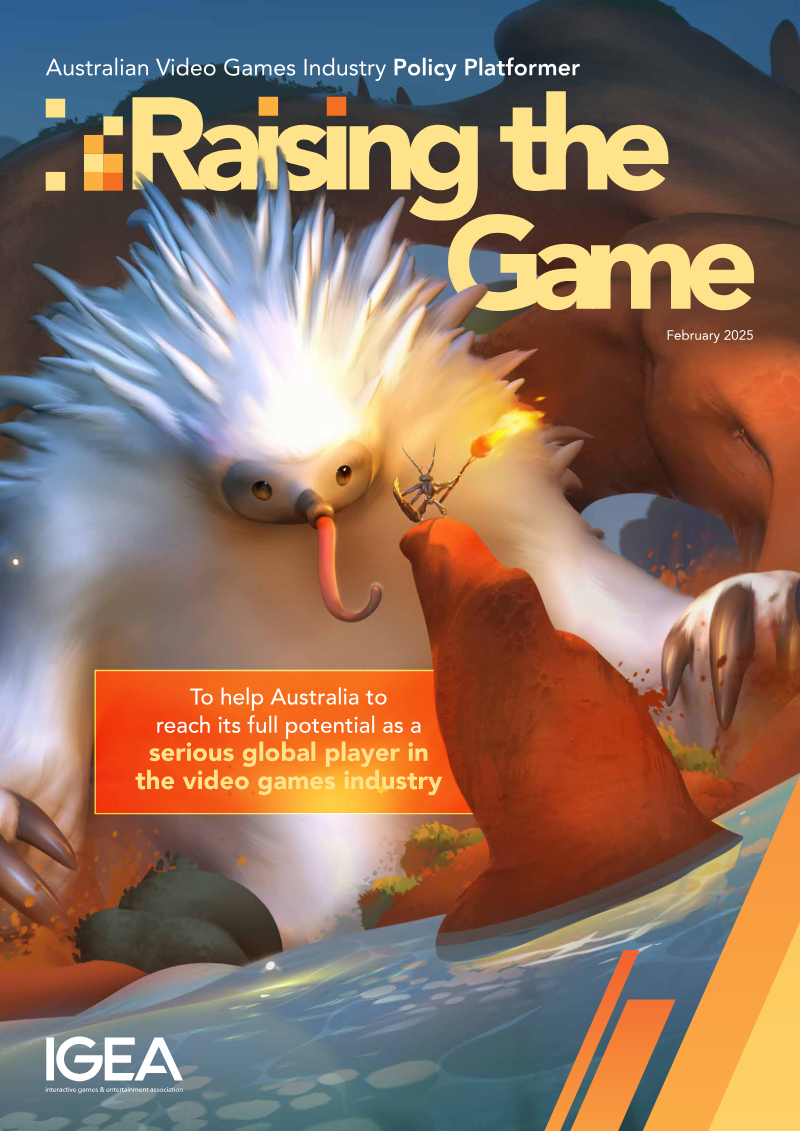
Australian Video Games Industry Policy Platform: February 2025
The Australian video games industry represents a vital economic sector, generating $339.1 million in revenue and supporting 2,465 full-time positions during the 2024 fiscal year. With 93 percent of revenue derived from international markets and over half of all studios anticipating continued income growth, the sector is positioned to evolve into a global powerhouse. The primary objective is to scale the industry to a $1 billion valuation by 2030, a goal that necessitates a strategic shift toward long-term policy frameworks, increased federal investment, and enhanced export support to facilitate international publisher partnerships and local intellectual property development.
To achieve this growth, the industry requires a modernized regulatory environment that replaces fragmented, reactive policies with evidence-based standards. Current classification and online safety laws often impose disproportionate burdens on developers, hindering innovation. By streamlining these frameworks and reducing administrative red tape, the government can provide the certainty required for studios to scale operations. Furthermore, the industry advocates for a more integrated approach to public policy, specifically by leveraging "serious games" to address societal challenges and fostering closer alignment between government initiatives and the practical needs of game developers.
Sustaining this trajectory also depends on addressing critical structural challenges, particularly regarding talent acquisition and capital access. The industry faces persistent talent shortages that demand improved migration pathways and a renewed focus on STEAM education to build a robust local workforce. By combining these educational and immigration reforms with targeted research and development incentives, Australia can foster a competitive ecosystem that attracts international investment while empowering domestic studios. Ultimately, the transition to a billion-dollar industry relies on a collaborative partnership between the public and private sectors to prioritize innovation, intellectual property protection, and sustainable economic development.
- The Australian video games industry aims to reach a $1 billion valuation by 2030, building on its 2024 fiscal year performance of $339.1 million in revenue.
- The sector currently supports 2,465 full-time positions, with 93 percent of its revenue generated from international markets.
- Over 50 percent of Australian game studios anticipate continued income growth, signaling strong potential for expansion into a global powerhouse.
- Industry growth is currently hindered by fragmented regulatory frameworks, specifically classification and online safety laws that impose disproportionate administrative burdens on developers.
- To sustain development, the industry requires improved migration pathways and enhanced STEAM education initiatives to address persistent talent shortages.
+1
Interactive Games & Entertainment AssociationFeb 2025
Report13 pages
FY2024 Report: Australian Game Development Survey
The Australian game development industry demonstrated resilience and stability during the 2024 financial year despite significant global economic headwinds. Total income generated by local studios reached $339.1 million, representing a minor 1.9% decrease from the previous year. Employment remained steady with 2,465 full-time equivalent workers, a marginal 0.3% increase. The sector is heavily export-oriented, with 93% of all revenue generated from outside Australia. Furthermore, 85% of studios focus on developing their own original intellectual property rather than work-for-hire projects.
The industry landscape is characterized by a mix of emerging and established entities. While 56% of studios were formed within the last five years, a quarter of the sector consists of mature studios operating for a decade or more. Small businesses dominate the ecosystem, with 47% of studios employing five or fewer staff members. Geographically, Victoria serves as the primary hub, hosting 52% of head offices and 36% of the national workforce, followed by Queensland and New South Wales.
Government support remains a critical pillar for the industry. The Digital Games Tax Offset, which passed in mid-2023, is already being utilized by 25% of respondents to fund new projects or expand existing ones. Despite this support, developers identified securing international and local publishing deals and attracting early-stage development funding as their primary challenges.
The findings are based on a voluntary survey of 137 Australian game development studios conducted by Bond University on behalf of the Interactive Games & Entertainment Association. The data covers the period from July 1, 2023, to June 30, 2024. Looking ahead, the sector maintains a cautiously optimistic outlook, with 81% of studios predicting stable or increased revenue and 61% planning to hire new staff in the coming year.
- The Australian game development industry generated $339.1 million in revenue during FY2024, reflecting a minor 1.9% year-over-year decline despite global economic headwinds.
- The sector is highly export-focused, with 93% of total revenue derived from international markets and 85% of studios prioritizing the development of original intellectual property.
- Employment remains stable at 2,465 full-time equivalent workers, with 61% of studios planning to increase their headcount in the coming year.
- Victoria is the industry's primary hub, hosting 52% of all studio head offices and 36% of the national workforce.
- The Digital Games Tax Offset, introduced in mid-2023, is already being utilized by 25% of studios to support project funding and expansion.
+1
Interactive Games & Entertainment AssociationJan 2024
Report14 pages
Australian Game Development Survey FY 2023
The Australian Game Development Survey FY2023 reveals a maturing industry experiencing significant growth in both revenue and employment. Total income generated by local studios reached $345.5 million, a 21% increase over the previous year, while the workforce expanded by 17% to 2,458 full-time equivalent employees. This growth is largely attributed to increased federal and state government support, including the Digital Games Tax Offset (DGTO), which has bolstered developer confidence and attracted international interest.
The sector is heavily export-oriented, with 87% of revenue derived from markets outside of Australia. While the industry is diversifying, it remains concentrated in the eastern states, with Victoria housing 29% of studios and 41% of the workforce. The ecosystem is characterized by a mix of established and emerging entities; 32% of studios have operated for over a decade, yet 45% are five years old or less, and 29% are currently developing their first title. Small businesses dominate the landscape, with 79% of respondents employing fewer than 20 people.
Despite this upward trajectory, the industry faces notable headwinds. The primary challenges identified include difficulty hiring staff with specialized technical skills, attracting early-stage development funding, and securing international publishing deals amidst tightening global economic conditions. Nevertheless, 63% of studios intend to hire more staff in the coming year, and 68% predict continued income growth.
The findings are based on a survey of 111 Australian game development studios conducted by Bond University on behalf of the Interactive Games & Entertainment Association (IGEA). The data covers the financial year from July 1, 2022, to June 30, 2023, and includes metrics on gender diversity, which showed an increase in the representation of women and gender-diverse individuals within the workforce.
- The Australian game development industry generated $345.5 million in revenue during FY2023, marking a 21% year-over-year increase.
- Total industry employment grew by 17% to 2,458 full-time equivalent employees, with 63% of studios planning further hiring in the coming year.
- The sector is highly export-focused, with 87% of total revenue derived from international markets.
- Government support, specifically the Digital Games Tax Offset (DGTO), is a primary driver of developer confidence and international investment.
- The industry is geographically concentrated in Victoria, which accounts for 29% of studios and 41% of the total workforce.
+1
Interactive Games & Entertainment AssociationJan 2023
Financial14 pages
Australian Game Development Survey FY2023 Industry Snapshot
The Australian Game Development Survey: FY2023 Industry Snapshot reveals a sector experiencing significant maturation and financial expansion. During the 2023 fiscal year, the local industry generated $345.5 million in revenue, marking a 21% increase over the previous year. This growth is mirrored in the workforce, which expanded by 17% to reach 2,458 full-time equivalent employees. The industry remains heavily export-oriented, with 87% of revenue derived from markets outside of Australia.
The data indicates a diverse ecosystem where 32% of studios have operated for over a decade, while 45% are relatively new, having existed for five years or less. Despite the presence of established firms, the sector is primarily composed of small businesses, with 79% of studios employing fewer than 20 people. Geographically, Victoria remains the primary hub, accounting for 29% of studios and 41% of the total workforce. Diversity metrics show a shift in the labor force, with women representing 26% of employees and gender-diverse individuals making up 5%.
Conducted by Bond University on behalf of the Interactive Games & Entertainment Association (IGEA), the survey gathered voluntary data from 111 Australian development studios between September and November 2023. The findings suggest that growth is heavily underpinned by government support, such as the Digital Games Tax Offset (DGTO) and state-level rebates, with 49% of respondents receiving some form of government funding.
While 68% of studios predict continued income growth, the industry faces notable headwinds. The primary challenges identified include difficulty hiring staff with specialized skills, attracting early-stage development funding, and securing international publishing deals amidst tightening global economic conditions. Nevertheless, the sector maintains a cautiously optimistic outlook, with 63% of studios planning to hire additional staff in the coming year.
- The Australian game development industry generated $345.5 million in revenue during FY2023, representing a 21% year-over-year increase.
- The workforce grew by 17% to 2,458 full-time equivalent employees, with 63% of studios planning further hiring in the coming year.
- The sector is highly export-dependent, with 87% of total revenue derived from international markets.
- Government support is a critical growth driver, as 49% of the 111 surveyed studios received funding through mechanisms like the Digital Games Tax Offset and state-level rebates.
- The industry is characterized by small-scale operations, with 79% of studios employing fewer than 20 people and 45% of firms having operated for five years or less.
+1
Interactive Games & Entertainment AssociationJan 2023
Legal18 pages
Code of Conduct
The IGEA Code of Conduct, revised in August 2020, establishes a comprehensive framework of mandatory behavioural standards for every individual associated with the Interactive Games & Entertainment Association—including employees, board members, contractors, volunteers, members, guests and visitors—across all IGEA offices, events and representations. Its central thesis is to foster a safe, respectful and inclusive gaming industry by embedding integrity, diversity, inclusion, health‑and‑safety and accountability into daily operations and external interactions.
Key provisions delineate precise obligations in areas such as workplace safety, security protocols, harassment, bullying and sexual misconduct, as well as stringent expectations for social‑media conduct, conflict‑of‑interest disclosure, fraud and corruption prevention, and the appropriate use of company resources, confidential information and gifts. Violations trigger a tiered response ranging from private reprimands to permanent bans, with the possibility of dismissal or criminal prosecution for serious breaches. The policy mandates immediate, confidential reporting, rapid managerial review and, where necessary, external investigation, with investigations required to be concluded within seven days. A structured appeal mechanism applies only to permanent sanctions, and final decisions rest with IGEA leadership.
The code’s scope is industry‑wide, covering the interactive games and entertainment sector globally wherever IGEA operates, and remains in force from its 2020 update onward. By defining clear reporting channels and assigning senior executives—CEO Ron Curry, Operations Manager and Diversity Lead Sav Emmett Wolfe, and COO Raelene Knowles—as enforcement contacts, the document seeks to embed a culture of responsibility and protect the sector’s reputation through consistent, enforceable standards.
- The IGEA Code of Conduct, effective since August 2020, mandates behavioral standards for all employees, board members, contractors, and visitors across all global operations and events.
- The policy establishes strict prohibitions against harassment, bullying, sexual misconduct, fraud, and corruption, while requiring the disclosure of conflicts of interest.
- Violations are subject to a tiered disciplinary process ranging from private reprimands to permanent bans, dismissal, or criminal prosecution.
- The framework mandates that all reported incidents undergo a rapid managerial review and, if necessary, an external investigation that must be concluded within seven days.
- Enforcement is overseen by a leadership team consisting of CEO Ron Curry, Operations Manager and Diversity Lead Sav Emmett Wolfe, and COO Raelene Knowles.
Interactive Games & Entertainment AssociationAug 2020