Digital Games
Company
Documents about Digital Games
Playing with One's Self: Notions of Subjectivity and Agency in Digital Games
Alec Charles argues that the sense of agency in digital games is largely an illusion, and that games function as instruments through which capital, military, and state interests construct and position their players.
- Charles argues that digital games create an illusion of player agency that functions as ideological interpellation, drawing on Althusser to explain how games shape player subjectivity through reactive, preset choices.
- The essay contends that the boundary between material history and its electronic mediation has largely collapsed, so the virtual is increasingly treated as the primary 'real' version of events, illustrated by the Gulf War, 9/11, and the America's Army recruitment tools.
- Using Barthes and the concept of the 'faux-scriptible' text, the author concludes that multiplayer games fragment authorship into parallel, solipsistic experiences rather than realizing Barthes's ideal of the reader as producer.
How Are Digital Games Used in Schools?: Complete Results of the Study
This study, published in May 2009, comprehensively investigates the use of digital games in schools across eight European countries, surveying over 500 teachers and interviewing more than 30 decision-makers and experts.
- Successful game-based learning depends on the pedagogical framework and teacher facilitation rather than the specific game title used.
- Digital games improve academic performance in core subjects like mathematics, language, and history when aligned with curriculum goals.
- Students show a preference for the high-quality design of commercial off-the-shelf games over purpose-built educational software, highlighting a need for better industry-education collaboration.
Reproducing the Machine
Mia Consalvo's 2009 editorial reflects on the first decade of game studies as an academic field and argues that its success has come with the unexamined construction of disciplinary structures that deserve critical scrutiny.
- Consalvo's editorial traces the institutional growth of game studies from the founding of the Digital Games Research Association in 2002 through the proliferation of journals, presses, degree programs, and conferences over roughly its first decade.
- The author argues the field has gained legitimacy, but the quality-assurance structures that enabled this (peer-reviewed venues, conventions) have also produced hierarchies and routines that may be going unexamined.
- Establishing peer-reviewed venues and international conferences helped legitimize games as a serious object of inquiry, and efforts to move beyond the psychology-dominated focus on game effects broadened the field's questions and methods.
Textual Analysis, Digital Games, Zombies
The document "Textual Analysis, Digital Games, Zombies" proposes a methodology for analyzing meaning in digital games, specifically applying it to the horror-survival game Resident Evil 4.
- The paper argues that textual analysis suits digital game studies because meaning emerges through situated play rather than residing fixed within the game, so interpretation depends on the analytical lens and reading context rather than a single dominant meaning.
- The proposed framework draws on Barthes' structural and lexia-based methods and on Bennett and Woollacott's concepts of intertextuality and "reading formations," and is tested on an early section of the 2005-era survival-horror game Resident Evil 4.
- The framework is also intended to resolve classification puzzles, such as whether the game's villagers, who are infected humans rather than true undead, belong in the zombie category at all.
Where Have All the Games Gone? Explorations on the Cultural Significance of Digital Games and Preservation
Barwick, Muir, and Dearnley's paper, presented at DiGRA 2009, contends that digital games are undervalued as cultural artifacts relative to film and television and remain largely absent from digital heritage preservation.
- The authors argue digital games are undervalued as cultural artifacts and largely absent from digital heritage preservation, despite the sector's commercial scale: $22 billion in US sales in 2008 and £4.03 billion in UK consumer spending.
- The neglect is attributed to an industry culture oriented toward disposability and a persistent negative public image of games.
- Material from the 1970s and 1980s, the formative era of the medium, is disappearing without systematic archiving, which the authors present as an urgent reason for immediate preservation.
Collusion: Mapping the Interplay Between Paid and Unpaid Labourers in the Digital Games Industry
The document, "Collusion: Mapping the Interplay Between Paid and Unpaid Labourers in the Digital Games Industry," proposes a conceptual framework for understanding digital game production as a dynamic "game" played by various actors on a heterogeneous and distributed field.
- Digital game production is framed as a game in itself, played among heterogeneous actors across both real and virtual spaces, with developers, publishers, and players treated as contingent players rather than passive prosumers or audiences.
- The central conflict is a struggle between 'luditude' and the imperial power of gaming capital over who writes the rules of games production and who is able to break them.
- Power over rule-setting is unevenly distributed: peripheral actors, such as workers in manufacturing plants building games console components, have little capacity to negotiate the rules governing them, while central actors can shape rule sets to their advantage.
Levels of Complexity: Cultural Diversity, Politics and Digital Games
The paper examines the applicability of cultural diversity concepts, traditionally rooted in national media policy, to the digital games sector.
- The paper argues that cultural diversity, a concept rooted in traditional media and national cultural policy, must be rethought for digital games shaped by global production networks, transnational audiences, and user-generated content.
- European policymakers increasingly treat digital games as a cultural industry deserving public support, but the author contends that existing national policy frameworks are poorly matched to how games are produced and consumed.
- Support mechanisms cited include the French tax credit system and dedicated schemes in the United Kingdom, Germany, and Scandinavia, while Canada, South Korea, and China are noted as competitive pressures on European game industries.
Translating Narrative into Code: Thoughts on a Technology-Centric Model of Digital Games as Programmable Media
Werning argues that digital games should be understood as programmable media whose meaning is shaped by the computer code and technology beneath their surface.
- Stefan Werning's 2007 article argues that digital game analysis has been fragmented by importing film and literary theory frameworks that fail to account for games' interactive nature, and proposes program code as a common foundation for understanding games.
- Werning's central proposal is an "object-oriented narrative" paradigm that borrows from object-oriented programming, treating environments, non-player characters, quests, and props as autonomous objects grouped into object classes, with recursive, symmetrical, and hierarchical structures of interactivity.
- The model aims to move beyond the long-standing ludology/narratology divide and is oriented toward interpretation, in contrast to Eladhari and Lindley's neo-structuralist tree-diagram methods, which prioritize production efficiency and avoiding narrative dead ends.
Play with Me: Exploring the Autobiographical through Digital Games
This paper investigates the potential of digital games as a medium for autobiographical expression, focusing on two game-based artworks by Mary Flanagan: "[domestic]" and, to a lesser extent, "[rootings]".
- The paper analyzes autobiography in digital games through two artworks by media artist Mary Flanagan, primarily the game modification [domestic] (2003), with a shorter look at [rootings].
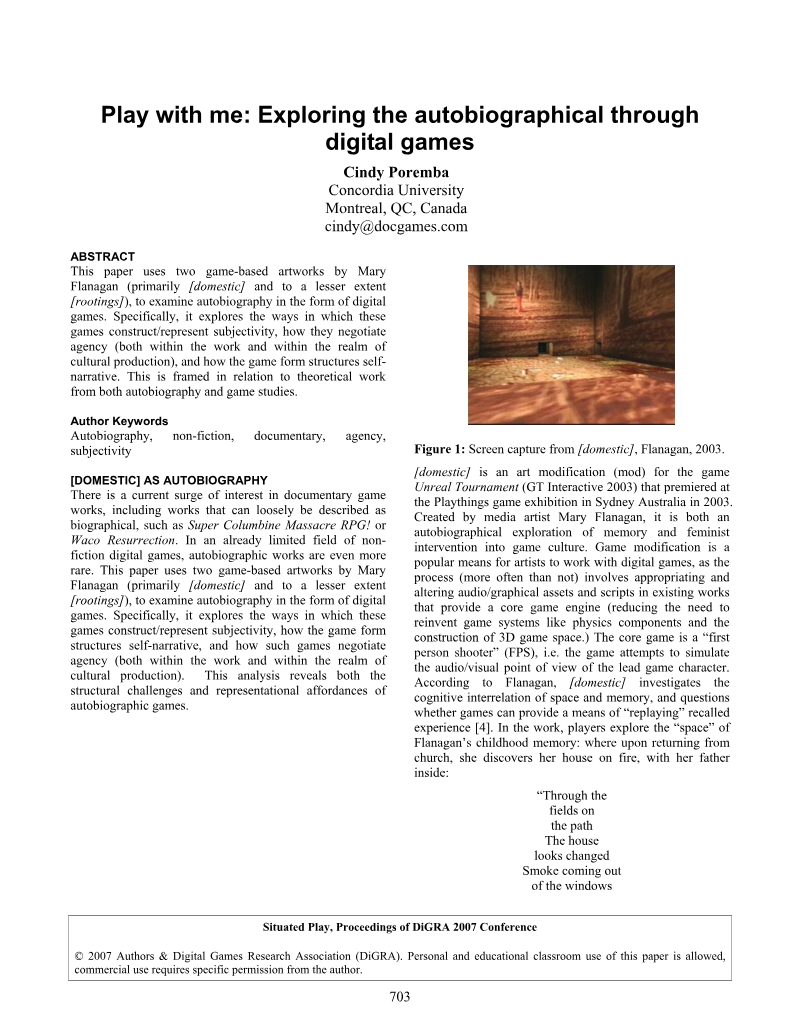
- [domestic] removes a visible avatar and replaces combat imagery with personal photographs and poetic text about a childhood house fire, leaving the player's identity in contention and producing a shifting subjectivity.
- The paper argues that [domestic] reframes the first-person shooter's rules, which originally address a masculine subject of mastery, so that the player's shooting becomes defensive resistance against trauma and a reclaiming of agency within a feminist autobiographical project.
Profiling Academic Research on Digital Games Using Text Mining Tools
Academic research on digital games, spanning from 1986 to 2006, is a profoundly multidisciplinary field, encompassing over 170 subject categories within the ISI Web of Science.
- The study analyzes 2,136 ISI Web of Science records (1986–2006) on digital games using VantagePoint text mining, with articles making up 81% of records, and maps the field's thematic and geographic evolution.
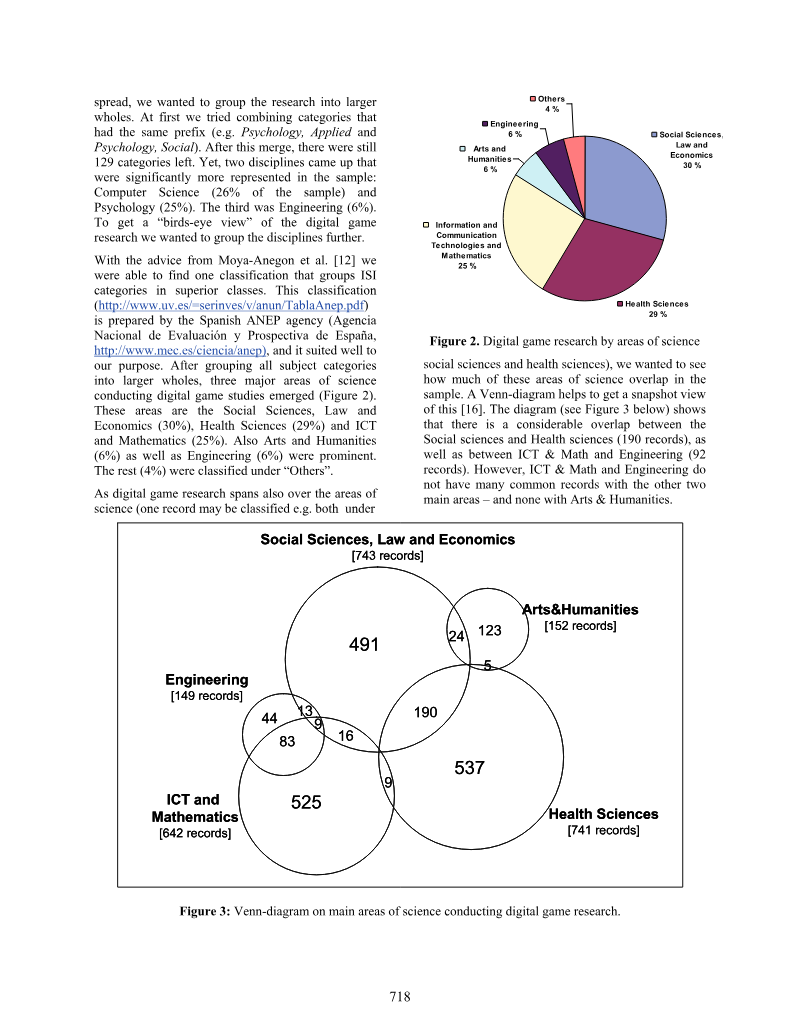
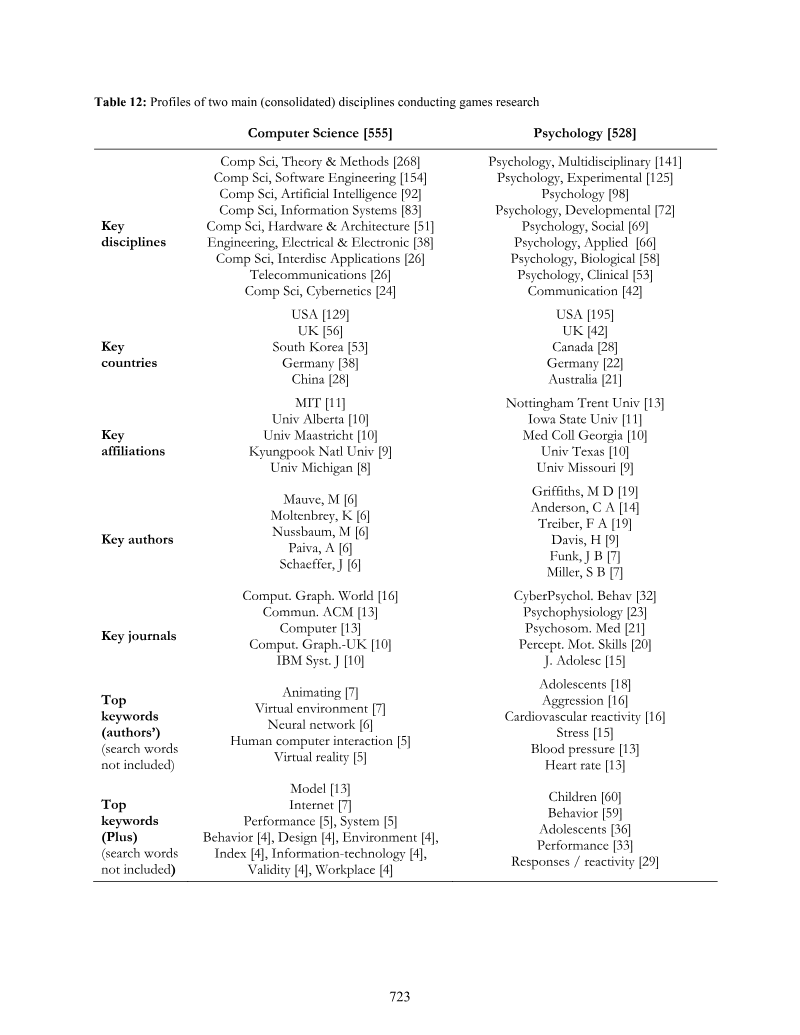
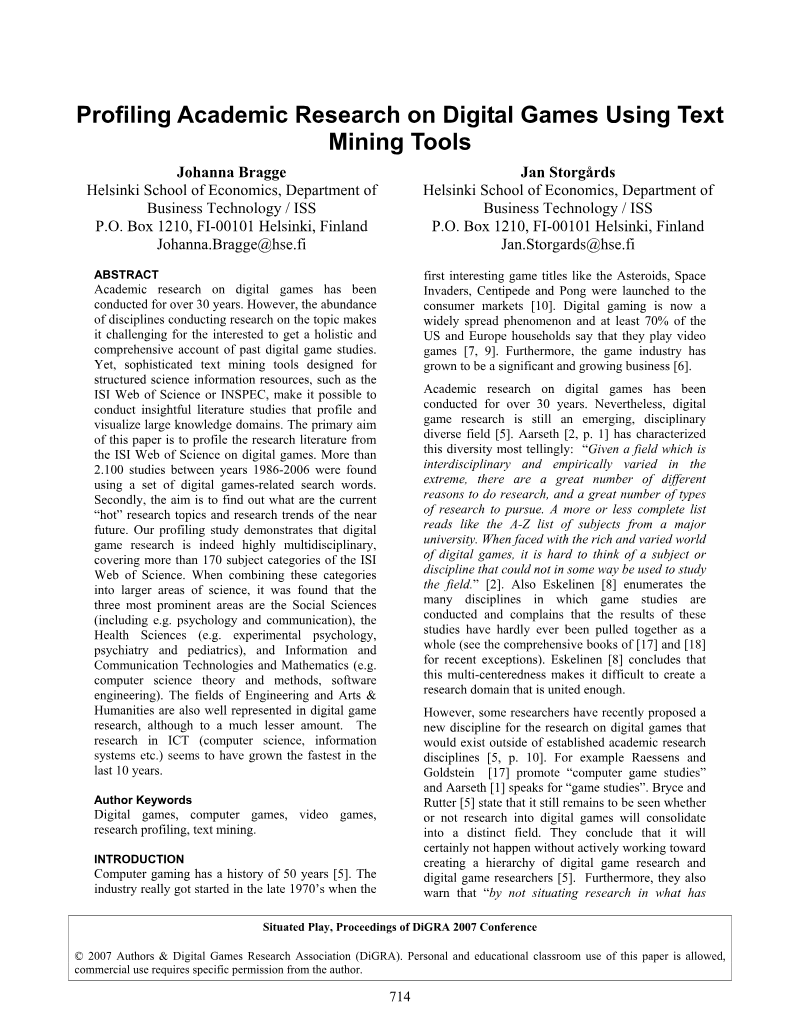
- Three research areas dominate: Social Sciences, Law & Economics (30%), Health Sciences (29%), and ICT & Mathematics (25%); at the discipline level Computer Science (26%) and Psychology (25%) lead.
- ICT & Mathematics is the fastest-growing area, rising 160% between the 1997–2001 and 2002–2006 periods, and publication volume rose steadily with a pronounced peak after 2003.
The Spontaneous Playfulness of Creativity: Lessons from Interactive Theatre for Digital Games
This paper argues that integrating the theories and practices of improvisational and activist theatre can significantly enhance spontaneous, playful creativity in digital game design.
- The paper argues that improvisational and activist theatre methods can introduce spontaneous, playful creativity into digital game design, shifting developers away from a sole focus on technical topics like facial rendering and AI agents.
- It proposes adapting Uta Hagen's character analysis questions and Stanislavski-inspired "inside out" development to build digital characters from the inside rather than from surface traits.
- It applies Chris Crawford's arithmetic formulation of relationship motivation, along with Keith Johnstone's status-tower and "Lists" exercises, to construct relationship dynamics and generate first-instinct game ideas.
Digital Games for Education: When Meanings Play
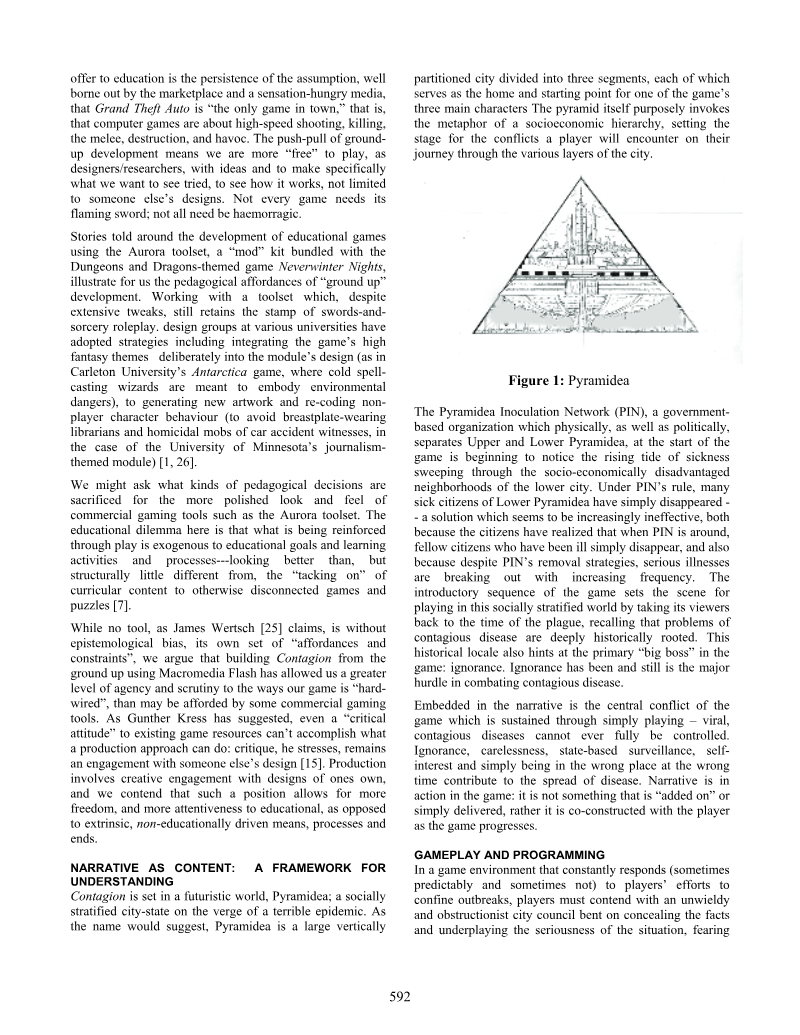
"Digital Games for Education: When Meanings Play" explores the intricate relationship between game design and educational outcomes, using the development of "Contagion," a web-based game for 10-15 year olds on contagious diseases, as a case study.
- The authors argue that educational meaning is embedded in every element of a game's design, including character selection, art, narrative, programming, goals, and play itself, not just its subject matter.
- The project Contagion, built in Macromedia Flash for ages 10 to 15, covers four infectious diseases (SARS, West Nile Virus, Avian Flu, and AIDS) and was developed through design-based research at Simon Fraser University and York University.
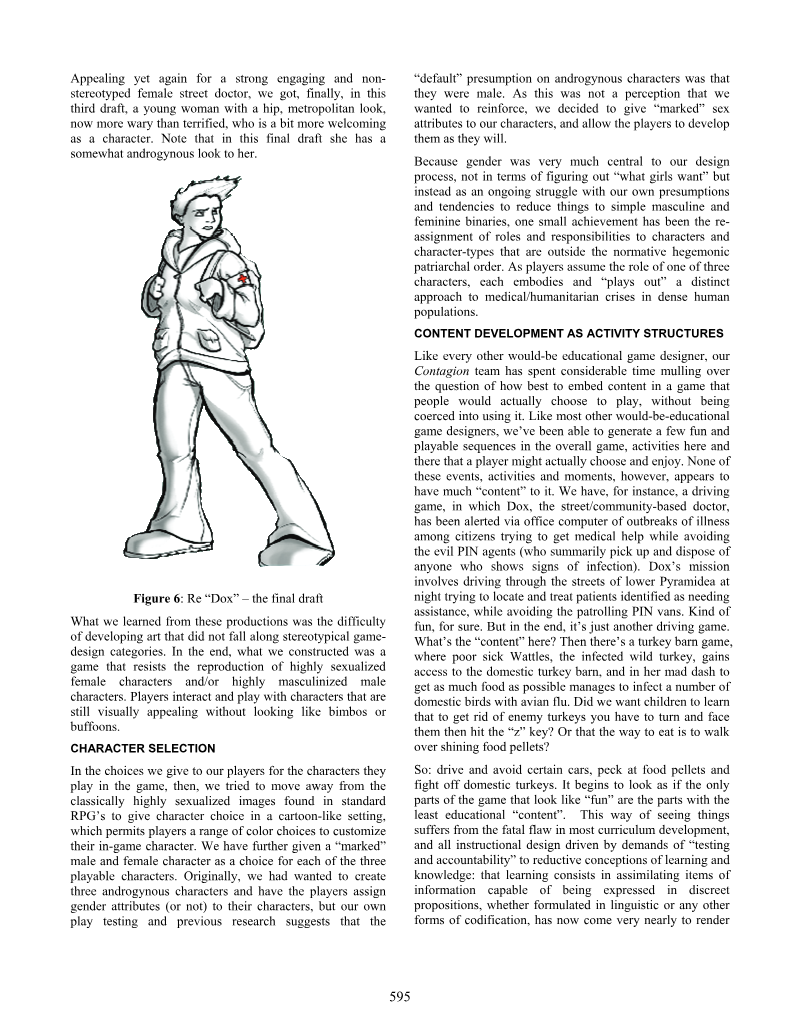
- The authors found that their initial character art and pronoun choices reproduced gender stereotypes, and they revised toward more ambiguous, "marked" characters.