1 free read left. Create a free account for unlimited reading + AI research.
Create free accountWhitepaper DiGRA
1 free read left. Create a free account for unlimited reading + AI research.
Create free accountWhitepaperDiGRA
Distilling the key insights…
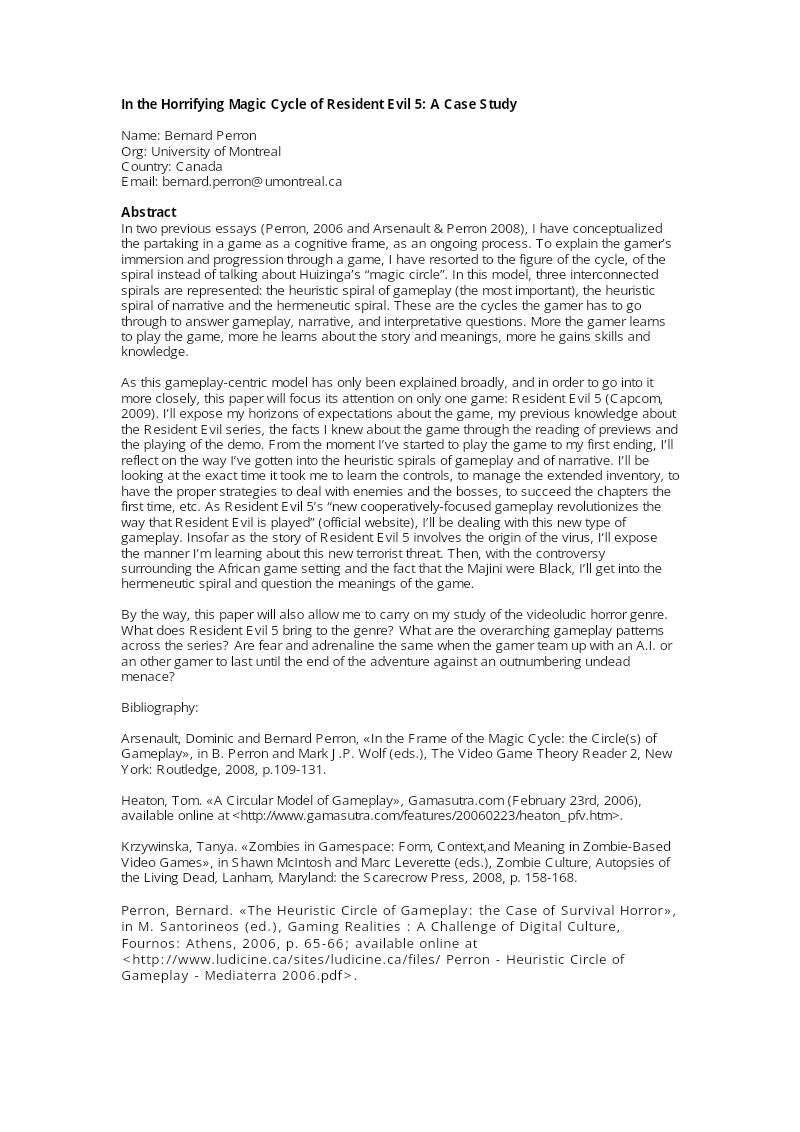
This paper argues that textual analysis is a valuable tool for digital game studies, because meaning in games emerges through situated play rather than residing fixed within the game itself. Drawing on Barthes' structural and lexia-based methods alongside Bennett and Woollacott's concepts of intertextuality and "reading formations," it proposes an analytical framework and tests it on an early section of the zombie survival-horror game Resident Evil 4. The central claim is that interpretation depends on the analytical lens and reading context, not on any single dominant meaning, and the framework is also meant to resolve classification puzzles, such as whether the game's villagers, who are infected humans rather than true undead, belong in the zombie category at all.
The analysis centers on the "work" seme as a case study. The villagers' labouring bodies and Leon's online, augmented status are read as expressions of anxieties about ability, disability, and classification, while the game's precision-based combat provides a counterweight of relief. The findings suggest that applying textual theory to games exposes gaps in existing accounts of ideology and interpellation, particularly those that claim to specify how a game positions its player. The author favors situated interpretation over such claims, arguing that player positioning is contingent on context rather than fixed by design.
The scope is a close reading of a single, brief opening segment of one 2005-era survival-horror title, situated within the wider zombie culture and horror scholarship that informs the study. The work is grounded in structural narrative theory, cybertext, and game studies frameworks, and draws on zombie-film scholarship concerning Romero and 28 Days Later. Its engagement is primarily theoretical and interpretive rather than empirical, with no quantitative data or broad sampling of games or players. A notable supporting observation from the game's script frames the neutralization of hostile others as a means of protecting "the subject," a detail that reinforces the paper's attention to ideology in play.
Each row is a game or company this document names, each column a document, oldest first. A mark means that document names it. Select a row to see those documents.



DiGRA · 2016



DiGRA · 2016



DiGRA · 2016



DiGRA · 2016



DiGRA · 2016



DiGRA · 2016

DiGRA · 2015



DiGRA · 2015



DiGRA · 2015



DiGRA · 2015
DiGRA · 2015
DiGRA · 2015
DiGRA · 2015