2015
Company
Documents about 2015

Machine Zone, Supercell and King spent $200M on US TV ads in 2015
The mobile gaming industry experienced a significant shift in marketing strategy during 2015, characterized by a rapid expansion into traditional television advertising.
- US television advertising spend for video games reached $630 million in 2015, marking a 47% year-over-year increase driven primarily by mobile-only studios.
- Machine Zone, Supercell, and King collectively spent nearly $200 million on US TV ads in 2015, with individual spends of $93 million, $60 million, and $41 million respectively.
- Top-tier mobile developers are utilizing a 'brute force' marketing strategy, leveraging calculated player lifetime value data to justify massive investments in broad-reach traditional media.

Return To Adventure Mountain 2015
The year 2015 served as a period of significant professional transition and creative output for an independent game developer based in Phoenix, Arizona.
- In 2015, a Phoenix-based independent developer shifted to rapid prototyping of small-scale titles following the dissolution of a previous business partnership.
- The developer released a diverse portfolio of experimental games throughout the year, including Wizard Golf RPG, Rogue Drop, Drill Planet, and Ride Share Z.
- Wizard Golf RPG achieved international press coverage, though the developer reported that it failed to reach significant commercial success.

Are Games the Future of the App Economy?
Apple's holiday 2015 App Store figures frame an examination of whether games will remain the dominant force in the app economy.
- Apple App Store revenue reached $20 billion in 2015, with cumulative developer payouts hitting $40 billion, one-third of which was generated in 2015 alone.
- Annual developer payouts grew by 40% year-over-year, rising from $10 billion in 2014 to $14 billion in 2015.
- While free-to-play games continue to dominate the top-grossing charts, non-gaming apps increased their presence in the Top 20 list from 5% in 2013 to 20% by January 1, 2016.

Did mobile gaming peak in 2015?
The mobile gaming industry reached a significant inflection point in 2015, as data indicates a one percent decline in total game session frequency compared to 2014.
- Mobile gaming experienced a 1% decline in session frequency in 2015, marking the first contraction for the category while the broader mobile app sector grew by 58%.
- The 2015 decline follows a multi-year deceleration, as mobile gaming growth slowed to 30% in 2014, consistently underperforming categories like productivity and news.
- Flurry data, derived from tracking 2.1 billion devices across North America, Europe, Japan, and Korea, indicates that the industry's early-stage explosive growth phase has concluded in mature markets.

FTUE: Rush of Heroes
Rush of Heroes, a Western adaptation of the highly successful Chinese mobile title I AM MT, represents a strategic attempt to export established Asian free-to-play mechanics to global markets.
- Rush of Heroes is a Western adaptation of the Chinese mobile title I AM MT, which achieved over 70 million players between 2014 and 2015.
- The game utilizes a card-based battle system centered on character collection, shard-based upgrades, and gacha-style hero acquisition mechanics.
- Core gameplay is defined by high-density automation, featuring two-speed battle toggles, rage-mode triggers, and a progression loop gated by a standard energy system.

Video Games and the Value of Entertainment
Video games are presented as a young but rapidly maturing medium, comparable to early cinema, and this work focuses on creative and entertainment games rather than serious or applied games designed for education or behavior change.
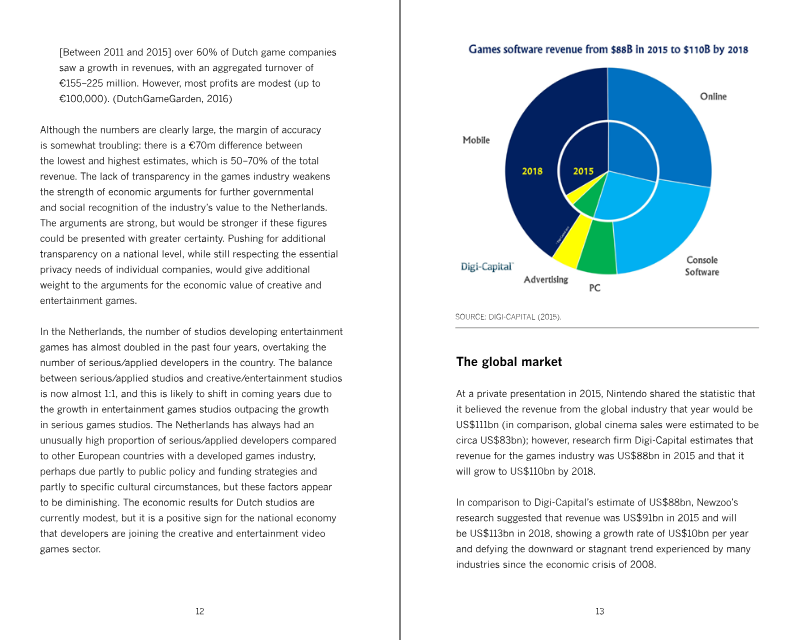
- The global games market was valued at roughly US$88–91 billion in 2015 and projected to reach about US$110–113 billion by 2018, with the United States and China expected to account for around half of it.
- A 2016 Newzoo figure places the global games market at $99.6 billion that year, underscoring the scale of commercial activity.
- The author argues the UK games sector generates more value added than film, television, music, publishing, design, fashion, and architecture combined, and that Europe must actively pursue this market to stay competitive.
Global Influences on Regional Industries: Game Development in Nordic Countries, China, and India
The document examines how cultural and regional contexts influence the structure of local game development industries and, to some extent, game content.
- The global games industry has been dominated by a few historically influential actors, principally Japan and the United States, whose practices serve as benchmarks that other regions tend to follow.
- The authors find that regional content still largely follows globally established standards, possibly because development tools and distribution platforms are concentrated among a small number of companies that pressure developers to adopt existing mechanics while varying aesthetics.
- Nordic game industries took different shapes according to their origins: Sweden and Finland grew out of software engineering and the demoscene with an emphasis on programming, while Norway and Denmark drew on film, animation, and visual storytelling traditions.
The Divide Between E-Sport and Playing Games in China
The document examines the growing divide between esports and general video game play in China, arguing that the rise of esports has transformed gaming and media landscapes, marginalizing other forms of gaming in public perception and discourse.
- The paper argues that media coverage of competitive e-sports, driven by record viewership, sponsorship, and prize-money narratives with China as the centerpiece of a global market, has made e-sports the only socially acceptable form of gaming in China and cast other play as less legitimate.
- The authors' evidence comes from ethnographic fieldwork in China conducted between 2013 and 2015, combining informal interviews with online forum observation.
- Terms from League of Legends and similar titles, such as "da ye" (jungling), "shua bin," and "penta kill," have spread into everyday Chinese speech, including among people who rarely or never play games.
Teaching Digital Game Curricula in the Communication Discipline in Higher Education Institutions in the Greater China Region: A Curriculum Analysis Approach
The document analyzes the state of digital game curricula within communication disciplines in higher education institutions across the Greater China Region (China, Hong Kong, Macau, Singapore, and Taiwan).
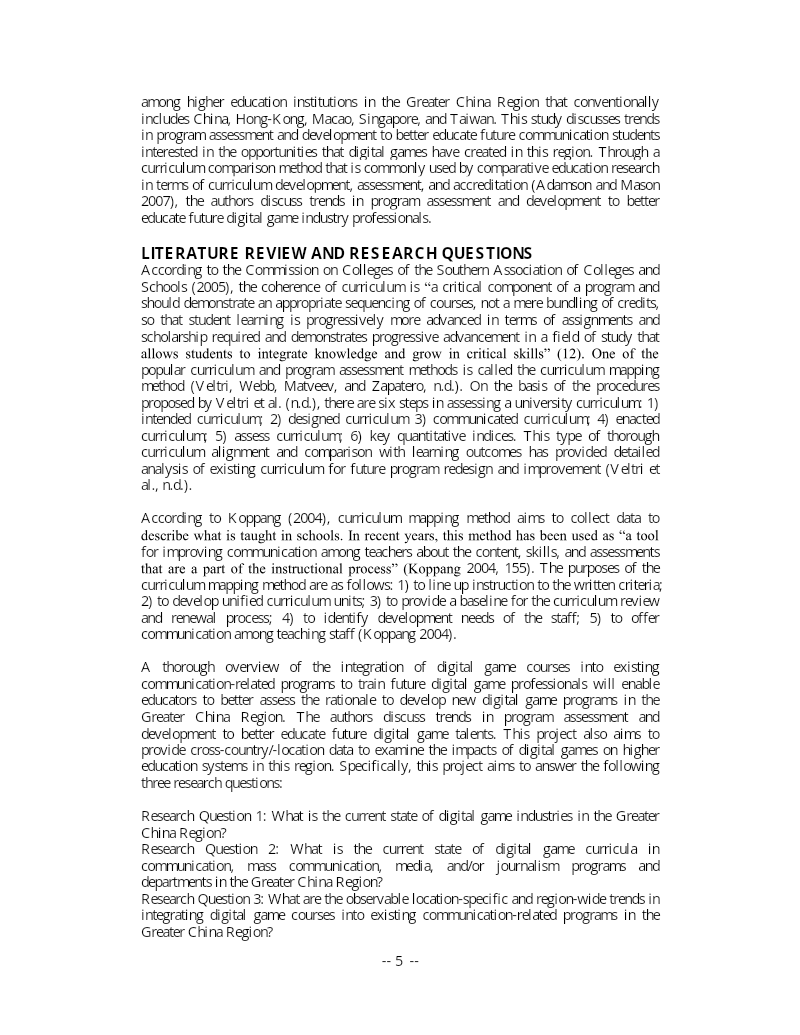
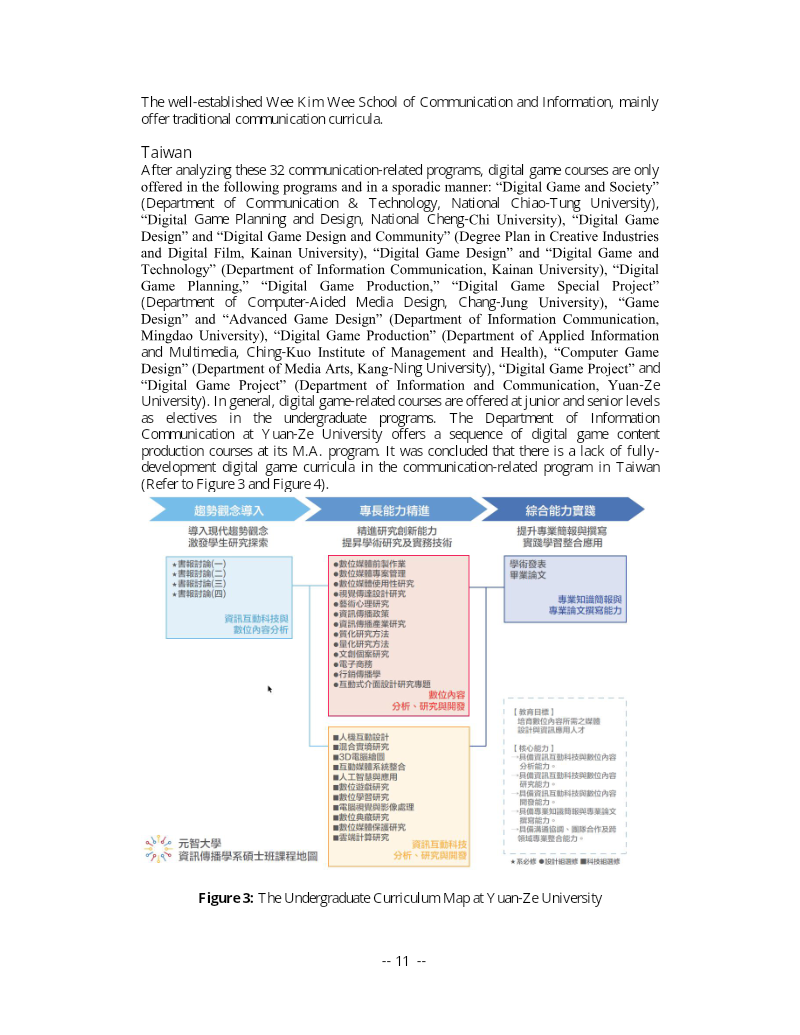
- Most traditional communication programs across the Greater China Region (China, Hong Kong, Macau, Singapore, Taiwan) offer few or sporadic digital game courses, leaving curricula out of step with a fast-growing industry.
- The Asian digital game market was projected to generate roughly $20 billion in revenue in 2015, about 38 percent of the global total, underscoring the scale of demand for skilled professionals.
- Where game courses exist, they lean heavily toward technical and programming instruction, while player research, the social implications of games, and game rhetoric receive comparatively little attention.
Designing for Constructive Failure: Reflections on the Design and Execution of an Introduction to Simulation Gaming
The document explores the concept of "constructive failure" within the context of simulation gaming in higher education, specifically focusing on an introductory course for Media & Entertainment Management students.
- Games can serve as a productive space for learning from failure, and the paradox of enjoyable play for serious professional ends can be deliberately harnessed in higher education, drawing on Juul, Statler et al., and Dweck's work on learning orientations.
- The course aimed to help future creative-industry managers recognize when simulation games might or might not help solve real-world problems, rather than to train game designers; it ran from 2011 to 2015 with third-year BBA Media & Entertainment Management students.
- Student reception varied across years: early non-mandatory sessions and weak incentives for preparatory reading were later replaced with stronger incentives, classic games such as the Dollar Auction and the prisoner's dilemma, and competitive paper-prototyping exercises.
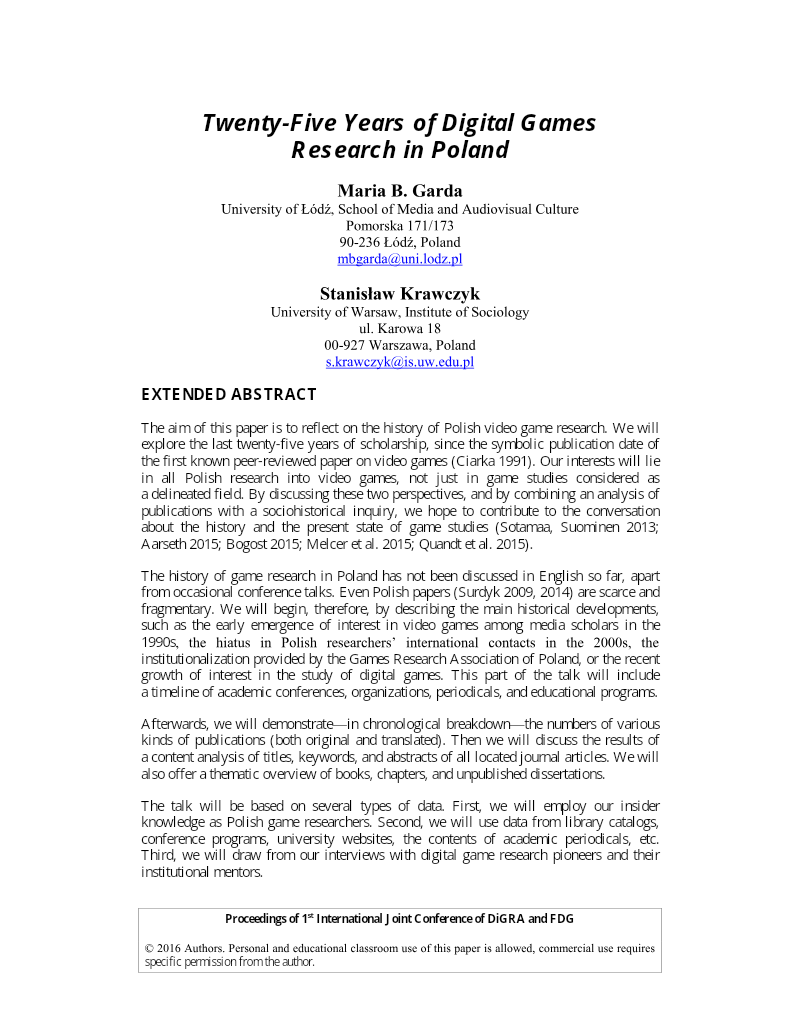
Twenty-Five Years of Digital Games Research in Poland
This paper provides a historical overview of digital games research in Poland over the past twenty-five years, beginning with the first known peer-reviewed publication in 1991.
- The history of Polish video game research is traced over roughly twenty-five years, beginning with what the authors identify as the first known peer-reviewed Polish paper on video games, published in 1991.
- The study takes a broad scope, covering all Polish research into video games rather than only work identifying with a delineated game studies field, and combines a sociohistorical account with analysis of publications including titles, keywords, and abstracts of journal articles.
- Key developments identified include early interest among media scholars in the 1990s, a hiatus in international contacts during the 2000s, institutionalization through the Games Research Association of Poland, and recent growth in research activity.
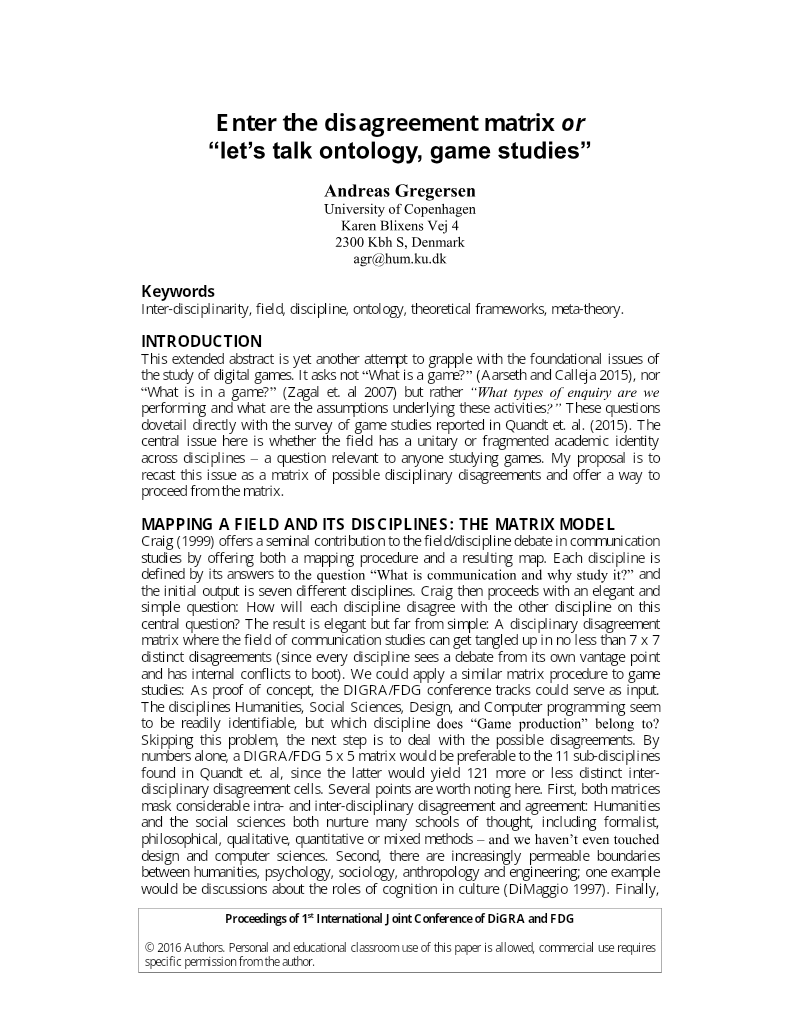
Enter the Disagreement Matrix or "Let's Talk Ontology, Game Studies"
This paper argues that game studies needs a clearer account of its own foundational assumptions, proposing a "disagreement matrix" as a way to map its disciplinary landscape.
- The paper argues game studies needs explicit accounts of its foundational assumptions, proposing a "disagreement matrix" that crosses disciplines against one another to locate where scholars actually disagree, shifting the core question from "what is a game?" to "what kinds of enquiry are we performing and what assumptions underlie them?".
- Mapping the field's five broad disciplines (humanities, social sciences, design, computer programming, game production) yields a 5 x 5 matrix of about 25 cells, versus roughly 121 cells if the 11 sub-disciplines from Quandt et al. (2015) were crossed, making the broad version more tractable.
- The central issue the paper identifies is whether game studies has a unitary or fragmented academic identity, and the matrix is proposed as a way to answer that question.