2015
Company
Documents about 2015
The Mainstreaming of US Games Journalism
This paper examines how mainstream American newspapers and lifestyle outlets have come to take video games seriously, a shift that was far from assured a decade ago.
- Mainstream American newspapers and lifestyle outlets have come to take video games seriously, a shift the authors argue was far from assured a decade before the study.
- The paper's central hypothesis is that mainstream journalists handle the tensions among gamers, the industry, and the press differently from enthusiast writers, due to distinct ideological, stylistic, and practical traditions.
- Mainstream reporting appears to lack the self-reflection tradition found in enthusiast games writing, which is why the study focuses on journalistic rather than critical coverage.
Hidden Paratextuality: Concealing the Factual Aspects of Video Games
Jan Švelch's paper introduces the concept of "hidden paratextuality," arguing that the absence of expected factual information about video games can itself carry meaning and shape how players interpret a game.
- Jan Švelch's paper introduces "hidden paratextuality," arguing that missing factual information about video games, such as developer identity, price, and system requirements, can itself carry meaning and shape player interpretation.
- Building on Gérard Genette's paratext theory, the paper contends that game studies has focused on explicit paratexts like trailers, manuals, patch notes, and credits while overlooking what is conspicuously absent.
- The author argues that the unavailability of factual paratexts creates a distinct paratextual quality that establishes its own threshold of interpretation.
Much Ado About Nothing? Analysis of the Polish Internet Discourse About "Hatred"
The analysis examines the Polish internet discourse surrounding the video game "Hatred" following its initial trailer release, focusing on how transgressive content influences and reshapes the boundaries of gaming discourse.
- The study argues that moral commotion around transgressive content, here the Polish reception of the trailer for the isometric shooter "Hatred" by Destructive Creations, acts as a catalyst for renegotiating interpretive frameworks and shifting the boundaries of Polish gaming discourse.
- The analysis draws on Pierre Bourdieu's theory of cultural economy and taste together with Aaron Julius's concept of transgressive content, treating transgression as either a tool that subverts or one that reinforces a social group's taste.
- The research used computer-aided content analysis and critical discourse analysis, conducted in September and October 2015, covering material published between October 2014 and September 2015.
This Could Be Us: Networked Intimacy in Single-Player Games
This extended abstract argues that single-player games remain relevant in a networked era because they can explore the complexities of online intimacy in ways multiplayer and social games seem unwilling or unable to.
- The paper argues that three single-player games—Christine Love's Don't Take It Personally Babe, It Just Ain't Your Story (2011), Mitu Khandaker-Kokoris' Redshirt (2013), and Robert Yang's Cobra Club (2015)—use the interface and narrative conventions of digital platforms to explore identity, privacy, surveillance, and consent.
- Don't Take It Personally Babe frames the player as a teacher with access to students' public and private online lives, exposing how networked devices enable warmth alongside gossip, hypocrisy, and abuse of trust, while questioning the agency that single-player games promise.
- Redshirt uses a Facebook-style interface on a doomed space station, where escape depends on cultivating powerful contacts, critiquing the instrumental, gamified treatment of relationships on social platforms.
Metagaming and Subversive Play in League of Legends
This study examines metagaming practices among high-level players of League of Legends, focusing on how competitors navigate a strategic metagame that shifts constantly because of frequent game patches.
- Metagaming in League of Legends, as examined in this study, goes beyond mechanical skill to include community-enforced strategic norms governing how players approach their roles and positions on entering a match.
- Frequent game patches constantly shift the metagame, and interviewed players reported that updates disrupted their established position and role combinations.
- Based on interviews with 13 high-level players from the Korean and Oceanic servers at the close of the 2015 competitive season, most players responded to patches by either switching to other pre-existing combinations or maintaining their habitual style even when it reduced their enjoyment.
Parasites to Gaming: Learning from GamerGate
This document explores the role of academia in the context of GamerGate, a series of misogynistic accusations directed at women in video game culture that escalated from Summer 2014 through 2015.
- Paolo Ruffino reframes the Reddit accusation that academics are "parasites" to gaming by drawing on Michel Serres's theory of the parasite as a mediator and disruptor, arguing the real question is how academics can be "good" parasites rather than whether they are parasites at all.
- GamerGate, which escalated from summer 2014 into 2015 with harassment of prominent women in games, was framed by industry commentators as signaling the end of "gamers" as a unified consumer category.
- Ruffino argues that justifying women's presence in gaming through market data is itself an aggressive argument, because it swaps one consumer category for another while leaving the underlying discourse that treats games as industry products and participants as consumers intact.
Charismatic Leadership and Digital Games
Digital games have long cast players as commanders who act decisively on critical problems or managers who organise processes toward known ends.
- The paper argues that the media through which audiences encounter leadership shape how they understand it, rather than studying skills players gain from games.
- Its central thesis is that different media formats support different models of charismatic leadership, based on Max Weber's theory: early twentieth-century cinema centres the charismatic individual with little role for followers, while serialised comics, television and digital games give the inner circle a much larger part.
- Digital games, especially role-playing titles, let players occupy a leader whose authority rests on normative compliance, drawing on Etzioni's typology of coercive, calculative and normative compliance.
Walking Simulators: The Digitisation of an Aesthetic Practice
Walking simulators such as Year Walk, Gone Home, and Dear Esther digitise an older aesthetic practice: walking as a means of exploration, discovery, and meaning-making in the Romantic tradition.
- The report argues that walking simulators such as Dear Esther, Gone Home, and Year Walk continue a Romantic tradition of walking as aesthetic and spiritual practice, making digital walking a legitimate extension of that tradition.
- The central claim is that movement through space, whether physical or virtual, generates meaning, and the contested label "walking simulator" may still be an apt description of these works.
- Environmental storytelling embeds narrative in landscape and architecture rather than delivering it through cutscenes, so players uncover story through observation and movement.
Game Jams as an Opportunity for Industry Development
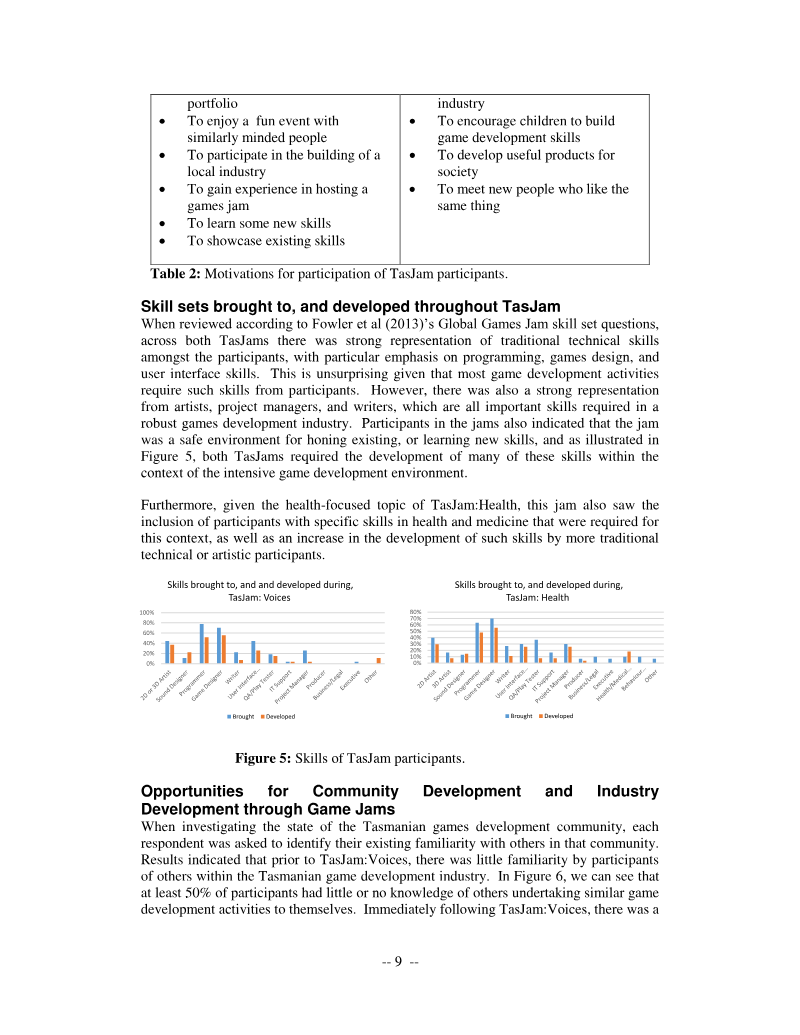
This paper investigates the role of game jams as a bottom-up mechanism for fostering community and industry development within weak game development ecosystems, specifically focusing on Tasmania, Australia.
- Game jams are proposed as a bottom-up way to connect isolated developers in Tasmania, a small Australian state with a weakly supported, poorly visible games sector, with the authors arguing community-building must precede formal industry growth.
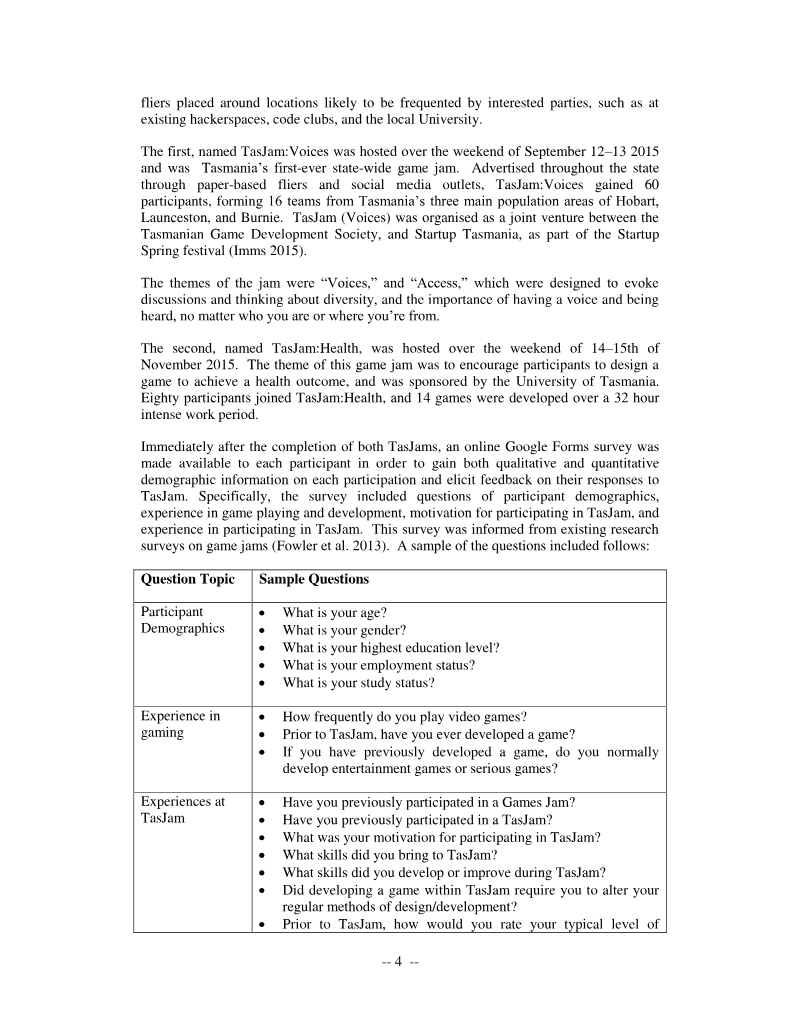
- The two 2015 state-wide jams drew 60 participants forming 16 teams at TasJam:Voices and 80 participants producing 14 games over 32 hours at TasJam:Health.
- Familiarity among local developers was low before the jams and rose markedly afterward, with over 70% of respondents reporting increased familiarity and most reporting new professional and personal contacts.
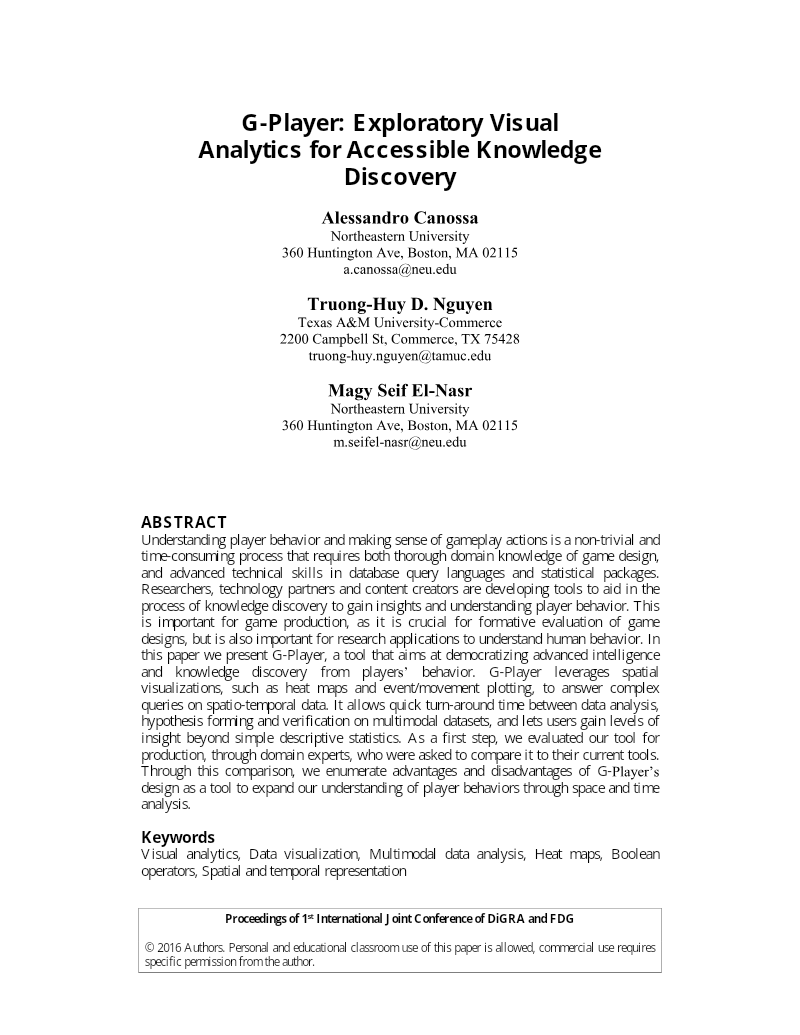
G-Player: Exploratory Visual Analytics for Accessible Knowledge Discovery
G-Player is an exploratory visual analytics tool designed to democratize the complex process of understanding player behavior in video games.
- G-Player is a spatio-temporal visual analytics prototype that makes game telemetry analysis accessible to non-experts by combining heat maps, movement plots, and Boolean operators, addressing the gap between aggregated statistics (which lose individual detail) and individual trace viewers (which don't scale).
- Its central contributions are space-time constraints and Boolean-compound heat maps, which let users filter and compare player behavior patterns with precision.
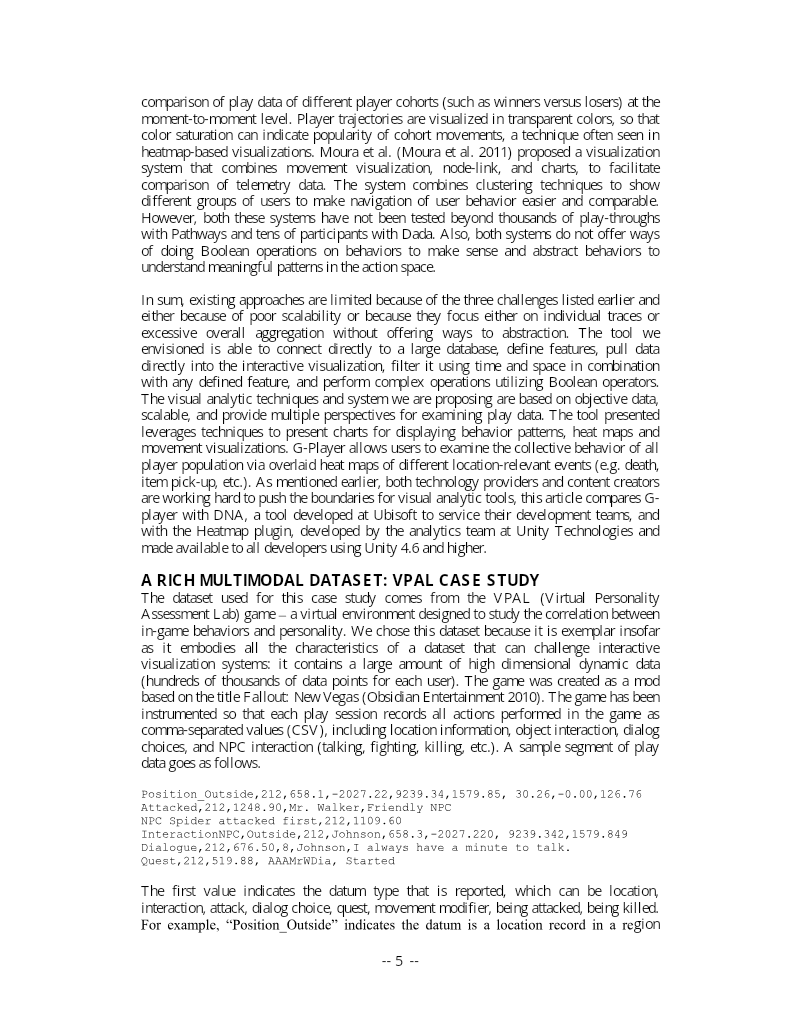
- The tool was demonstrated on a pickpocketing example from the VPAL case study, a Fallout: New Vegas modification that generates extensive per-user logs, with the system designed to handle hundreds of thousands of logged data points per user.
Review of Social Features in Social Network Games
The document provides a comprehensive review of social features within social network games, primarily focusing on Facebook titles.
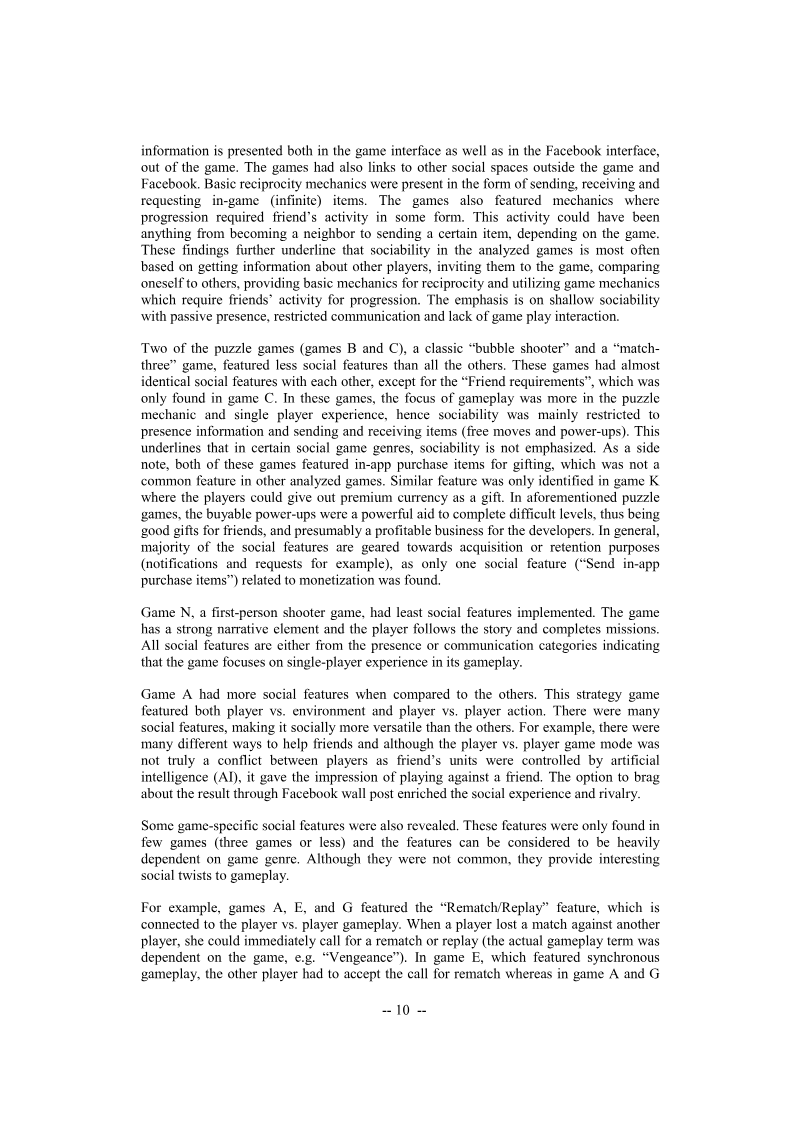
- Of 16 Facebook social games analysed, 30 social features were identified, but informational and invitational features (presence indicators, off-game links, Facebook notifications, invite requests) appeared in every title.
- Genuine player-to-player interaction and team formation were largely absent, leading the authors to describe these games as "massively parallel single-player games."
- Gameplay interaction and monetized gifting were comparatively rare, and only one feature was directly tied to monetization.
Rapidly-Exploring Random Tree Approach for Geometry Friends
This document details a Rapidly-exploring Random Tree (RRT) approach designed to solve individual levels within the physics-based platform game, Geometry Friends.
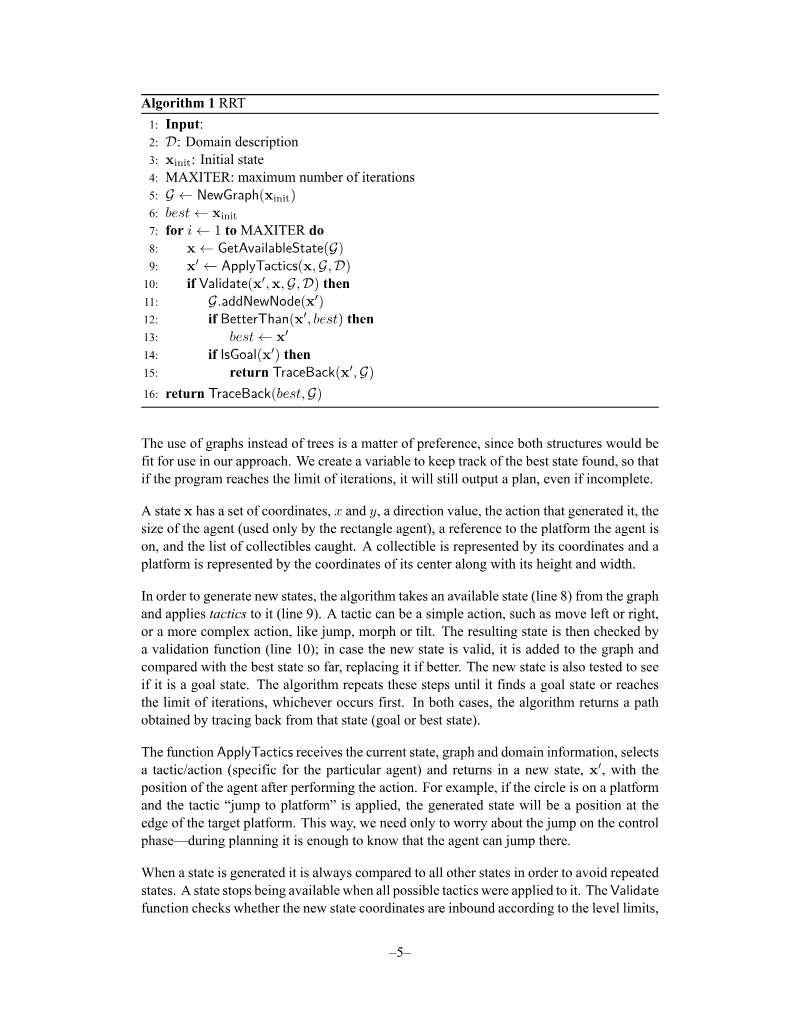
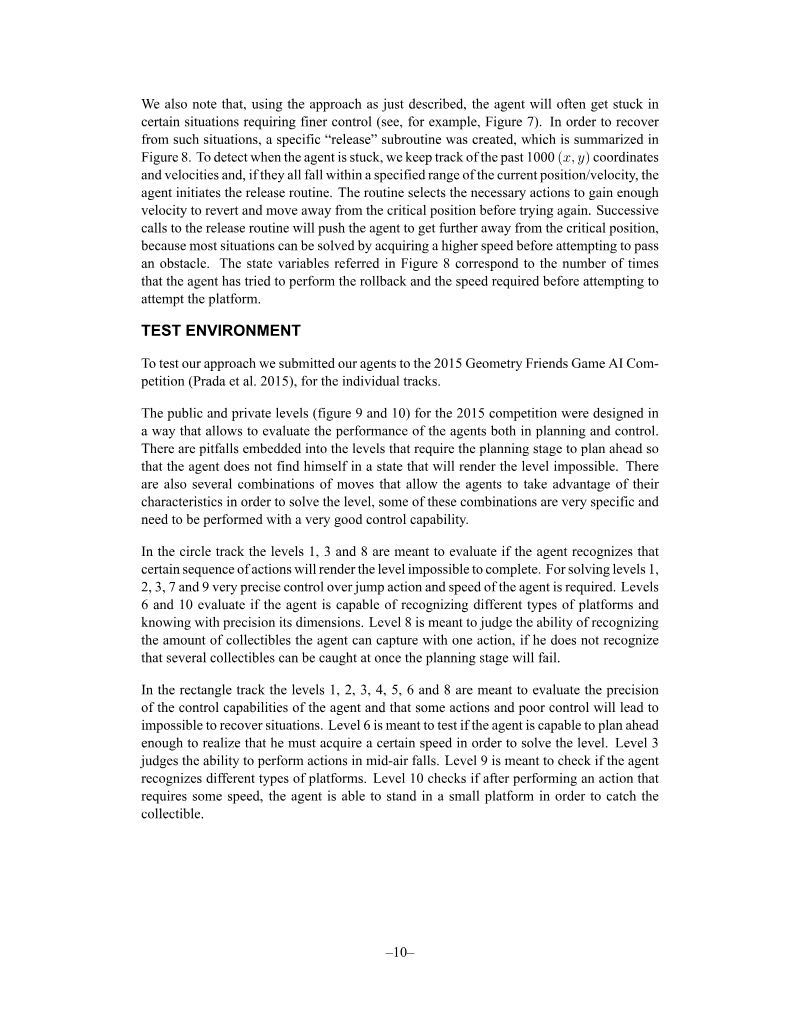
- The paper proposes a two-stage Geometry Friends agent: a Rapidly-exploring Random Tree (RRT) handles high-level planning and a PID controller handles real-time execution, with the aim of a generic, map-feature-independent method that generalizes to unseen levels.
- The circle agent placed first on the circle track of the 2015 IEEE Computational Intelligence and Games competition with a score of 2096, while the rectangle agent placed third on the rectangle track with 1487.
- Success rates were 0.32 on public circle levels and 0.38 on private levels, which the authors cite as evidence that performance does not collapse on unseen maps.