1 free read left. Create a free account for unlimited reading + AI research.
Create free accountWhitepaper DiGRA
1 free read left. Create a free account for unlimited reading + AI research.
Create free accountWhitepaperDiGRA
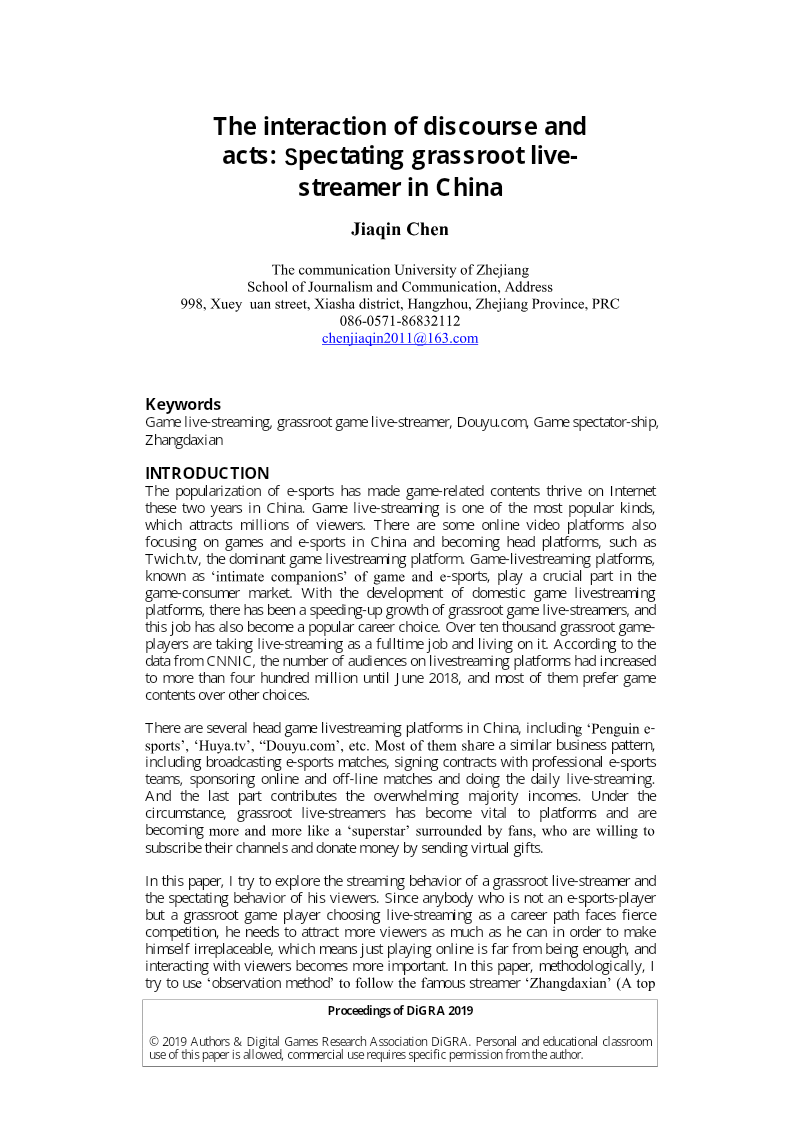
Coverage emphasizing record viewership, sponsorship, and prize money, with China as the centerpiece of a global market, has framed e-sports as the legitimate form of gaming. The paper argues other play is cast as less legitimate.
The paper argues that the rise of competitive e-sports in China has reshaped public perception of gaming, crowding out other forms of play from media discourse and everyday life. It traces e-sports' growth as a media spectacle, sustained through stylized tournaments and secondary coverage by news outlets, marketing firms, and conference organizers that emphasize record viewership, sponsorship, and prize money, with China positioned as the centerpiece of an expanding global market. Its central claim is that this framing has turned e-sports into the only socially acceptable form of gaming, positioning other play as less legitimate.
The study draws on ethnographic material gathered in China between 2013 and 2015, with informal interviews and online forum observations. Its evidence centers on language: terms originating in League of Legends and similar titles, such as "da ye" (jungling) and "shua bin," as well as expressions like "penta kill," have migrated into everyday speech, including among people who rarely or never play games. The authors note that some of this spread is spontaneous rather than a direct product of the e-sports media complex, and that it often proceeds without awareness of its gaming origins.
The paper also examines how gamers respond to this dominant narrative. Critics within the Chinese game community worry that the e-sports dualism, which frames e-sports as distinct from "games," erodes space for diverse game cultures. Many ordinary players, however, treat the dichotomy as artificial and pursue varied titles, particularly indie and niche games on platforms like Steam, while avoiding open confrontation with the mainstream. The authors observe that this quiet differentiation sometimes hardens into a sense of superiority toward mainstream titles, a dynamic they tie to the broader discourse of e-sports.
Each row is a game or company this document names, each column a document, oldest first. A mark means that document names it. Select a row to see those documents.

DiGRA · 2026

DiGRA · 2026



DiGRA · 2026



DiGRA · 2026



DiGRA · 2026



DiGRA · 2026



DiGRA · 2026



DiGRA · 2026

DiGRA · 2026



DiGRA · 2026



DiGRA · 2026

DiGRA · 2026
DiGRA · 2025