2015
Company
Documents about 2015
Perilous and Peril-Less Gaming: Representations of Death with Nintendo's Wolf Link Amiibo
Rex Barnes argues that Nintendo's Wolf Link Amiibo, used in The Legend of Zelda: Breath of the Wild (2017), treats in-game death as meaningful in three ways: as a practical perk, as a ritualized object, and as a narrative device.
- Rex Barnes argues that death in video games is typically framed as ludic failure rather than a meaningful narrative or affective event, and positions Nintendo's Wolf Link Amiibo in The Legend of Zelda: Breath of the Wild (2017) as a distinct alternative model.
- The Wolf Link Amiibo mitigates player elimination, allowing the avatar to be summoned back into play rather than leaving the player with a momentary setback.
- Wolf Link's summoning carries a 24-hour respawn timer, which turns mortality into a lasting consequence of play and introduces a time-based, ritual awareness of death.

The Significance of True Line of Sight in Warhammer 40,000
The document explores the concept of "true line of sight" (TLOS) in the tabletop wargame Warhammer 40,000 (W40k), analyzing its significance beyond a mere game mechanic to encompass player perception, bodily engagement, and the hobbyist's creative process.
- True line of sight (TLOS) is a Warhammer 40,000 rule that determines which miniatures can see and attack one another, requiring players to trace a line from a model's head or weapon to a target's body.
- The paper argues that vision in wargaming is inherently tied to violence, since TLOS only has meaning within the shooting and damage resolution rules that follow it.
- Because the rule takes models and terrain positions at face value, a miniature's size, shape, and pose directly affect its vulnerability: a crouching figure is harder to shoot but less able to fire, while an exposed figure invites more fire, making modeling decisions strategically consequential.
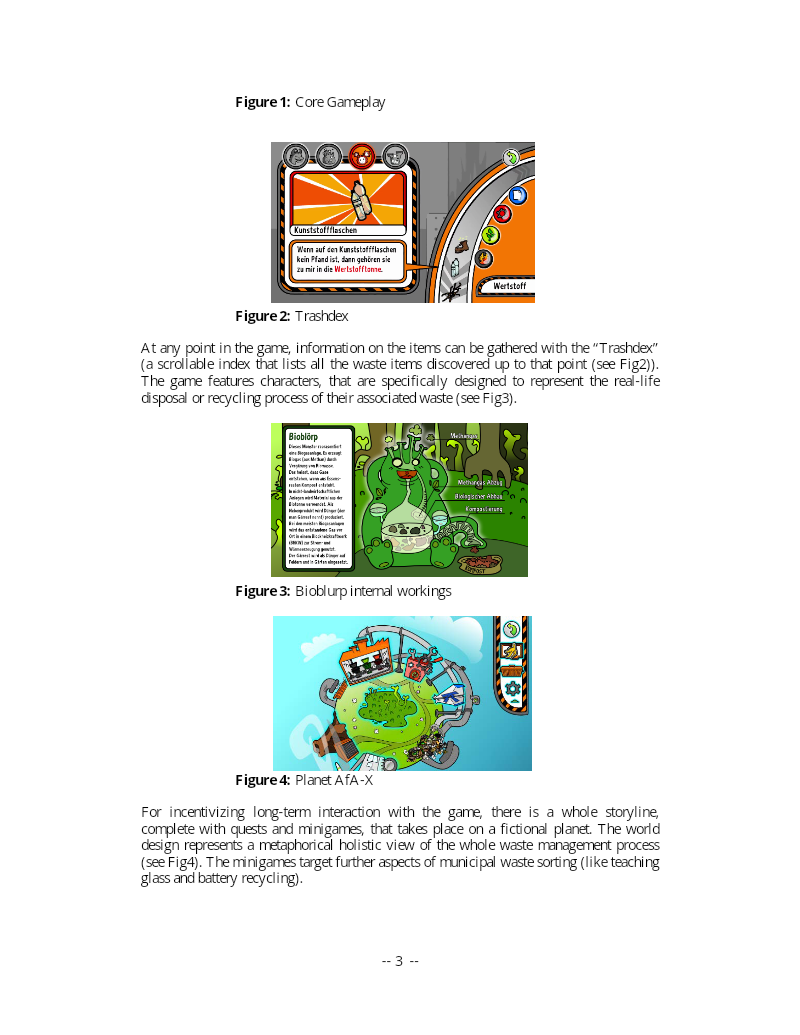
Incentivizing Correct Waste Sorting by Game Design
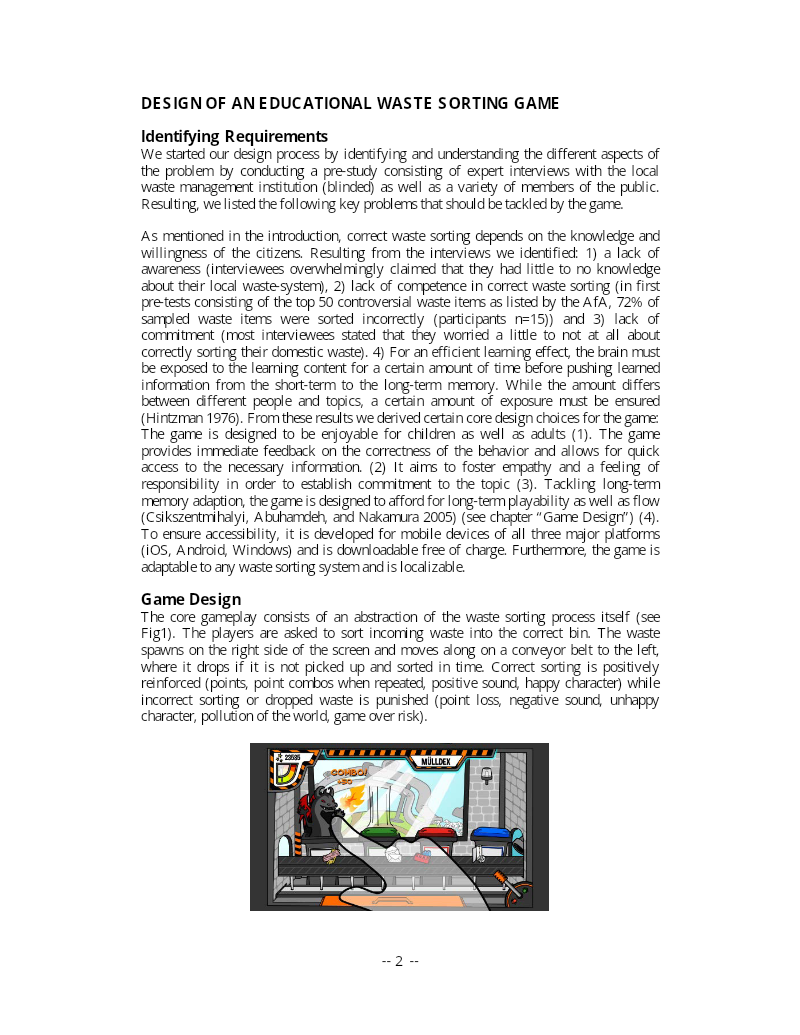
This document outlines the design and preliminary evaluation of a serious mobile game aimed at incentivizing correct waste sorting.
- A pre-test found 72% of 50 controversial waste items were sorted incorrectly by 15 participants, and most interviewees reported little knowledge of their local sorting system or concern about sorting correctly.
- The authors frame citizen sorting errors as stemming from three gaps (low awareness, weak competence, and limited commitment), and argue game design can address all three.
- Because EU municipal waste systems differ, the authors propose a localizable app that adapts to any local sorting scheme as a substitute for the absence of a uniform EU-wide recycling system.
Implied Play Styles: An Analysis Tool to Understand Player Behavior and Meta-Game Emergence
The document introduces the concept of "Implied Playstyles" as an analytical tool to understand player behavior and the emergence of meta-games.
- Implied playstyles are proposed as a narrower construct than general player freedom: the strategic behaviors a game must elicit for it to be played "well" or as its designers intended, building on Iser's implied reader and Aarseth's implied player.
- Designers encode implied playstyles through the combination of mechanics and object attributes, so the same mechanic can produce markedly different behavior depending on the properties of the objects it acts upon.
- The framework is illustrated with units from StarCraft II: Legacy of the Void and Sins of a Solar Empire, each featuring three visually and mechanically distinct factions, selected partly because the author is familiar with them.

Blank Arcade: Exhibition of Games and Toys as Art
The Blank Arcade is a recurring exhibition of games, play art, and interactive media, organized by Lindsay Grace of American University in association with the Digital Games Research Association's annual conference.
- The Blank Arcade is a recurring games-and-play art exhibition organized by Lindsay Grace of American University in association with the Digital Games Research Association's annual conference, aiming to bring game art practice and history into the game studies community.
- Prior editions were held in Salt Lake City (2014), Lüneburg, Germany (2015), and Dundee, Scotland (2016), and the abstract proposes a 2018 edition.
- The model is designed to be sustainable for host conferences: organizers handle curation, outreach, advertising, and web hosting, while local hosts provide space, equipment, and logistics, with sponsorships sometimes covering shipping and catering.
How Local Policies Shape Game Production: A Nordic Perspective
This extended abstract examines how national and regional policies shape game production in the Nordic countries, with a focus on Finland, Norway, and Sweden.
- The paper argues that the spatial organization of Nordic game production is tied to local histories, networks, and policy environments, and that how governments classify games (as cultural heritage, technology projects, or business ventures) concretely affects their funding, regulation, and the games made.
- Norway channels game funding mainly through the Norwegian Film Institute, favoring projects that foster national cultural heritage, while Finland has historically routed most industry funding through Tekes, the national technology and innovation agency, emphasizing technological and economic aims.
- Sweden has lacked a coherent domestic policy for game development, though recent years have seen movement toward a Finnish-style model.

Interpretive Challenges in Games
The document introduces and defines the concept of "interpretive challenges" in games, distinguishing them from traditional physical and mental challenges.
- Jonne Arjoranta's paper defines the 'interpretive challenge': a mental challenge in which a player must draw on knowledge outside the game (understanding people, cultural frameworks, background concepts) to progress or win, distinct from the logical or strategic challenges usually discussed in game studies.
- Most games involve some interpretation, but only a small number make successful interpretation a condition of play, which is why the category is useful for identifying a specific class of games.
- The paper's central case study is Her Story (2015), in which players search fragmentary video interview clips about a murder and revise hypotheses to connect vague statements to narrative events.
Man Caves and the Fantasy of Homosocial Escape
Gaming "man caves" are theorized here as domestic enclaves of technomasculinity that promise both homosocial belonging and escape from everyday life.
- The paper analyzes posts from the "Post your setup" threads on NeoGAF, drawn from the 2007 and 2015 editions, to trace how depictions of domestic gaming arrangements shifted across the Xbox 360, Wii, and PlayStation 3 console generation.
- The authors frame the gaming "man cave" as a "media apparatus" whose staged images of shared play rarely reflect actual co-presence, suggesting the homosocial bonding it displays is largely virtual or aspirational.
- The masculine subject in these threads is argued to seek escape from domestic obligations, from the feminized home, and from diversity calls affecting technology and gaming culture.
Production Pipelines as Actor-Networks: Rethinking the Game Studio as a Technological Platform
Game studios can be understood as technological platforms whose production pipelines shape the games that emerge from them.
- The paper reframes the game studio's production pipeline as an Actor-Network drawing on Bruno Latour, arguing that human and technological mediators (third-party engines, middleware, Lean management) actively transform the ideas and assets they carry rather than merely passing them along.
- The authors position the work as a bridge between production studies and platform studies, responding to calls within game studies for an approach that connects industrial context with platform analysis.
- Methodologically, the study combines production cultures research (drawing on John Caldwell and Sherry Ortner) with interviews with triple-A and independent designers and case studies of Alien: Isolation (Creative Assembly, 2014) and Everybody's Gone to the Rapture (The Chinese Room, 2015).
(Re)Play the Beginning of the End: 1988 as Prequel to Umbrella Movement in Hong Kong
This extended abstract examines the 2015 alternative history video game 1988 (光輝歲月), created by independent designer and political activist Cheng Lap, as an overlooked agent of digital activism in Hong Kong after the 2014 Umbrella Movement.
- The study treats 1988, a 2015 alternative history game by Hong Kong designer Cheng Lap, as a form of digital activism emerging from the aftermath of the 2014 Umbrella Movement, set a decade before the 1997 handover to China.
- The game places a teenage immigrant from mainland China against a hegemonic alliance of the Chinese Communist Party and real estate interests, and the author argues it actively constructs and circulates "Hong Kong local" identity as an emerging nationality.
- The analysis distinguishes two dimensions of "Hong Kongness": the richly detailed fictional Hong Kong built within the game, and the online community that treats playing and discussing it as a progressive political act.
Avatar-Kinaesthetics as Characterisation Statements in Horizon: Zero Dawn
This study investigates how "avatar-kinaesthetics" function as characterization statements in digital games, using Horizon: Zero Dawn (HZD) as a specific case study.
- The paper proposes that avatar-kinaesthetics in Horizon: Zero Dawn (Guerrilla Games, 2017) act as characterisation statements, meaning controller haptics and avatar movement communicate character traits rather than serving only immersion.
- Specific traits conveyed through player-performed kinaesthetic feedback include Aloy's weight, the difference between her childhood and adult physicality, and her hunting skill, exemplified by fully drawing a bow.
- The authors argue that this kinaesthetic engagement strengthens the prosthetic relationship between player and avatar, drawing on Klevjer's 2007 account.
An Inclusive Perspective on Gameplay: Towards a Wide Understanding of Gameplay in Theory and Praxis
Jahn and Möring argue that practices conventionally treated as non-standard, including cheating, modding, speedrunning, glitching, and repurposing games, should be understood as ordinary gameplay.
- Jahn and Möring argue that non-standard gameplay practices such as cheating, speedrunning, modding, glitch exploitation, and subversive play have been wrongly marginalized as "other" and should be integral to any understanding of gameplay.
- The authors critique foundational game theory (Huizinga, Caillois, Juul, Adams and Rollings, Leino, Smith) for treating deviations from designer intent as exceptional, and contend that no clear formal distinction separates functional rule-learning from rule-breaking.
- Drawing on Perron and Arsenault's model of the player's mental model, the paper argues that the boundary between standard and non-standard play is hard to sustain formally and reflects developer hegemony over legitimate play.