1 free read left. Create a free account for unlimited reading + AI research.
Create free accountWhitepaper European Conference on Games Based Learning (ECGBL)
1 free read left. Create a free account for unlimited reading + AI research.
Create free accountWhitepaperEuropean Conference on Games Based Learning (ECGBL)
The paper revisits its theoretical foundations.
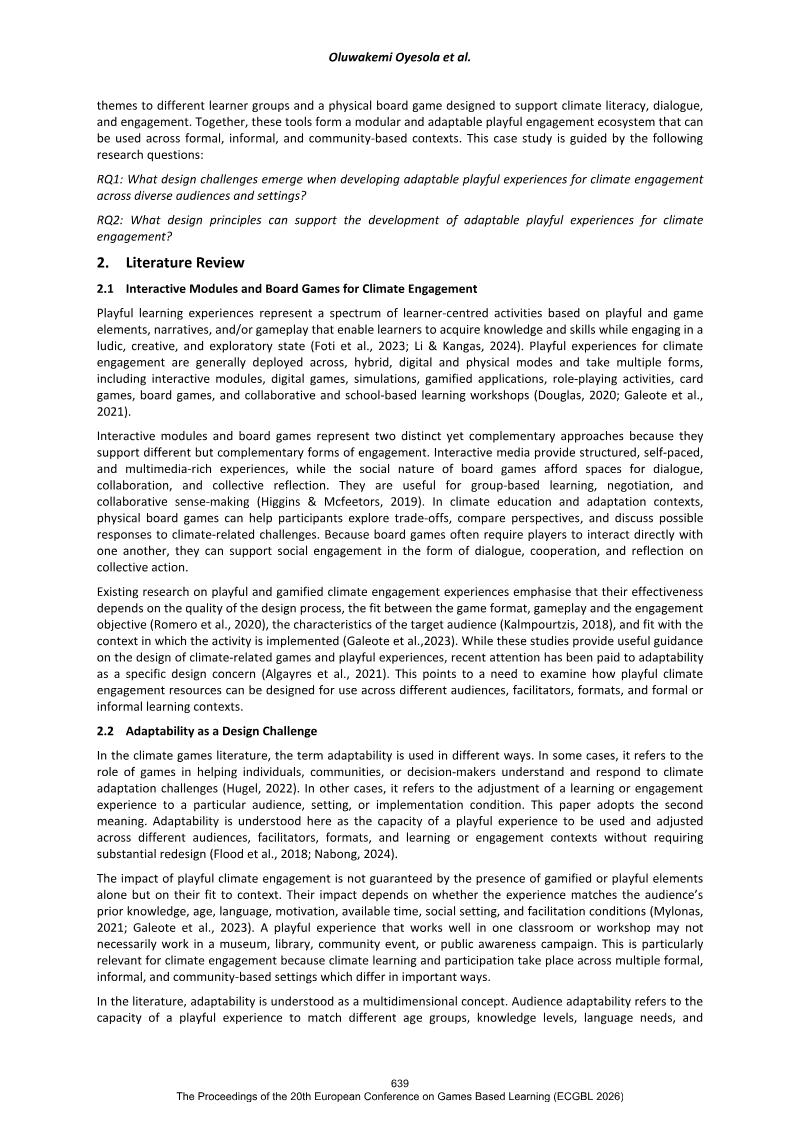
This paper, by Alice Thise of the University of Liège, revisits the theoretical foundations of "serious games" (SG), a term the author acknowledges is contested because it implies games are not serious by nature. Written as a narrative review in English drawing on French and English literature, it situates SG within debates over what constitutes a game or play, drawing on Huizinga, Caillois, Brougère, and Henriot. The author adopts a subjectivist position: play is ultimately defined by the player's perception, while objects designed as games remain games regardless of how they are received. The paper is framed as a summary of a chapter from a doctoral thesis in progress, with heritage mediation as its applied context.
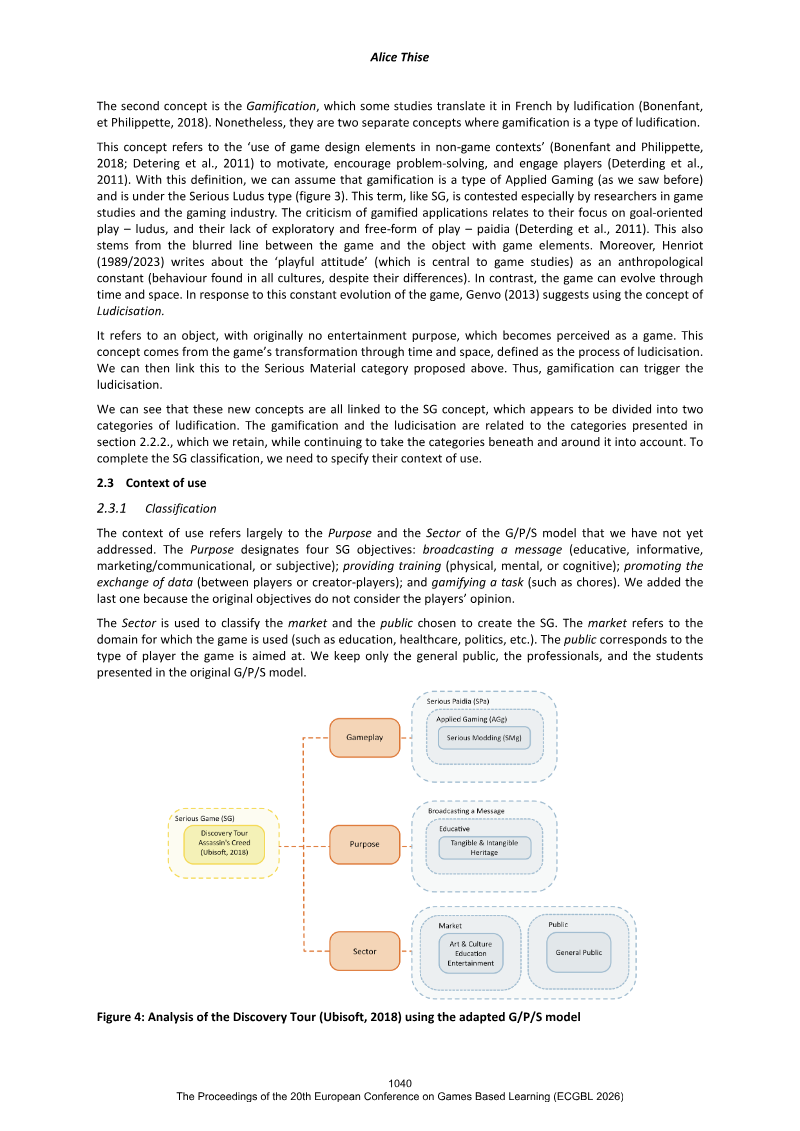
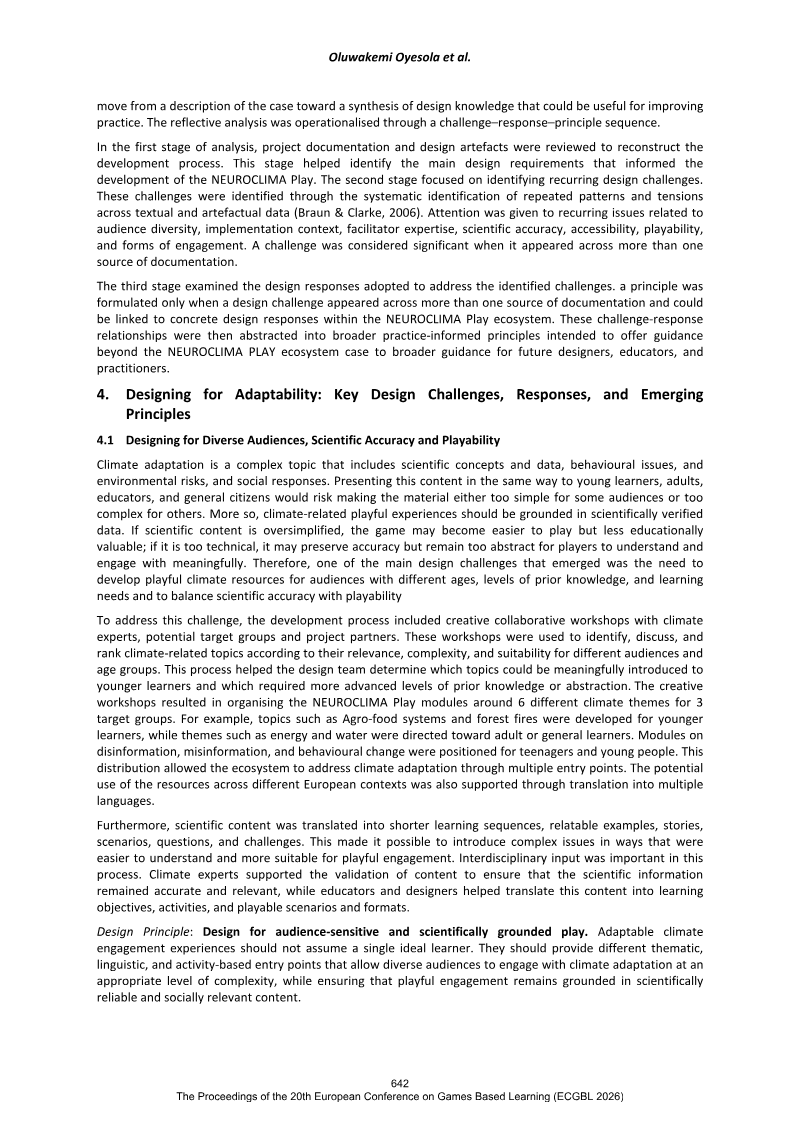
The paper reviews the classification of SG and related concepts such as ludification, gamification, and ludicisation, several of which the author finds complementary rather than rendering SG obsolete. Building on the Gameplay/Purpose/Sector model of Alvarez, Djaouti and Rampnoux (2012), the author proposes an extended framework that adds categories such as Serious Material and Serious Paidia, and introduces historical periods: Ancient Serious Games, Retro Serious Games, and the post-2002 SG period. The author also revises the starting point of the Retro period from 1972 to 1951, the date of an early computer chess program developed for research purposes, and notes that physical and phygital media, including Sun Tzu's Wei Hai and Sutherland's 1968 head-mounted display, predate the digital emphasis common in the literature.
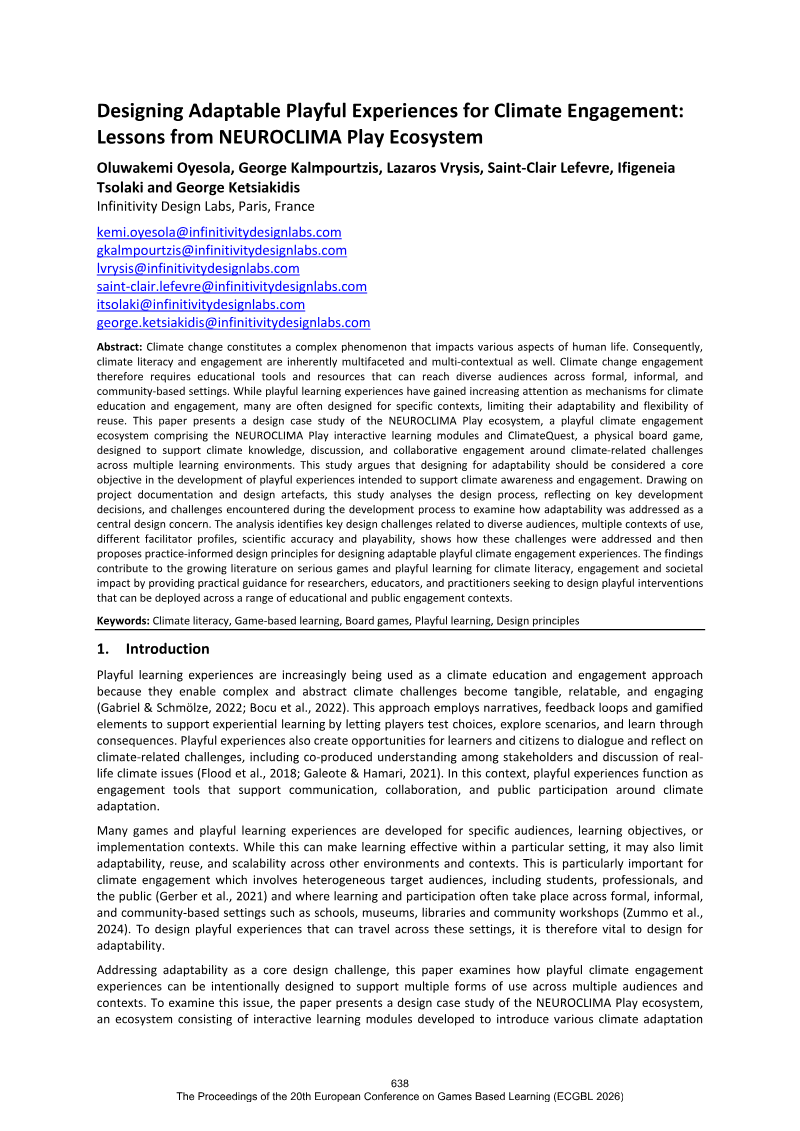
On effectiveness, the paper focuses exclusively on motivation, using Yee's (2006) three-part typology of achievement, social, and immersion motivations, alongside Nicholson's (2015) BLAP and RECIPE mechanics frameworks. The author observes that reward-based systems can sustain engagement only while rewards continue, whereas intrinsic approaches depend on challenge, curiosity, and player autonomy. The paper's methodology is qualitative and conceptual rather than empirical, with no survey or sample data. It concludes by noting that factors such as interactivity, performance pressure, and ethical concerns remain open for further research.

European Conference on Games Based Learning (ECGBL) · 2026



European Conference on Games Based Learning (ECGBL) · 2026

European Conference on Games Based Learning (ECGBL) · 2026



European Conference on Games Based Learning (ECGBL) · 2026



European Conference on Games Based Learning (ECGBL) · 2026



European Conference on Games Based Learning (ECGBL) · 2026



European Conference on Games Based Learning (ECGBL) · 2026



European Conference on Games Based Learning (ECGBL) · 2026



European Conference on Games Based Learning (ECGBL) · 2026



European Conference on Games Based Learning (ECGBL) · 2026



European Conference on Games Based Learning (ECGBL) · 2026



European Conference on Games Based Learning (ECGBL) · 2026
European Conference on Games Based Learning (ECGBL) · 2026
European Conference on Games Based Learning (ECGBL) · 2026
European Conference on Games Based Learning (ECGBL) · 2026



Comments