Global reports and market data
Documents
Narrative Structure in Trans-Reality Role-Playing Games: Integrating Story Construction from Live Action, Table Top and Computer-Based Role-Playing Games
This document explores the concept of Trans-Reality Role-Playing Games (TRRPGs), which integrate established forms of role-playing games: table-top (TTRPG), live-action (LARP), and computer-based, particularly Massively Multiplayer Online RPGs (MMORPGs).
- Trans-Reality Role-Playing Games (TRRPGs) propose integrating table-top, live-action, and computer-based MMORPG role-playing into one coherent, persistent game world so players across staging contexts experience a shared world.
- The authors argue each form offers distinct storytelling strengths: table-top RPGs rely on collaborative verbal improvisation, MMORPGs on fixed audiovisual performance primitives, and LARPs on embodied face-to-face performance that produces a multitext where each player holds a different story perspective.
- Achieving a shared experience requires a unified and persistent game space, consistent characters, objects, NPCs and mobs across all players, and shared rules and mechanics.
Architecting Scalability for Massively Multiplayer Online Gaming Experiences
Scalability in Massively Multiplayer Online Games (MMOGs) is framed here as the capacity to absorb growing player demand without degrading the player experience, a requirement that varies by genre, from fast-paced First Person Shooters to turn-based strategy.
- Scalability in MMOGs is defined as absorbing growing player demand without degrading the player experience, and the required standard varies by genre, from fast-paced FPS to turn-based strategy.
- The report argues that scalability challenges in simulation, communication, content distribution, and structural architecture are interdependent and cannot be solved in isolation, so a generic MMOG infrastructure needs an integrated design.
- Client/Server models remain dominant in deployed MMOGs, while Peer-to-Peer simulation is constrained by load balancing, state coherence, peer unpredictability, and cheating risks.
Her Own Boss: Gender and the Pursuit of Incompetent Play
The document "Her Own Boss: Gender and the Pursuit of Incompetent Play" critiques the prevailing discourse surrounding gender and computer game playing, arguing that current research often misrepresents female engagement with games, thereby exacerbating girls' disadvantage in computer-based educational and occupational…
- The paper argues that computer game-based learning initiatives risk deepening girls' existing disadvantage in computing, since educational game design is often treated as technologically neutral and rarely incorporates girls' perspectives.
- Aggregate statistics showing women playing as much as men are misleading, partly because classification shifts that count women who play card or board games as "gamers" fold gender into homogeneous player data.
- When broken down by genre and time spent, men play action and role-playing games for roughly twice as long as women, indicating video game playing remains predominantly male territory.
Gendered Gaming Experience in Social Space: From Home to Internet Café
This paper investigates how social relations within various gaming environments influence players' online gaming experiences, with a particular focus on gender differences.
- Online gaming is primarily a social activity, so access to both virtual and physical gaming spaces strongly shapes players' enjoyment.
- Girls face stricter regulation than boys at home and are discouraged from visiting Internet cafés, especially with friends, which widens gender disparities in public gaming.
- Internet cafés in Taipei are a stigmatized public space dominated by male customers, and this social stigma limits girls' access to them.
Interactive Digital Storytelling: Towards a Hybrid Conceptual Approach
The document proposes a conceptual framework for Interactive Digital Storytelling (IDS), defining it as a convergence of game design and cinematic narrative principles.
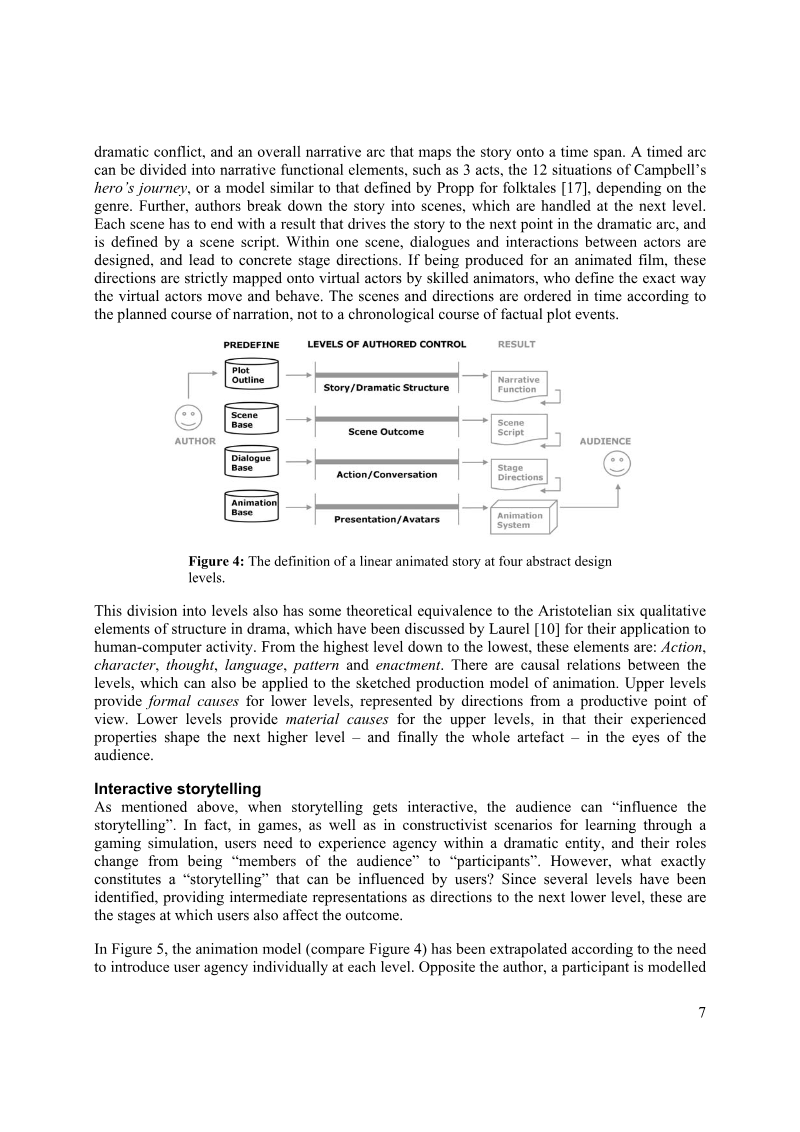
- Interactive storytelling is framed as a hybrid of game design and cinematic narrative, shaped by computer animation, human-computer interaction, game design, and artificial intelligence, rather than as a single concept.
- The central tension is between predefined story structure and user agency, and the quality of interactive storytelling depends on how, where, and to what degree user input shapes the narrative.
- The author argues this balance can only be refined through play-testing, not resolved in theory alone.
Push. Play: An Examination of the Gameplay Button
The document examines the pervasive role of the "gameplay button" in video game interfaces, arguing that while it has been central to the medium's development, its limitations hinder the exploration of more diverse and embodied gameplay experiences.
- Griffin's essay "Push. Play," presented at DiGRA 2005, argues that the video game button, despite its near-universal use, limits the medium's expressive development.
- The author's central thesis is that the button reflects a cognition-centered design approach that disregards the body's abilities, and he recommends revising the button rather than replacing it to add tangible, embodied interaction while preserving simplicity.
- The button succeeds because it reduces friction between player intent and in-game action, letting players focus on the game world rather than the device, a point grounded in play theory such as the "magic circle" concept.
Role Theory: The Line Between Roles as Design and Socialization in EverQuest
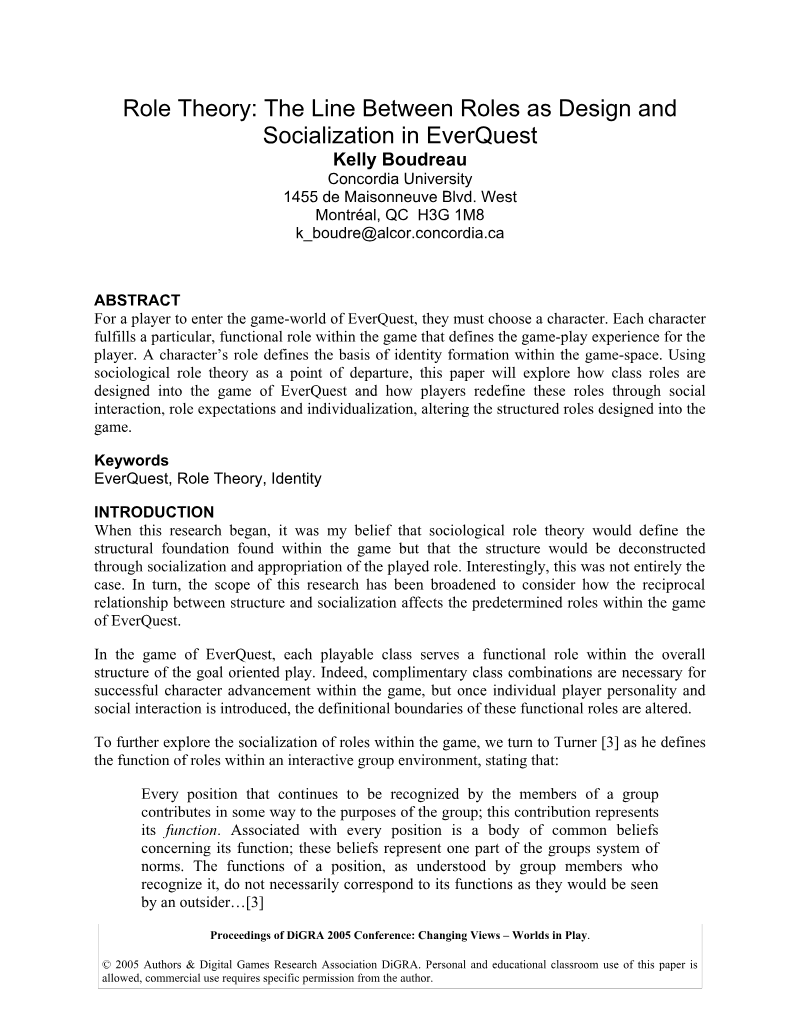
The document explores the interplay between designed game roles and player socialization in EverQuest, using sociological role theory as its framework.
- Role theory is applied to EverQuest, arguing that character classes are first functionally designed, then refined by community norms, and finally individualized through each player's personality and style of play.
- The paper finds that the relationship between game structure and player socialization is reciprocal rather than simply oppositional, challenging the expectation that player interaction would deconstruct rigid structural roles.
- Using the cleric class as its main example, the paper shows that design prioritizes the stability of the class role over any individual player, so any competent cleric can fill the position in group play.
Law, Order and Conflicts of Interest in Massively Multiplayer Online Games
This paper examines social interaction, conflicts, and the evolution of rules and norms within Massively Multiplayer Online Games (MMOGs), specifically using Everquest as a case study.
- Rules in large online games like Everquest arise from two sources: the publisher's formal rules and the norms players develop among themselves over time.
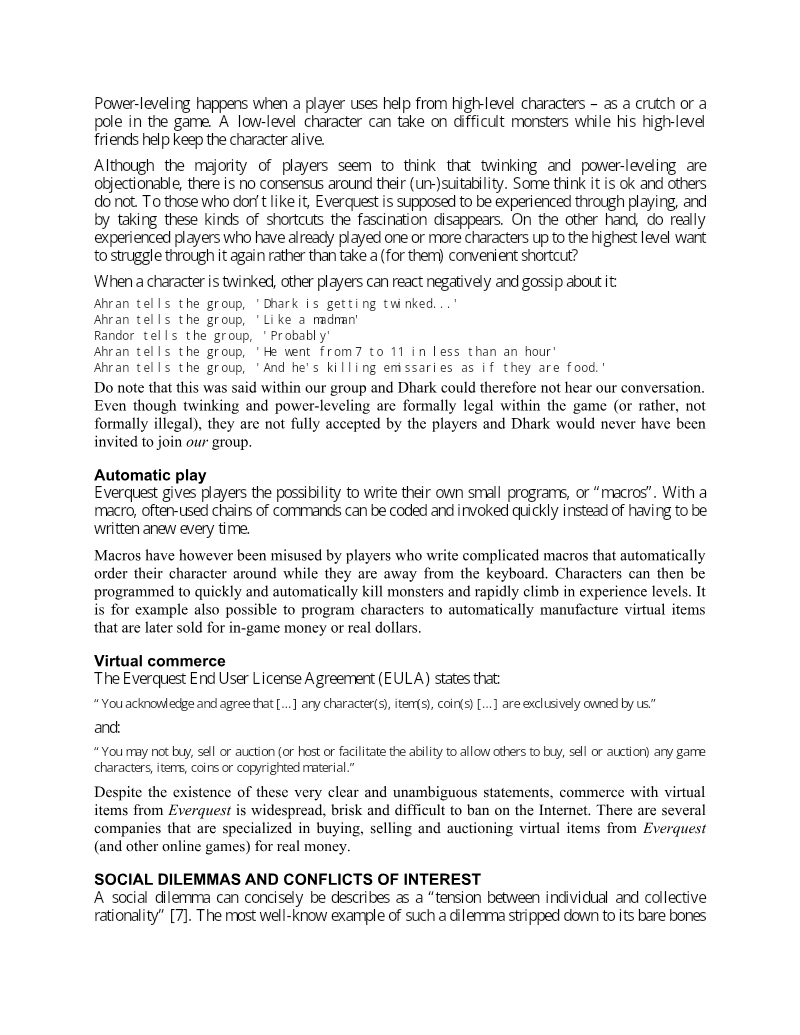
- Based on roughly 400 hours of ethnographic gameplay (February–April 2004), supplemented by in-game interviews, event logging, and analysis of two Everquest forums including Sony's official forum, the authors identify recurring objectionable behaviors such as kill-stealing, train-pulling, camping, twinking, power-leveling, macro-driven automated play, and real-money item trading.
- Most objectionable behaviors are regulated through informal social sanctions rather than formal enforcement, and their effectiveness depends heavily on how susceptible each individual player is to social pressure.
Studying Games in School: A Framework for Media Education
The document outlines a comprehensive framework for integrating digital games into media education, shifting the focus from merely utilizing games as instructional tools to critically examining them as significant cultural artifacts.
- Pelletier et al. argue that digital games should be studied in schools as a subject in their own right, not merely as tools for teaching other disciplines.
- The proposed framework analyses games through an integrated combination of design, play, and culture, adapted from Buckingham's three-part media education model of text, audiences, and institutions.
- Young people's informal game literacy is uneven and shaped by unequal social access, which the authors argue makes structured classroom study and practical game-making valuable.
Information Behavior and the Formation and Maintenance of Peer Cultures in Massive Multiplayer Online Role-Playing Games: A Case Study of City of Heroes
This conceptual framework outlines research examining how play theory and information behavior theory, particularly meaning-making, explain the development and maintenance of peer cultures within Massive Multiplayer Online Role-Playing Games (MMORPGs), using City of Heroes as a case study.
- The paper is an early-stage conceptual framework for a planned study, not a report of empirical results; its claims rest mainly on existing literature rather than new data.
- It proposes that play theory and information behavior theory (especially meaning-making) together can explain how MMORPG players form and sustain guilds, clans, and teams with their own rules and mores despite anonymity and missing offline social cues.
- The framework treats MMORPGs three ways: as games, as 'virtual sandbox' play spaces, and as cultures where knowledge, behavior, and artifacts are learned and negotiated.
Addressing Social Dilemmas and Fostering Cooperation Through Computer Games
This document explores how computer games, specifically Massively Multiplayer Online Role-Playing Games (MMORPGs), can be utilized to address social dilemmas and foster cooperative behavior within online communities.
- The paper's central thesis is that cooperation in games is best fostered by increasing trust and by making individuals explicitly aware of their choices, and that in-game communities should develop their own norms rather than have them imposed from outside.
- A prior three-researcher study using a custom Neverwinter Nights module with pre- and post-gameplay surveys found that players experimented with alternative strategies, but this did not measurably change their real-life choices in a hypothetical social dilemma, though it did prompt deeper reflection on real-world situations.
- The earlier study's authors attributed the null behavioral result to the game's limited depth and the absence of interaction with other real people, and concluded that identity is more complex than anticipated, shaped by individual differences.
Growing Complex Games
"Growing Complex Games" argues for a re-evaluation of computer simulation games, specifically "God Games" and "Real-Time Strategy Games," through the lens of complexity science.
- Glean's 2005 DiGRA paper argues that strategy and 'God' simulation games such as SimCity, Civilization, Children of the Nile, and Rome: Total War should be analyzed as complex systems using concepts from complexity science.
- Although fully deterministic, these games generate emergent, unpredictable, and novel play patterns arising from interacting agents and player decisions.
- The paper frames such games not as accurate predictive models of real-world phenomena but as 'transitional objects' that enable experimentation and reflection.