1 free read left. Create a free account for unlimited reading + AI research.
Create free accountWhitepaper DiGRA
1 free read left. Create a free account for unlimited reading + AI research.
Create free accountWhitepaperDiGRA
Globally dispersed players self-organise to master complex game environments, according to the proposal.
This doctoral research proposal examines how spontaneous communities of learning emerge within massively multiplayer online games (MMOGs), using City of Heroes as its primary case. Grounded in social learning theory, communities of practice, connectivism, and emergence theory, the project employs ethnography and social analysis to study informal learning ecosystems that form when otherwise unconnected players, spread across the globe, self-organise to master complex game environments. The authors argue that because mastery in these games typically requires collaboration, players develop symbiotic learning relationships that extend beyond the game into forums, chat channels, and face-to-face meetings, creating a rich web of metagame learning.
The theoretical framing draws on Lave and Wenger's legitimate peripheral participation, Siemens' connectivism, and Levy's notion of distributed intelligence to argue that learning is best understood in naturally occurring contexts rather than formal classrooms. The authors contend that traditional educational research has largely ignored such settings, and that studying learning in artificially structured environments yields artificial results. Game designers deliberately engineer interdependence through class-based systems and challenges that exceed solo capacity, which the authors present as a key source of community and sustained engagement.
A central claim is that MMOGs function as learning machines in which players acquire transferable skills such as improvisation, resourcefulness, teamwork, and innovation, often as collateral learning rather than explicit instruction. Players share strategies, document undocumented loopholes through peer transmission until a tipping point is reached, and co-produce the game world alongside developers. The authors position these dynamics as evidence for a new kind of learning ecology relevant to twenty-first century knowledge work.
The document is primarily a theoretical rationale rather than a report of completed findings, so its empirical conclusions are prospective. Its scope is focused on one game and on player communities in general, with the methodological emphasis on ethnography and participant observation intended to capture emergent cultures and their evolving social practices.
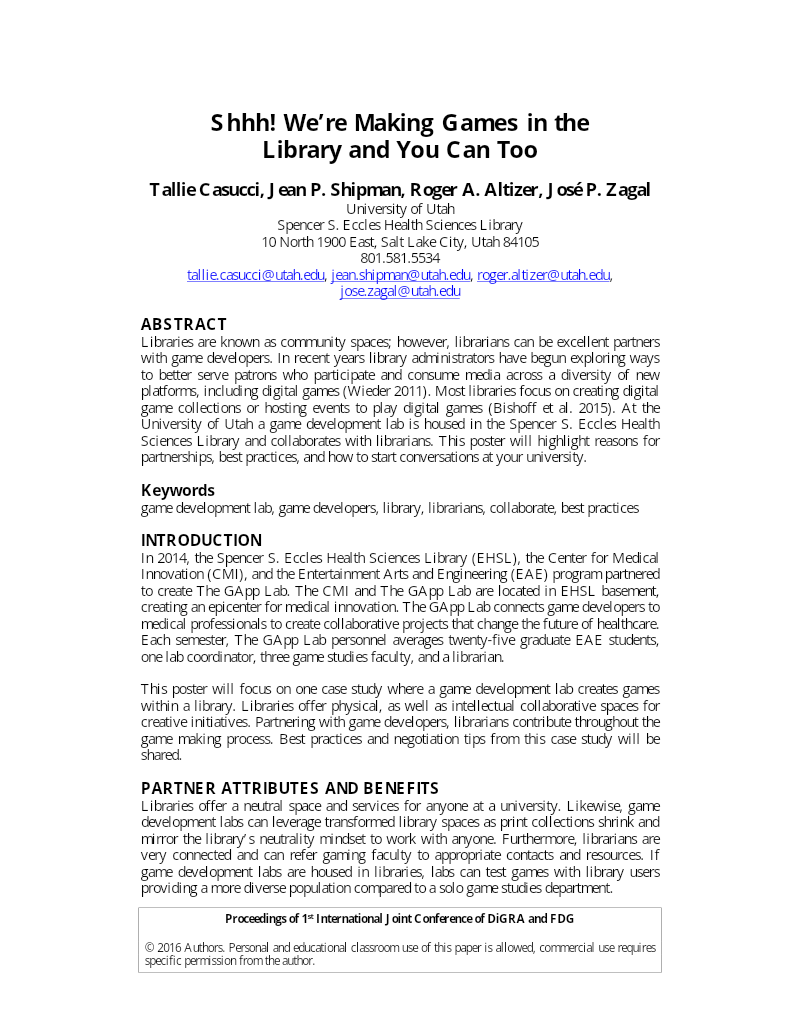
Each row is a game or company this document names, each column a document, oldest first. A mark means that document names it. Select a row to see those documents.
DiGRA · 2016
DiGRA · 2016
DiGRA · 2016
DiGRA · 2016

DiGRA · 2016

DiGRA · 2016



DiGRA · 2016

DiGRA · 2016

DiGRA · 2016

DiGRA · 2016

DiGRA · 2016

DiGRA · 2016
DiGRA · 2011