Global reports and market data
Documents
The Pervasive Interface: Tracing the Magic Circle
Eva Nieuwdorp's DiGRA 2005 paper, "The Pervasive Interface: Tracing the Magic Circle," argues that pervasive games, which embed fantasy within everyday physical and social settings, demand a rethinking of what counts as an interface.
- Eva Nieuwdorp's DiGRA 2005 paper argues that pervasive games, which embed fantasy within everyday physical and social settings, require rethinking the concept of an interface beyond hardware and screens.
- The paper proposes a "liminal interface" crossed in two stages: the paratelic interface, a playful state where players set aside lifeworld conventions through Goffman's rules of irrelevance, and the paraludic interface, a rule-bound structure where the game world's semiotic conventions dominate.
- The paper reworks the magic circle as a permeable, two-way boundary rather than a sealed space, and contends that the game world must feel omnipresent and internally consistent or the magic circle is pierced and the game collapses.
The Narrative and Ludic Nexus in Computer Games: Diverse Worlds II
The Diverse Worlds II study examines how narrative structure and game mechanics relate in computer games, aiming to move past the long-standing narratology-ludology debate by investigating dynamic relationships rather than fixed categories.
- The study analyses 80 critically acclaimed 2003 titles using Jenkins' four dimensions of narrative architecture and Aarseth, Smedstad and Sunnanå's thirteen-factor ludological typology, aiming to move past the narratology-ludology debate by examining how story and mechanics interact dynamically.
- Narrative formal systems appear in roughly three-quarters of the sampled games, with evoked and enacted narrative the most prevalent forms, while flashback and flash-forward techniques are rare and story information is predominantly presented objectively.
- Most titles feature geometrical topography, finite goal structures, real-world-paced time, and single- or two-player configurations, with deterministic responses, real-time environments, and objective-based rules common, and overcoming evil the dominant strategic objective.
The Localization of Digital Games: A Case Study in China
This paper examines the challenges facing digital game localization, using China as a case study to explore why some foreign games succeed in the Chinese market while others fail.
- Game localization is more complex than general software localization because games function simultaneously as commercial and cultural products.
- The authors propose a three-dimensional model comprising the In-Game Environment (storyline, gameplay, engagement, interface), the External Environment (social, political, legal, ideological factors), and the Users, who link the two.
- The central contention is that all three dimensions should be considered throughout the entire game design process rather than treated as a late-stage adjustment.
The Use of Video Game Technology for Investigating Perceptual and Cognitive Awareness in Sports
This paper, presented at the DiGRA 2005 conference, proposes a framework for using video game technology to study and enhance the perceptual, attentional, and cognitive skills underlying expertise in sport, with ice hockey as the focal domain.
- The paper is a 2005 DiGRA conference proposal, not a completed study, and it reports no empirical results; its planned experiment's outcome remains untested.
- The authors argue that expert athletes and skilled video game players both build advanced perceptual and decision-making abilities through immersive practice, with ice hockey as the focal sport domain.
- The central claim is that expertise depends on holding and shifting between multiple knowledge types (cue utilization, pattern recognition, visual search, situational probability assignment) within ecologically realistic contexts rather than isolated lab trials.
Contexts, Pleasures and Preferences: Girls Playing Computer Games
Diane Carr's study examines how girls' gaming preferences are formed, drawing on observations of a computer games club at a single-sex state school in South London.
- Preferences are not fixed: over one school term, the nine participating girls expanded their favourite-game lists from 26 titles to include 16 newly encountered games, suggesting that simply offering new games in a new context was enough to alter stated tastes.
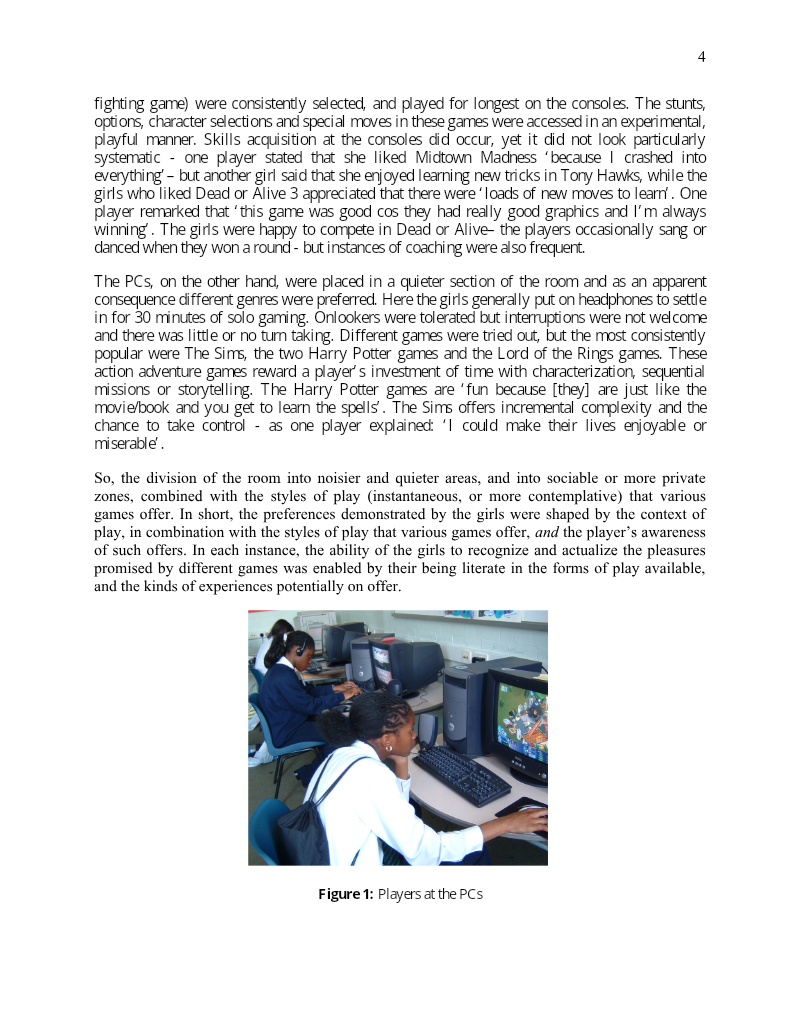
- Physical site features shaped genre choice: consoles placed near the noisy social area drew girls to instantly gratifying, turn-taking games such as Tony Hawk's Pro Skater 4 and Dead or Alive 3, while the solitary PC corner favoured narrative-driven titles like The Sims and the Harry Potter and Lord of the Rings games.
- Avatar gender mattered less than assumed: the girls showed little interest in female-led games, and questionnaire responses about ideal characters rarely specified gender, with those who did sometimes choosing male avatars, most pronounced among girls with the greatest home access.

The Psychophysiology of Video Gaming: Phasic Emotional Responses to Game Events
A 2005 study by Ravaja and colleagues, presented at DiGRA, investigates the psychophysiology of video gaming by measuring phasic, event-level emotional responses rather than the tonic, averaged physiological states that prior game research relied upon.
- The study shifts from tonic, averaged physiological measures to phasic, event-level responses, arguing that tonic measures cannot separate the varied emotions elicited by specific moments of play.
- Physiological data (facial EMG, skin conductance, and cardiac interbeat intervals) were recorded from 36 participants playing Monkey Bowling 2 and synchronized with video at roughly single-frame accuracy.
- Falling off the lane and knocking down pins both produced positive-valence responses, and falling off the lane also elicited high arousal, suggesting active participation can make even failure emotionally rewarding.
Building and Reconstructing Character: A Case Study of Silent Hill 3
This paper, by Petri Lankoski of the University of Tampere, examines how the player character Heather is constructed in Silent Hill 3, a 2003 survival horror game.
- Predefined functions such as cutscene dialogue and written monologue are the primary means by which Heather's nature is revealed in Silent Hill 3, while goals play only a minor role.
- Possible and impossible actions frequently reinforce the characterization conveyed by predefined functions, operating through the game's control design.
- The opening user guide, the playable nightmare sequence, and the first cutscenes are especially important for setting the player's interpretive expectations of the character.
Playing in the Sandbox: Developing Games for Children with Disabilities
This study, presented at the DiGRA 2005 conference, argues that children with disabilities, particularly those with cerebral palsy, do not primarily need specially designed games; they want to play the same commercial titles as their peers.
- The principal barrier for children with disabilities, especially those with cerebral palsy, is physical rather than a lack of suitable content: console controllers for Xbox and PlayStation require two dexterous hands, and many of these children lack them.
- The author argues these children do not primarily need specially designed games; they want to play the same commercial titles as their peers, so the priority is accessible input hardware for mainstream multiplayer games.
- Informal interviews with cerebral palsy students aged 18 to 21 at a centre attached to a mainstream high school reported that games made them happier, improved self-esteem, and gave a sense of social belonging, with one student believing driving games helped him control a powered wheelchair.
From Real-World Data to Game World Experience: Social Analysis Methods for Developing Plausible & Engaging Learning Games
The document presents a methodological framework for transforming qualitative interview data into interactive learning games, using HEALTHSIMNET, a prototype designed to improve practice within an HIV health care network in British Columbia, as its central case.
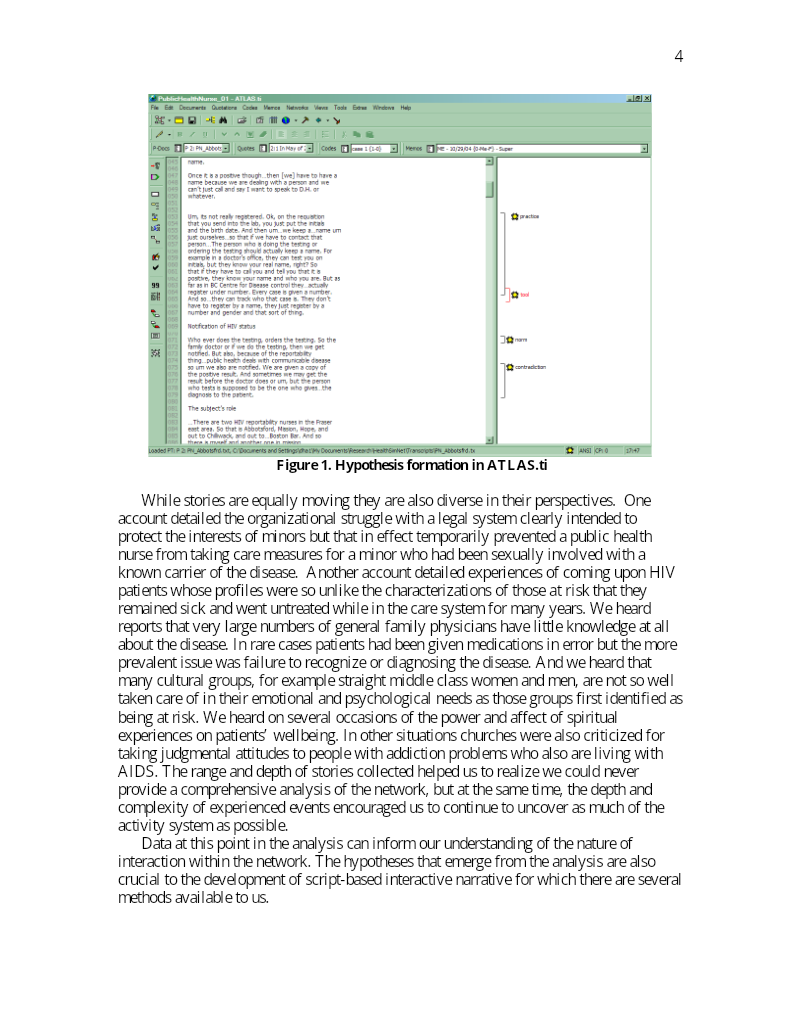
- The report's core method converts qualitative interview data into causally structured game narratives using cultural-historical activity theory, grounded theory coding in ATLAS.ti, action-relevant episodes, and TEAMVIEW representations, so that tensions within activity systems can be resolved in multiple ways to produce varied plot developments.
- The central case is HEALTHSIMNET, a prototype for improving practice within an HIV health care network in British Columbia, built from interviews with network participants.
- Interviews surfaced consequential design issues including legal barriers to public health action, widespread gaps in family physician knowledge about HIV, underserved patient populations, and spiritual and judgmental influences on care.
Framing Virtual Law
"Framing Virtual Law," presented at DiGRA 2005, argues that the conventional real-versus-virtual dichotomy obscures how legal order actually operates in online game worlds.
- The paper replaces the real-versus-virtual dichotomy with a five-layer model (actual, interface, system, instantiation, virtual) and argues that control over virtual worlds is distributed across these layers rather than held by a single authority.
- Actual-world law operates mainly at the outermost layer through courts and sanctions, while end-user license agreements at the interface layer often waive participants' access to courts, leaving owners largely shielded from legal challenge.
- Illustrative cases such as the Korean Lineage "off-line PK" assault and the banishment of Peter Ludlow from The Sims Online show owners excluding participants with little practical recourse.
Game Mediated Communication: Multiplayer Games as the Medium for Computer Based Communication
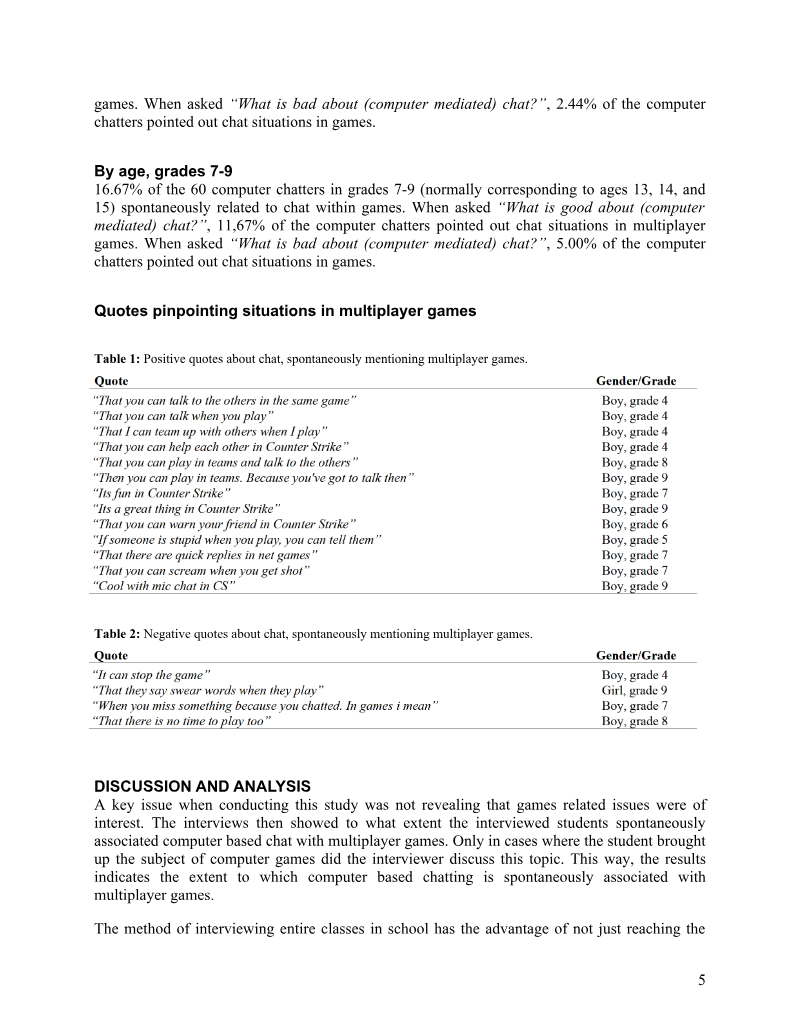
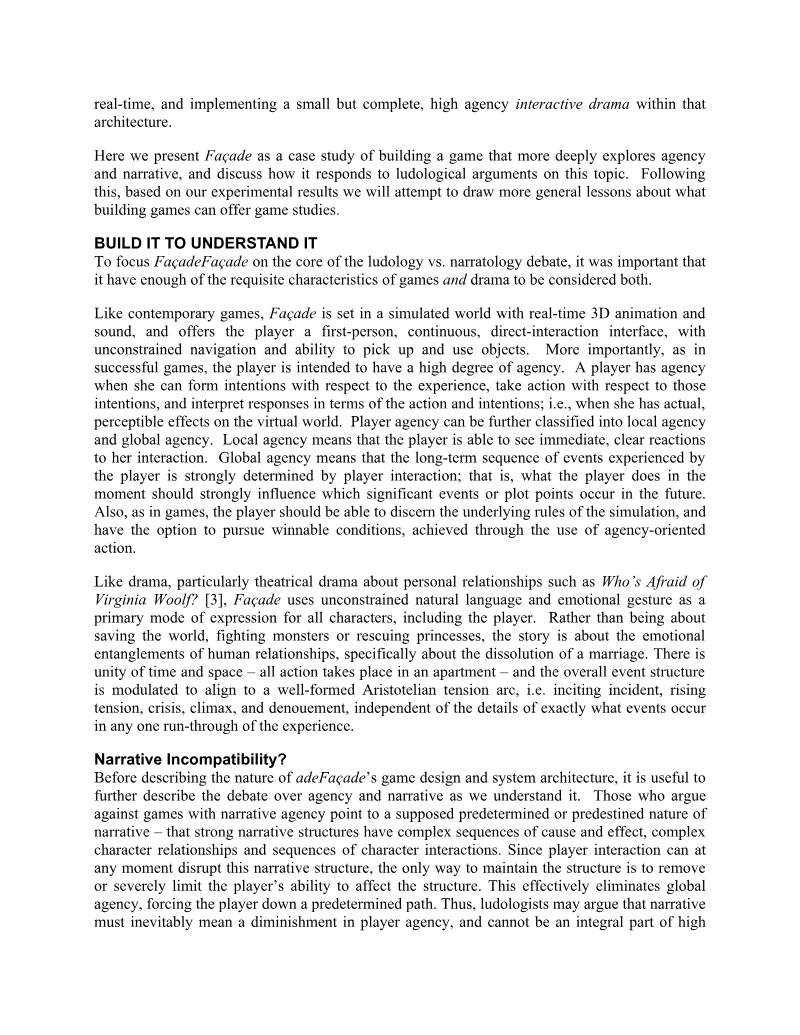
This study by Mats Wiklund at Stockholm University investigates whether multiplayer games are becoming the natural medium for computer-based communication, a question motivated by the growing prominence of in-game chat and voice interaction.
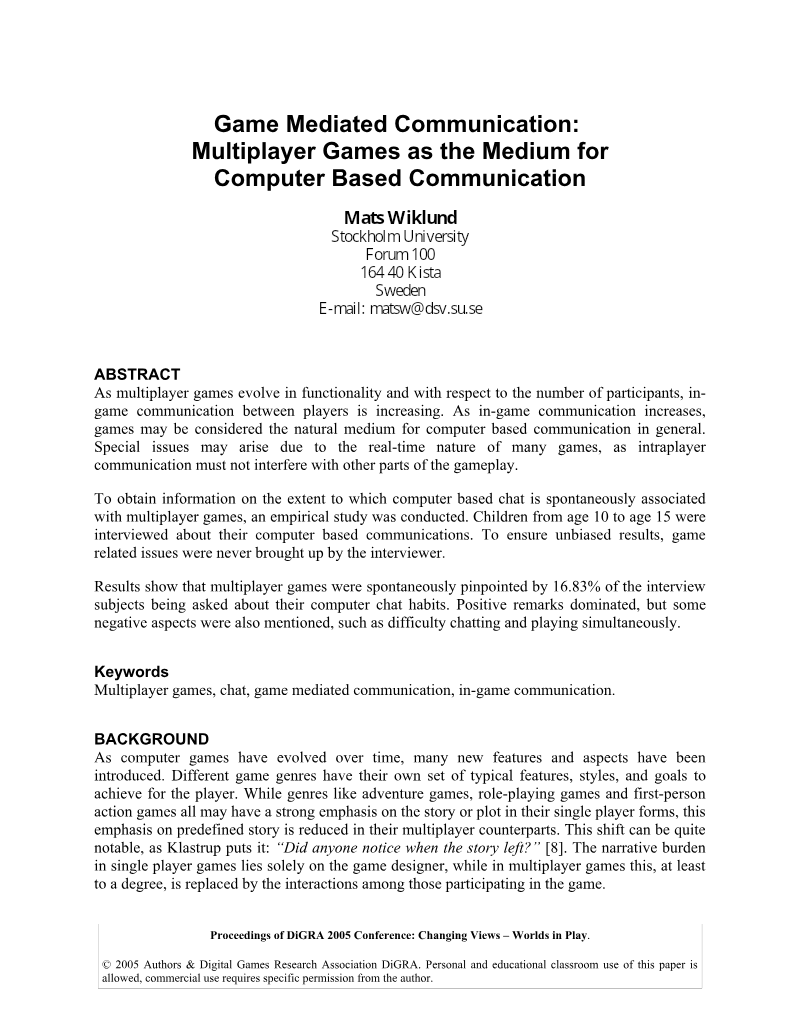
- Roughly 16.83% of computer chatters spontaneously linked chat with multiplayer games even though the interviewer never raised games, suggesting games are already a natural association for computer-mediated conversation.
- Among students aged roughly 10 to 15 at two Swedish schools, 101 of 131 interviewed reported chat use, and spontaneous game association was nearly identical for younger and older students (17.07% vs. 16.67%).
- Positive associations dominated: 76.47% of game-related answers arose from questions about the benefits of chat.
Build It to Understand It: Ludology Meets Narratology in Game Design Space
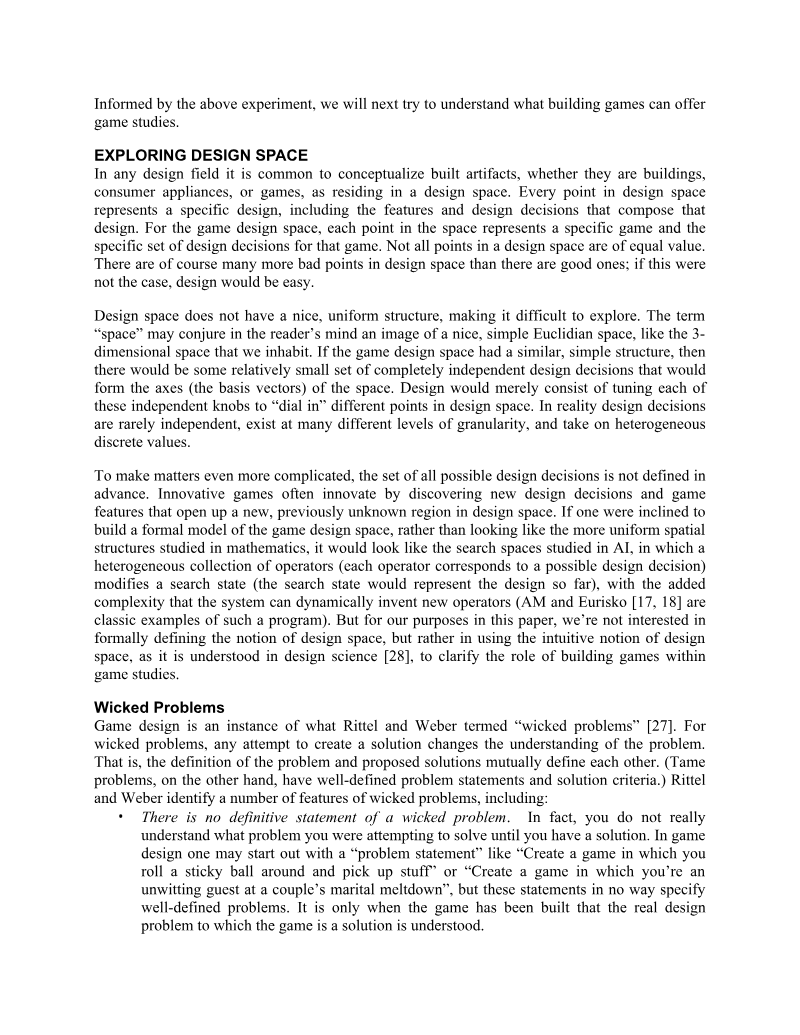
Mateas and Stern's paper argues that building experimental games can advance game studies beyond the analysis of existing titles.
- Mateas and Stern argue that building experimental games yields theoretical and design insights that purely analytical study of existing titles cannot reach, because analysis cannot anticipate new regions of design possibility.
- The authors contend that ludologist skepticism about combining player agency with strong narrative partly reflects the absence of successful agency-rich narratives, and they test this claim with their interactive drama Façade.
- Façade recasts story interactions as abstract social games (affinity, hot-button, and therapy games) driven by natural-language discourse acts and coordinated by a layered architecture and drama manager managing multiple narrative fronts.