Game Studies reports and market data
Documents
El Presidente Experiences: Mechanisms of Capitalizing Player Productivity in Tropico, Torchlight, and Diablo
This analysis examines how video game developers capitalize on player productivity, defined as the investment of time, skills, and cultural capital to generate value for a title.
- Game developers increasingly design mechanics that prioritize the capitalization of player productivity—defined as both gameplay efficiency and the creation of fan-made modifications—over traditional notions of player skill.
- In Tropico III (2009), success is tied to the adoption of authoritarian and neocolonial management styles, forcing players to internalize and execute specific ideological patterns to progress.
- Diablo III (2012) and Torchlight II (2012) utilize different strategies for player engagement: Blizzard focused on centralizing gameplay through online systems and auction houses to monetize play, while Runic Games leveraged expressive productivity by encouraging community-driven modding.
What Will Be the Future of the Past?: Report from the NECS 2015 Conference
The 2015 European Network for Cinema and Media Studies (NECS) conference, held in Lodz, Poland, served as a major academic forum for nearly 350 researchers from 33 countries to address the evolving challenges of audiovisual culture, with a specific focus on the preservation and archiving of digital media.
- Traditional museum and gallery frameworks are currently inadequate for preserving digital art and video games, as these media often exist outside institutional channels.
- Preserving video games requires moving beyond physical media like cartridges and discs to capture the intangible experience of gameplay and user interaction.
- Major online game titles host populations comparable to small nations, yet the industry lacks standardized, sustainable methods for archiving these massive digital environments.

City Beyond the City: Manifestations of Contemporary Flâneurism in Video Games
Video games serve as sophisticated digital environments that facilitate a contemporary form of flâneurism, transforming the act of movement into a primary method of narrative construction.
- Video games function as a unique medium for urban representation by allowing players to experience virtual space through movement, mirroring the way individuals navigate and assign meaning to physical cities.
- The player's movement in virtual environments is an intuitive process based on real-world navigation strategies, where physical actions like climbing or opening doors translate directly from daily urban life.
- Contemporary game design often bifurcates into two distinct modes of spatial interaction: the 'traceur' model, characterized by high-speed, kinesthetically dynamic movement, and the 'flâneur' model, focused on contemplative, slow-paced exploration.

gamevironments 2015
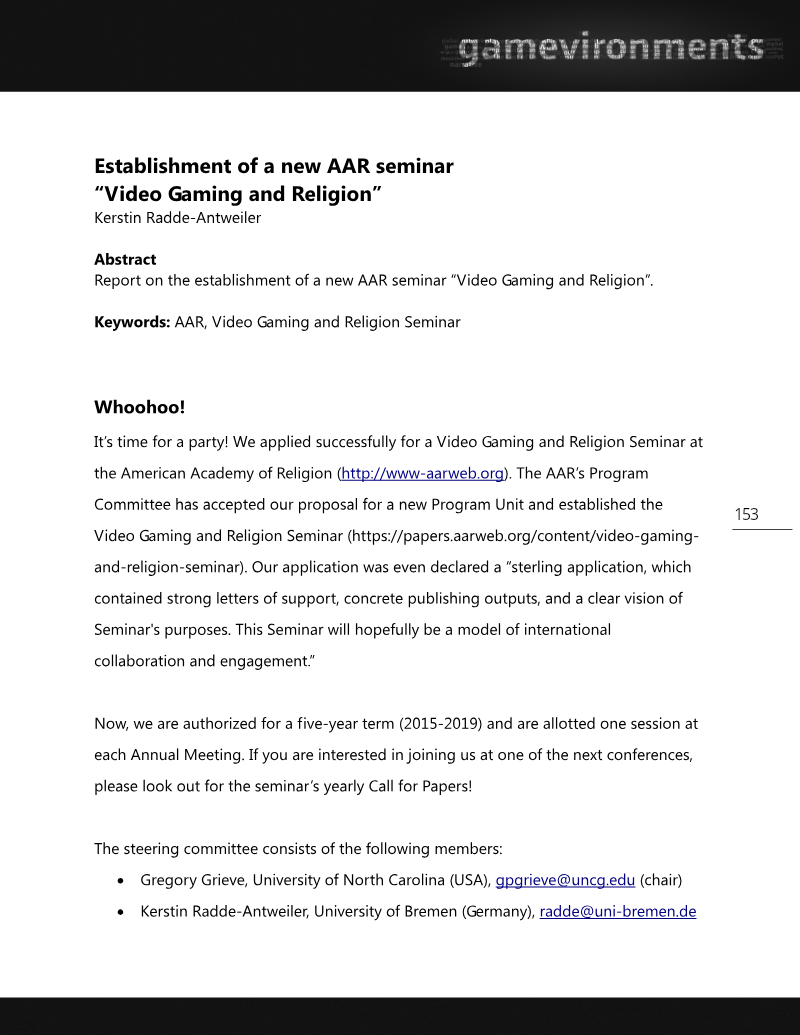
The document announces the establishment of a new Video Gaming and Religion Seminar within the American Academy of Religion (AAR), a major professional body for religious studies scholars.
- The AAR Program Committee approved a new Video Gaming and Religion Seminar for a five-year term (2015–2019), with one session at each Annual Meeting.
- The seminar was founded to address the marginal status of video games within Religious Studies, with author Kerstin Radde-Antweiler arguing that video games now depict religious themes just as film did in the twentieth century.
- The seminar aims to build a multidisciplinary, international network covering personal computer, console, and mobile games, with a steering committee of six scholars from the United States, Canada, Germany, and Finland.

Current Key Perspectives in Video Gaming and Religion
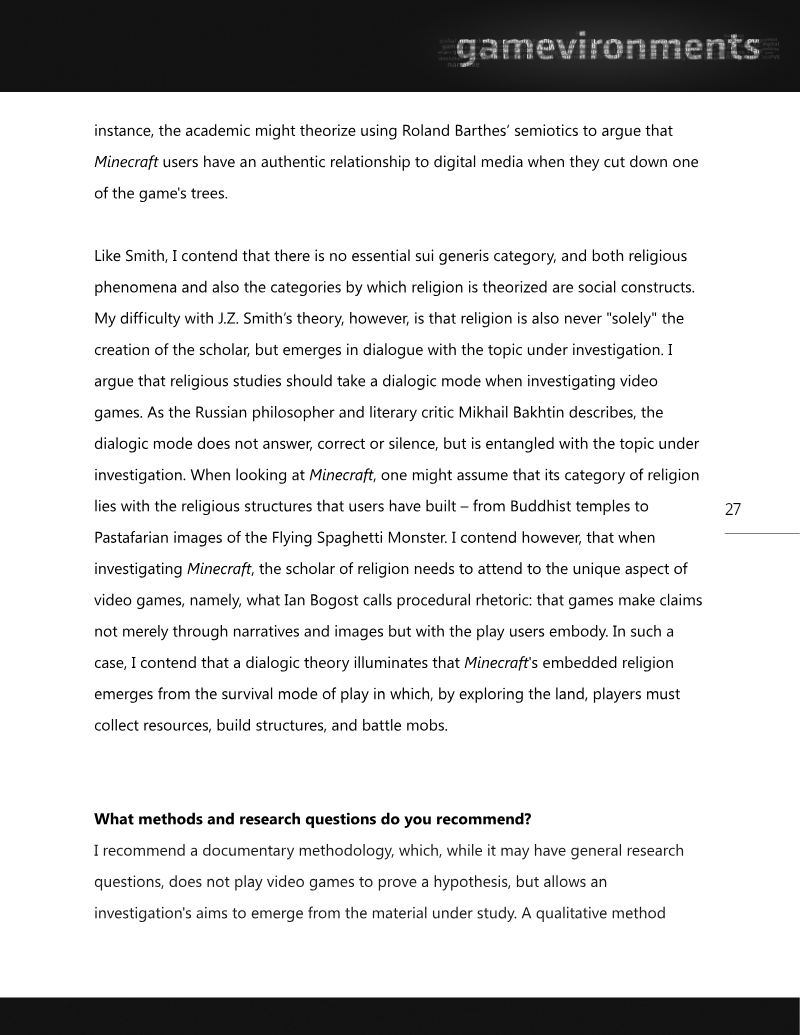
Gregory Grieve's contribution to this special issue on video gaming and religion argues that religious studies should examine video games through a "cultural dialogic mode," treating games as a space where religion and human meaning-making emerge rather than as objects that either hide timeless sacred symbols or serve merely as…
- Gregory Grieve argues that religious studies should examine video games through a "cultural dialogic mode," treating games as spaces where religion and human meaning-making emerge, rather than as hiding timeless sacred symbols or as mere products of the scholar's imagination.
- Grieve draws on Mircea Eliade, J. Z. Smith, Mikhail Bakhtin, and Ian Bogost's concept of procedural rhetoric, contending that in Minecraft religious meaning arises from the embodied experience of play, especially the survival mode's cycle of exploration, resource gathering, construction, and combat.
- Grieve proposes a documentary methodology called "close play," which requires scholars to actually play the games they study, since procedural meaning cannot be fully grasped through narrative or imagery alone.

Current Key Perspectives in Video Gaming and Religion
Kerstin Radde-Antweiler's theses, published in a 2015 special issue on video gaming and religion, argue that religious studies cannot ignore video games, since games form part of today's mediatized life-worlds in which online and offline religious practice increasingly merge.
- Religious studies cannot ignore video games because they form part of today's mediatized life-worlds, where online and offline religious practice increasingly merge.
- Games reach well beyond 'digital natives': German data showed at least 20 percent of players in 2006 were aged 40 to 64, and gaming shapes religious identity construction generally, not only within digital culture.
- Radde-Antweiler warns against overstating any single medium, arguing that media change interacts with individualization, globalization, and economization, so research should start with actor-centered inquiry into gamers' mediatized worlds rather than games as isolated objects.
Hackers and Cyborgs: Binary Domain and Two Formative Videogame Technicities
Brendan Keogh's paper "Hackers and Cyborgs: Binary Domain and Two Formative Videogame Technicities" uses Sega's Binary Domain as a lens for arguing that two competing modes of identifying with videogames have shaped the medium.
- Using Sega's Binary Domain as its lens, the paper treats the cyborg as a resistant and complementary perspective rather than a strictly opposed one, arguing the two identities are entangled and interdependent.
- The author contends the hacker ideal is masculinist and that this "technicity" influences which games get made, which are celebrated as exemplary, and how scholarly and popular discourse values the medium.
- Mainstream journalism and design privilege skill-based mastery, leading critics to dismiss exploration-focused and queer or women-created titles such as Dear Esther and Gone Home as "not real games," a rhetorical policing that also hits casual and avant-garde games reaching broader, more diverse audiences.

From Team Play to Squad Play: The Militarisation of Interactions in Multiplayer FPS Video Games
Multiplayer first-person shooter games increasingly rely on the adoption of real-world military communication doctrines to facilitate high-level coordination.
- Expert multiplayer FPS players evolve from 'team play' to 'squad play' by adopting real-world military communication protocols to improve tactical coordination.
- Squad play utilizes standardized military terminology—such as 'enfilade,' 'overwatch,' and 'defilade'—to eliminate ambiguity and ensure shared situational awareness among distributed players.
- Effective squad communication relies on precise, brevity-focused voice procedures that allow players to act as individual sensors, creating a collaborative, multi-perspective view of the battlefield.
Precarious Play: To Be or Not to Be Stanley
The tension between player agency and systemic control defines the contemporary digital gaming experience.
- The player experience is best defined as a 'split-subject' model, where human autonomy is in constant negotiation with the rigid systemic and narrative constraints of the game software.
- Immersion should be analyzed as 'mediated presence'—a variable psychological construct—rather than a binary state of being inside or outside the game world.
- Identification with an avatar is primarily dictated by the phenomenological alignment of camera control and navigational input.
Brechtian Alienation in Video Games
Brechtian alienation serves as a sophisticated analytical framework for game design, challenging the industry-wide preoccupation with seamless immersion.
- Brechtian alienation challenges the industry standard of seamless immersion by using mechanical interruptions to force critical engagement with a game's themes and systems.
- Designers can categorize distancing techniques into aesthetic alienation, which uses meta-narrative and simulated glitches to expose the virtual world's artificiality, and system alienation, which integrates hardware and save-file management into the game's diegesis.
- Intentional disruption of player absorption shifts the gaming experience from passive consumption to active, analytical participation.
Compassionate Play in the Ludic Century
Games have ascended to become the primary cultural framework of the modern era, fundamentally restructuring human experience and systemic interaction.
- The pervasive gamification of modern life functions as a mechanism of sustained delusion that prioritizes systemic interaction over genuine self-awareness.
- Contemporary play-spaces have evolved into fluid, transitory environments where participants act simultaneously as both designers and players, rendering traditional academic concepts like the 'magic circle' obsolete.
- The 'ludic century' is defined by a systemic trap where individuals adopt fictitious roles to avoid confronting their own non-substantial nature, leading to a state of 'bad faith'.
An Analysis of Open World Player versus Player in The Lord of the Rings Online
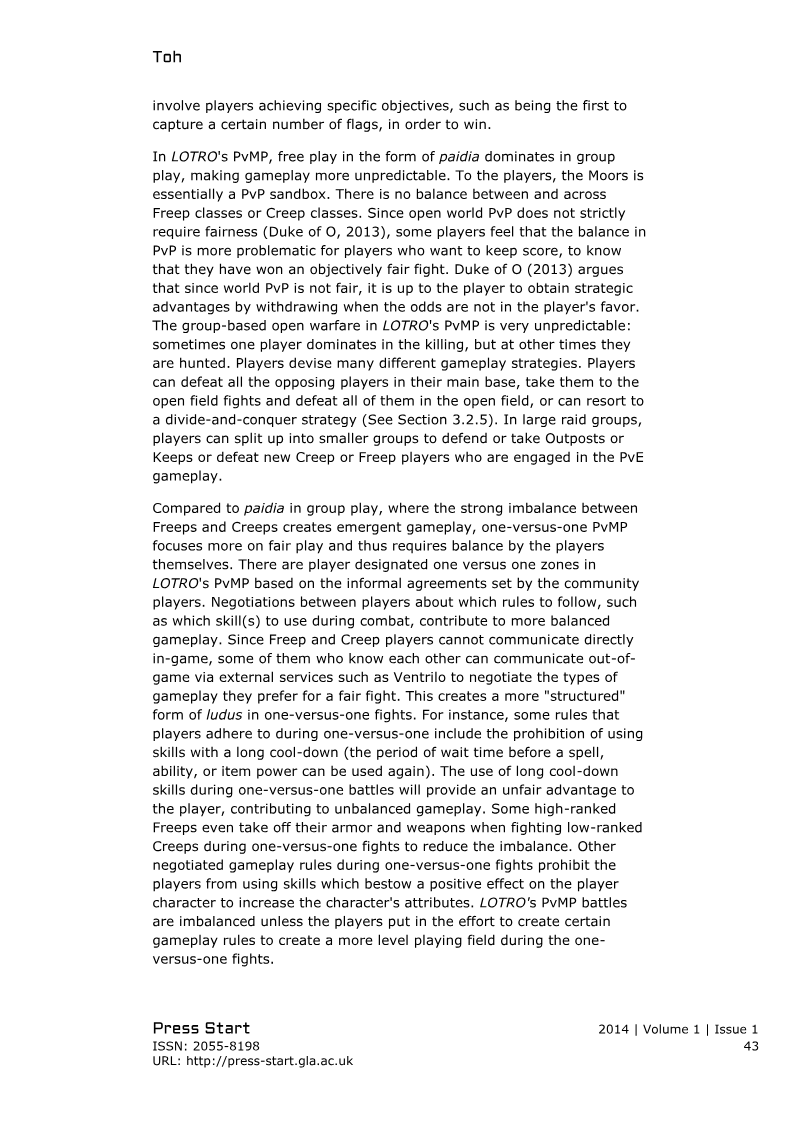
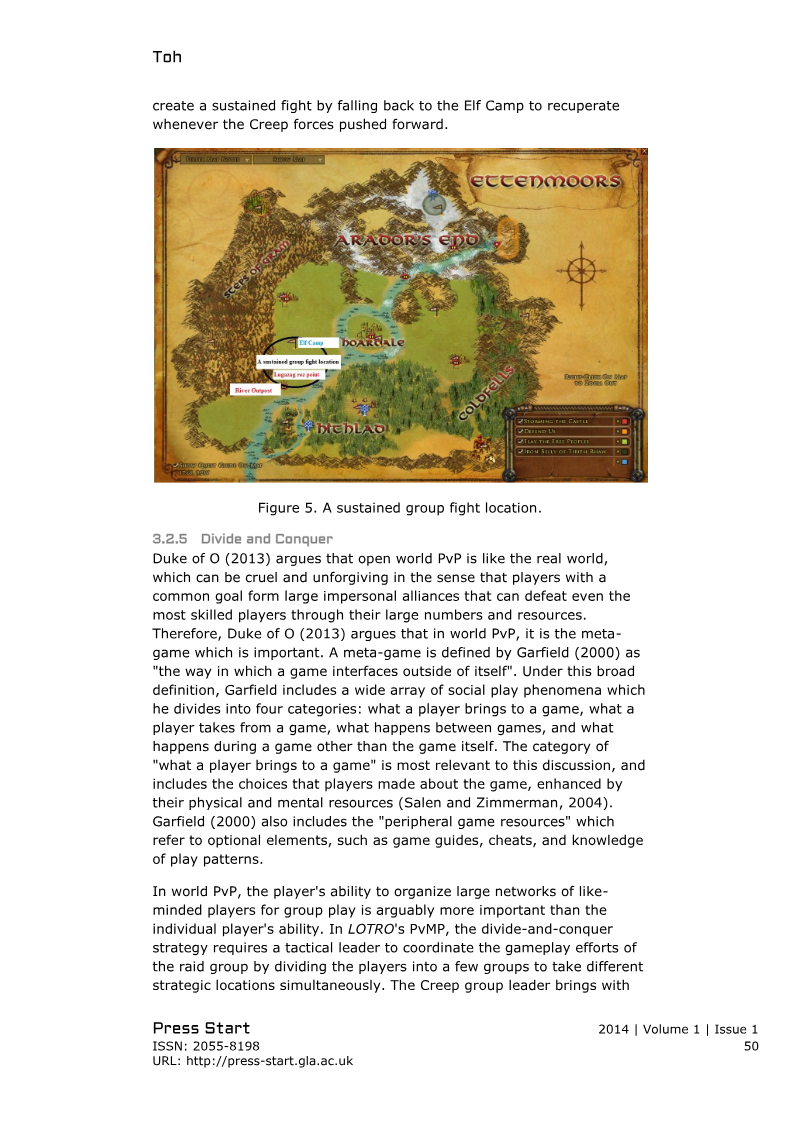
The open-world Player versus Monster Player (PvMP) environment in The Lord of the Rings Online serves as a primary case study for understanding how sandbox design fosters emergent gameplay.
- The Lord of the Rings Online’s PvMP environment demonstrates that sandbox design fosters emergent gameplay by prioritizing player agency over rigid, instanced combat constraints.
- A hybrid regulatory model, combining developer-enforced policies with community-led governance, is essential for maintaining social cohesion and preventing disruptive behaviors like ganking.
- Social conventions often supersede mechanical limitations, as players independently establish and enforce codes of conduct for one-versus-one combat.
Writers
Games and companies
Games