Game Development reports and market data
Documents
Always Be Composing: The Flexible Music System of Plants vs. Zombies Heroes
The musical architecture of Plants vs. Zombies Heroes centers on a highly interactive, flexible system designed to mirror gameplay progression while maintaining distinct character identities.
- The music system maintains a cohesive sonic identity by utilizing a fixed tempo of 125 BPM and shared key centers across all hero-specific themes and combat sequences.
- Engineers achieved a complex, adaptive audio experience within a strict 60MB asset footprint by using a hybrid MIDI and wave-based framework managed through Wwise.
- The audio team optimized memory usage by developing a custom 24-instrument sample library and implementing shared reverb and strategic compression techniques.
So You're Ready to Pitch to a Publisher? You're Not
Securing a publishing deal in the modern indie landscape requires a fundamental shift in perspective, moving away from unrealistic expectations of massive financial windfalls toward a pragmatic understanding of market viability.
- Publishers prioritize projects with realistic sales targets between 30,000 and 150,000 units rather than seeking massive financial windfalls.
- A successful pitch deck must be designed to stand alone, enabling internal stakeholders to advocate for the project without the developer present.
- The vertical slice or first playable demo must be tailored to the genre: action-adventure titles require high visual fidelity, while systems-based games must prioritize functional, proven design loops.
Lateral Up with Kylan Coats | Game Dev Unchained Episode 0201
Independent game development requires a strategic shift from specialized AAA roles toward a holistic, entrepreneurial mindset.
- Independent developers can mitigate financial volatility by adopting a hybrid business model that balances personal game projects with contract UX/UI design services for non-gaming sectors like automotive entertainment and voice-activated platforms.
- Crowdfunding platforms such as Kickstarter serve as essential tools for validating non-traditional, high-risk game concepts and building community trust before full-scale production.
- Success in the independent market is driven by targeting specific, underserved demographics, such as older players interested in narrative-driven strategy titles, through inclusive storytelling and unique character representation.
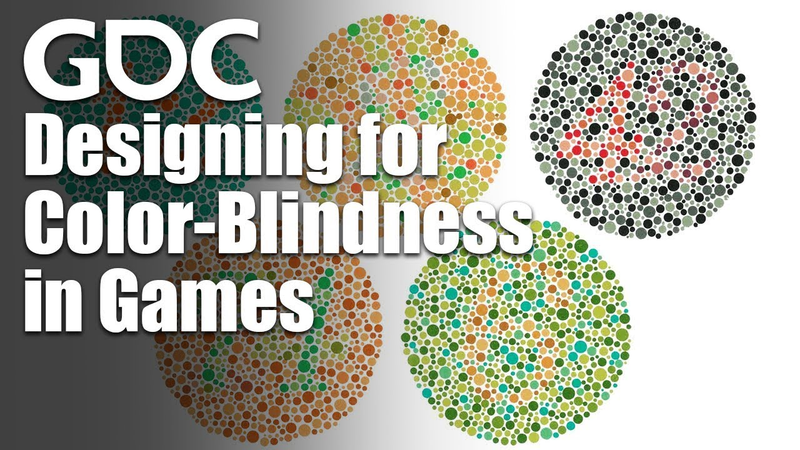
Solving an Invisible Problem: Designing for Color-Blindness in Games
Color blindness affects approximately 8% of the global male population, stemming from photoreceptor defects that hinder the ability to distinguish specific hues.
- Approximately 8% of the global male population experiences color blindness, creating significant barriers when games rely exclusively on color to convey critical information like team identification or health status.
- Designers must move beyond color-dependent communication by integrating redundant visual cues, such as distinct shapes, patterns, and icons, to ensure information remains accessible to all players.
- Developers should prioritize granular customization options, such as manual UI color and contrast adjustments, over global screen filters to provide a more functional and tailored user experience.
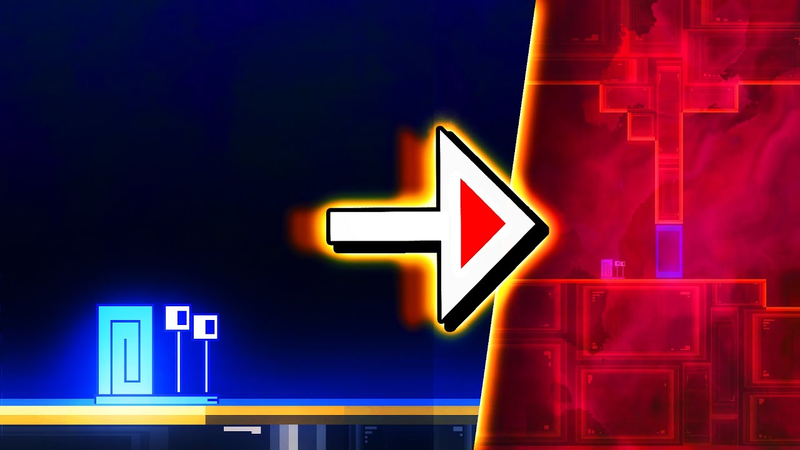
1 Week of Game Dev = ???
This analysis examines the practical output of a solo indie game developer over a single work week to address the common perception that progress in game development is often slow or invisible.
- Solo indie developers can achieve significant output in one week, including the implementation of 130 new voice lines and the design of three new tutorial levels.
- Operational efficiency is improved by building automated systems for repetitive tasks, such as the developer's new tool for streamlining future audio integration.
- Maintenance of existing titles is a recurring time investment, evidenced by the developer updating ISLANDERS to a new engine version and expanding its localization to 11 languages.
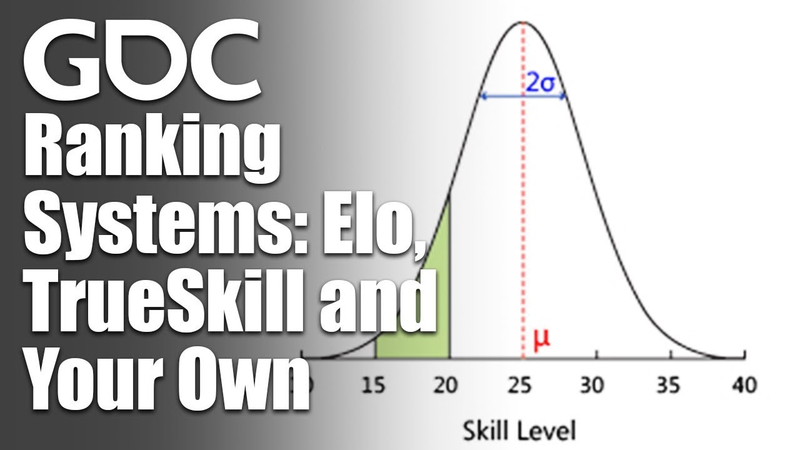
Ranking Systems: Elo, TrueSkill and Your Own
Competitive matchmaking relies on sophisticated mathematical models to ensure fair play, with Elo and TrueSkill serving as the primary industry frameworks.
- The Elo rating system, originally developed for chess, relies on a normal distribution to predict win probability based on the rating difference between two players, but it lacks mechanisms for time decay or handling multi-player matches.
- Microsoft's TrueSkill system improves upon Elo by using two variables: 'Mu' (the mean skill level) and 'Sigma' (the uncertainty of that skill), allowing for faster convergence and the ability to model draws and multiplayer game modes.
- TrueSkill uses a conservative rating calculation of 'Mu minus 3 times Sigma,' which provides a 98% confidence interval that a player's actual skill is higher than the displayed rank, helping to improve player perception by allowing ratings to trend upward.
GDC Plays Age of Wonders: Planetfall with Lennart Sas
Age of Wonders: Planetfall marks a pivotal evolution for Triumph Studios, representing the franchise’s transition from high fantasy to a science fiction setting and its inaugural release on consoles.
- Triumph Studios transitioned the Age of Wonders franchise from high fantasy to science fiction, marking the series' inaugural release on consoles after a four-year development cycle.
- The design team modernized the 4X genre by replacing standardized unit archetypes with faction-specific designs and prioritizing high turn density to increase combat lethality and pace.
- To ensure accessibility on consoles, the studio implemented radial menus and scalable UI elements, maintaining parity between manual tactical combat and automated AI-simulated battles.
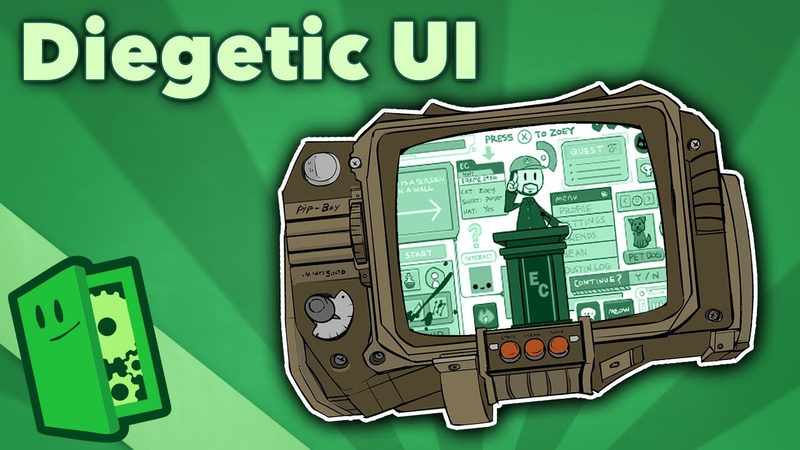
Diegetic UI - Realistic, or Distracting? - Extra Credits
The design of user interfaces (UI) and heads-up displays (HUD) in video games involves a constant tension between narrative immersion and functional clarity.
- Effective UI design must prioritize the principle of form following function, as overly complex diegetic systems can hinder gameplay and accessibility.
- The industry categorizes UI into four frameworks: diegetic (in-world), non-diegetic (screen-based), spatial (context-sensitive), and meta (visual effects).
- Diegetic UI, such as weapon-mounted ammo counters, exists within the game world for both the player and the character, whereas non-diegetic UI exists solely for the player.
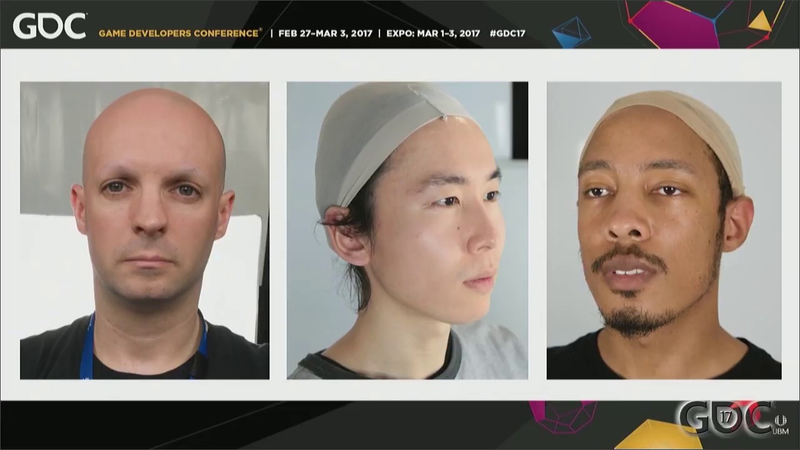
Achieving High-Quality, Low-Cost Skin: An Environment Approach
Square Enix has pioneered a transformative approach to character skin rendering by applying environment art principles to character design.
- Square Enix reduced character sculpting time by 40 percent by shifting from custom-sculpted 4K micro-detail maps to a tiling texture system.
- The new workflow utilizes generalized human pore patterns and tiling textures to maintain high-fidelity skin rendering while eliminating the need for unique, memory-intensive high-resolution assets.
- Artists use vertex painting to blend shared detail textures, allowing for granular control over skin elasticity and age without requiring changes to the underlying technical foundation.

THQ Nordic AB (publ) Acquires Gunfire Games: Investor Presentation
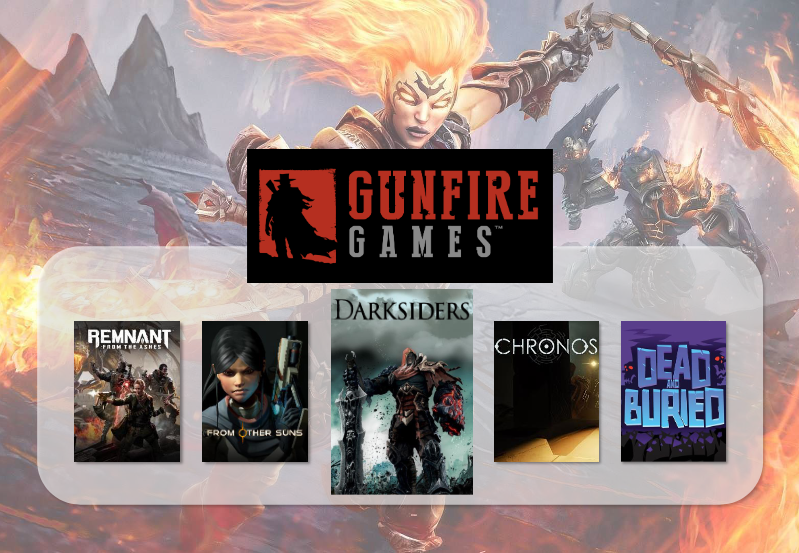
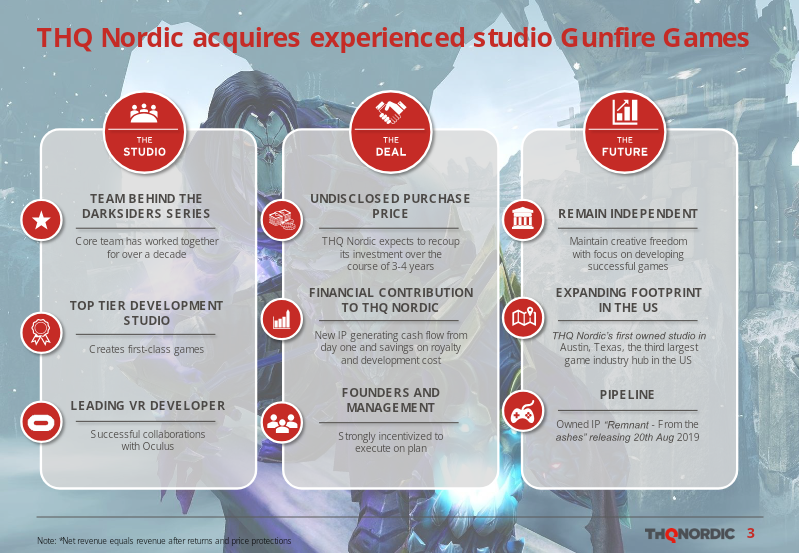
THQ Nordic AB (publ) announced its acquisition of Gunfire Games on August 14, 2019, presenting the deal as a strategic expansion into the US market and a move to secure top-tier development talent.
- THQ Nordic AB has acquired Austin-based Gunfire Games, marking the company’s first owned development footprint in the United States.
- The acquisition is projected to be recouped within three to four years through immediate cash flow from existing IP, including 'Remnant: From the Ashes', and reduced royalty and development costs.
- Gunfire Games will retain operational independence and creative freedom, allowing the studio to continue external collaborations while contributing to THQ Nordic’s internal development pipeline.
THQ Nordic AB Acquires Goodbye Kansas Game Invest: Investor Presentation
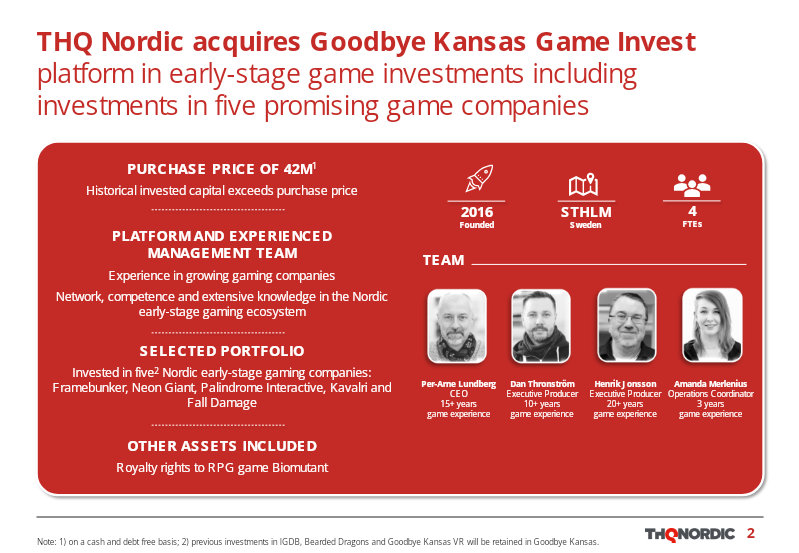
THQ Nordic AB acquired Goodbye Kansas Game Invest, an early-stage game investment platform, for SEK 42 million on August 14, 2019.
- THQ Nordic AB acquired Goodbye Kansas Game Invest for 42 million SEK to expand its Nordic development footprint and internal capabilities.
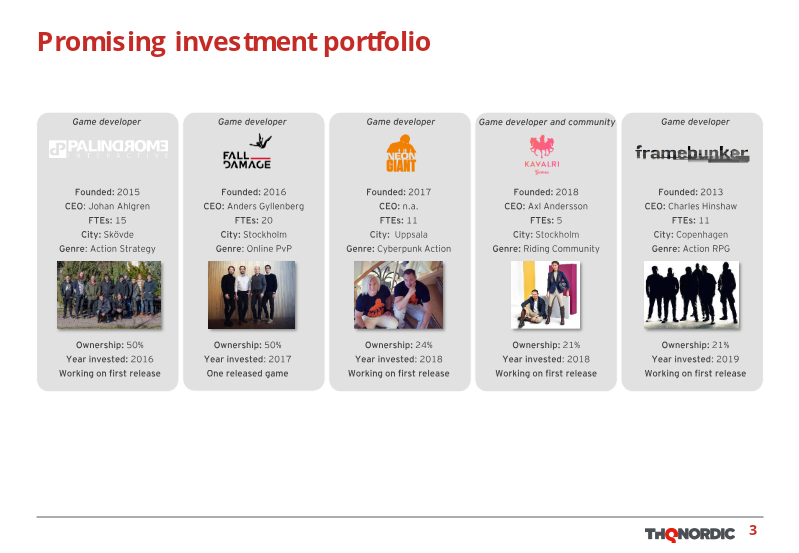
- The acquisition grants THQ Nordic equity stakes ranging from 21% to 50% in five game studios: Framebunker, Neon Giant, Palindrome Interactive, Kavalri, and Fall Damage.
- The deal includes the acquisition of royalty rights for the action RPG title Biomutant.

THQ Nordic AB Acquires Milestone s.r.l.: Investor Presentation
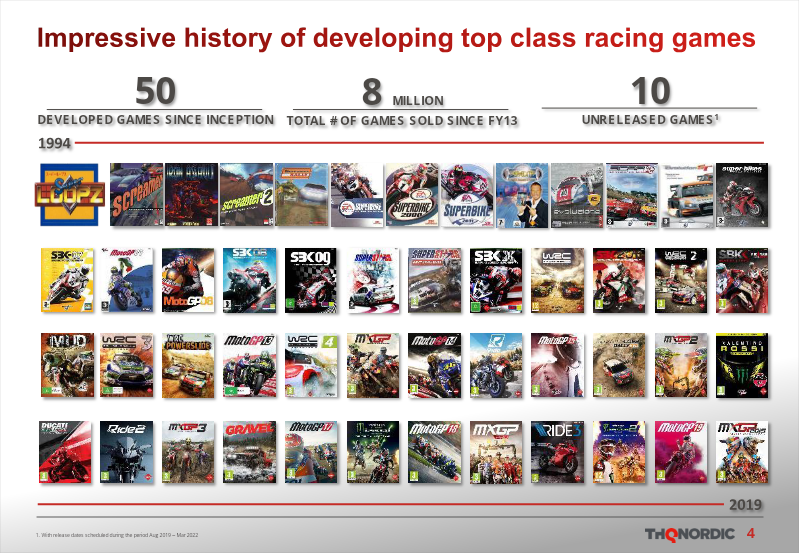
THQ Nordic AB's investor presentation outlines its acquisition of Milestone s.r.l., a globally leading racing games company specializing in two-wheel racing titles.
- THQ Nordic acquired Italian developer Milestone s.r.l. on August 14, 2019, for a total upfront consideration of EUR 55.8 million, comprised of EUR 44.3 million in cash and EUR 11.5 million in B-shares.
- The acquisition includes an earn-out provision tied to Milestone’s adjusted EBIT performance through the end of fiscal year 2022.
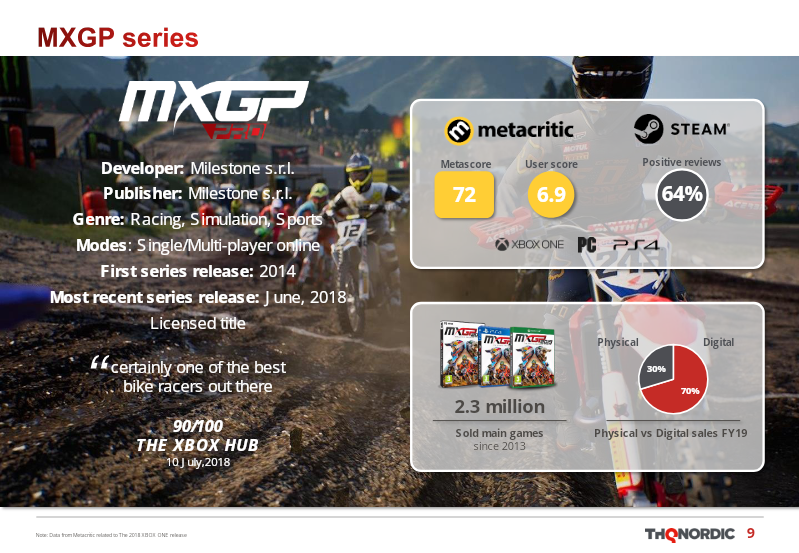
- Milestone brings a portfolio of established racing franchises including MotoGP, MXGP, Monster Energy Supercross, and RIDE, supported by a pipeline of ten titles scheduled for release between 2020 and 2022.
Writers
Games and companies
Games