Game Development reports and market data
Documents

Conquering the Creative Challenges in Marvel's Spider-Man
The development of Marvel’s Spider-Man centered on the ambition to craft a definitive superhero experience that balanced high-stakes action with the grounded, human struggles of Peter Parker.
- Marvel’s Spider-Man achieved record-breaking commercial success as the fastest-selling PlayStation title at launch, moving 3.3 million units within its first three days.
- The development team prioritized the core character tension between Peter Parker’s personal life and his superhero responsibilities to ensure emotional resonance and narrative depth.
- The studio moved away from traditional superhero tropes by reimagining the protagonist as a 23-year-old, focusing on situational humor and authentic character development rather than forced quips.
Designing Episode's Interactive Fiction in Three Phases
Successful interactive fiction on mobile platforms requires a synthesis of cinematic storytelling techniques and rigorous, data-driven design.
- Interactive fiction design must integrate player agency directly into the initial writing process, ensuring branching paths are fundamental to the narrative rather than aesthetic additions.
- Development success is measured through a continuous feedback loop tracking story starts, retention rates, and the depth of choice engagement.
- Mobile-first design requires prioritizing portrait-mode visuals and bite-sized narrative segments to align with the specific constraints of mobile consumption.
The Freelancing Life with Ewan Croft | Game Dev Unchained Episode 202
Transitioning from a decade-long tenure at a major studio to a freelance career requires a strategic blend of professional reputation, financial discipline, and personal boundary setting.
- Successful freelancing requires a strategic transition from studio work by leveraging established professional networks and maintaining high-quality output.
- Financial sustainability for independent contractors depends on disciplined business management, specifically setting aside significant portions of income for taxes and maintaining transparent billing communication.
- Freelancers must proactively combat professional stagnation and social isolation, as the solo mercenary model lacks the inherent collaborative environment of traditional studios.
A Survival Guide for Game Developers
Long-term success in the game development industry depends less on raw technical proficiency and more on the cultivation of emotional intelligence, adaptability, and self-awareness.
- Career longevity in the game industry is driven more by emotional intelligence, adaptability, and self-awareness than by raw technical proficiency.
- Developers should prioritize interpersonal skills and ego management to navigate the industry's inherent volatility and frequent layoffs.
- Systemic crunch and rigid hierarchies are indicators that a developer should seek new employment rather than accepting poor work-life balance as a standard.
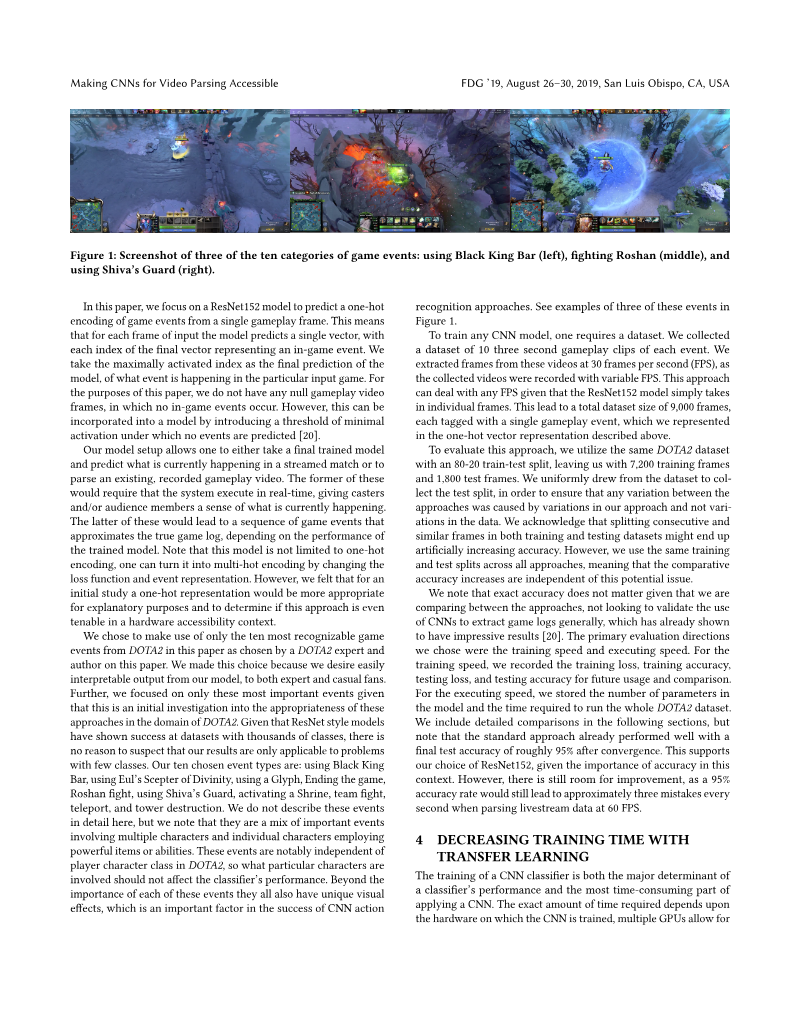
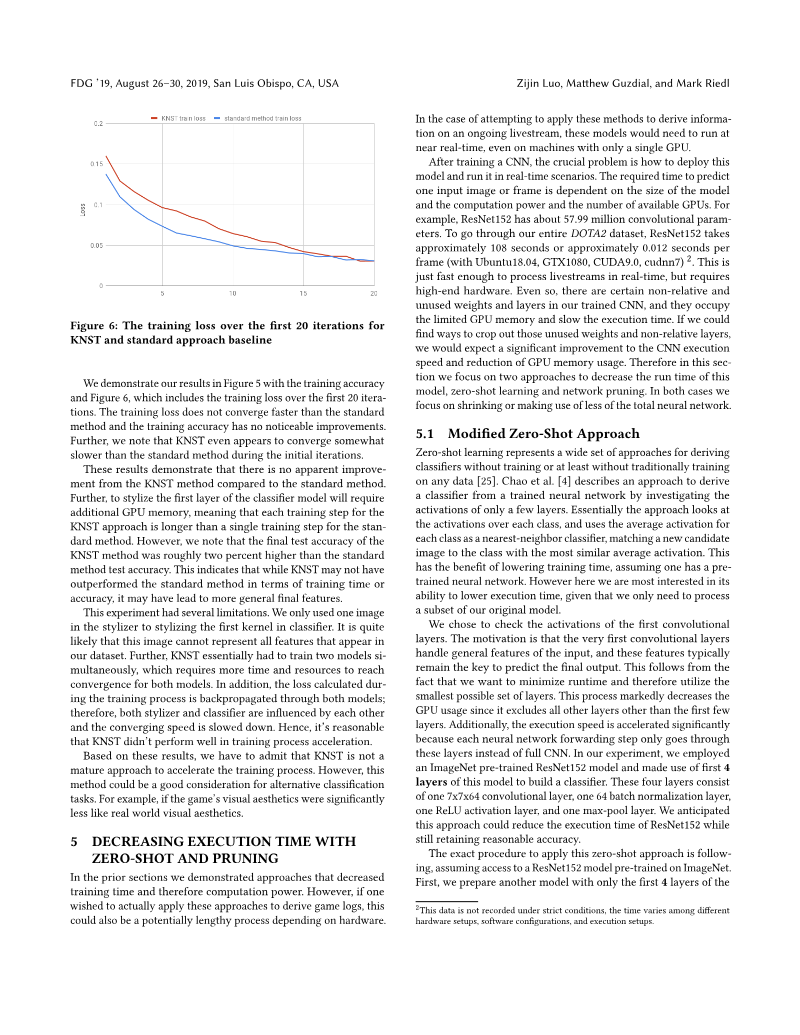
Making CNNs for Video Parsing Accessible: Event Extraction from DOTA2 Gameplay Video
The paper, by Zijin Luo, Matthew Guzdial and Mark Riedl of Georgia Institute of Technology, presents an approach to extract game-event sequences from DOTA2 gameplay video using convolutional neural networks, aiming to reduce the hardware and time needed to train and run such models.
- Teacher-student transfer learning reached 99.8% final test accuracy, compared with 94.6% for the standard backpropagation-from-scratch method.
- The authors state that the teacher-student approach needed only about 10% of the training epochs the standard method required to converge.
- ThiNet pruning models retained high test accuracy while having far fewer parameters than the full ResNet152 model's 57,992,384.
Two-Step Constructive Approaches for Dungeon Generation
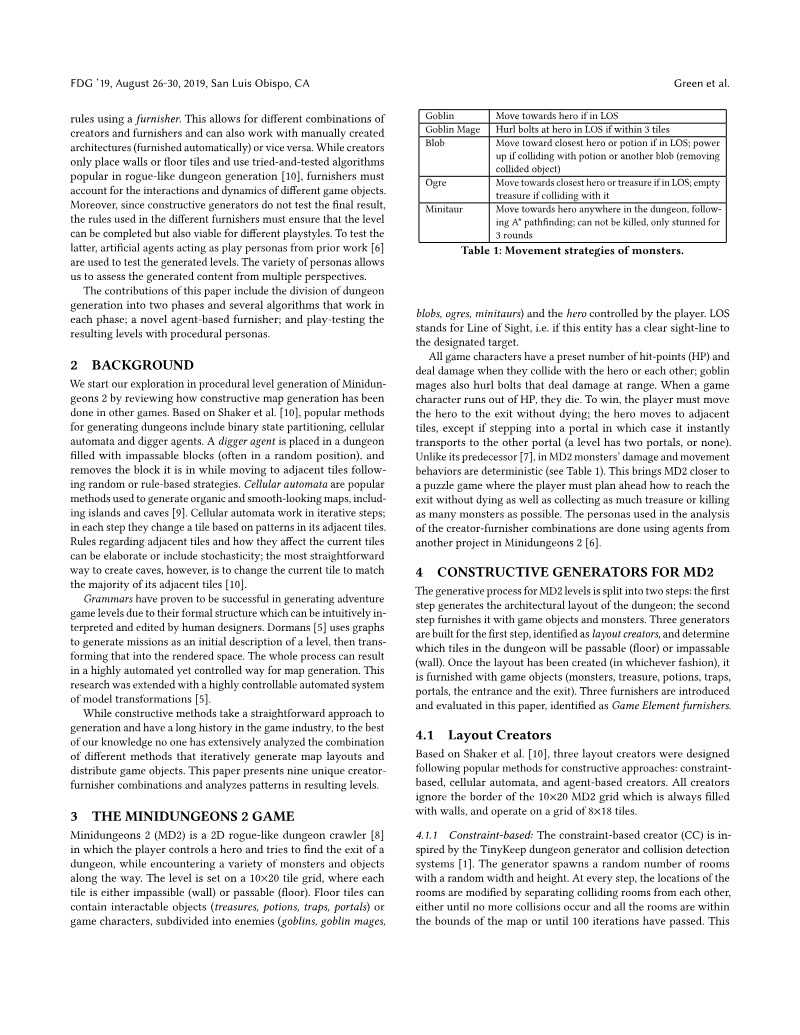
This research explores a two-step constructive approach to procedural level generation for the rogue-like puzzle game MiniDungeons 2.
- A two-step procedural generation framework—decoupling architectural layout from object placement—enables efficient, controllable level design for mobile environments.
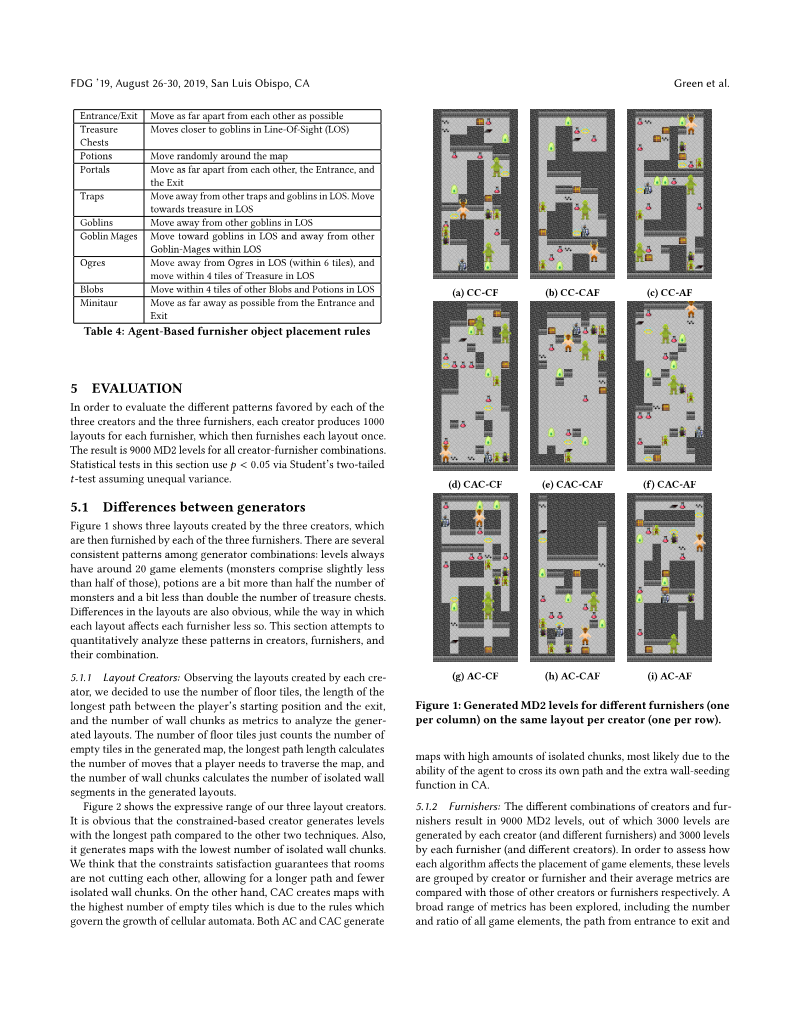
- Testing nine combinations of three layout creators (constraint-based, cellular automata, agent-based) and three furnishers across 9,000 generated levels confirms that layout creators dictate architecture while furnishers control object density.
- Constraint-based layout creators consistently produce superior architectural quality, characterized by longer paths and fewer isolated wall segments compared to other methods.
Organic Building Generation in Minecraft
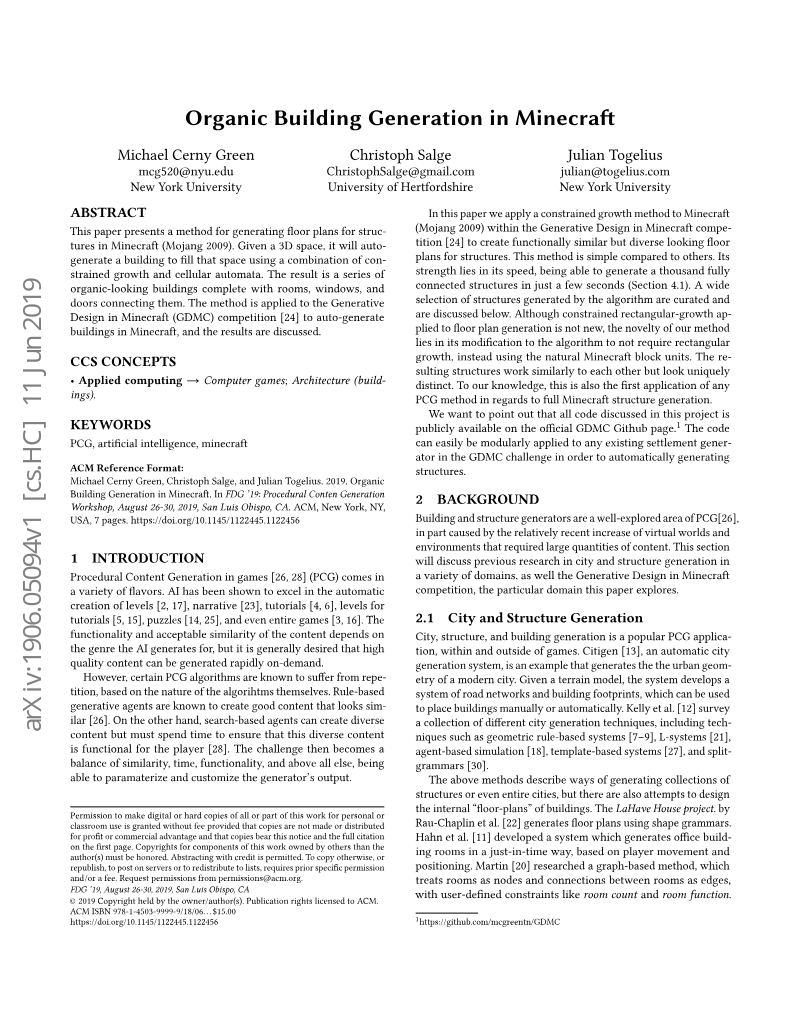
This research presents a novel procedural content generation (PCG) method for creating organic, non-rectangular building floor plans and exterior walls within the Minecraft environment.
- A new procedural content generation method moves beyond rigid, template-based building designs in Minecraft by using a constrained growth algorithm combined with cellular automata.
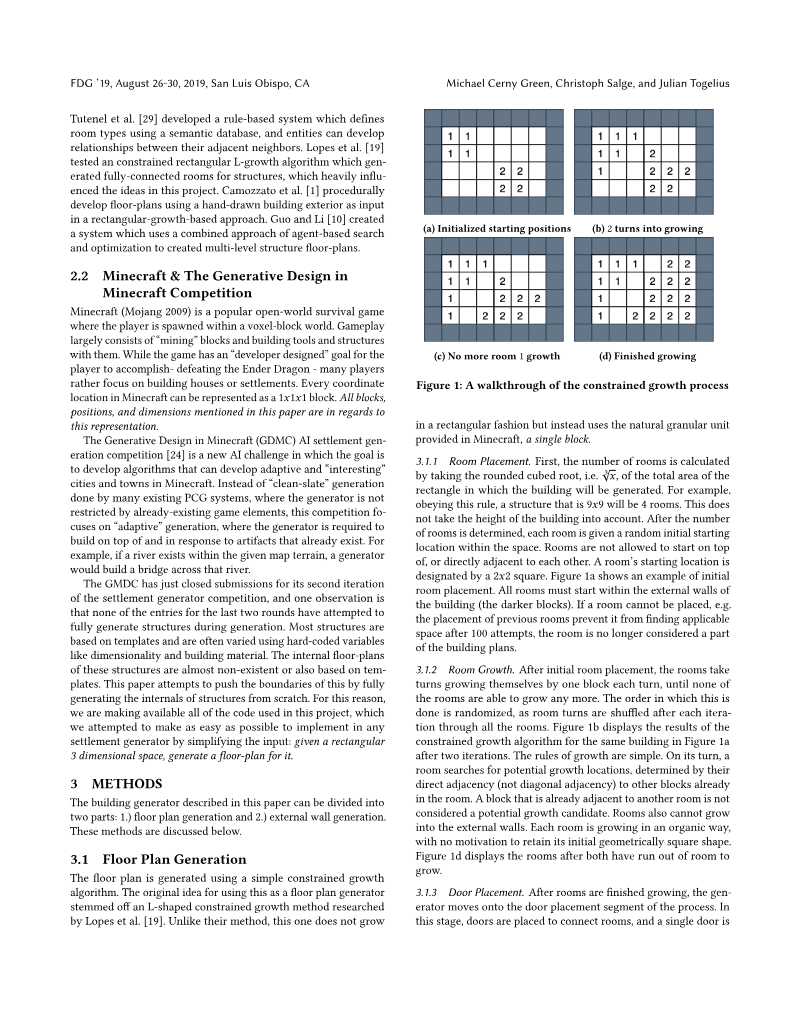
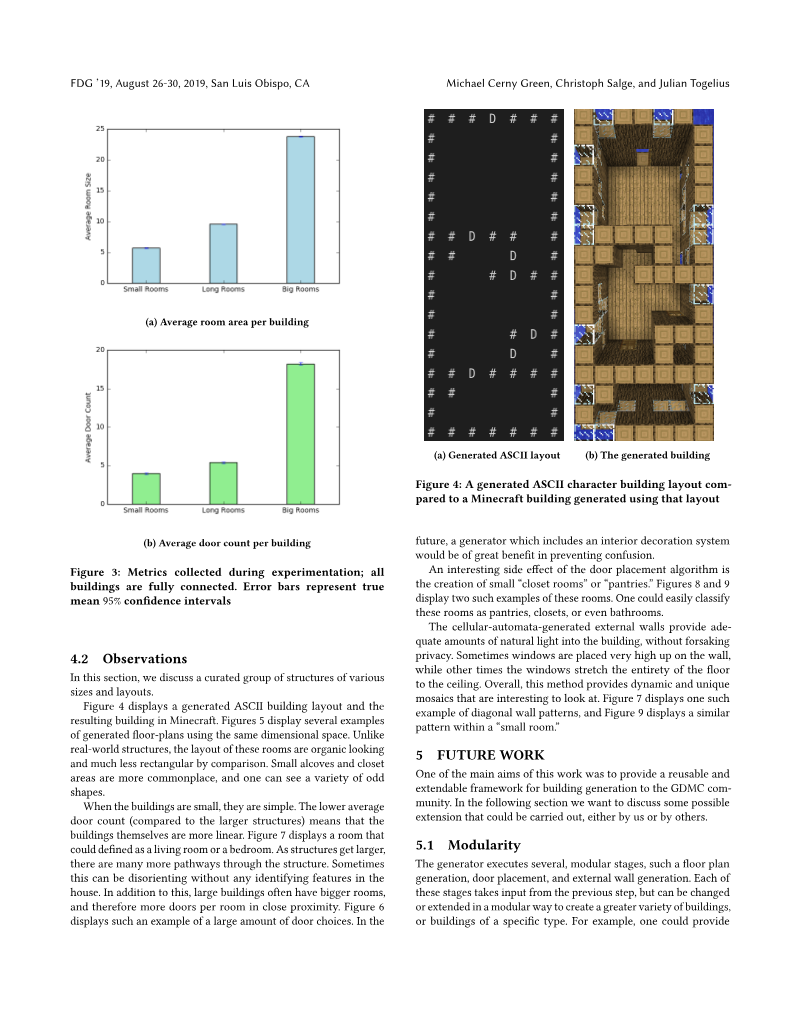
- The methodology generates non-rectangular floor plans through iterative room growth and ensures functional connectivity via a granular door-placement process.
- Cellular automata are utilized to organize solid blocks and glass windows, resulting in aesthetically varied, organic exterior facades.
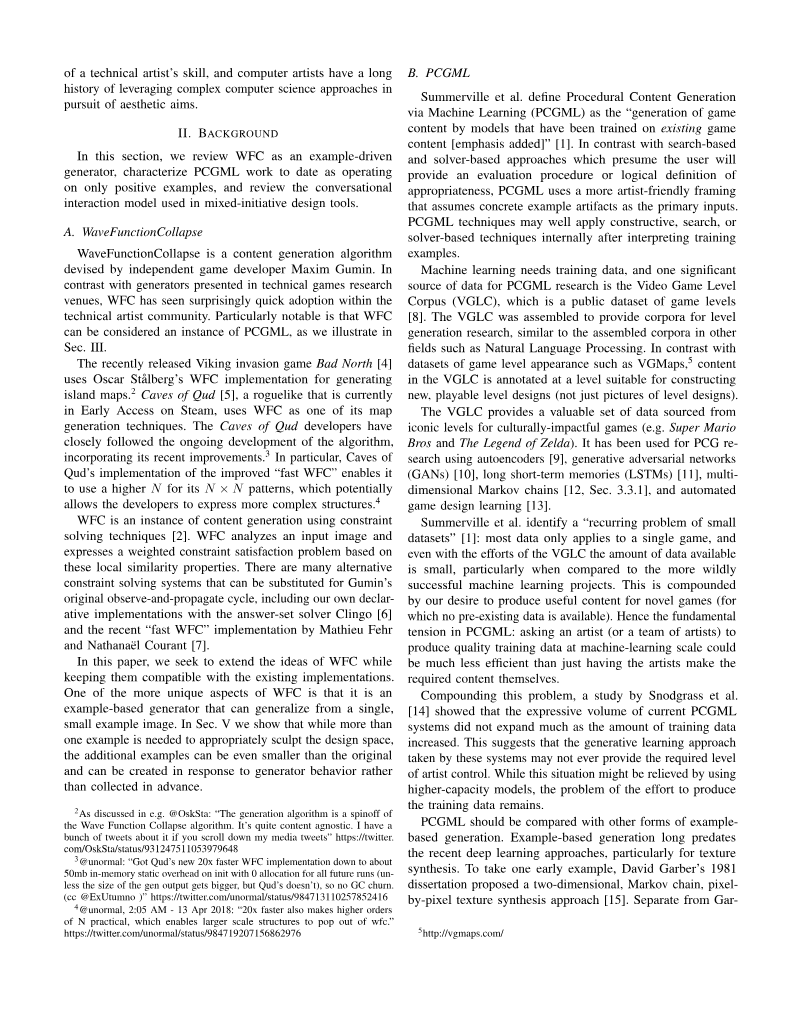
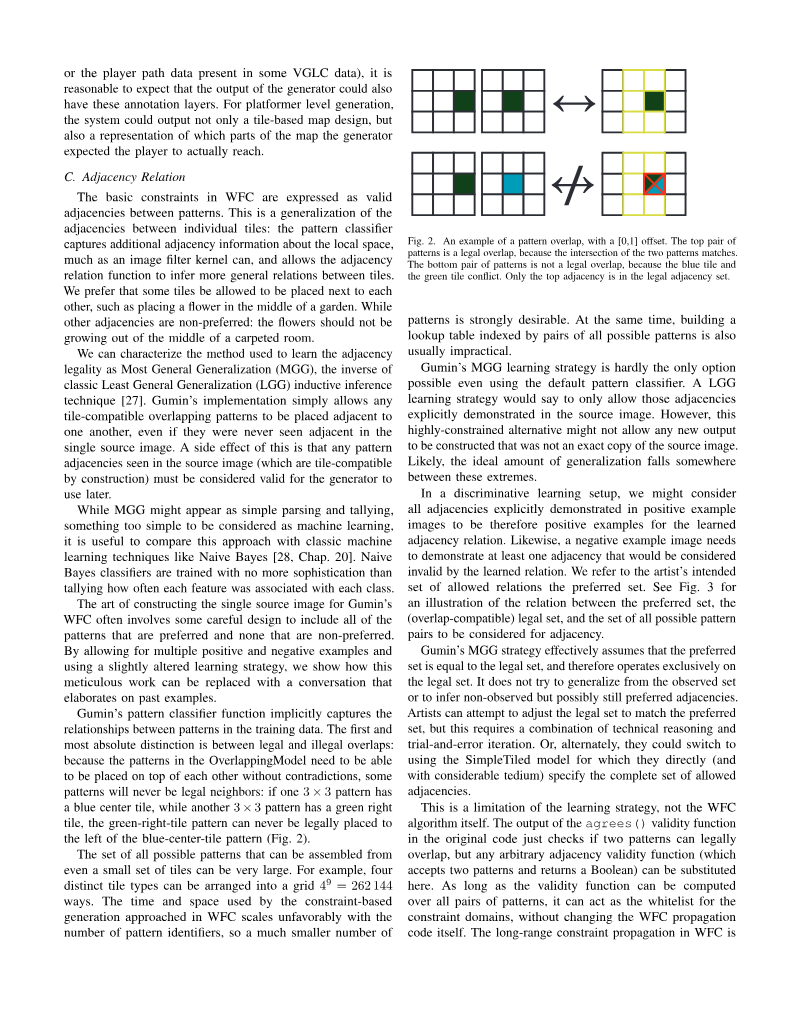
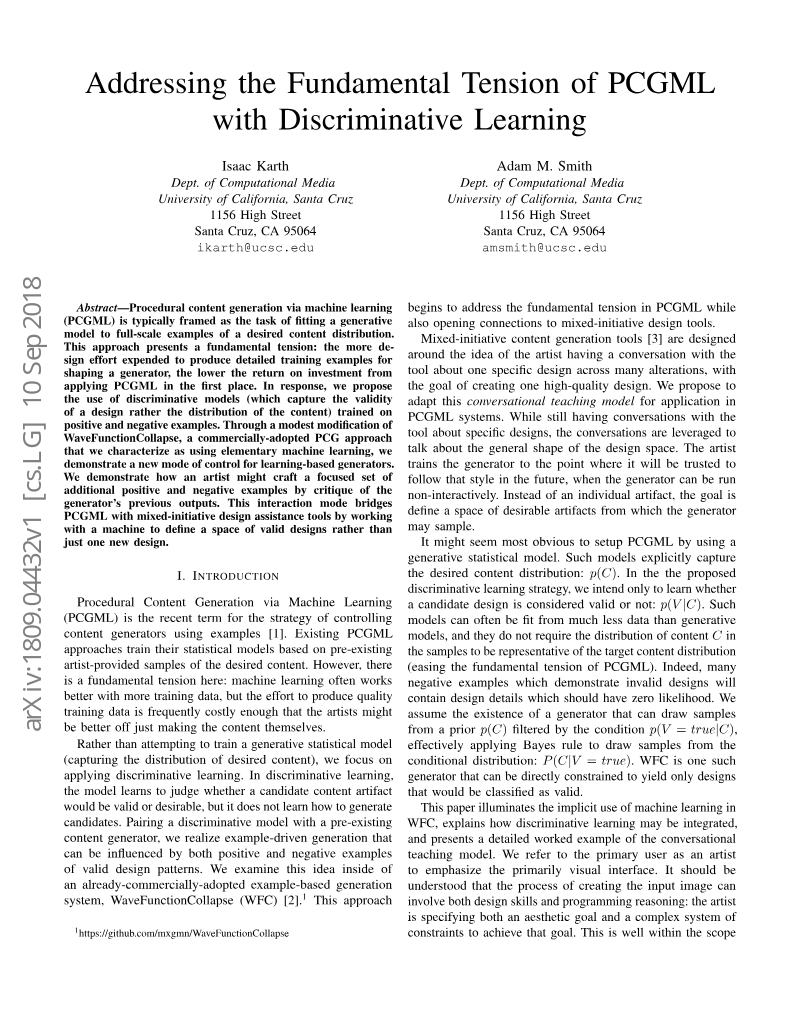
Addressing the Fundamental Tension of PCGML with Discriminative Learning
Isaac Karth and Adam M. Smith, both of the Department of Computational Media at the University of California, Santa Cruz, present a paper on procedural content generation via machine learning (PCGML).
- The authors contrast a discriminative model that learns validity, p(V|C), with a generative model of content distribution, p(C), arguing the former can often be fit from much less data.
- The authors state that WFC's original implementation accepts only one input image, and that a minimally modified clone was used to allow multiple positive and negative examples.
- The paper reports that a study by Snodgrass et al. found the expressive volume of current PCGML systems did not expand much as training data increased.

Guiding with a Soft Touch: Directing Players in Nonlinear Levels Without UI
Mark Tempini, a game and level designer, reports a study of whether a large nonlinear 3D level can be navigated without navigational UI.
- After design changes, the final playtest reached a 90% completion rate, a significant difference from the previous playtest, which had a 0% completion rate.
- In the expert review, no participant found the end house, and the town area, especially the end house, needed radical changes.
- The author concluded that no single navigational technique was enough, because different players responded to different aspects such as lighting, geometry and textures.

How To YouTube | FOR GAME DEVELOPERS
Establishing a YouTube presence serves as a powerful, cost-effective marketing tool for independent game developers, offering a direct pipeline for community feedback and professional growth.
- YouTube marketing requires a significant time investment, often consuming up to 50% of a developer's total working hours.
- Audience growth on YouTube typically follows an exponential rather than linear trajectory, necessitating a long-term commitment to the platform.
- To maximize retention, developers must eliminate generic intros and immediately state the video's core value proposition within the first few seconds.

5 secrets to a VIRAL indie game trailer (my experience!)
Creating a viral indie game trailer requires a strategic approach to audience engagement, prioritizing consumer interest over developer sentiment.
- Capture viewer attention within the first ten seconds by leading immediately with the most compelling gameplay or atmospheric visuals.
- Structure the trailer around a central mystery or 'seed' of curiosity that motivates the viewer to purchase the game to find the answer.
- Synchronize all cuts and transitions to the rhythm of the music to build emotional intensity and reach a satisfying climax.

Bringing Fantasy to Life in Final Fantasy XV
The development of Final Fantasy XV centered on the ambitious premise of creating a "fantasy based on reality."
- To maintain narrative cohesion across multi-media projects, the development team established strict character-specific rules, such as speech ticks and nickname conventions, to ensure consistency among multiple writers.
- The team utilized a 'fantasy based on reality' design philosophy by incorporating real-world linguistic influences, such as Italian for the Venice-inspired city of Altissia, to create a 'familiarly foreign' aesthetic.
- To make complex lore accessible, the team replaced esoteric terminology with common, layman-friendly concepts, such as referring to summoned characters as 'Astrals' and using familiar archetypes like gods and oracles.
Writers
Games and companies
Games