Game Development reports and market data
Documents

Animation Isn't the Answer
The modern landscape of game development demands a fundamental shift in how animators and engineers interact, moving away from rigid departmental silos toward a model of deep, iterative collaboration.
- Game development success requires moving away from rigid departmental silos toward a model of deep, iterative collaboration between animators and engineers.
- Studios should prioritize the development of hybrid professionals who possess the skills to bridge the gap between creative nuance and functional engineering.
- Technical systems must be designed to serve creative intent, ensuring that high-fidelity artistic vision is not compromised by underlying software architecture.

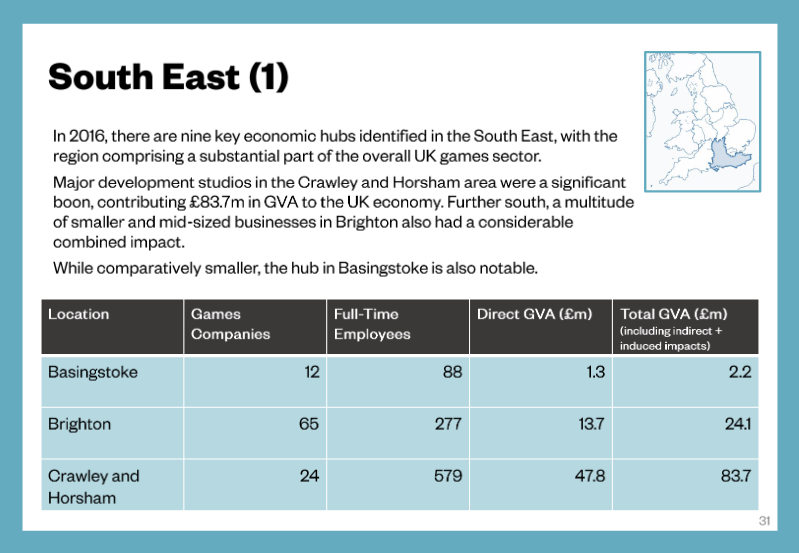

Think Global, Create Local: The Regional Economic Impact of the UK Games Industry
Ukie, the UK trade body for the games and interactive entertainment industry, presents a regional analysis of the UK games industry's economic impact in 2016.
- UK games companies directly employed 16,140 FTE roles and contributed £1.35bn in GVA in 2016, rising to a total impact of £2.87bn in GVA once indirect and induced effects are included.
- London's games sector generated £1.4bn in GVA and directly employed over 5,107 FTE roles in 2016.
- Outside London, the North East's games industry had the biggest impact on its local economy, at £1.90 of every £1,000 of regional GVA.

Should You Play the Classics? - Why Game History Matters - Extra Credits
The primary thesis of this analysis is that studying classic video games is an essential practice for anyone working in the game industry, particularly for designers.
- Studying foundational classic games is essential for designers to understand the core psychological and emotional drivers of player engagement rather than merely replicating surface-level features of modern hits.
- Modern game design often suffers from excessive complexity and bloated mechanics, whereas classic titles provide a streamlined look at the fundamental gameplay loops that define successful experiences.
- Tracing the lineage of game design to its primordial roots allows developers to identify untapped mechanical potential and move beyond the industry's cycle of derivative, iterative refinement.
A Practical Approach to Developing Forward-Facing Rigs, Tools and Pipelines
Monolithic tool development frequently leads to bloated, unmaintainable codebases that hinder long-term project scalability.
- Transitioning from monolithic tool development to a factory-based plugin architecture prevents bloated, unmaintainable codebases and enhances long-term project scalability.
- Using abstract base classes to define requirements and a factory to manage modular components isolates features, preventing updates from causing unintended side effects across the pipeline.
- A directory-based structure combined with Python’s keyword arguments allows for the seamless integration of 'bolt-on' functionality, such as specialized export logic or animation tools.
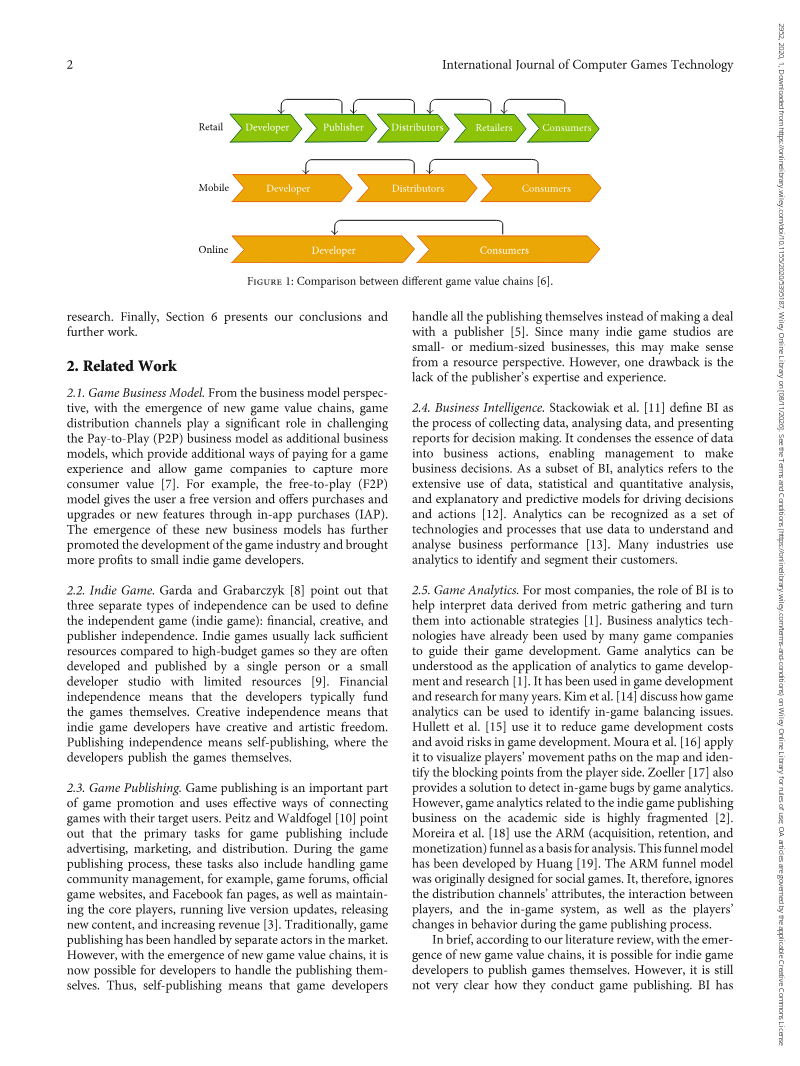


Business Intelligence Challenges for Independent Game Publishing
The article by Yanhui Su, Per Backlund, and Henrik Engström of Skövde University, Sweden, published in the International Journal of Computer Games Technology in 2020, examines business intelligence challenges faced by independent game developers when self-publishing.
- Interviewed indie studios identify marketing as a main challenge, with the CEO of one studio noting that the biggest challenge is breaking through and getting the game seen.
- Studios reported that few games receive platform features, forcing them to rely on other marketing means when they are not featured.
- Studios rely mainly on basic metrics such as retention, revenue, and daily users, collected largely through third-party tools.
More Feelings, Fewer Features: Showcasing Your Indie Game Through Messaging and Video
Effective indie game promotion requires a cohesive strategy that integrates clear messaging with compelling visual storytelling.
- Define a clear 'hook' that focuses on the specific emotional resonance and unique player experience rather than listing generic game features or genre-based comparisons.
- Develop messaging early in the production cycle to serve as a foundational filter for both marketing efforts and core design decisions.
- Avoid industry jargon and clichés in promotional copy, using descriptive language that clearly explains the 'what' and 'why' of the gameplay to make the title easier for players to share.
Performance and Memory Postmortem for Middle-earth: Shadow of War
Middle-earth: Shadow of War required extensive technical optimization to support a complex open-world environment featuring up to 200 unique AI actors.
- To manage 200 unique AI entities in Middle-earth: Shadow of War, the team moved away from individual system threading in favor of a 'monolithic' approach, where entire systems like effects were scheduled to run on a single core to minimize context switching and cache misses.
- The engine team replaced expensive kernel semaphores with lightweight multiple-reader/single-writer primitives, such as Microsoft’s Slim Reader/Writer (SRW) lock, to reduce CPU overhead during high-contention scenarios.
- To optimize GPU constant buffer uploads, the team implemented named constant buffers and heuristic-based data packing, which prioritized frequently used constants and zero-valued data to minimize memory footprint and avoid cache line flushing issues.
Forging Audio Workflow Changes on Destiny: Rise of Iron
The development of audio for Destiny: Rise of Iron necessitated a fundamental shift in production methodology to overcome inefficiencies inherent in traditional, isolated testing environments.
- The development team reduced individual audio mix-testing cycles from fifteen minutes to mere seconds by shifting from manual testing to an automated, intuitive workflow.
- Transitioning from siloed, solo testing to a collaborative framework where audio leads participated in design and balance sessions ensured mixes were informed by complex, real-world multiplayer gameplay.
- The implementation of 'Guardian,' a centralized PC-based development tool, replaced cumbersome platform-specific debug menus with a streamlined command assistant interface.

Automated Testing and Profiling for Call of Duty
The development of the Call of Duty franchise relies on a sophisticated, custom-built continuous integration system known as Compass to manage the immense technical complexity of multi-studio, multi-platform production.
- The Call of Duty franchise utilizes a custom Python-based CI system called Compass to manage a massive infrastructure comprising 700 worker PCs, 300 development kits, and 50,000 daily tasks.
- By shifting from GUI-based build servers to a code-centric architecture, developers can define performance metrics and memory statistics directly within source control, enabling version history and debugging for testing workflows.
- The system employs advanced error-bucketing to categorize failures by log-based keys, allowing teams to address recurring trends rather than isolated incidents.

Build Your Brand as a Digital Artist with Ryan Kingslien | Episode 212
The digital art industry is undergoing a fundamental shift that necessitates a transition from traditional technical specialization to a more entrepreneurial, brand-focused career model.
- Digital artists must transition from technical specialists to entrepreneurial brand-builders, as software-specific skills have a short half-life due to rapid advancements in AI and machine learning.
- Long-term career stability requires viewing professional output as a business entity, prioritizing the mastery of cash flow, market competition, and strategic personal branding.
- Artists should adopt a reverse-engineered approach to professional development by aligning their training directly with the specific, practical requirements of target employers rather than relying on traditional academic frameworks.
How to Talk About Games, Today
Public and political scrutiny of video games frequently mirrors historical moral panics directed at previous forms of entertainment, such as comic books and tabletop role-playing games.
- Public and political scrutiny of video games is a recurring cycle of moral panic that mirrors historical anxieties directed at comic books and tabletop role-playing games.
- Scientific research has failed to establish a causal link between gaming and real-world violence, as studies often rely on flawed laboratory proxies for aggression and struggle to isolate media consumption from socioeconomic variables.
- The industry must shift from a defensive posture to proactive advocacy, ensuring that legislative policy and public discourse are based on empirical reality rather than sensationalized misinformation.

The 2019 Experimental Gameplay Workshop
The 2019 Experimental Gameplay Workshop serves as a vital platform for exploring the boundaries of interactive design, advocating for a shift away from traditional genre conventions toward systems-driven, unconventional experiences.
- The 2019 Experimental Gameplay Workshop advocates for a shift from traditional genre-based progression loops toward systems-driven, unconventional design experiences.
- Innovation is driven by opportunistic learning, where designers transform daily observations, technical constraints, or unique physical properties into core gameplay mechanics.
- Successful experimental titles like 'Carto' and 'What the Golf?' demonstrate the value of deconstructing established mechanics, such as tile-based map manipulation and sports physics, through constant iteration.
Writers
Games and companies
Games