Game Development reports and market data
Documents
Cursed Problems in Game Design
Cursed problems represent fundamental, unsolvable contradictions in game design where two or more core player promises are inherently incompatible.
- Cursed problems are fundamental, unsolvable contradictions in game design where core player promises are inherently incompatible and cannot be resolved through standard balancing.
- Designers must shift from seeking perfect solutions to managing trade-offs through strategic sacrifice, intentionally weakening one design goal to preserve the integrity of another.
- Attempting to force opposing goals to coexist often undermines the player experience, leading to negative outcomes such as toxic social dynamics or the erosion of long-term progression.
Art Direction: Escaping Your Comfort Zone
In this 2018 GDC presentation, Ubisoft art director Liam Wong explores the professional and personal growth achieved by stepping outside one’s comfort zone.
- Creative stagnation is best overcome by actively seeking out unfamiliar territory where you feel out of your depth, as this is where the most significant artistic breakthroughs occur.
- Artists should prioritize sharing their work publicly rather than waiting for perfection, as consistent curation and exposure are essential for building professional confidence.
- Proactive networking, including reaching out to industry icons and collaborators, is a critical component of career advancement that requires overcoming the fear of rejection.
Random Tidbits: Use Chance to Enhance Fun!
This presentation explores the strategic application of randomness in game design, emphasizing that random number generation (RNG) should be treated as a deliberate design tool rather than a mere technical necessity.
- Treat random number generation as a deliberate design tool rather than a technical necessity to align outcomes with specific player experiences.
- Implement custom RNG systems using high-quality, efficient algorithms like Xorshift128+ instead of relying on basic platform-provided functions.
- Avoid common technical pitfalls such as re-seeding before every request and bias in modular arithmetic when calculating dice rolls.
Destiny 2: Linear Music in an Open World
The audio team at Bungie developed a modular, systemic approach to music implementation for Destiny 2 to address the challenges of scaling linear, high-production-value scores across a vast, open-world environment.
- Bungie transitioned from Destiny's original system of custom-scripted, one-off music for missions to a modular 'music system' that uses expanded, multi-intensity audio pieces to create a linear-feeling score in an open-world environment.
- The new system allows designers to script activity scores directly during development, enabling them to audition music immediately and reducing the need for audio team intervention in the early scripting process.
- Music is organized into 'music sets' assigned to specific destinations, which randomly cycle through various intensity levels and transitions to maintain a consistent, high-quality score without requiring unique, hard-coded implementation for every encounter.
The German Games Industry 2019
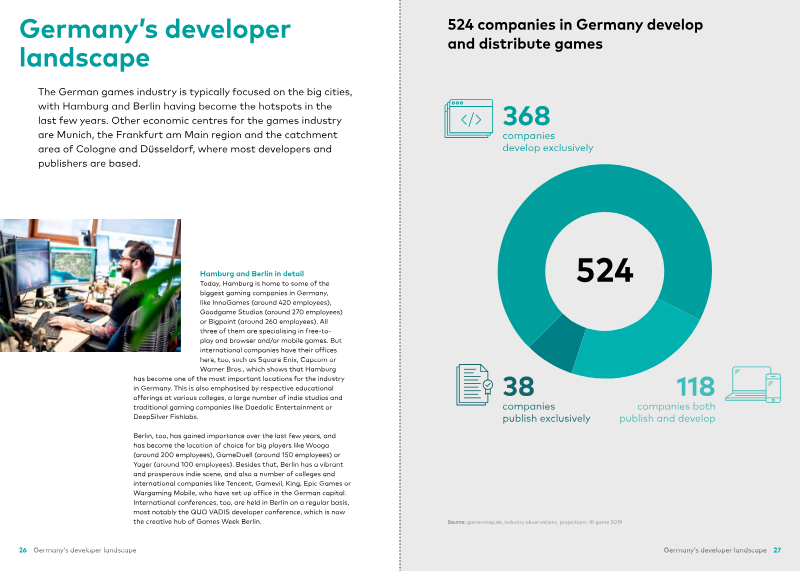
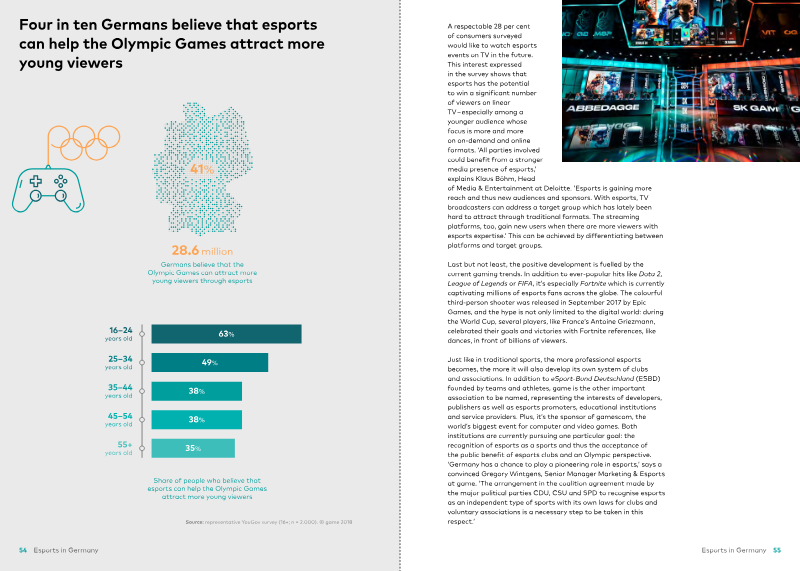
The German Games Industry 2019 is a brochure published by game, the German Games Industry Association, covering Germany's games market, funding, associations, developer landscape, job market, esports and gamescom.
- Germany's games market generated around 4.4 billion euros in 2018, a 9 per cent increase on the previous year.
- In-game and in-app purchases grew by 28 per cent to 1.9 billion euros in 2018 and are described as the strongest growth drivers.
- The smartphone, with 18.2 million players, became the most popular gaming platform in Germany, ahead of the PC with 17.3 million.
The 2019 Tech Toolbox
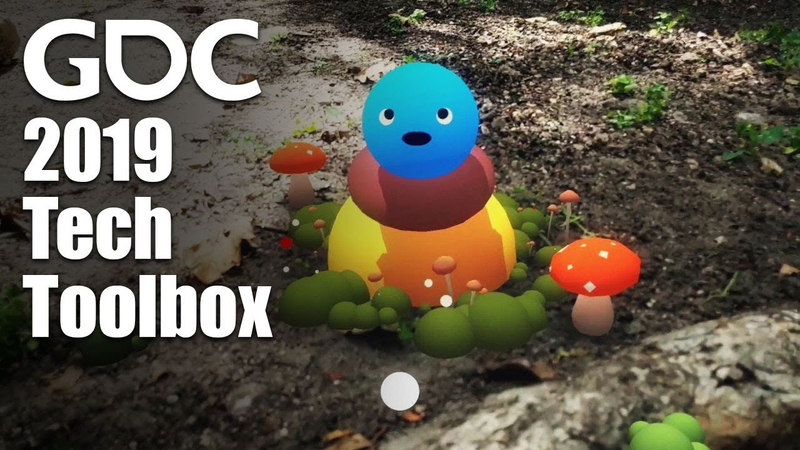
Modern game development increasingly relies on the creative repurposing of enterprise technology and the implementation of specialized, tactile tooling to foster iterative design.
- Modern game development is shifting toward decoupling complex narrative logic from core code by integrating enterprise tools like Google’s Dialogflow and node-based frameworks such as Yarn Spinner.
- Developers are bypassing traditional, time-consuming compilation cycles by adopting hardware-integrated interfaces, such as MIDI controllers, to manipulate game variables and physics in real-time.
- Procedural techniques, specifically the use of Perlin noise for organic animation and parameterized storylets for narrative generation, are being used to reduce reliance on manual keyframing and labor-intensive asset creation.
Indie Dev with Family | Game Dev Unchained Episode 213
Independent game development requires a strategic synthesis of professional management frameworks and personal flexibility, particularly when operating within a family-based studio structure.
- Independent studios can achieve sustainability by balancing creative projects with part-time consulting work for major industry players like Blizzard and Riot, which provides the financial stability to avoid premature commercialization.
- Transitioning from rigid, top-down AAA hierarchies to a bottom-up design philosophy fosters a more resilient production cycle and encourages creative flexibility within small teams.
- Organizational psychology tools, such as the DISC personality assessment, should be used to tailor management styles and mitigate interpersonal friction during the forming, storming, and norming phases of development.
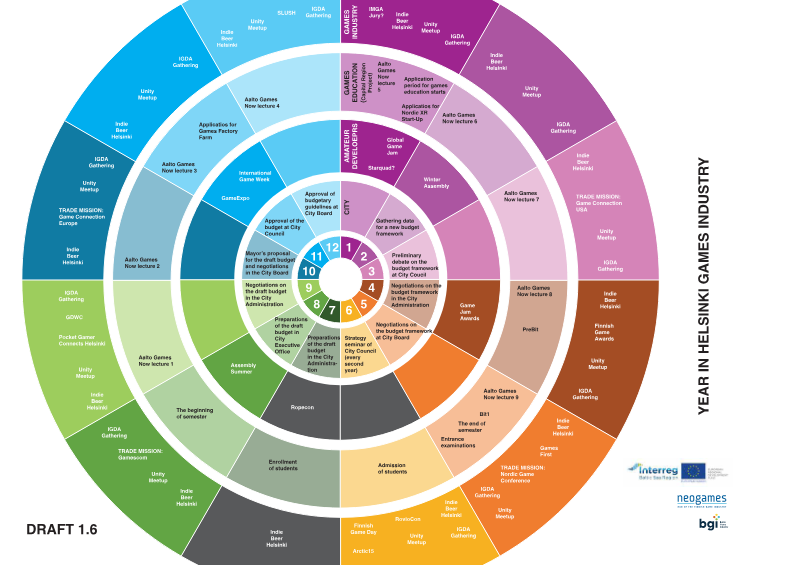
Finland Games Industry: 2018 Year in Review
The "Finland Games Industry: 2018 Year in Review" document provides a high-level overview of key events and activities within the Helsinki games industry throughout 2018.
- The Helsinki games industry in 2018 operated through a highly integrated ecosystem connecting municipal governance, academic institutions, and professional organizations.
- Municipal support was a primary driver of stability, with the Helsinki City Council and City Board aligning budgetary cycles and long-term planning with industry needs.
- Aalto University and specialized Unity-focused programs served as the primary talent pipeline, with the industry's professional rhythm dictated by the academic calendar.
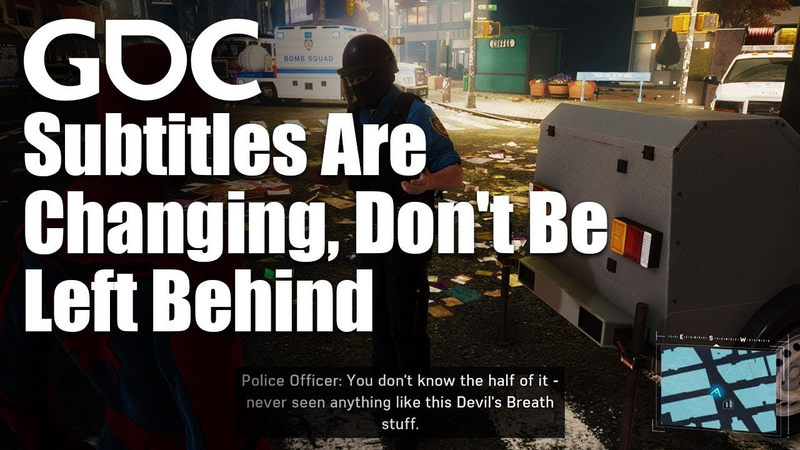
Subtitles Are Changing, Don't Be Left Behind
Subtitles are a critical accessibility feature in modern gaming, serving a diverse user base that extends far beyond the deaf and hard-of-hearing community.
- Over 60% of players utilize subtitles, as evidenced by usage metrics from Assassin’s Creed Origins, indicating that demand extends well beyond the deaf and hard-of-hearing community.
- Effective readability requires a minimum font size of 46 pixels at 1080p, with text limited to two or three lines per screen and a maximum of 38 characters per line.
- Developers must prioritize high contrast by using drop shadows, outlines, or adjustable background boxes to ensure text remains legible against varying game environments.
I attempt to design a game as good or better than Adventure Communist. PART 1
Success in the modern game industry requires a shift away from the pursuit of corporate wealth toward a deeply personal and authentic motivation.
- Reverse-engineering successful titles like Adventure Communist is a critical strategy for minimizing financial waste during the iterative discovery phase of game development.
- Developers should prioritize the identification of core engagement loops over abstract financial targets to ensure commercial viability within the free-to-play market.
- Professional longevity and high-level performance in the game industry are best sustained by a sincere, internal purpose rather than external financial incentives, which are often limited by lack of equity or profit-sharing.

Why I planned on quitting game dev for good
The primary purpose of this discussion is to address the common phenomenon of burnout among independent game developers and to provide a framework for overcoming the desire to quit the industry.
- Burnout and the desire to quit are often temporary phases of stagnation rather than definitive indicators that a developer should abandon their career.
- Professional disillusionment is primarily driven by creative boredom from repetitive artistic styles, financial instability caused by reinvesting revenue into subsistence-level cycles, and the psychological burden of repetitive tasks like bug fixing.
- Developers can reignite passion by taking intentional breaks from game development to pursue unrelated creative fields, such as filmmaking, to gain necessary perspective.
The Gamer's Brain, Part 3: The UX of Engagement and Immersion (or Retention)
Engageability serves as the foundational pillar for long-term player retention, requiring a multifaceted approach that integrates cognitive science with game design.
- Retention and engagement are driven by motivation, which relies on managing goals, fostering a sense of competence, and maintaining positive moment-to-moment emotions through game feel.
- Rewards should be designed as starting points for new goals rather than end points; they must be meaningful and provide feedback on competence to avoid decreasing intrinsic motivation.
- Effective onboarding is critical for long-term retention, as poor tutorials are frequently identified as the most impactful factors for player churn.
Writers
Games and companies
Games