Game Development reports and market data
Documents

Data Science at Games Studios | Andre Cohen Head of Data Science at Tilting Point
Data science functions as a critical third pillar of revenue in modern game studios, operating alongside in-app purchases and ad monetization to drive profitability.
- Data science functions as a critical third pillar of revenue alongside in-app purchases and ad monetization, focusing on optimizing user acquisition bidding and return on ad spend.
- Successful data science teams prioritize robust data engineering, quality management, and pipeline maintenance over complex machine learning research.
- Studios should focus on pragmatic, short-term projects that directly address core business constraints rather than esoteric, long-term research initiatives.

Presenter Announcement | GduX.me 2020
The Game Dev Unchained Expo (GduX.me) serves as a free, virtual conference designed to democratize access to industry knowledge for developers worldwide.
- The Game Dev Unchained Expo (GduX.me) is a free, virtual conference scheduled for June 1st–3rd, 2020, designed to provide global access to industry knowledge without financial or geographic barriers.
- The event features over 12 presenters who provide technical breakdowns and case studies on industry realities, focusing on both professional successes and personal hardships.
- Educational sessions cover critical business and legal topics, including long-term career sustainability, marketing strategies, intellectual property protection, and the legal implications of user-generated content.

3 Easy Effects To Make Your Game Look GORGEOUS | Let's Play Neversong Episode 4
The primary purpose of this presentation is to demonstrate how specific visual effects and post-processing techniques can enhance the aesthetic quality of a 2D game within the Unity engine.
- Removing core post-processing and environmental effects results in a 20% to 30% reduction in a game's perceived ambient quality and emotional impact.
- Trail renderers applied to character sprites effectively simulate motion and energy, enhancing the visual fluidity of 2D animation.
- Color correction ramps, created using one-pixel-high gradients, provide precise control over shadows, mid-tones, and highlights to establish environmental mood.
3 GAME DEV TOOLS used for my Steam game! | Let's Play Neversong Episode 3
The development of the title Neversong centers on a streamlined technical workflow that prioritizes modularity and visual cohesion.
- The development workflow for Neversong relies on a core stack of Photoshop for asset design, Spine 2D for character animation, and Unity as the primary game engine.
- Technical efficiency is maintained by prioritizing reusable, generic scripts over object-specific code to ensure a modular and scalable architecture.
- Spine 2D event triggers are integrated directly into the Unity environment to synchronize complex character animations with particle effects and audio cues.

How I make my STEAM INDIE GAMES (Basic Overview)!
Successful independent game development on Steam prioritizes functional, shippable gameplay over the pursuit of a pristine or perfectly organized editor environment.
- Prioritize functional, shippable gameplay over maintaining a perfectly organized editor environment to meet Steam marketplace demands.
- Implement robust, reusable systems like persistent Game Master prefabs and centralized animation-driven UI navigation to streamline development.
- Decouple character graphics from physics-based capsule colliders to ensure fluid movement while using tools like Spine or native 2D animation packages for visual quality.

How to Run Your Own Career Fair on a Tiny Budget
Hosting a successful career fair on a minimal budget requires a strategic blend of professional networking, resourcefulness, and meticulous logistical planning.
- Leverage existing organizational infrastructure, such as local IGDA chapters, to gain immediate credibility and access to established professional networks.
- Secure low-cost or free venues by trading promotional visibility for space with local stakeholders like academic institutions or community centers.
- Maintain a professional environment through high-quality branded materials, clear signage, and structured networking formats to attract both high-profile and agile studios.

What's an actual Steam game look like in UNITY? | | Let's Play Neversong Episode 2
This analysis examines the technical development and design philosophy behind the indie game Neversong, utilizing the creator’s own development environment to illustrate core mechanics.
- Game feel is achieved by integrating event-driven programming where Spine 2D animation keyframes trigger specific Unity scripts for particle emissions and randomized audio pitch variations.
- Environmental audio immersion is managed through Unity audio snapshots, which apply location-specific reverb to voice acting based on the player's immediate surroundings.
- Combat responsiveness is enhanced by physics-based feedback, such as implementing specific bounce effects triggered by downward sword swings.

RIPPING OPEN my Steam game in Unity | Let's Play Neversong Episode 1
This analysis examines the development and technical architecture of the indie game Neversong, a 2.5D adventure title developed in the Unity engine.
- Neversong achieved its 2.5D visual style by rendering the game world in orthographic mode and using custom scripts to simulate parallax through Z-axis manipulation.
- The development team targeted a goal of 50,000 Steam wishlists ahead of the game's May 2020 launch to ensure commercial viability.
- Character and object animation relies on Spine 2D rather than traditional 3D cloth physics, while environmental interactions like vines and elevators utilize custom physics scripts.

VR Lessons Learned in the Level Design of 'Blood & Truth'
The development of virtual reality (VR) action-adventure titles requires a specialized approach to level design that prioritizes player comfort, spatial awareness, and intuitive interaction.
- To minimize motion sickness, implement easing in and out for movement and vary speed based on distance, as moving short distances quickly is a common comfort trigger.
- Establish strict cover metrics to ensure players can comfortably see over cover, duck to feel safe, and reach interactable items like ammo or weapons.
- Utilize a rail-based traversal system with 'snap zones' to automate approximately 90% of movement, which helps maintain a consistent, comfortable experience for the player.
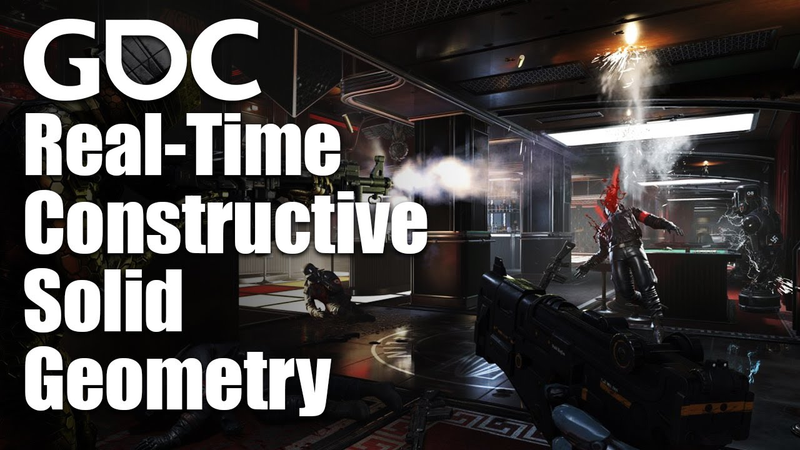
Geometry in Milliseconds: Real-Time Constructive Solid Geometry
Constructive Solid Geometry serves as a foundational methodology for game level design, facilitating rapid prototyping and iterative workflows by allowing designers to manipulate geometry in real-time.
- Modern CSG implementations have shifted from inefficient Binary Space Partition (BSP) trees to per-brush computation, treating individual convex brushes as the primary unit for real-time processing.
- The system utilizes boolean operation lookup tables and routing tables to categorize polygon pieces against brush planes, effectively determining which surfaces are discarded and which remain visible.
- To minimize redundant data and optimize processing, the framework encodes branching paths into indexable structures and utilizes row caching.

Substance 2020 Updates with Jeremie Noguer & François Cottin | Game Dev Unchained Episode 224
The gaming industry is undergoing a period of rapid expansion, fueled by increased player engagement and the widespread adoption of real-time 3D technology.
- Real-time 3D technology is expanding beyond gaming into automotive, luxury goods, and architecture to accelerate design iterations and reduce production costs.
- The industry is shifting from standard physically based rendering to complex material properties, including clear-coat layering, subsurface scattering, and realistic cloth simulation.
- Production-ready automation, specifically AI-driven tools for photogrammetry, UV unwrapping, and texture cleanup, is enabling teams to scale asset creation without increasing headcount.
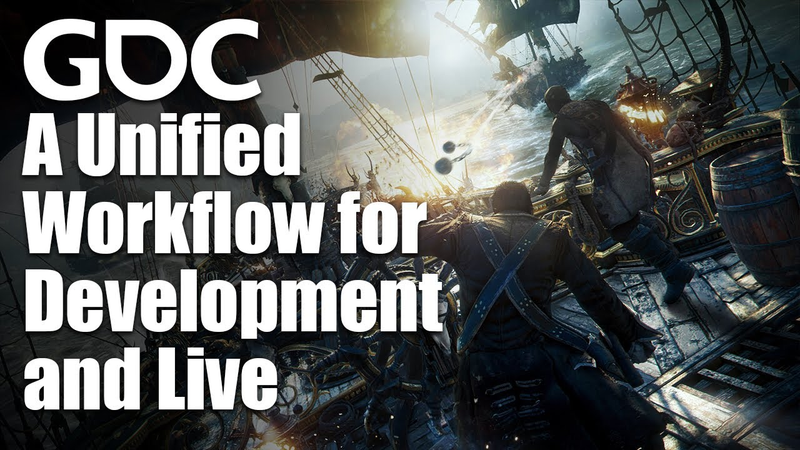
Start-And-Discard: A Unified Workflow for Development and Live
The Start-and-Discard workflow represents a strategic shift in online game development, moving away from static, on-premise infrastructure toward a cloud-native, ephemeral environment model.
- Ubisoft Massive implemented the 'Start-and-Discard' workflow, which utilizes infrastructure-as-code (Terraform and Google Cloud) to instantiate identical, production-like environments on demand.
- The methodology eliminates the use of inaccurate 'stubs' or 'shims' by allowing developers to test and debug within full-stack, isolated environments that mirror the final live product.
- By discarding environments immediately after task completion, teams optimize costs by avoiding the maintenance of expensive, permanent staging servers.
Writers
Games and companies
Games