Game Development reports and market data
Documents
Game Developers Are Doing It All Wrong
Game development success relies heavily on prioritizing design as the foundational element of the production process, rather than focusing exclusively on technical implementation.
- Game development success requires prioritizing design as the foundational element of production rather than focusing exclusively on technical implementation.
- Developers should achieve design mastery by immersing themselves in specific genres and meticulously deconstructing the mechanics of existing titles to understand successful gameplay loops.
- Because the fun and balance of a mechanic cannot be predicted theoretically, the development process must be iterative and include a willingness to scrap features even after months of work.
Making Your First Game? You Must Do THIS...
The primary thesis of this discussion is that incorporating small, interactive elements—referred to as "funsies"—is a critical strategy for independent game developers to enhance player engagement and improve overall game reception.
- Incorporating small, interactive environmental elements—termed 'funsies'—is a high-impact strategy for indie developers to improve player engagement and increase positive Steam ratings.
- These minor interactions, such as breakable objects or functional fixtures, provide a sense of agency that can compensate for limitations in core mechanics or narrative depth.
- Developers should implement a global 'interactable' script in Unity to standardize physics, sound effects, and animations across various environmental assets.
All Game Trailers Are Not Created Equal
Game trailers serve as critical marketing instruments that require tailored strategies based on their specific purpose, platform, and audience.
- AAA trailers function as technical showcases for console hardware and often utilize cinematic structures, whereas indie trailers must prioritize immediate gameplay loops, art direction, and world-building to differentiate themselves in a competitive market.
- Animated trailers carry significant financial risk, costing between $1,000 and $4,000 per second, and can create player backlash if the animation style creates a misleading expectation of the game's actual art direction.
- Always create a rough cut of a trailer using your own voiceover before hiring a professional, as this process effectively identifies pacing, script, and footage issues before incurring expensive recording costs.

'Yar's Rising' and Reimagining Classics for Game Development with James Montagna | 347
The revitalization of classic intellectual property requires a delicate balance between honoring foundational source material and integrating modern gameplay innovations.
- Reimagining legacy IP like the 1982 Atari title 'Yars’ Revenge' requires balancing original source material with modern genre shifts, such as transitioning the game into a side-scrolling metroidvania.
- Developers can modernize retro titles by repurposing classic mechanics into narrative-driven features, such as converting original gameplay elements into interactive hacking terminals for a protagonist.
- Maintaining a nimble, independent studio structure supported by deep institutional knowledge and passion is essential for navigating the volatility of the current gaming market.

Mastering the Roblox Meta
Roblox functions as a hyper-competitive digital ecosystem where success is defined by rapid iteration, organic discovery, and a deep understanding of player behavior.
- Roblox hosts 350 million monthly active users and generates $3.3 billion in annual bookings, creating a hyper-competitive environment where success requires constant iteration rather than static development formulas.
- Long-term traction is driven by organic discovery, influencer activity, and inherent social mechanics rather than traditional marketing or initial seeding efforts.
- Developers must prioritize 'bare-bones' fun and core gameplay mechanics, as the platform's audience frequently cycles through multiple titles in a single session.

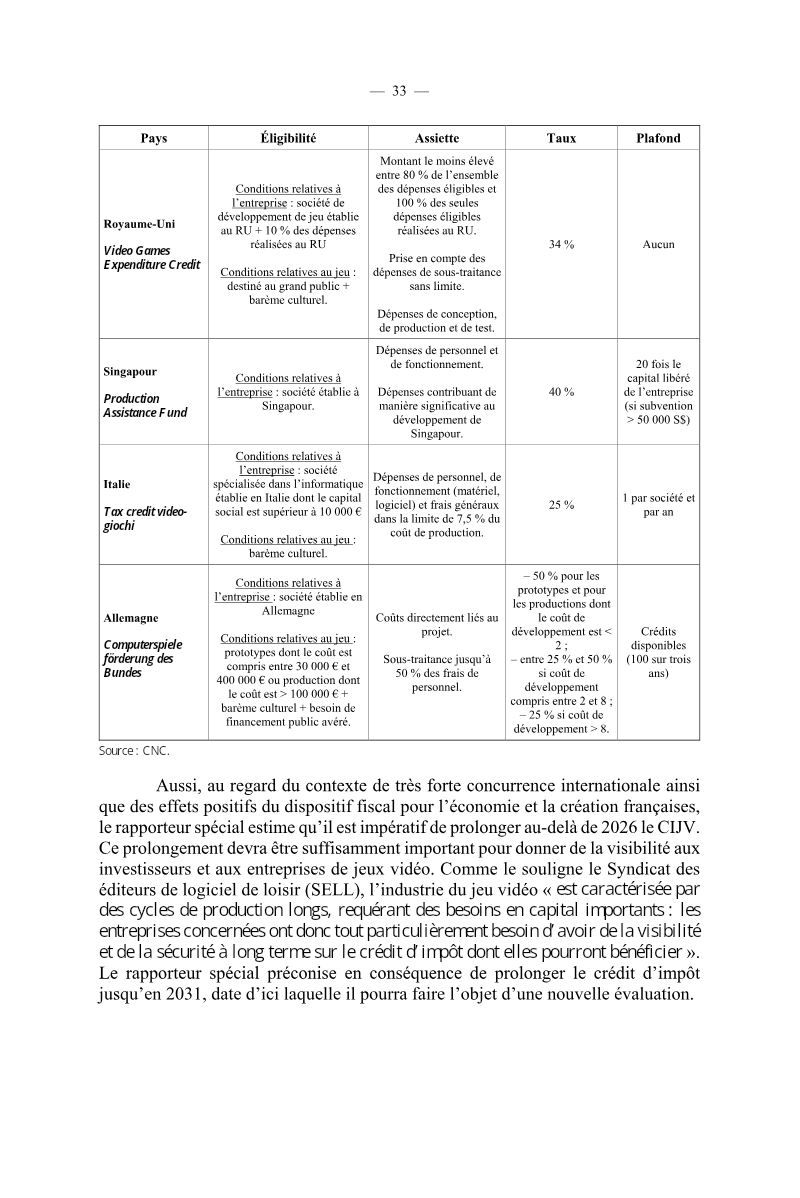

Rapport d'information sur le crédit d'impôt en faveur des entreprises de jeux vidéo
This 2024 French National Assembly information report, prepared by the Finance Committee's rapporteur spécial Denis Masséglia and registered on 21 May 2024, evaluates the crédit d'impôt jeux vidéo (CIJV), a tax credit for French video game companies created in 2007 and reformed in 2017.
- The tax credit grew from 13 million euros in 2016 to 66 million euros in 2023 after the 2017 reform.
- The number of video games supported by the credit reached 144 in 2023, almost four times the 2016 count.
- The report says the 2017 reform created or preserved about 2,500 jobs in France, according to a study commissioned by the SNJV and SELL.
GameDevDojo: An Educational Game for Teaching Game Development Concepts
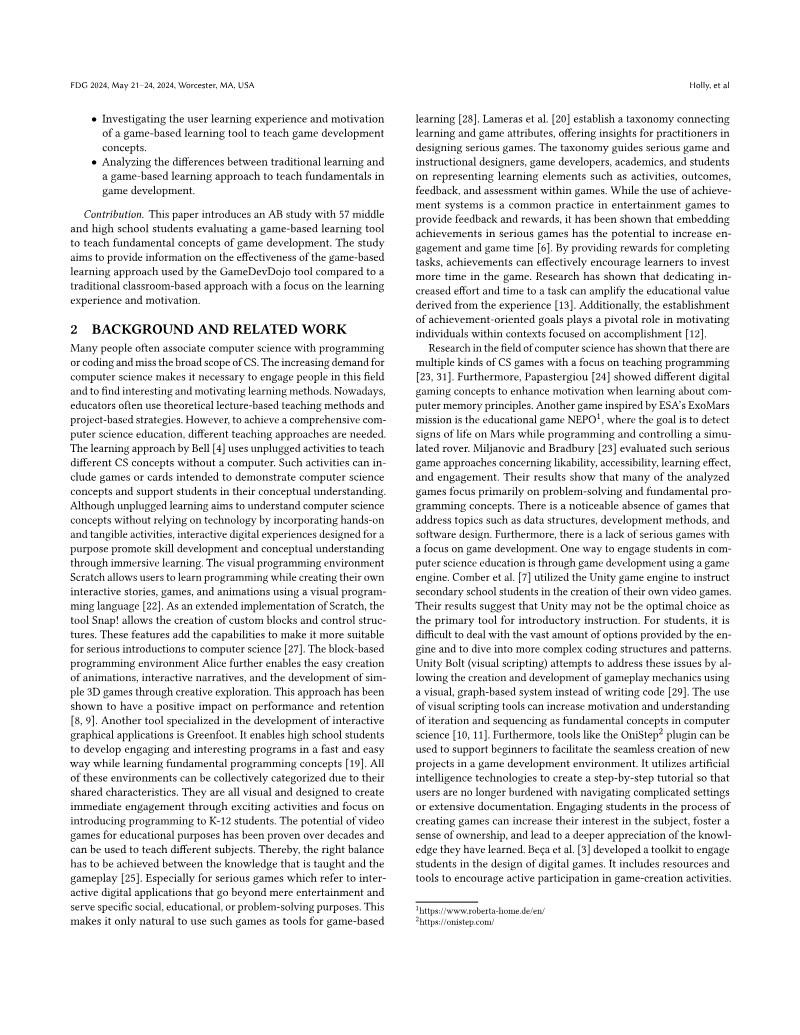
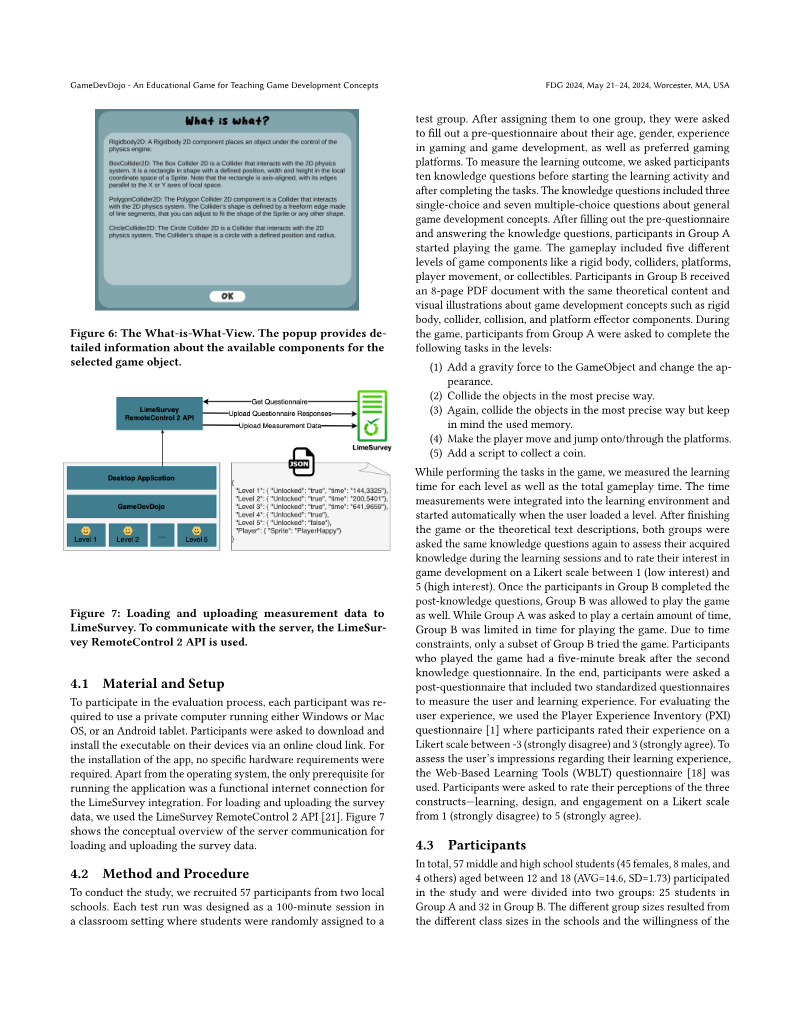
This paper, by Michael Holly, Lisa Habich and Johanna Pirker, presents GameDevDojo, a game-based learning tool that teaches foundational game development concepts without programming.
- Group A's overall knowledge success rate rose from 28.0% to 44.4%, while Group B's rose from 26.9% to 52.2%. The authors report no significant difference between the groups' learning increases.
- Group A's average interest in game development rose from 2.60 to 3.00 on a 5-point scale, while Group B's fell from 2.68 to 2.34.
- Participants rated the learning application's effectiveness highly, with a learning score of 4.23 on a 5-point scale.
You Only Randomize Once: Shaping Statistical Properties in Constraint-based PCG
This paper, by Jediah Katz, Bahar Bateni, and Adam M. Smith, introduces You-Only-Randomize-Once (YORO), a pre-rolling technique for influencing the output statistics of generic constraint solvers used in procedural content generation.
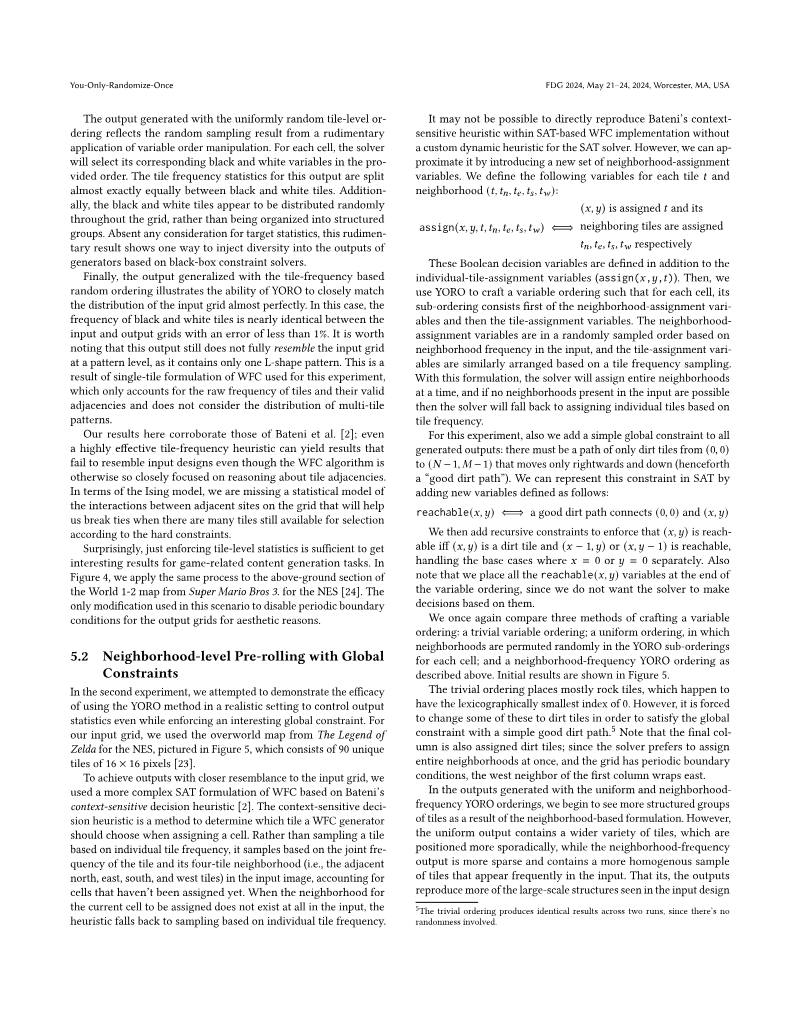
- Using a tile-frequency ordering, the black-and-white 20 x 20 example's output tile frequencies matched the input closely, with an error of less than 1%.
- YORO works by concentrating all randomness into a preprocessing step that produces a variable ordering, so the solver itself needs no new randomness.
- A trivial lexicographic variable ordering produced a uniformly black output in the 20 x 20 toy example, with no white tiles at all.
DreamCraft: Text-Guided Generation of Functional 3D Environments in Minecraft
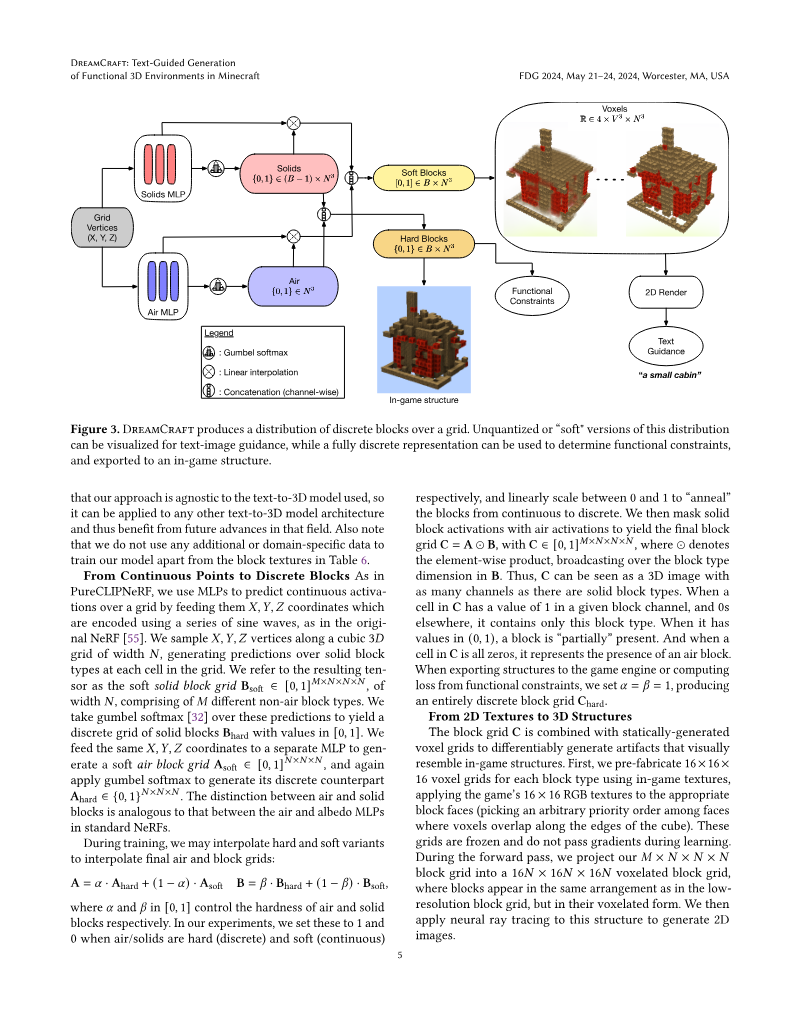
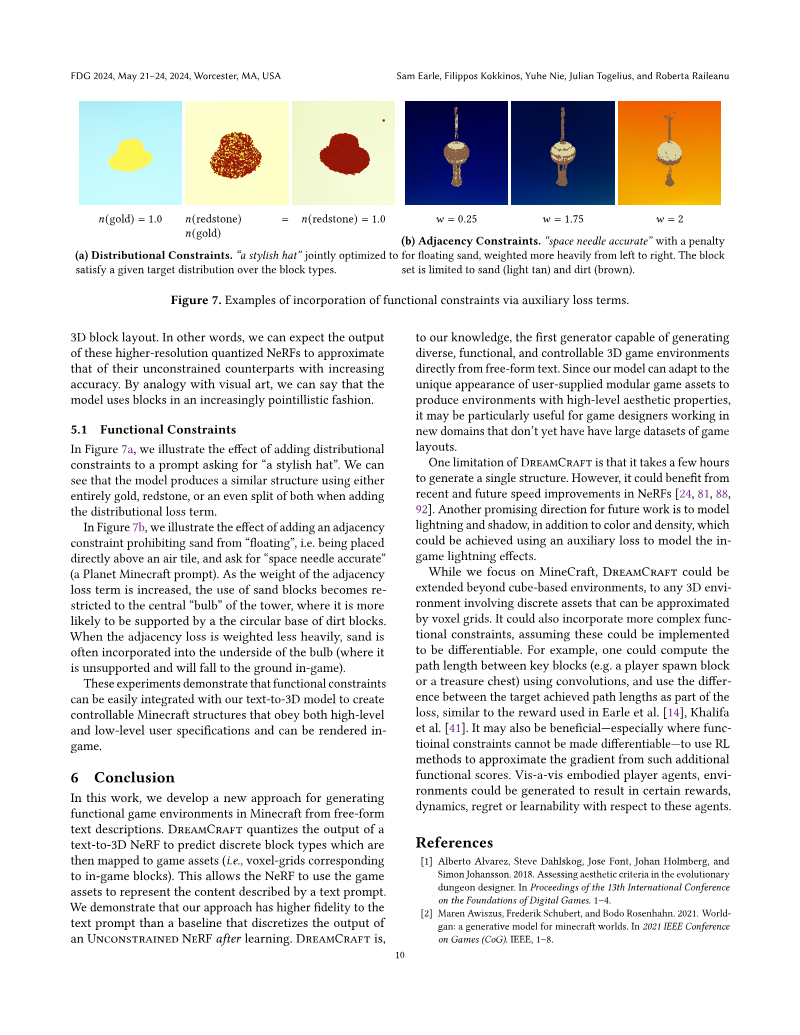
The authors present DreamCraft, a method for generating functional 3D environments in the open-world game Minecraft from free-form text prompts.
- On Planet Minecraft prompts, DreamCraft's in-game renders scored higher R-precision than the unconstrained NeRF baseline that was discretized after training.
- For neural renders, the unconstrained NeRF outperformed DreamCraft, but the gap narrowed on domain-specific prompts, with a CLIP ViT-B/16 ratio of 0.46 on Planet Minecraft versus 0.32 on COCO.
- For Planet Minecraft, the best quantization scheme pairs hard solid block types with soft air blocks, with the authors finding soft air blocks crucial for learning stability.
The Ink Splotch Effect: A Case Study on ChatGPT as a Co-Creative Game Designer
The Ink Splotch Effect is a 2024 Foundations of Digital Games paper by Asad Anjum, Yuting Li, Noelle Law, M Charity and Julian Togelius, studying whether ChatGPT (GPT-3.5) can act as a co-creative game designer.
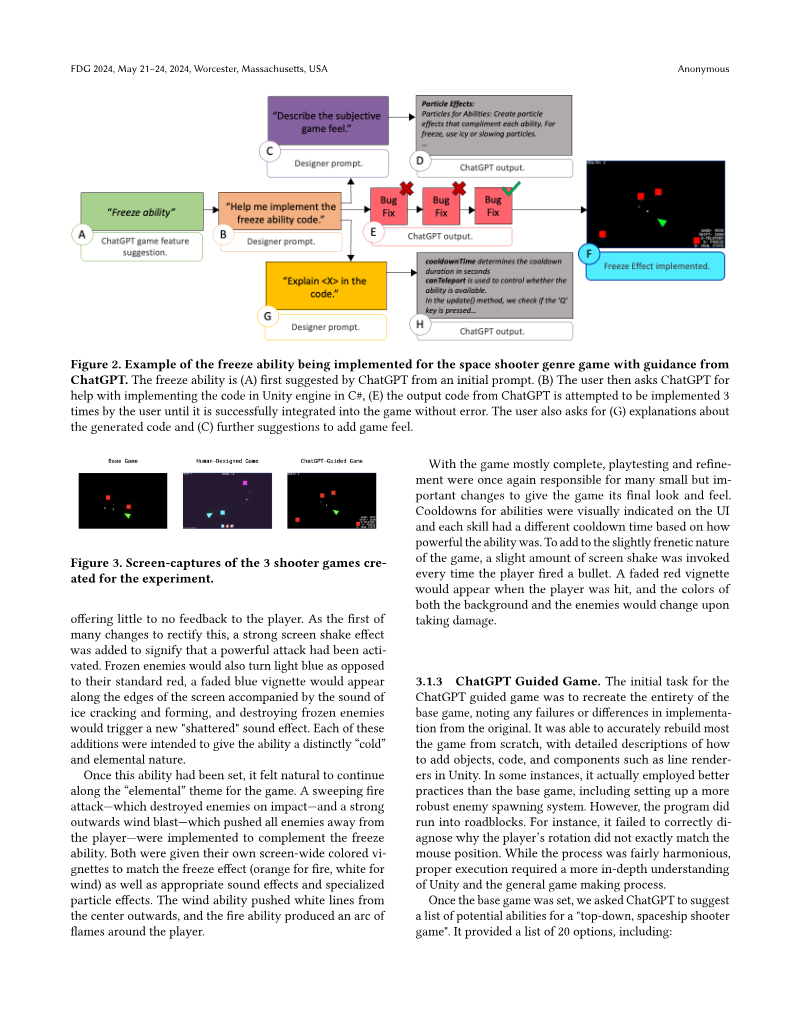
- The authors state that ChatGPT performed best when prompted for abstract, high-level feature suggestions rather than direct code implementation.
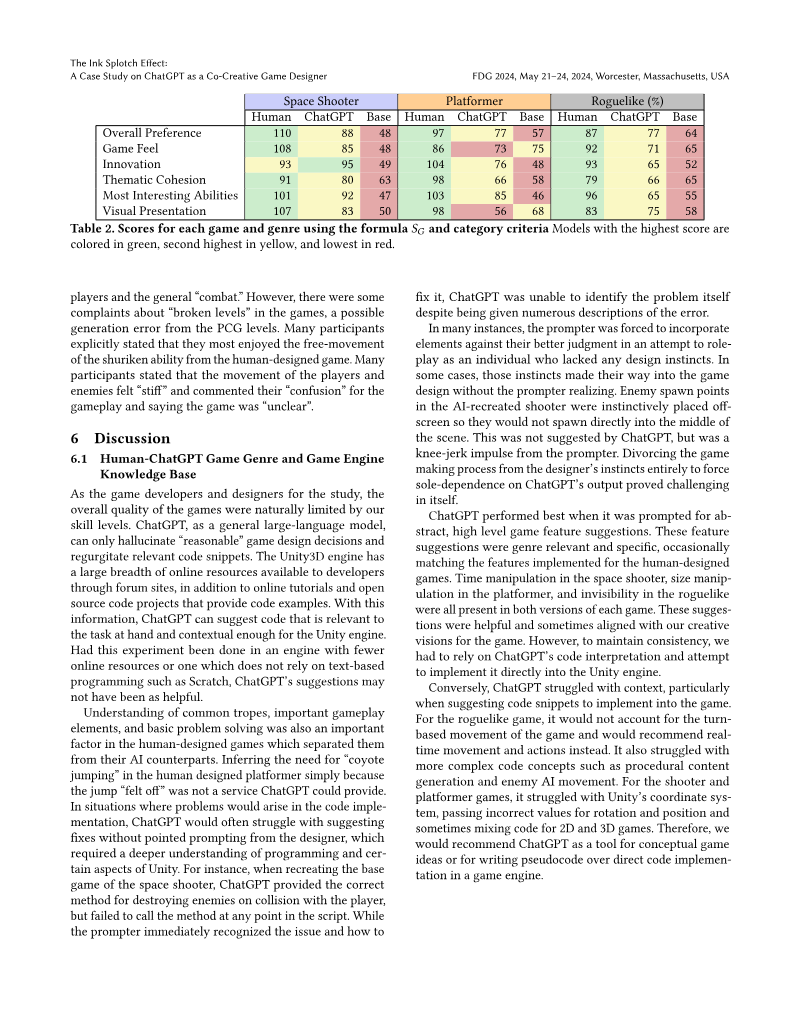
- The authors report that participants almost consistently rated human-designed games higher than ChatGPT-suggested games, with both above the baseline in most categories.
- The authors report that ChatGPT could not recreate the turn-based roguelike base game and struggled with its procedural generation and enemy AI.

On the Evaluation of Procedural Level Generation Systems
The paper, by Oliver Withington, Mike Cook and Laurissa Tokarchuk (Queen Mary University of London and King's College London), surveys how procedural content generation (PCG) systems that generate video game levels and environments are evaluated.
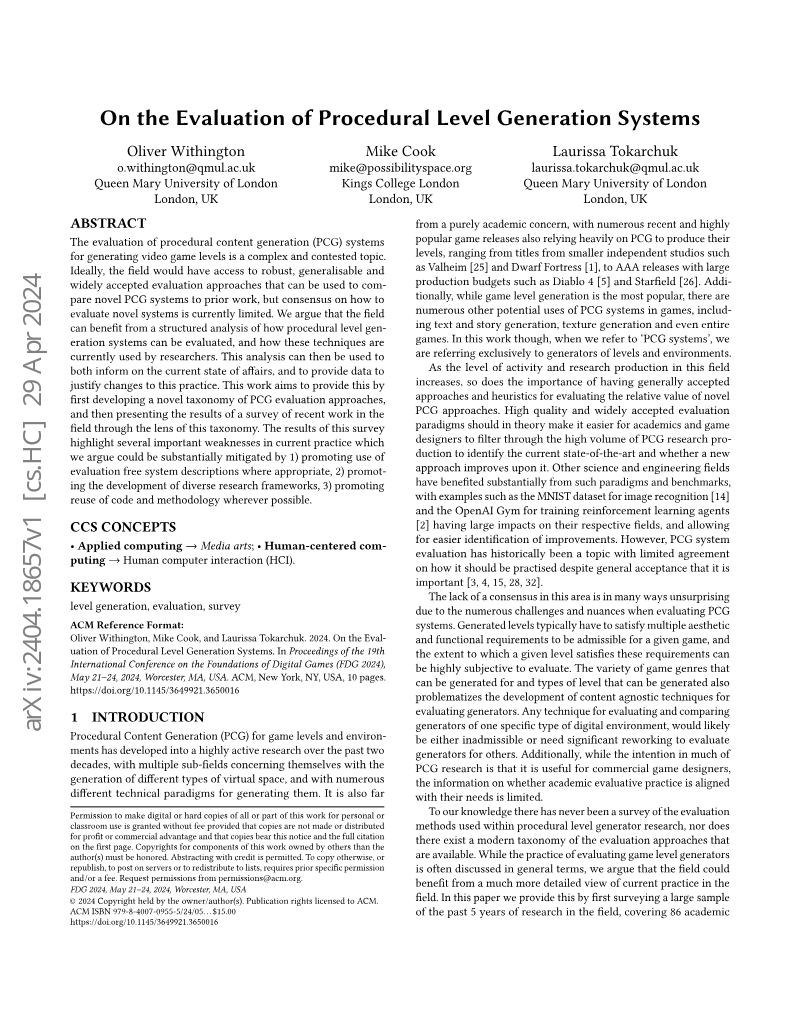
- Calculating features directly from the level representation was the most common data gathering method in the surveyed literature. The authors note this dominance is expected because system designers already have direct access to these representations.
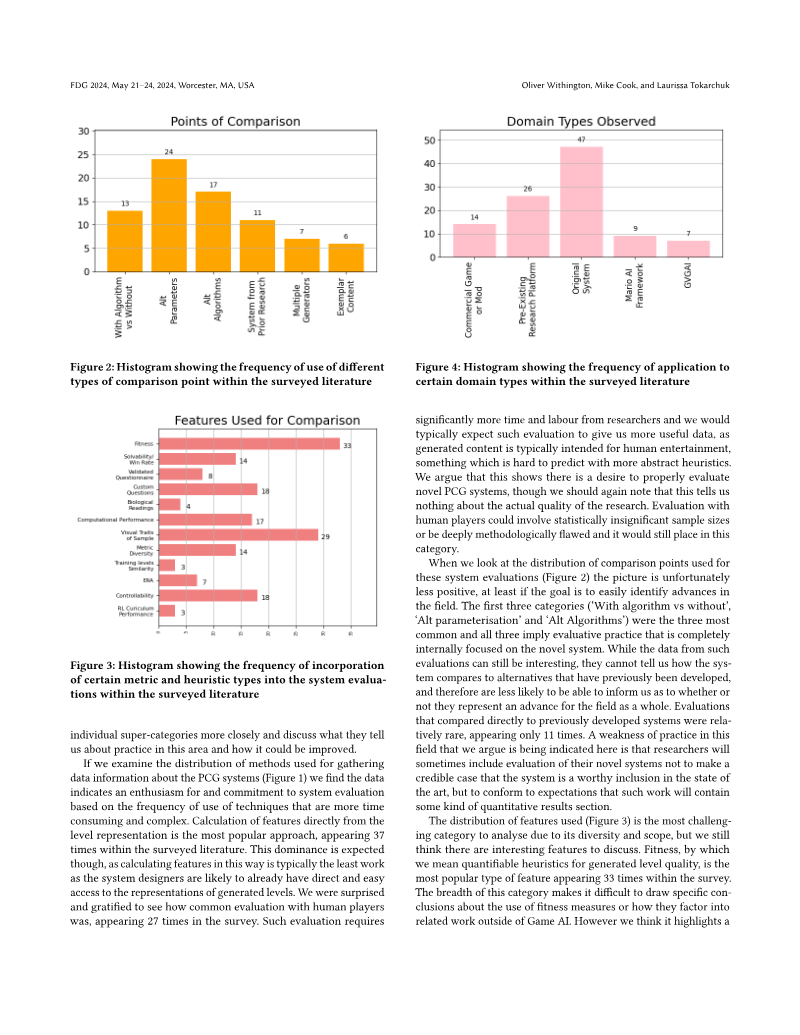
- Comparisons against previously developed systems were relatively rare. The authors argue that researchers sometimes evaluate novel systems to conform to expectations rather than to make a credible case.
- Over half of the surveyed works, 47 of 86, developed original game domains or level representations for their testing. The authors argue this makes the novel systems hard to compare to alternatives.
Elevating Game User Research with a Guided Interface for Data Analysis
The paper, by Haider, Romanus, Tang, Gerling and Vanden Abeele of KU Leuven and Karlsruhe Institute of Technology, presents a guided web interface for analysing Player Experience Inventory (PXI) questionnaire data, developed through a user-centered design process that drew on interviews with 12 games user research (GUR)…
- Participants' SUS scores ranged from 38 to 90 with a mean of 64.5, which the authors describe as below average, and they attribute the lower score mainly to excessive explanatory texts.
- Four of the five participants found the platform valuable and said they would use it themselves, and they reached a better understanding of the data after the analysis.
- Missing data must be resolved before other statistical tests can run, so the platform hides or disables later steps until missing values are handled.
Writers
Games and companies
Games