Game Culture reports and market data
Documents
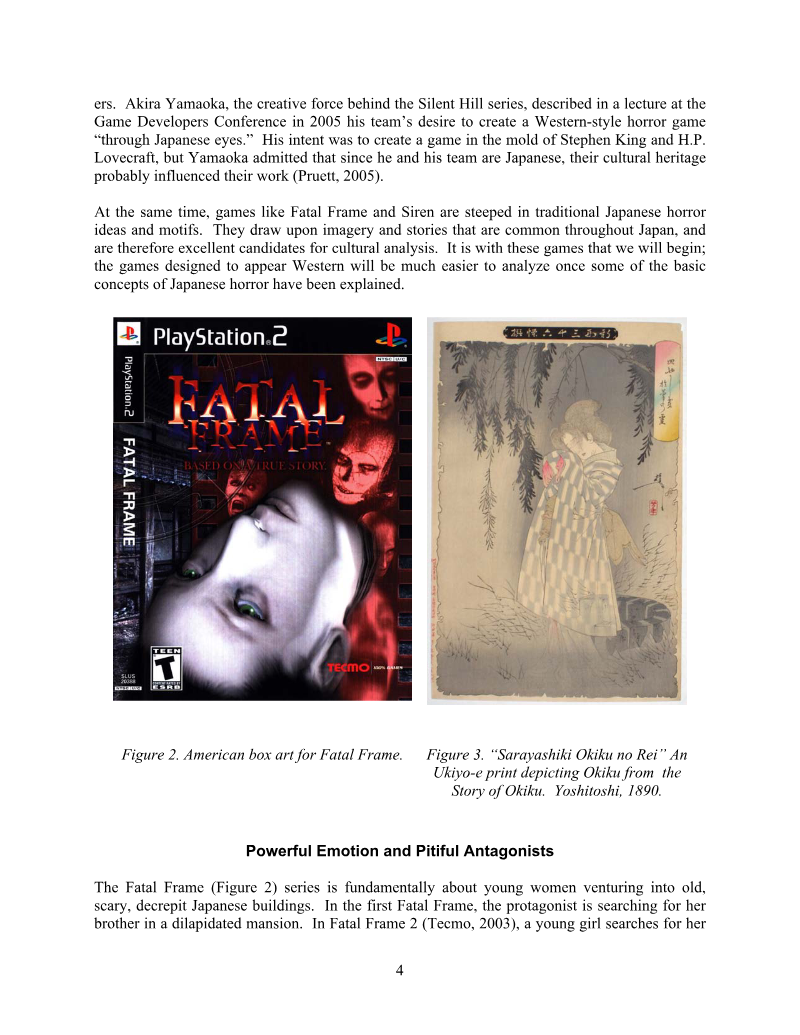


The Anthropology of Fear: Learning About Japan Through Horror Games
Chris Pruett's paper, "The Anthropology of Fear: Learning About Japan Through Horror Games," uses Japanese horror games as a lens for studying Japanese culture rather than studying the culture directly.
- The document states that Japan released more horror games than the West almost every single year since 1995. It presents this as evidence of a strong Japanese interest in the genre.
- The author says Resident Evil's successor achieved sales of close to five million, compared with a metric for financial success of only a few hundred thousand copies.
- The paper says the Resident Evil series alone accounts for twenty separate games, while the only Western horror franchises with three or more games are Alone in the Dark (four) and Evil Dead (three).
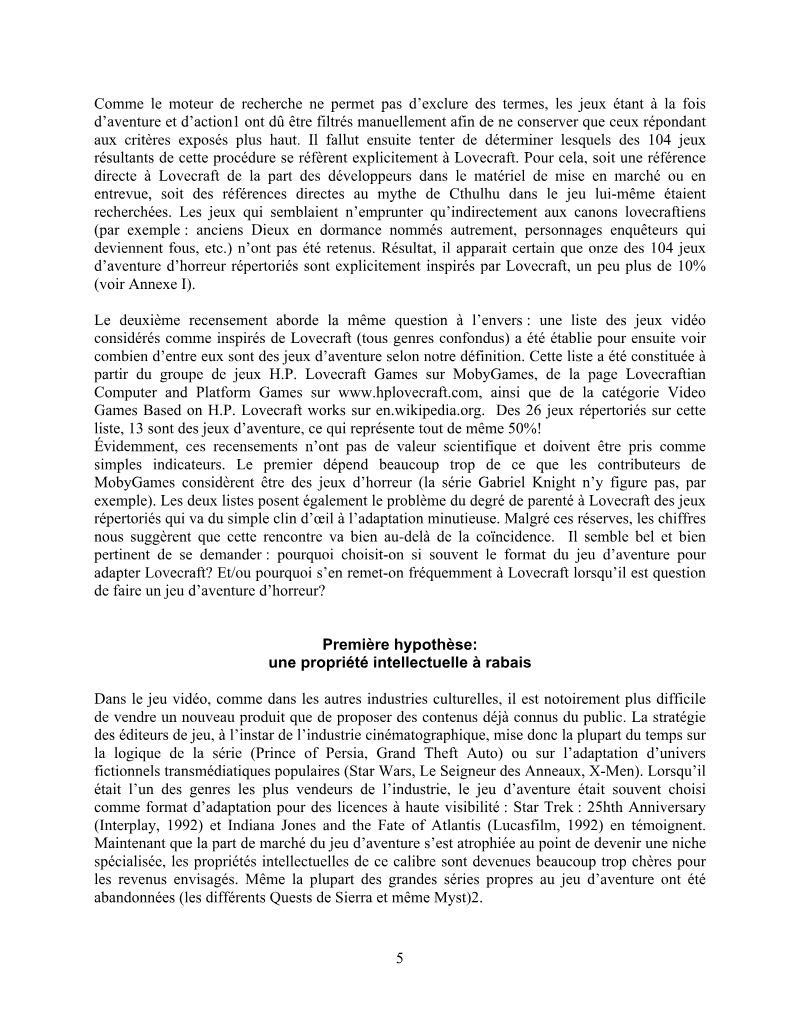
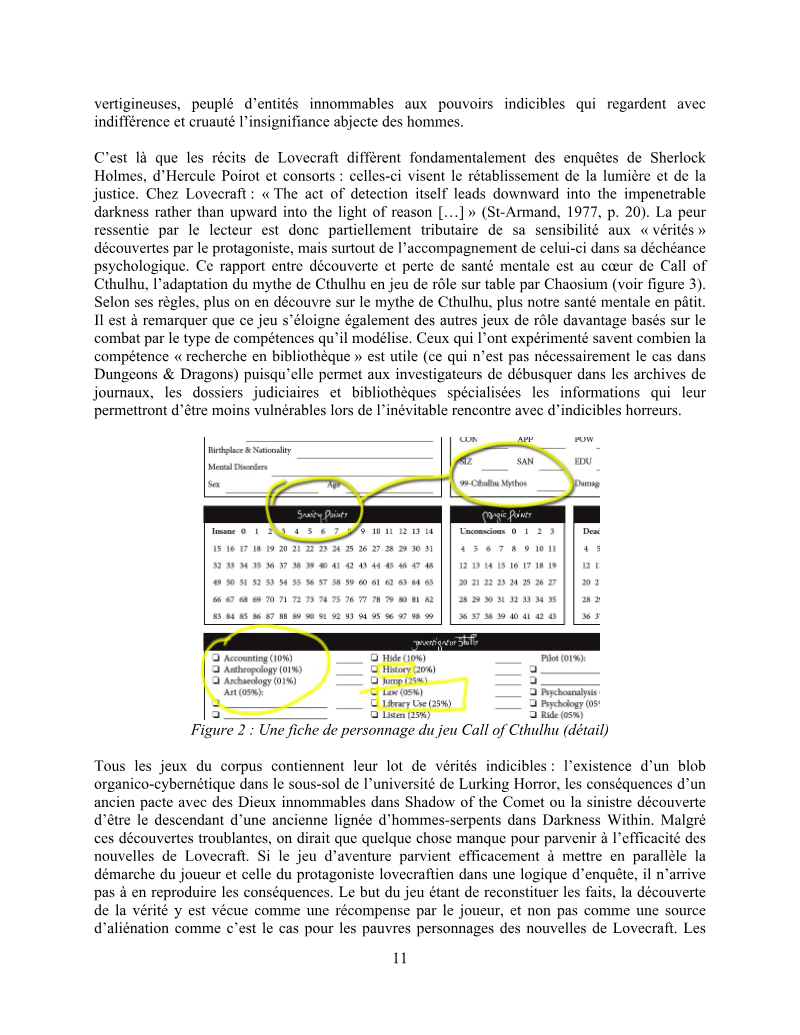
Lovecraft, le jeu d'aventure et la peur cosmique
Jonathan Lessard of the Université de Montréal examines why Lovecraftian mythology is so often adapted into adventure games, and whether such games can generate the cosmic fear Lovecraft aimed for.
- About 10% of horror adventure games on MobyGames, eleven of 104, are explicitly inspired by Lovecraft.
- Of 26 games on a Lovecraft-inspired list, 13 are adventure games, which the author gives as 50%.
- The author argues that the player and the Lovecraftian protagonist both act as researchers or investigators, motivated by curiosity.
L'adaptation de films d'horreur en jeu vidéo: Émergence d'une horreur vidéoludique
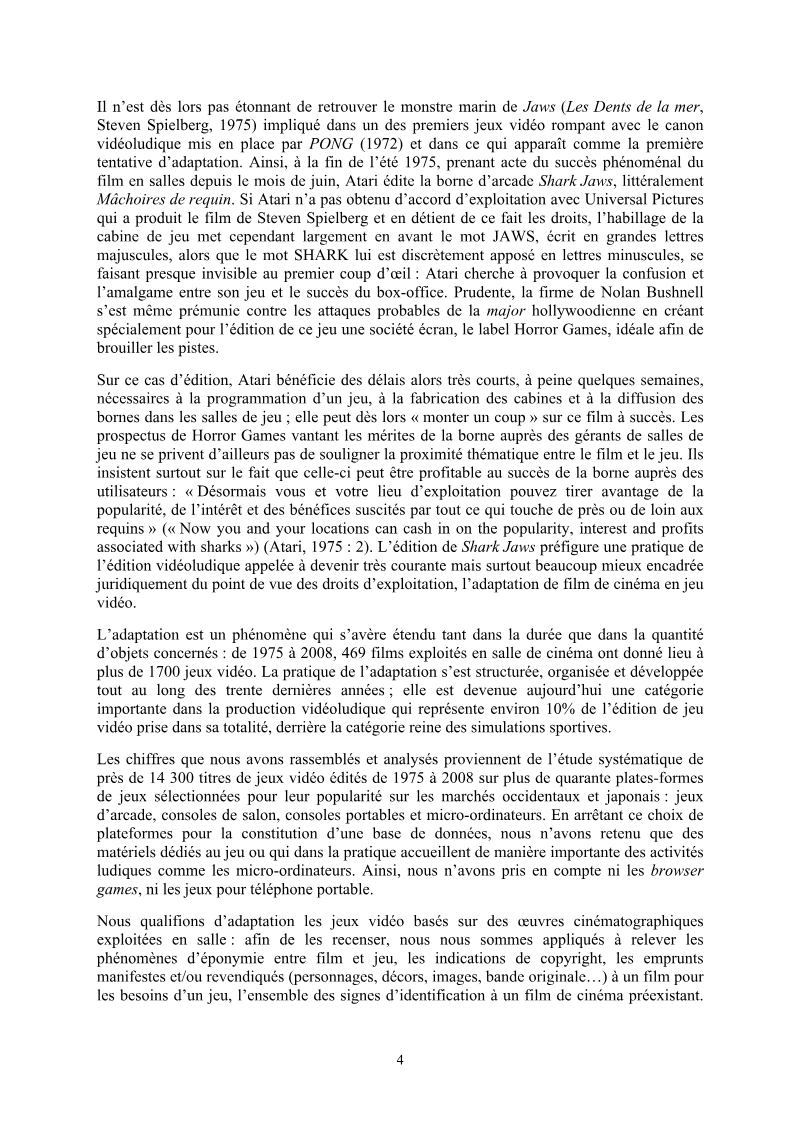
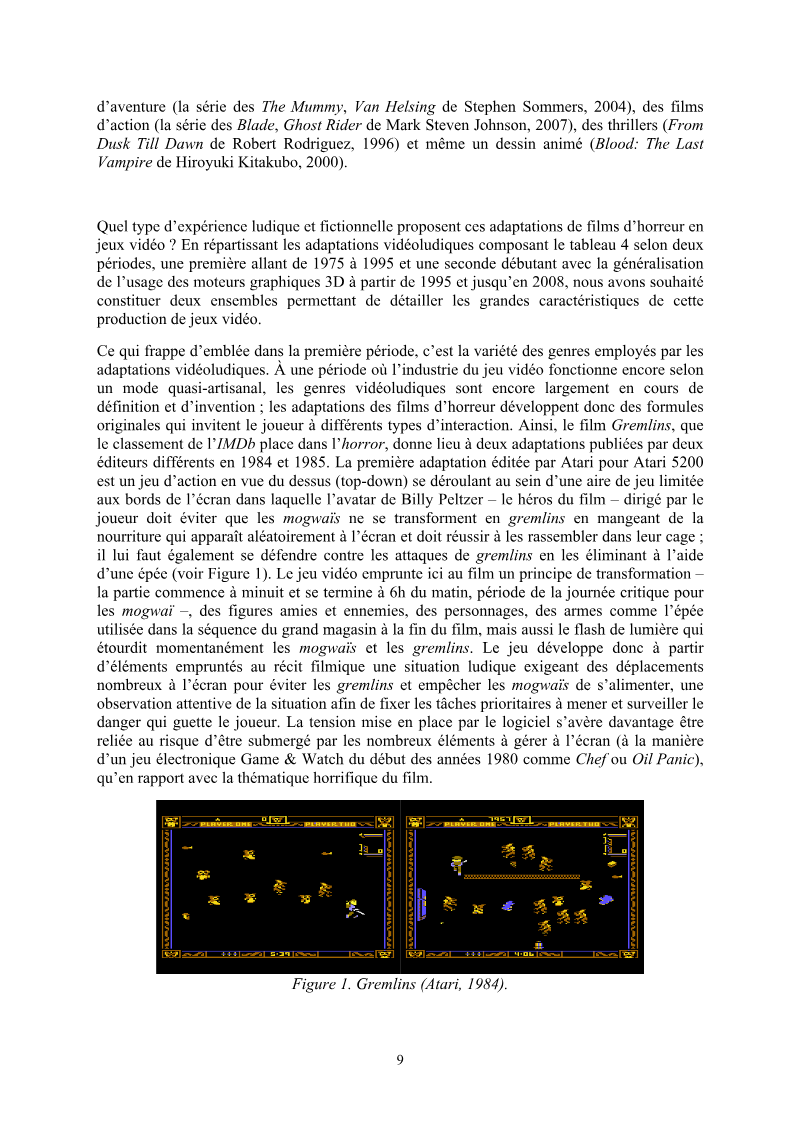
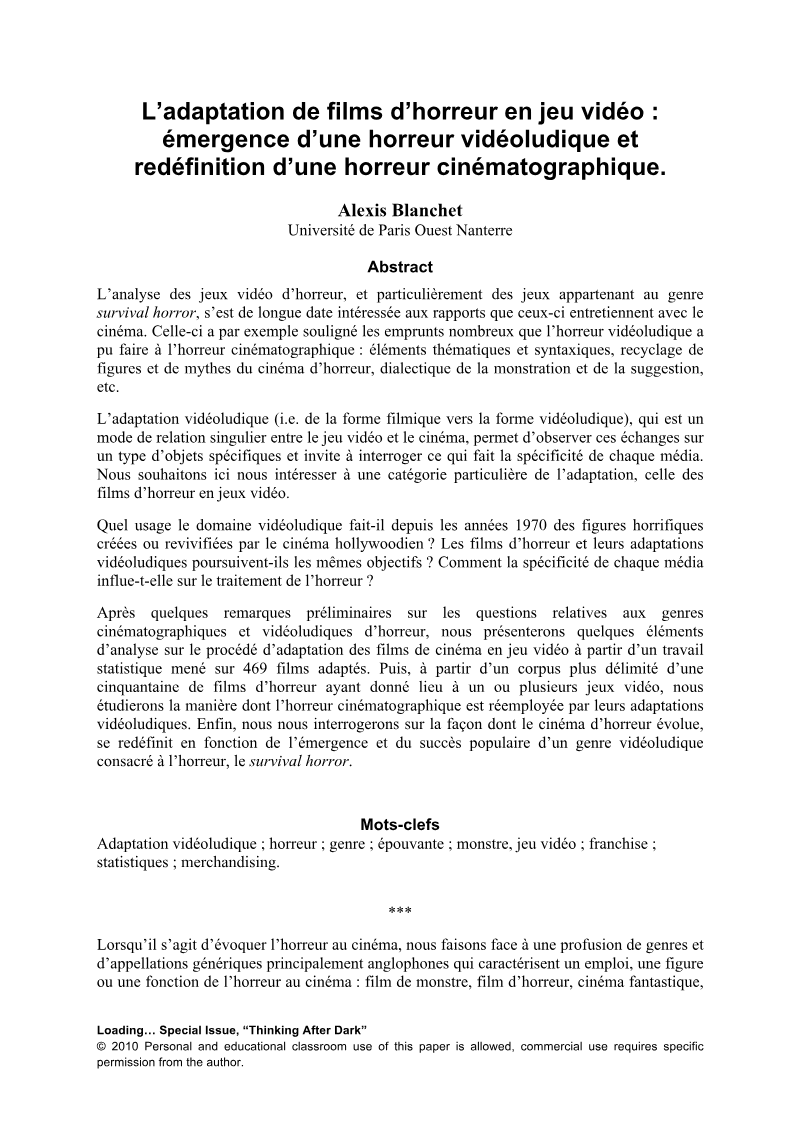
This article by Alexis Blanchet of the Université de Paris Ouest Nanterre examines how film horror is adapted into video games, from the 1970s onward.
- Of 469 films adapted into video games between 1975 and 2008, the author counts more than 1,700 games, and adaptations make up about 10% of video game output.
- American films account for 88% of the films adapted into video games.
- Horror films were adapted mostly after their theatrical release: 48 adaptations were reprises, against 28 simultaneous adaptations.
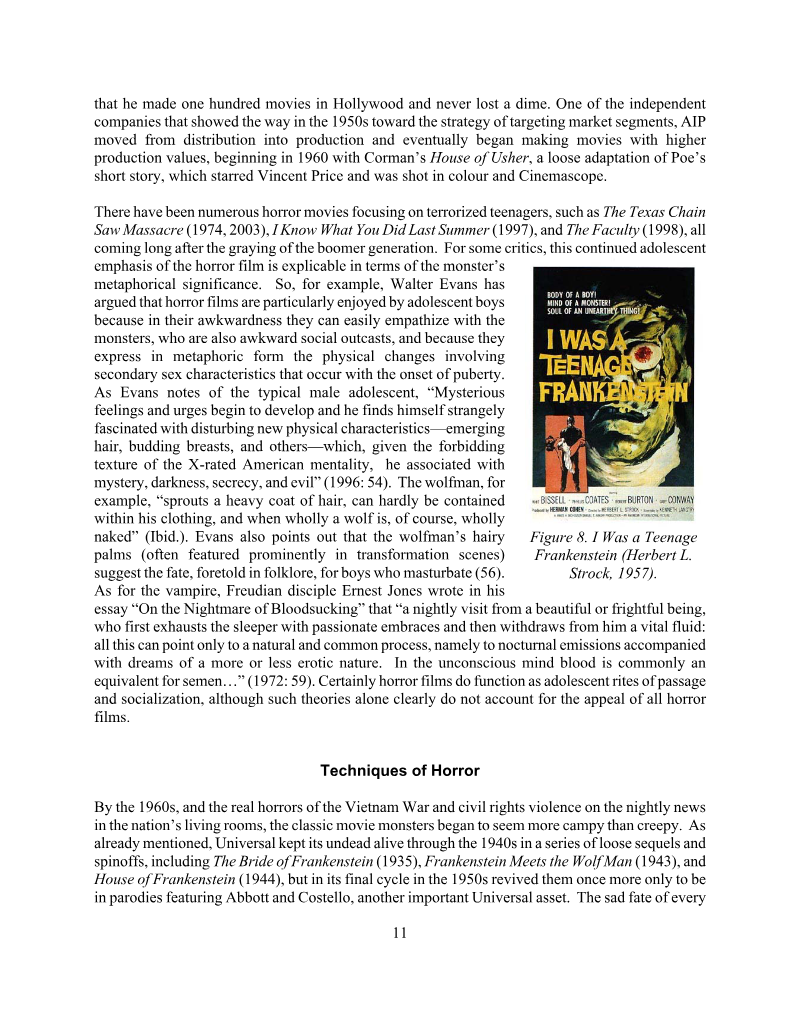
Screams on Screens: Paradigms of Horror
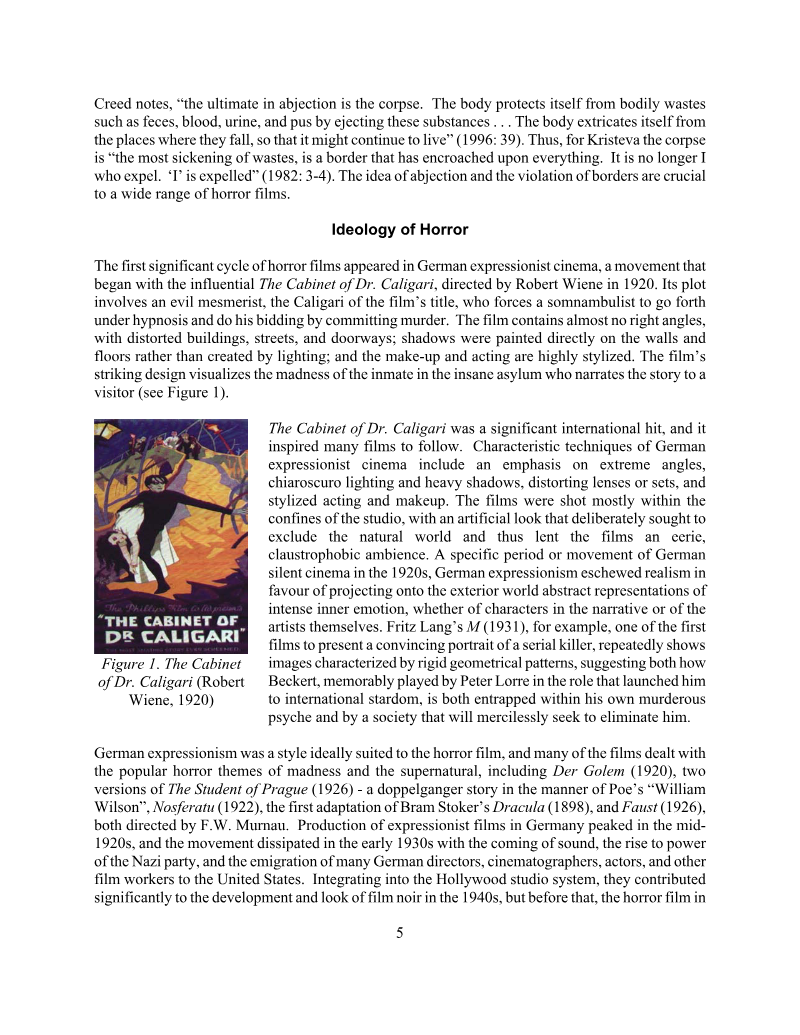
Barry Keith Grant of Brock University presents a broad historical overview of horror films, their ideology, and their cultural roots, written to introduce video game scholars and gamers to the genre's history in cinema.
- The author describes horror as one of the few genres defined by its intended affect rather than by setting or narrative content. Horror is grouped with melodrama and pornography as a 'body genre' in which a strong physical response is the measure of success.
- Horror has been part of film history from the beginning, and it was already an important genre in the silent era, unlike musicals and gangster films, which had to wait for synchronized sound.
- Robin Wood argued that horror films repress desire and project it outward as a monstrous Other, so the monster can be read as a 'return of the repressed'.
Designing Social Worlds: On Intrigue and Interaction in Live Action Role Playing Games
The Nordic Live Action Role Playing (LARP) scene has evolved over the past two decades into a sophisticated, experimental environment characterized by complex social dynamics and intricate narrative design.
- Nordic LARP design principles have successfully transitioned from a niche subculture into professional frameworks for institutional training, academic research, and national theater productions.
- Major European institutions, including the European Parliament, the European Commission, and the Council of Nordic Ministers, utilize these interactive design methodologies for civic engagement and human rights education.
- The methodology leverages experiential learning and interactive narrative design to simulate complex human behavior across diverse genres, ranging from historical dramas to modern political simulations.
Stillborn Gamers? Writing a Birth Certificate for Corporeality and Locomotion in Game Research
Nørgaard's paper, presented at the Nordic DiGRA conference in 2010, argues that game research has largely neglected the corporeal and locomotive dimensions of play.
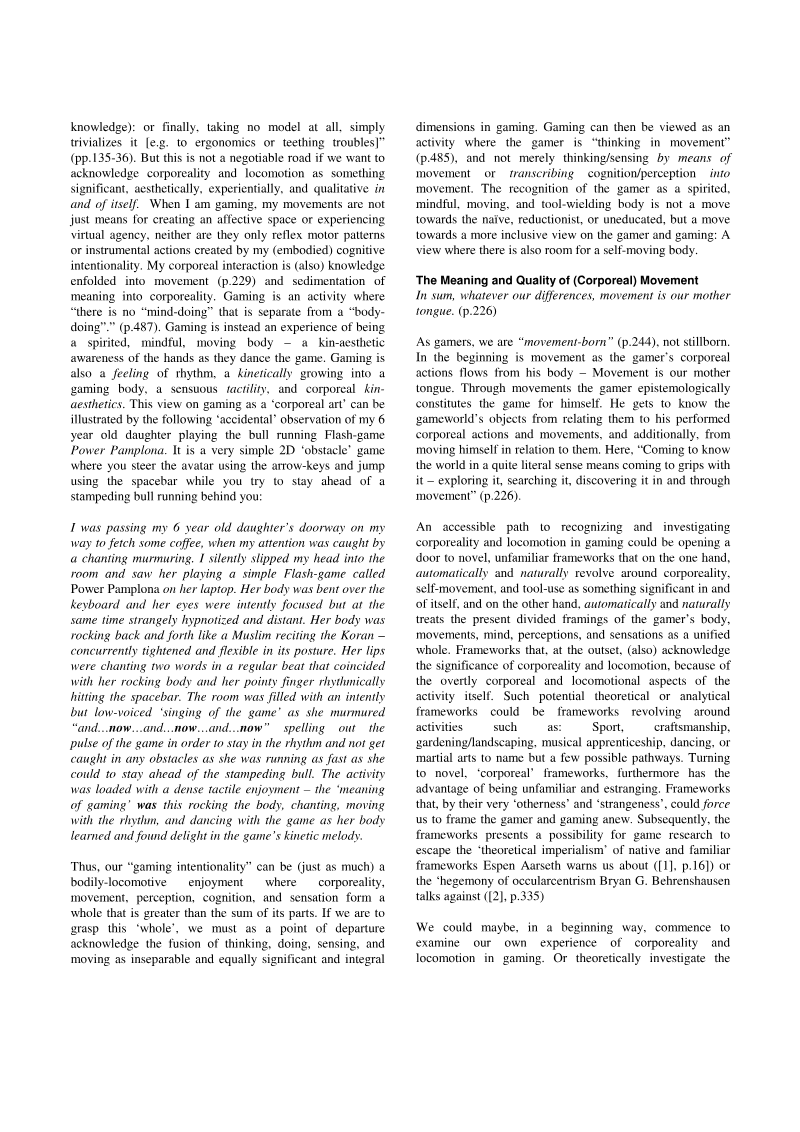
- Nørgaard's 2010 paper argues that game research has neglected the corporeal and locomotive dimensions of play, portraying gamers as detached cognitive observers when they are fundamentally embodied, movement-based agents.
- The author frames gaming as "thinking in movement," drawing on phenomenology (Drew Leder, Maxine Sheets-Johnstone, Edward Casey) on body memory and the primacy of movement.
- A survey of the thirteen articles in the WoW Reader found none addressing corporeality or movement, and a search of 99 papers in Game Studies found none focused on gamers' bodies, locomotion, or tool-use.
A Framework for Games Literacy and Understanding Games
Jose P. Zagal, of DePaul University's College of Computing and Digital Media, proposes a framework for evaluating games literacy, drawing on research into the difficulties students face in game studies and game design courses.
- Zagal and Bruckman found that students taking game studies and game design courses at the university level often confuse being insightful about a game with being successful at playing it, and tend to describe games superficially or judgmentally rather than analytically.
- The paper argues that playing, understanding, and making games are distinct parts of games literacy, and that gamer literacy should not be equated with games literacy.
- The framework defines understanding games across four contexts: human culture, other games, the technological platform, and the deconstruction of a game's components and the experiences they facilitate.
Serious Learning in Playful Roles: Socio-political games for education and social change
Negin Dahya, of York University, examines four socio-political "serious games" in an autoethnographic study drawn from her Master's thesis.
- Game design was most effective when content centred on a focused concept, attitudinal change or affective understanding rather than a specific real-world situation.
- In Replay: Finding Zoe, poor game mechanics made the content difficult to engage with, and the author found the fill-in-the-blank dialogue task ultimately boring.
- Darfur is Dying's text blurbs omitted context, which the author says portrayed one Arab nation as needing to be fought and one African nation as needing to be saved.
Videogames and Complexity Theory: Learning through Game Play
This analysis explores video games as complex, adaptive, and self-organizing systems that facilitate sophisticated learning.
- Video games function as complex, adaptive systems that facilitate superior learning by coupling information with action, unlike traditional educational models that isolate tasks from their context.
- Games foster emergent learning by keeping players within a 'regime of competence' through well-ordered, pleasantly frustrating challenges that promote system thinking over rote memorization.
- The inherent instability and infinite, emergent possibilities within a game environment serve as the primary drivers for high levels of player engagement and skill acquisition.
Frames and Simulated Documents: Indexicality in Documentary Videogames
Cindy Poremba's paper examines Traffic Games' 2003 documentary videogame JFK Reloaded, which is built on a ballistics and event simulation drawn from Warren Commission data.
- The author argues that JFK Reloaded's strong indexical relation lies between the game and the documents, not the historic act of the assassination itself, and that the game's primary strength as a documentary work is in re-engaging the archive rather than simulating history.
- Citing Fullerton and Wolf, the paper notes that forensic simulations have gone from being seen as suspect to being legally admissible as substantive evidence, with Wolf noting that judges must remind jurors of their unreal nature.
- The author states that semi-formal human systems are less predictable and cannot be entirely formalized because they involve human interpretation of rules.
Seeking the Embodied Mind in Video Game Theory: Embodiment in Cybernetics, Flow, and Rule Structures
This analysis examines the role of the human body within video game theory, specifically critiquing how cybernetics and flow theory conceptualize the player.
- Current game theory is overly reliant on formalist, rule-based frameworks that prioritize cognitive processes while neglecting the player's physical and material reality.
- Cybernetic models in game theory treat players as disembodied information processors, focusing exclusively on mechanical feedback loops rather than human experience.
- Flow theory creates a flawed, adversarial relationship between mind and body, requiring the player to condition their physical self to achieve immersion.
Playing in the Fields of Desire: Hegemonic Masculinity in Live Combat LARPs
The paper by Mark Malaby and Benson Green of Ball State University examines masculinity in live-combat LARPs, specifically the boffer-based LARP game New England Role-playing Organization (NERO) International, which the authors describe as having more than fifty chapters in Canada and the United States.
- Participants described power-gamers as achieving significant success in the game, both in winning and in storyline attention, and as identified as successful outside the game.
- The authors report that storylines usually start with power-gamers, who are liable to exclude role-players from the action.
- James noted that the game structure is such that aggressive, combat-oriented players are given more attention and tend to advance more quickly than role players.
Writers
Games and companies
Games