Loading the document
Key insights
4 slides
The setup
Twenty participants read reviews before playing a 15-minute game.
Participants read either positive or negative review text before playing Tag: The Power of Paint for 15 minutes. Players were randomly assigned to conditions, balancing for sex.
1 / 4
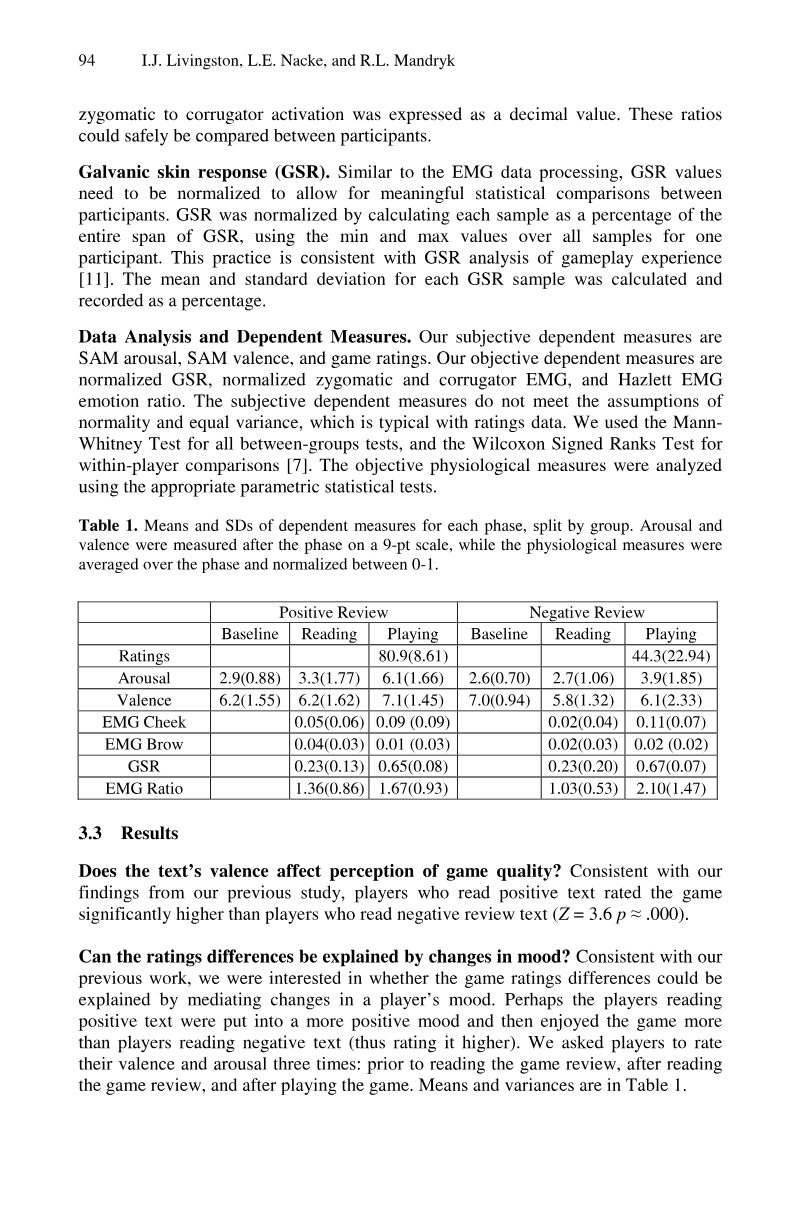
- 01Players who read positive review text rated the game significantly higher than those who read negative text.See it on page 6
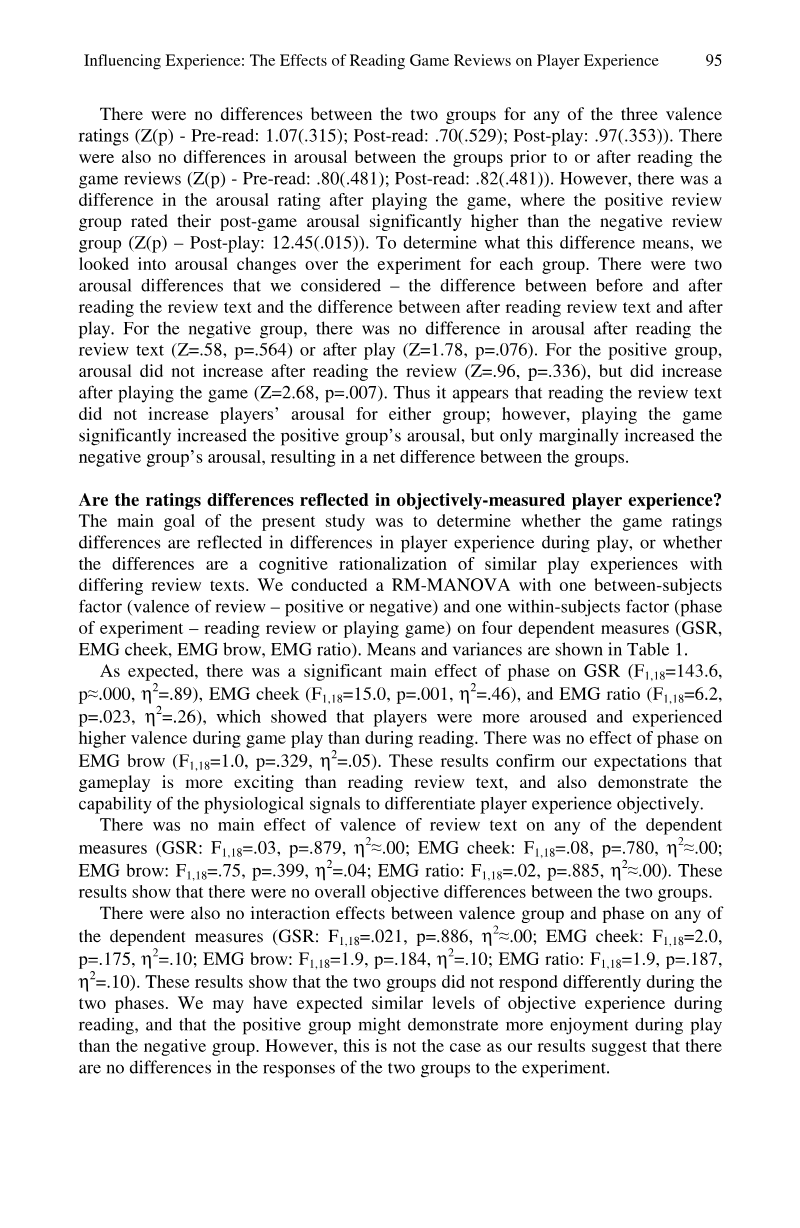
- 02Review valence did not produce a significant main effect on any objective physiological measure.See it on page 7
- 03The positive-review group's post-play arousal rose significantly after playing, while the negative-review group's rise was only marginal.See it on page 8
- 04Gameplay produced significantly higher GSR and cheek EMG than reading the review text.See it on page 8
- 05The authors argue that the rating differences reflect a post-play cognitive rationalization of similar experiences rather than different play experiences.See it on page 8
- 06The authors argue that studios should be careful about critical reception before release, since negative reviews bias players' perception of quality.See it on page 9
Ask AI about this report
Summary
Livingston, Nacke, and Mandryk of the University of Saskatchewan and University of Ontario Institute of Technology report a between-subjects study of 20 participants (8 female, aged 18-25, mean 21.8 years) who read either positive or negative game review text before playing Tag: The Power of Paint for 15 minutes. Players were randomly assigned to conditions, balancing for sex. Ratings were collected via a 0-100 guideline without showing numerical scores, while physiological measures (GSR for arousal, facial EMG for valence) were recorded throughout. Players who read positive text rated the game significantly higher than those who read negative text (Z = 3.6, p ≈ .000). Mood ratings did not differ between groups at any of the three valence measurements. Arousal differed after play, with the positive group rating it significantly higher. Physiological measures showed no main effect of review valence and no interaction with phase. Gameplay produced significantly higher GSR and cheek EMG than reading. The authors argue that ratings differences reflect post-play cognitive rationalization rather than different play experiences.