Game Culture reports and market data
Documents

Der Zusammenhang von Anfängen und Serialität in Computerspielen: Wie die konzeptionelle Serialität von Computerspielen Erwartungshaltungen gegenüber ihren Anfängen determiniert
Ilona Mader's essay, published in the Spiel|Formen journal (Heft 1: Anfänge), examines how different kinds of beginnings in computer games are shaped by distinct forms of seriality, and how these shape players' expectations.
- The author argues that players of serial games develop expectations that concern gameplay more than content, since most games in a series have closed narratives.
- The ending of Mass Effect's third part led many players to negatively rate the whole series afterwards, according to the essay.
- The essay links the failure of Tomb Raider: The Angel of Darkness to gameplay issues, such as the sluggish and delayed response of the character.


Regel(er)klärungen in Gesellschaftsspielen: Eine gesprächsanalytische Perspektive
Peter Menke's article, published in the series Spiel|Formen (Heft 1: Anfänge), is a conversation-analytic study of how players explain and learn the rules of board and card games.
- In the first group, players read the rulebook aloud almost without interruption, which took about 23 minutes of quasi-monologic talk, and the author notes little explicit signalling of understanding.
- The author states that the rule-reading strategy relied on the assumption that a chronological reading would produce sufficient understanding, and that this assumption was rarely questioned.
- The second group explained rules largely in their own words and used a card placed in the middle, synchronising gestures with spoken terms such as "Bonus", "Namen" und "Wert".
Wissenschaft und Computerspielforschung: Bereits gemachte und noch mögliche Anfänge
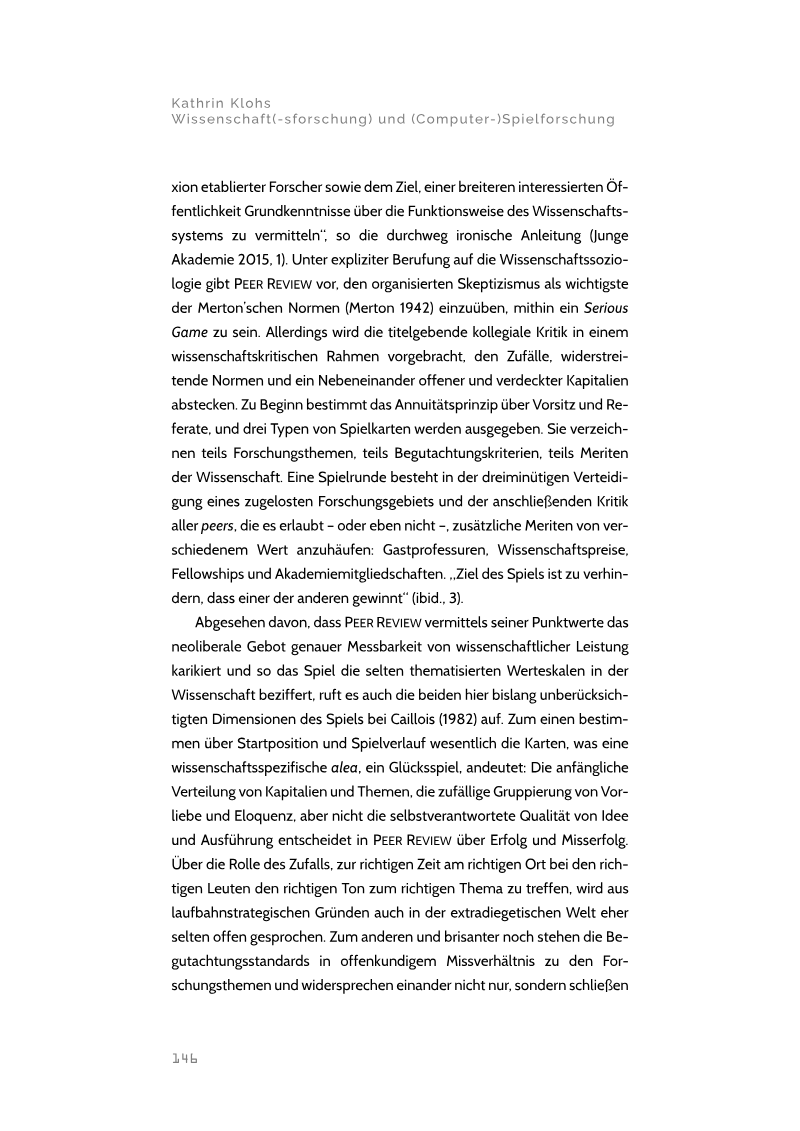
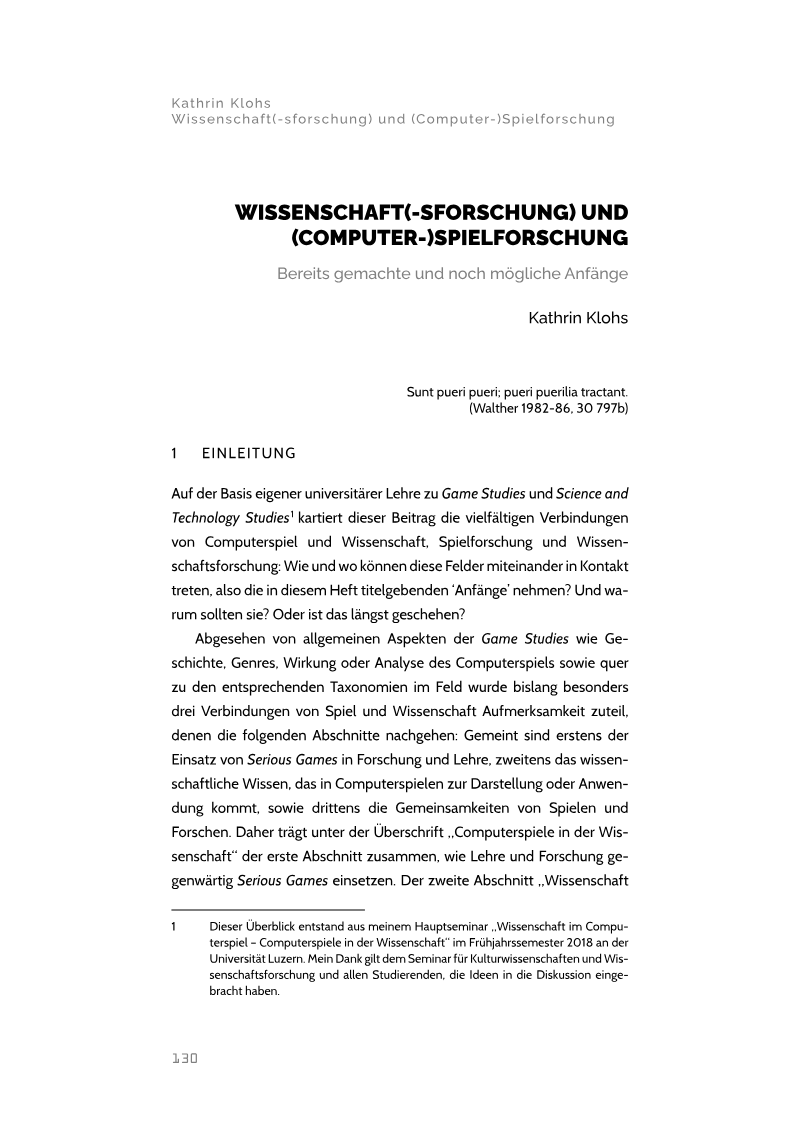
Kathrin Klohs, drawing on her university teaching in Game Studies and Science and Technology Studies, maps connections between computer games and science, published in the first issue of the journal Spiel|Formen.
- The author states that empirical findings on computer and serious games are more differentiated than the long-held view of gaming youth as prone to violence, inattention and lack of exercise.
- Citizen science projects built on frequented online games are described as drawing on the community's work as well as the computing power of their devices.
- According to the author, players in such projects take part not only in data collection but also in analysis, interpretation, defining research problems and selecting methods.


Kartenspiele: Die Anfänge moderner Games
Claudius Clüver's essay, published in the series Spiel|Formen (Heft 1: Anfänge), traces the history of playing cards as the origin of the modern game concept in early modern European civic culture.
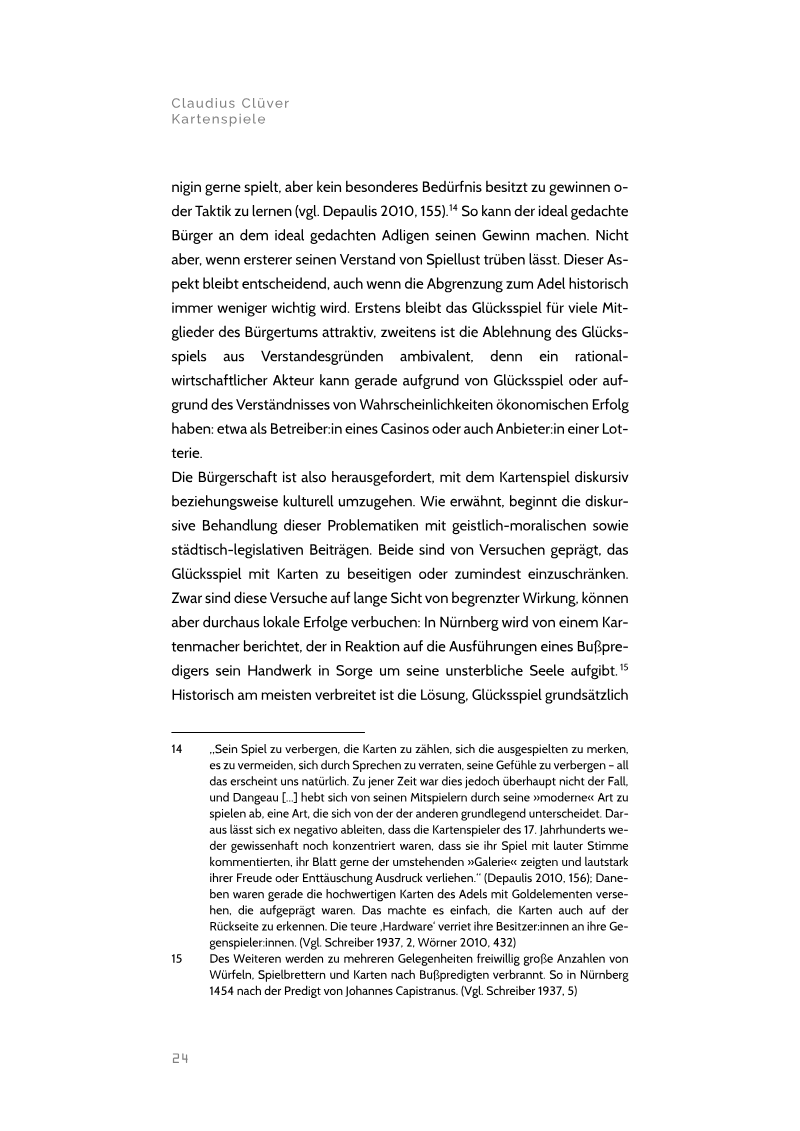
- Playing cards were produced in series from the woodcut era, with serial production already realised by the 15th century, and paper's transportability made them a cross-regional trade good.
- Card play was practically exclusively gambling until around 1600, with skill-based games appearing only gradually over time.
- The author links the card-table gambling discourse to the emergence of probability theory, citing Strouhal and Schnyder's view that the probabilistic revolution began at the gaming table.


Creating Playgrounds in Online Teaching Spaces: Kanami and Nene's "Hero Journeys"
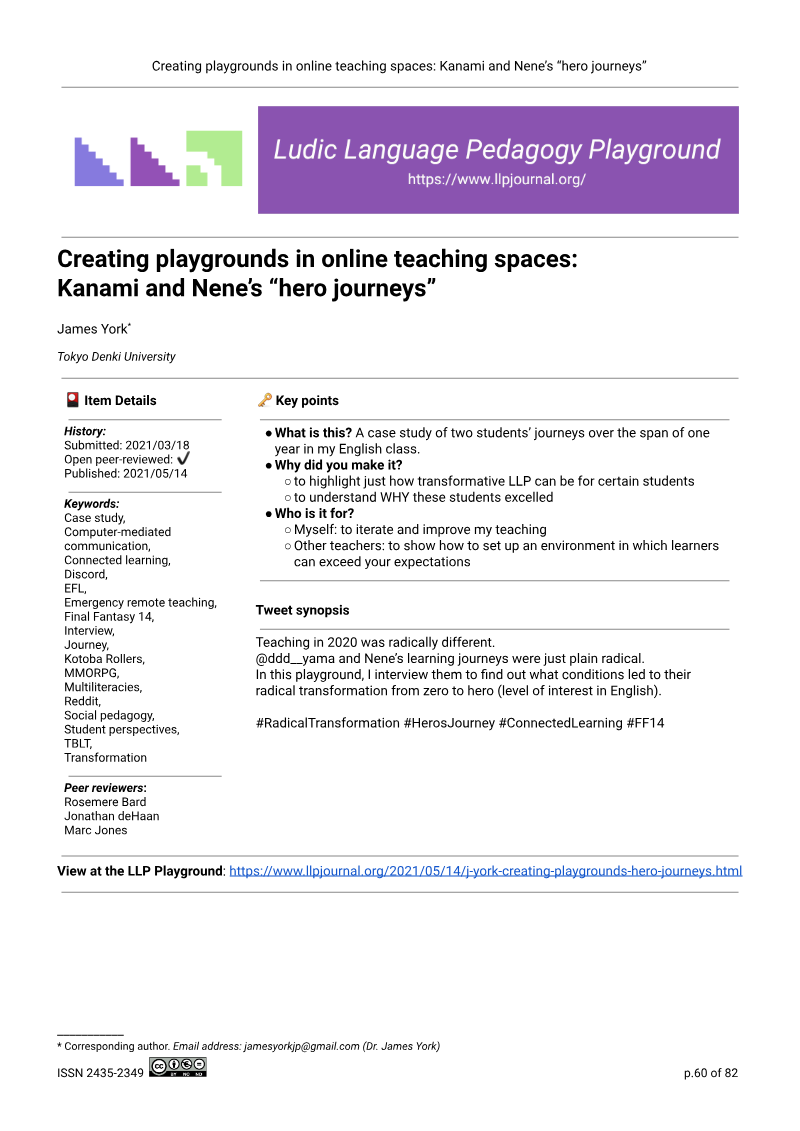
James York, of Tokyo Denki University, presents a case study of two first-year female students, Kanami and Nene, across one year of his English class, which was conducted entirely online during the COVID-19 emergency remote teaching context in 2020.
- Both students started the course with negative views of English, and Nene's reflection describes a shift from English as a required study to something she wanted to do.
- The author identifies three conditions behind Nene's growth as an active English learner: interest, community, and opportunity, which align with the Connected Learning keywords.
- The two students submitted five best-play clips each, with an average video length of 7.5 minutes each, because they had many recordings to choose from after playing outside class with English speakers.
The Musical Ludo Mix of Taiko no Tatsujin
Costantino Oliva's paper, published in the Transactions of the Digital Games Research Association in March 2021 (Vol. 5 No 2, pp.
- The author argues that the musical literacy conveyed by Taiko no Tatsujin extends beyond media references to taiko drumming culture, which the paper describes as a largely oral, non-notated practice.
- The paper reports that by the end of the 1990s, over 350 CDs of game music were available on the Japanese market, citing Yamakami and Barbosa.
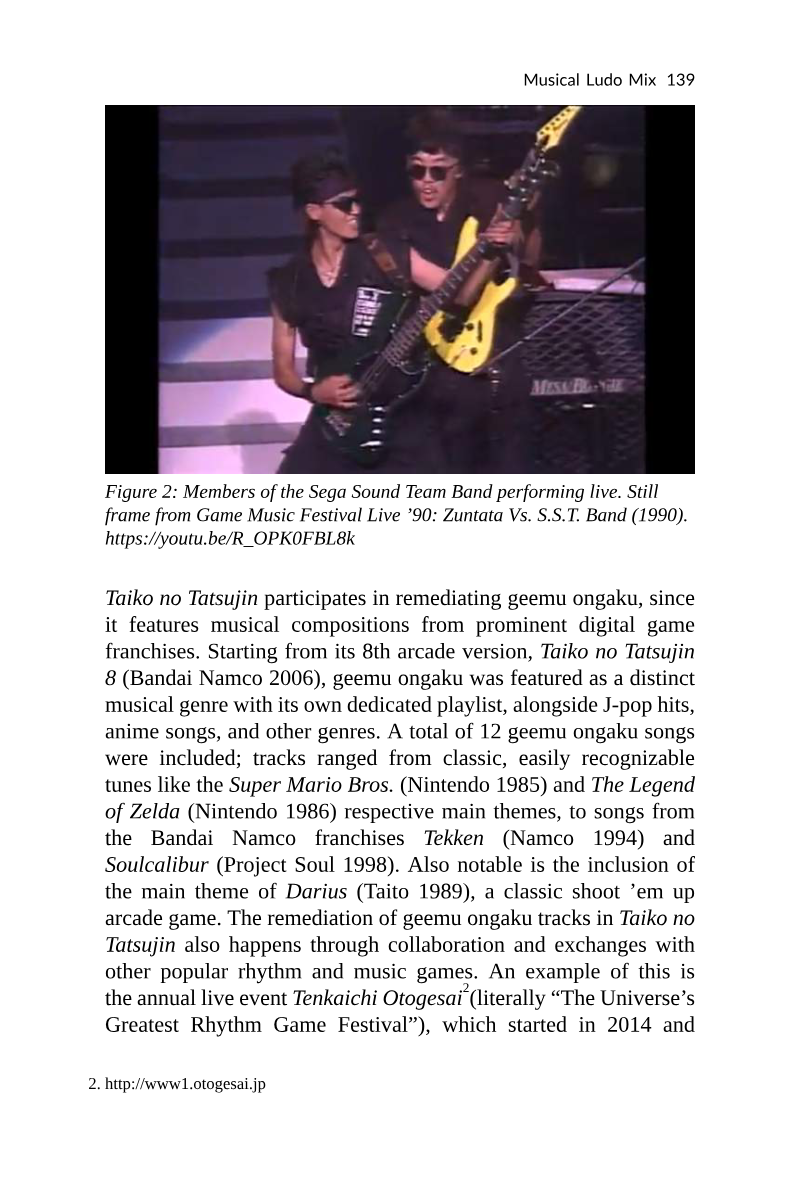
- Starting with Taiko no Tatsujin 8 in 2006, game music was featured as a distinct genre with its own dedicated playlist, containing 12 geemu ongaku songs.
The Ludo Mix and the Loss of In-Game Narrative: A Case Study of the Final Fantasy XV Universe
This article, published in the Transactions of the Digital Games Research Association (March 2021, Vol. 5 No 2, pp.
- Tabata gave the reason for the transmedia approach as avoiding having to ship the story as multiple games, which the author notes presupposes that a single story needs multiple games.
- The article reports that Insomnia, which is perhaps even more relevant to the plot of the game, is prominently featured in the film and anime but has been relegated to a mere dungeon in the main game.
- The author states that the Final Fantasy XV Universe includes a CGI feature film, an anime series, an audio drama, a novel, manga, six separate games, and episodic DLC.

Game Designers and the Ludo Mix: Constructing an Aesthetic Experience
This paper by Laureline Chiapello, published in the Transactions of the Digital Games Research Association (March 2021, Vol. 5 No 2, pp.
- The author argues that ludo mixes ought to be seen as grand experiences rather than grand narratives, shifting focus from story to a whole experience.
- In the first phase, students mostly transposed anime elements into games in a straightforward manner, ending with "a bunch of mechanics" rather than cogent game systems.
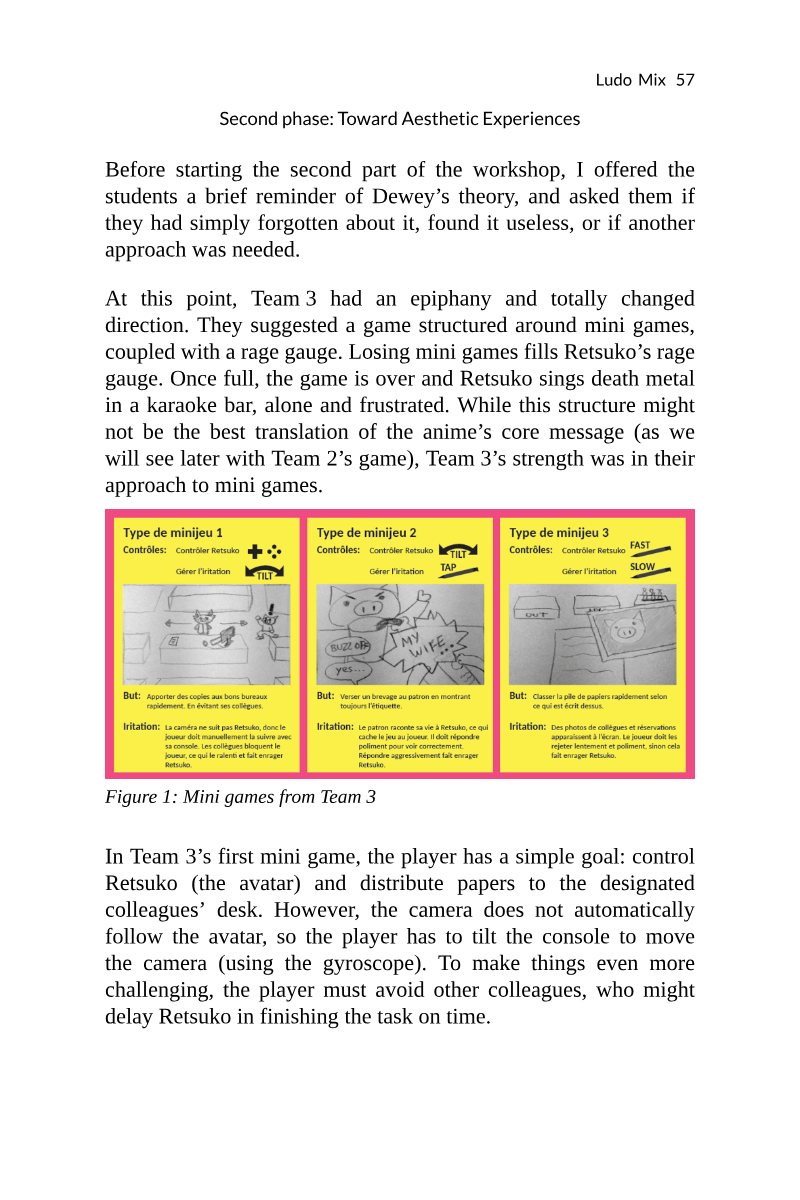
- After a reminder of Dewey's theory, one team restructured its game around mini-games coupled with a rage gauge, where losing mini-games fills Retsuko's rage gauge.
How We Developed Both Inside and Outside a "Games and Multiliteracies" Seminar: A Comparison of a Society-Focused Journey and a Self-Focused Journey
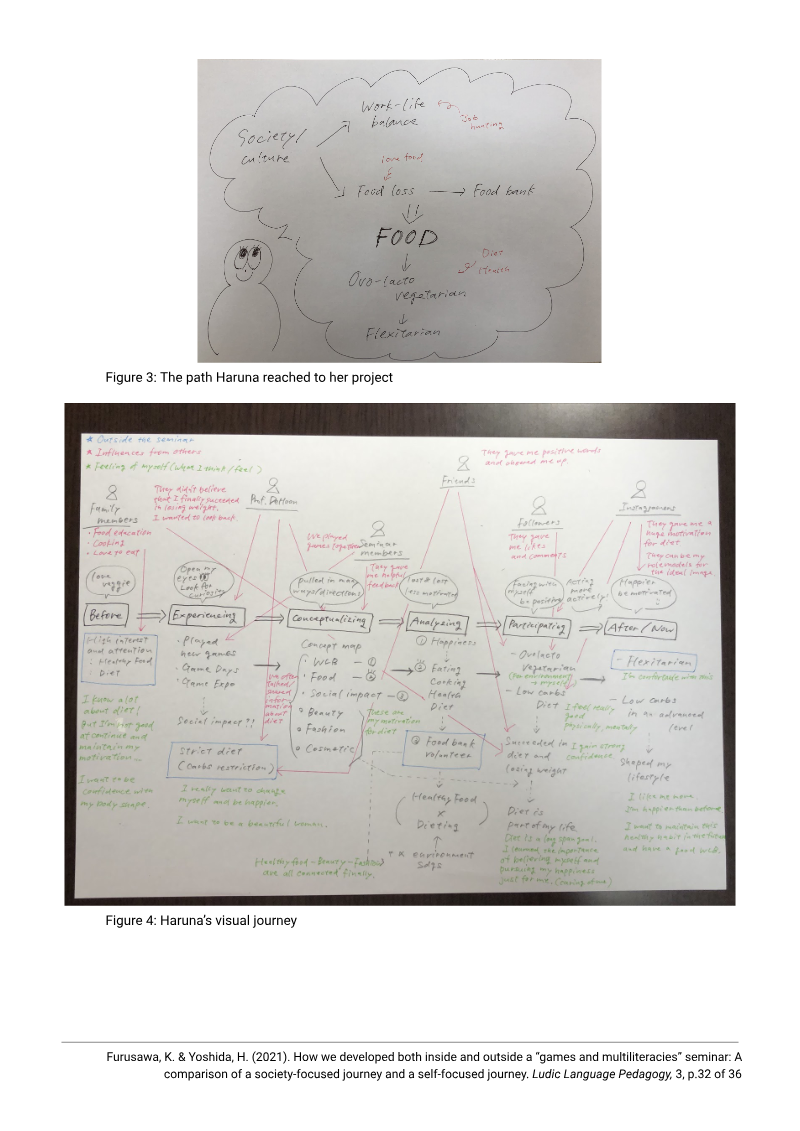
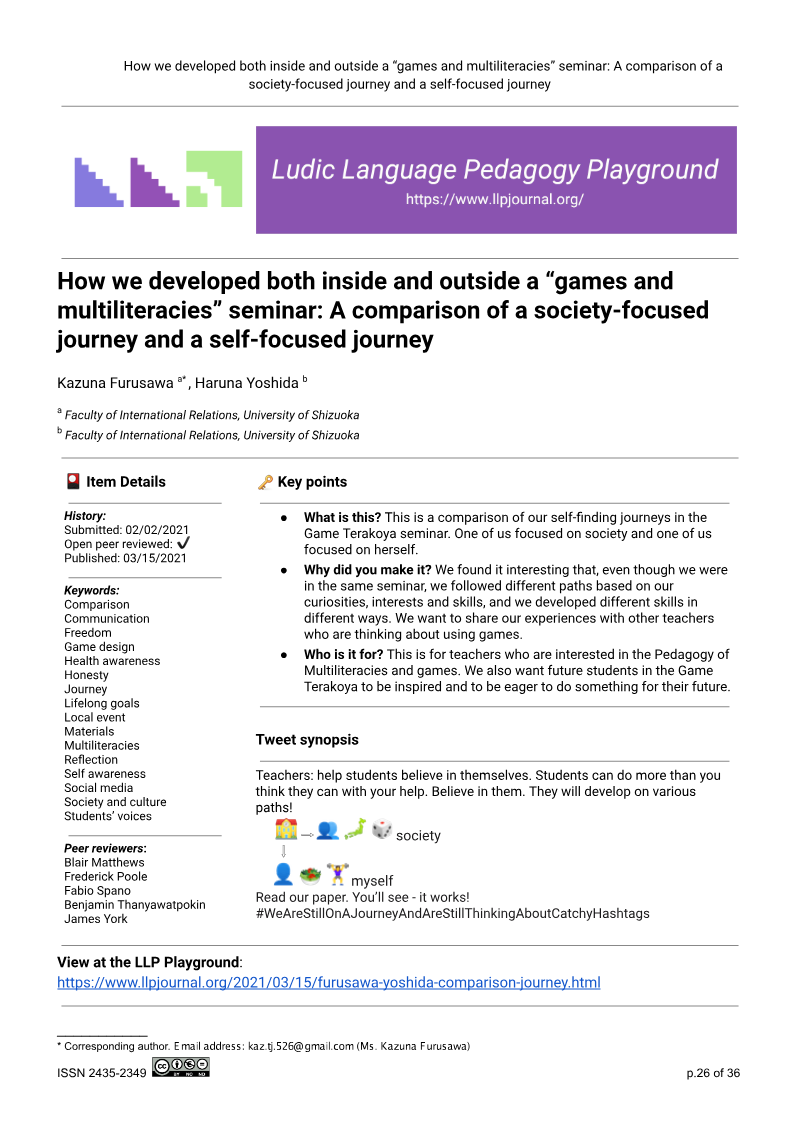
This analysis examines the developmental trajectories of two university students participating in a "Games and Multiliteracies" seminar at the University of Shizuoka.
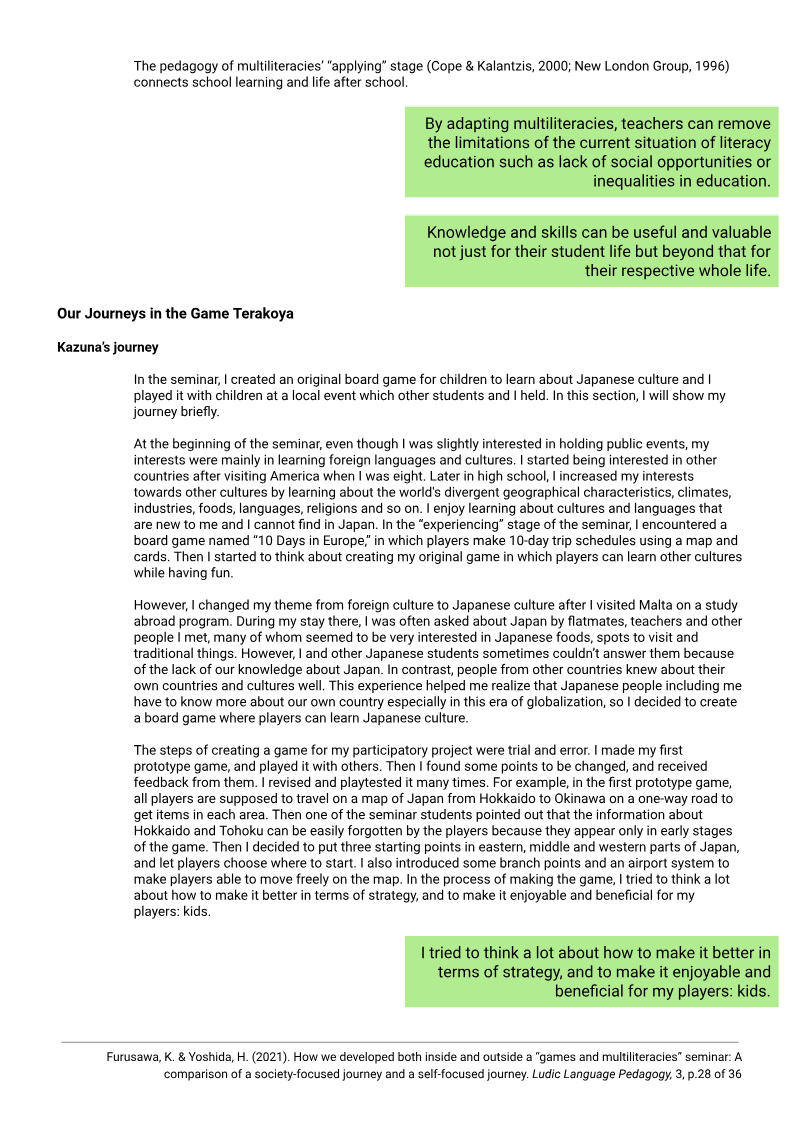
- A multiliteracies-based pedagogy allows students to achieve highly individualized learning outcomes by connecting academic assignments to personal interests and real-world applications.
- The 'Game Terakoya' seminar at the University of Shizuoka demonstrates that a single curriculum can successfully facilitate both society-oriented community engagement and self-oriented personal transformation.
- Students pursuing a society-focused path through board game development and local event facilitation reported gains in creative thinking, teamwork, and professional clarity regarding community involvement.
Heterodoxy in Game History: Towards More Connected Histories
The primary purpose of this analysis is to advocate for a transition in game history scholarship from isolated, local case studies toward more integrated, connected histories.
- Game history scholarship must transition from isolated, local microhistories toward integrated, transnational analyses to accurately reflect the hybrid nature of digital gaming development.
- Local game history research is inherently heterodox, as it frequently identifies outlier examples in peripheral regions that challenge established North American and Japanese-centric grand narratives.
- Digital gaming development was historically defined by the interaction between local structural factors, imported hardware components, and international distribution networks rather than purely local innovation.
Introduction: Game History and the Local
This chapter is the introduction to the edited volume Game History and the Local, by Melanie Swalwell, published in 2021 as part of Palgrave's Games in Context series.
- Widely cited sales claims about early home computing and console markets were presented without stating the geographic market they describe.
- Garda and Grabarczyk's data shows Polish 8-bit tape publishing peaked later than the worldwide trend, around 1993 rather than the 1980s.
- Sandqvist's study covers the development of the Swedish game industry between 1990 and 2010, combining Statistics Sweden data with developer interviews.

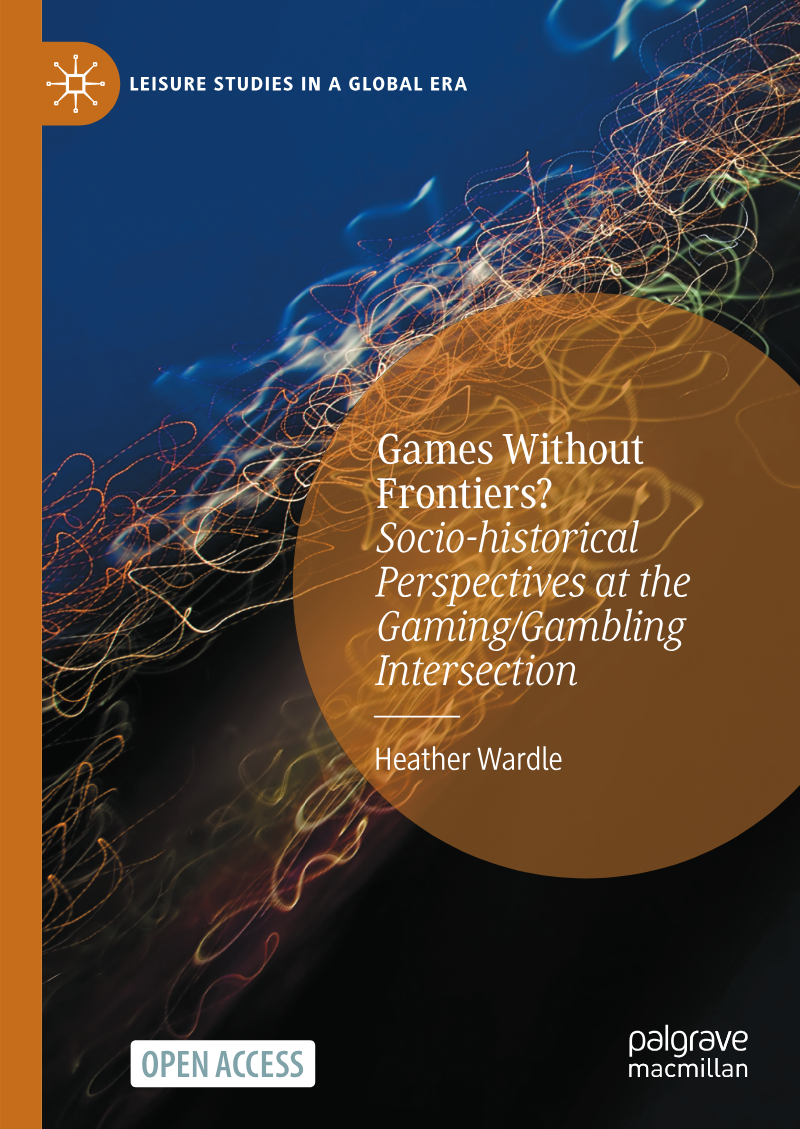
Games Without Frontiers? Socio-historical Perspectives at the Gaming/Gambling Intersection
This book by Heather Wardle, a University of Glasgow researcher, is part of the Palgrave Macmillan Leisure Studies in a Global Era series and is open access.
- Among 16-24-year-olds in the author's British study, people who paid money for loot boxes, rather than obtaining them through play, were more likely to experience problem gambling.
- The author's research found that two out of five skin bettors displayed problem gambling behaviours, compared with one in fifty among those who did not bet skins.
- A 2019 estimate found around 9% of adult Americans engaged in daily fantasy sports, which the author notes is over 20 million people.
Writers
Games and companies
Games