Report33 pages
Annual Report of the German Games Industry 2023
The German games industry demonstrated remarkable resilience throughout 2022, maintaining a stable market valuation of 9.87 billion euros despite global economic headwinds, inflationary pressures, and hardware supply constraints. This performance represents a 1% growth rate, bucking international trends of market decline. The sector’s expansion is further evidenced by a 15.5% increase in the number of companies and a 7% rise in the workforce over the past year. Mobile gaming continues to dominate revenue streams, while digital distribution has solidified its position as the primary purchasing method for PC users and younger demographics.
Despite this growth, the industry faces structural challenges that threaten its long-term international competitiveness. A critical shortage of skilled labor in programming, technical art, and production persists, exacerbated by bureaucratic hurdles that impede the recruitment of international talent. Furthermore, the intermittent availability of federal funding has created an environment of instability, hindering strategic planning. To address these issues, the industry is advocating for a transition toward tax-based incentives, improved educational standards, and the establishment of specialized academic institutions to foster domestic expertise.
Beyond economic metrics, the sector is increasingly focused on professionalizing its ecosystem and enhancing its global footprint. Events such as Gamescom and the devcom Developer Conference have reinforced Germany’s status as a central hub for digital innovation, attracting significant international attention and political engagement. Simultaneously, the industry is prioritizing sustainability through climate-neutral initiatives and strengthening youth protection frameworks to ensure a safe gaming environment. By aligning advocacy efforts with a commitment to diversity and educational outreach, the German games sector aims to secure its position as a leading global player in the digital economy.
- The German games market remained resilient in 2022 with a valuation of 9.87 billion euros, achieving 1% growth despite global economic pressures.
- The industry saw significant structural expansion, marked by a 15.5% increase in the number of companies and a 7% rise in the total workforce.
- Mobile gaming remains the primary revenue driver, while digital distribution has become the standard purchasing method for PC users and younger demographics.
- A persistent shortage of skilled labor in programming, technical art, and production is currently hindering the industry's long-term international competitiveness.
- Industry advocates are pushing for a shift from intermittent federal funding to a more stable system of tax-based incentives to improve strategic planning.
+1
game – Verband der deutschen Games-Branche e. V.
Report41 pages
Annual Report of the German Games Industry 2024
The German games industry reached a total revenue of 9.97 billion euros in 2023, marking a 6 percent increase driven largely by hardware sales, mobile gaming, and in-game purchases. Despite this financial expansion and a 52 percent growth in the number of development and publishing companies since 2020, the sector faces a period of cooling optimism. A challenging international economic climate, coupled with the unpredictability of federal funding, has slowed the pace of new company formations and employment growth. While Germany maintains its position as the largest games market in Europe, domestic developers are increasingly disadvantaged by a reliance on fixed-budget funding models that lack the stability of the tax credit systems utilized by international competitors.
To secure long-term competitiveness, the industry is advocating for a transition to a hybrid, tax-based funding model. Strategic priorities for 2024 include the cultivation of a specialized workforce, the integration of gaming into educational frameworks, and the expansion of digital infrastructure. These efforts are complemented by a strong commitment to social and environmental responsibility. A significant majority of companies have adopted sustainability measures, such as transitioning to green energy, while industry-led initiatives continue to promote diversity, combat toxicity, and provide professional support for esports athletes through structured talent development programs.
The industry’s cultural and economic influence remains anchored by the global success of gamescom, which continues to expand its international footprint through satellite events in Singapore and Brazil. Furthermore, the sector is prioritizing rigorous youth protection standards and the promotion of games as essential cultural and educational tools. By balancing these community-focused initiatives with a push for more consistent federal policy, the German games industry aims to solidify its status as a premier global hub for development, innovation, and esports, ensuring both economic resilience and social sustainability in an evolving digital landscape.
- The German games industry generated 9.97 billion euros in revenue in 2023, representing a 6 percent year-over-year increase driven by hardware, mobile gaming, and in-game purchases.
- While the number of development and publishing companies has grown by 52 percent since 2020, the sector is experiencing a slowdown in new company formations and employment growth due to economic instability and unpredictable federal funding.
- Industry stakeholders are advocating for a shift from fixed-budget funding to a hybrid, tax-based model to remain competitive against international rivals who benefit from more stable tax credit systems.
- Germany remains the largest games market in Europe, with its global influence bolstered by the international expansion of the gamescom event into markets like Singapore and Brazil.
- Strategic priorities for 2024 include workforce development, the integration of gaming into educational frameworks, and the improvement of digital infrastructure.
+1
game – Verband der deutschen Games-Branche e. V.
Report162 pages
Corporate Responsibility Report 2020: Germany
This PDF document contains all information on accountability (“Management & facts”) from Deutsche Telekom’s 2020 CR Report. Version: 20.01.2022 The themed pages “Green future”, “Digital life”, “New ways of working”, and “Good stewardship” may be downloaded individually using the “Print this page” function or as one document using the “Info basket” function.
- Deutsche Telekom's 2020 Corporate Responsibility Report highlights a strong focus on compliance, with 122 reports made via the "Tell me!" portal, 38 confirmed as misconduct, and 63 investigated as compliance cases. Most tip-offs concerned financial compliance interests.
- The company's sustainable capital investment strategy for the Deutsche Telekom Pension Fund was recognized in 2019, placing second in the "ESG Implementation" category at the Institutional Assets Awards.
- In 2020, 45% of supplier violations were related to occupational health and safety, 15% to working hours, and 14% to environmental issues. One supplier's business relationship was terminated due to indications of forced labor and youth labor protection lapses, and only resumed after corrective measures were verified.
- Deutsche Telekom calculates an "Enablement Factor" for climate protection, which was x4.31 in 2020 (excluding USA), representing 38.0 million metric tons of CO2e emissions reductions by customers against 8.8 million metric tons of DT's own CO2e emissions.
- In 2020, over 235 million online bills were sent to mobile and fixed-line customers in Germany, accounting for approximately 83% of all bills and credit notes. Additionally, discounted food sales after 4 p.m. at two German locations prevented 2,400 items from being thrown away since November 2020.
+1
Deutsche Telekom
Report39 pages
German Games Industry: 2025
The German games industry navigated a period of significant contraction in 2024, with total market revenue falling 6% to €9.4 billion. This downturn, driven by a decline in mobile revenue and console hardware sales, resulted in the first recorded reduction in the number of active companies and industry employees in recent years. Despite these headwinds, Germany maintains its status as the largest games market in Europe and the fifth largest globally. The domestic player base remains robust and increasingly diverse, encompassing 37.5 million individuals with an average age of 39.5 years, reflecting the deep integration of gaming into the national cultural fabric.
Strategic instability during this period stemmed largely from restrictive federal funding guidelines and project application freezes, which disproportionately impacted smaller studios. However, the outlook for 2025 is increasingly positive, anchored by a new coalition agreement that pledges to increase federal funding to €125 million annually by 2026 and introduce competitive tax incentives. These policy shifts aim to bolster Germany’s international standing, which industry leaders currently view as suboptimal despite the nation’s strong infrastructure, academic training programs, and successful startup initiatives like the "Press Start" grant.
To secure long-term growth, the industry is prioritizing a hybrid funding model, the establishment of a dedicated "Games University," and the expansion of digital cultural heritage projects, such as the AI-driven archiving of over 40,000 titles. Professionalization efforts continue through the game association, which represents over 500 members and manages critical networking platforms like gamescom. By integrating esports development, sustainability commitments, and structured career pathways, the German ecosystem is positioning itself to transition from a period of market correction toward a more resilient and internationally competitive future.
- The German games market contracted by 6% in 2024, resulting in total revenue of €9.4 billion and the first recorded decline in industry employment and active companies.
- Federal funding is set to increase to €125 million annually by 2026, supported by new competitive tax incentives designed to improve Germany's international market standing.
- Germany remains Europe's largest games market and the fifth largest globally, supported by a robust player base of 37.5 million people with an average age of 39.5.
- Market instability in 2024 was primarily driven by a downturn in mobile revenue and console hardware sales, alongside restrictive federal funding guidelines and project application freezes.
- The industry is prioritizing long-term growth through a hybrid funding model, the creation of a dedicated 'Games University,' and the AI-driven archiving of over 40,000 titles.
+1
game – Verband der deutschen Games-Branche e. V.Jan 2025
Report36 pages
Mobile Games: State of the Market & Playtime Q3 2023
Mobile games: state of the market & playtime Joint report of Apptica & Gamelight The purpose of this study is to analyse the state of gaming category in Q3 2023. All data presented in this report has been collected from Apptica and Gamelight platforms. "Games" category is defined by a store's tag. The basis of this analysis is made up of data from the Apptica's Store, Ad and Market Intelligence sections and Gamelight's playtime and app usage data.
- iOS remains the dominant platform for mobile gaming revenue, accounting for 56.01% of the total global share compared to 43.99% for Android.
- The United States and Japan are the leading revenue generators among major markets, contributing $2.92 billion and $2.03 billion respectively, with the six analyzed countries accounting for 59% of global gaming revenue.
- South Korea experienced the highest growth in game installs at 32% compared to Q3 2022, while the United States and France saw declines of 5% and 0.7%, respectively.
- Card games are the most engaging genre globally with an average playtime of 41.68 minutes, consistently ranking as the top genre for user engagement across analyzed regions.
- Average daily playtime is higher on iOS (38.69 minutes) than on Android (32.17 minutes) across the studied markets.
+6
AppticaJan 2023
Report31 pages
Annual Report of the German Games Industry 2022
01 Players in Germany 8 02 German market for computer 14 03 The games industry in Germany 26 .1 Employment figures and companies .3 The ten demands of the games industry 04 Esports 40 05 esports player foundation 42 06 gamescom and devcom 44 07 German Computer Games Awards 48 08 Entertainment Software 50 09 Foundation for Digital Games 52 10 About game –...
- The German games market grew by 19% in 2021, reaching €5.448 billion, following strong growth in 2020. In-game and in-app purchases were major growth drivers, increasing by 30% to €4.239 billion.
- 59% of Germans play computer and video games, a 6% increase since 2019, with 48% of players being women and 52% men. This indicates sustained engagement even after the pandemic-related surge in 2020.
- The German games industry is experiencing an upward trend, with increases in both companies and employees in 2021 and 2022. This growth is partly attributed to increased games-related study programs at universities.
- Germany has introduced a games funding scheme and its first federal games strategy, which aims to make Germany a globally competitive location for the games industry. Regional funding has also increased, with new schemes launched in Rhineland-Palatinate and plans in Mecklenburg-Vorpommern and Schleswig-Holstein.
- Esports has become a mass movement in Germany, with a growing number of hobby players, clubs, and professional esports players. The esports player foundation provides comprehensive support for aspiring professionals, including sports psychology, nutrition, and financial coaching.
Game – Verband der deutschen Games-Branche e.V.Jan 2022
Report18 pages
Key Insights Into German Gamers
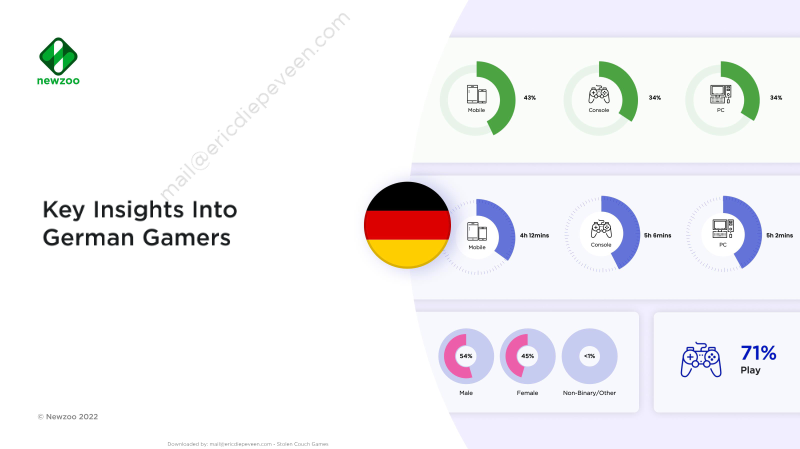
Germany represents a significant pillar of the global gaming industry, ranking as the largest games market in the European Union and the fifth largest worldwide by revenue. As of 2022, the German gaming landscape is characterized by a high level of engagement, with 71% of the online population aged 10 to 65 identifying as game enthusiasts. This engagement extends beyond active play to include viewing gaming video content, social interaction, and community participation.
The demographic profile of German players is nearly balanced by gender, consisting of 52% males and 48% females. While gaming is popular across all age groups, the 21-35 age bracket represents the largest segment at 31%. Motivation for play is primarily driven by the desire to relax and unwind, followed by the pursuit of achievement and social connection. Among the various gamer personas, Time Fillers and Mainstream Gamers are the most prevalent, reflecting a mix of casual mobile play and more dedicated multi-platform engagement.
Platform preferences show that mobile gaming has the highest reach, utilized by 43% of the online population, followed by console and PC at 34% each. Despite the higher reach of mobile, PC and console players demonstrate higher average weekly play times, exceeding five hours. Popular titles in the market include Minecraft, Roblox, and Grand Theft Auto V, with Adventure and Action genres leading in popularity.
Monetization remains strong, with 63% of players spending money on games. The primary driver for spending is the availability of sales or special offers, though a significant portion of consumers also pays to unlock exclusive content or to personalize their in-game experience. These findings are based on a 2022 survey of 2,057 online consumers in Germany, forming part of a broader global research initiative covering 36 markets.
- Germany is the largest gaming market in the EU and the fifth largest globally, with 71% of the online population aged 10 to 65 identifying as game enthusiasts as of 2022.
- Mobile gaming has the highest market reach at 43%, though PC and console players demonstrate higher engagement with average weekly play times exceeding five hours.
- The German gaming demographic is nearly gender-balanced at 52% male and 48% female, with the 21-35 age bracket serving as the largest segment at 31%.
- Monetization is robust, as 63% of players spend money on games, primarily driven by sales, special offers, and the desire to unlock exclusive content or personalization options.
- Adventure and Action are the leading genres in the market, with Minecraft, Roblox, and Grand Theft Auto V identified as popular titles.
+1
NewzooJan 2022
Report70 pages
State of Mobile: Germany 2022
The German mobile market experienced a period of rapid acceleration in 2021, characterized by a 72% increase in consumer spending over two years to reach $4.0 billion. Daily engagement rose to 3.4 hours per user, with social and video applications capturing 60% of that time. While gaming remains the primary economic driver, accounting for over 70% of total app spend and $2.8 billion in revenue, the broader ecosystem saw significant diversification into finance, retail, and health sectors. High-performance titles like Genshin Impact and Coin Master led the gaming sector, while neobanks and cryptocurrency platforms gained substantial traction among younger demographics.
The retail and service sectors underwent a digital transformation, evidenced by record-breaking engagement in shopping apps and a 37% surge in food and drink sessions. This growth was fueled by the rise of rapid delivery services and international publishers capturing larger shares of the German market. Simultaneously, the health sector remained robust, with local utility apps like CovPass and Corona-Warn-App dominating download charts due to pandemic-related requirements. This period also marked a significant rebound for travel and sports engagement, which grew by 25% and 45% respectively as restrictions eased and major international events returned.
Social and entertainment categories continue to anchor the mobile experience in Germany. WhatsApp maintains its position as the leading app by time spent, while TikTok saw a 75% year-over-year increase in engagement. Consumer spending in non-gaming categories is increasingly driven by dating and streaming services, with dating app revenue surging 115% since 2018. Overall, the German mobile landscape is defined by a sophisticated mix of high-spending gaming audiences, a rapidly maturing mobile commerce sector, and a strong reliance on mobile utilities for daily life and public health.
- The German mobile market reached $4.0 billion in consumer spending in 2021, marking a 72% increase over two years.
- Gaming remains the primary economic driver, generating $2.8 billion in revenue and accounting for over 70% of total app spending, led by titles like Genshin Impact and Coin Master.
- Daily mobile engagement reached 3.4 hours per user, with social and video applications capturing 60% of that time.
- Dating app revenue has surged 115% since 2018, while TikTok engagement grew by 75% year-over-year.
- The retail and service sectors saw significant digital transformation, highlighted by a 37% surge in food and drink app sessions.
+1
data.aiJan 2022
Report26 pages
Annual Report of the German Games Industry 2021
01 Players in Germany 8 02 German market for computer 14 03 The games industry in Germany 24 .1 Employment figures and companies .4 The ten demands of the games industry 04 gamescom 38 05 About game – the German 42 .1 Diversity initiative Hier spielt Vielfalt .2 Environmental and climate protection in the .3 Foundation for Digital Games Culture .5 Entertainment Software Self-Regulation Body 06 D...
- The German games market experienced significant growth in 2020, with overall sales revenue increasing by over 30% due to the COVID-19 pandemic. Hardware sales, including consoles and gaming PCs, reached a record high, and subscription services saw a 44% increase in sales revenue.
- Germany launched a major EU-notified games funding guideline in late 2020, with several studios receiving over one million euros in funding, marking a significant first for the country's games industry.
- The number of companies in the German games industry increased by 5% for development and publishing companies and 7% for publishing-focused companies in 2021. However, employment in the core market grew by only 8% to 10,906 people, indicating that most new companies are microenterprises.
- gamescom 2020 successfully transitioned to a digital format due to the pandemic, attracting millions of viewers from over 180 countries and featuring 370 partners across five show formats, with gamescom: Opening Night Live being a highlight.
- game – the German Games Industry Association, with approximately 340 members including developers and publishers, advocates for improved industry conditions, youth protection, and diversity, and has been climate-neutral since early 2021.
+1
game – Verband der deutschen Games-Branche e. V.Jan 2021
Report43 pages
Games Industry 2019/20
Germany stands as Europe’s largest video‑game market and the world’s fifth‑largest, a position reinforced by a robust developer community, flagship events and a policy framework that actively subsidises production. Federal funding of €50 million per year, allocated as non‑repayable grants covering a quarter to half of project costs, is complemented by regional programmes and a business climate that benefits from a sizable domestic audience and a highly skilled workforce.
The market generated a record €4.4 billion in 2018, expanding 9 percent year‑on‑year, while the sector’s organisational base grew to roughly 524 game‑related firms that year. These include 368 development studios, 38 pure publishers and a further 118 hybrid entities, employing about 11 000 staff directly in development and nearly 28 000 when ancillary roles are counted. More than 50 higher‑education institutions now deliver dedicated curricula in game design, computer science, art and virtual reality, concentrating talent pipelines in Berlin and Hamburg.
Mid‑size studios such as Deep Silver, Kolibri Games and Mimimi have produced internationally recognised titles, and the annual gamescom exhibition in Cologne underscores the industry’s global reach. In 2023 the event attracted 31 300 trade professionals, delivered over 500 000 concurrent viewers for its Opening Night Live broadcast and amassed more than 100 million video hits, prompting the launch of a gamescom Asia edition in Singapore to capture growth in the Asia‑Pacific region.
A dense network of over 200 development and publishing firms and more than 150 specialist service providers—spanning localisation, cloud infrastructure, legal counsel, marketing and middleware—covers virtually every German city. This comprehensive, SME‑driven ecosystem, supported by mature ancillary services, positions Germany for sustained expansion and reinforces its role as a central hub for both domestic creation and international distribution of video‑games.
- Germany is the largest video-game market in Europe and the fifth-largest globally, generating a record €4.4 billion in 2018 with a 9 percent year-on-year growth rate.
- The German government supports the industry with €50 million in annual non-repayable grants, which cover 25 to 50 percent of project costs for developers.
- The sector comprises approximately 524 game-related firms, including 368 development studios, employing 11,000 staff directly and nearly 28,000 when including ancillary roles.
- The industry is supported by a robust talent pipeline from over 50 higher-education institutions, with development hubs concentrated primarily in Berlin and Hamburg.
- The annual gamescom exhibition in Cologne is a major international industry driver, attracting 31,300 trade professionals and over 100 million video hits in 2023.
+1
game – Verband der deutschen Games-Branche e. V.Jan 2020
Report27 pages
Jahresbericht der deutschen Games-Branche 2019
01 Gamer in Deutschland 6 02 Markt für Computer- und 12 03 Games-Branche in Deutschland 22 .1 Beschäftigtenzahlen und Unternehmen .4 Die 10 Forderungen der Games-Branche 04 eSports 36 05 gamescom 40 06 Deutscher Computerspielpreis 42 07 Unterhaltungssoftware 44 08 Stiftung Digitale Spielekultur 46 09 Über den game – Verband 48 Herausgeber ...
- The German games market grew by 14% to 3.5 billion Euros in 2018, driven by a 97% increase in revenue from online service fees (to 305 million Euros) and a 57% increase in in-game purchases (to 297 million Euros).
- 34.3 million Germans play computer and video games, with 48% being female. The average age of gamers has risen to 36.4 years, with nearly 10 million players over 50 years old, representing 29% of all gamers.
- The purchase of games as downloads or on physical media is no longer the largest market segment, declining by 10% to 1.1 billion Euros. Downloads accounted for 41% of sales and 28% of revenue in 2018, a slight decrease from 2017.
- Germany's games industry faces a challenging financing situation, making game production up to 30% more expensive than in other countries like France, the UK, and Canada, which have stronger government support.
- eSports is rapidly growing in popularity and economic potential in Germany, with major events like ESL One tournaments and the League of Legends Championship Series hosted there. Many German sports clubs and companies like Mercedes-Benz, Audi, and Vodafone are investing in eSports.
game – Verband der deutschen Games-Branche e. V.Jan 2019
Report27 pages
Arbeiten in der Games-Branche: Kreativität trifft Technologie
14 und kreative Köpfe, 14 folgende Frage höre und lese ich immer wieder: „Wie werde ich Spiele-Entwickler/in und was muss ich dafür mitbringen?“ Das ist auf die Schnelle gar nicht so leicht zu beantworten. Das Arbeiten in der Games-Branche ist unglaublich vielfältig und genauso zahl- reich sind auch die Wege, die dahinführen.
- The German games market is experiencing significant growth, with revenue increasing by 15% in 2017 compared to the previous year, and projections showing continued growth from 3689 million Euros in 2016 to an estimated 5295 million Euros in 2021.
- Digital sales and microtransactions are booming in the German games market, driven by mobile games and the free-to-play model, while sales of physical media are stagnating or declining.
- The average German gamer is 36.1 years old, with the largest player group being over 50, and women constitute 47% of players, indicating a broad and diverse audience for games.
- Game development is a highly interdisciplinary and collaborative process, typically involving teams of dozens or even hundreds of specialists (e.g., programmers, graphic designers, game designers, sound designers) working together, rather than individual creators.
- Key roles in game development include Game Designers (who conceive game ideas and systems), Programmers (who develop core systems), Graphic/Animation Artists (who create game worlds), Audio Designers (who create soundscapes), and Producers (who manage project completion, budget, and quality).
game.deJan 2019
Report31 pages
Game Fokus: Esports 2019
Editorial 6 01 Einleitung 8 02 Geschichte des eSports 14 Interview mit Alexander Müller, Gründer und Geschäftsführer beim eSports-Team SK Gaming 03 Status quo von eSports 22 Interview mit Melek Balgün, freie Moderatorin und eSports-Expertin Interview mit Alexander Jobst, Vorstand Marketing und Kommunikation, FC Schalke 04 Interview mit Toan Nguyen, Executive Director und Partner bei ...
- The German eSports market is projected to reach approximately 130 million Euros by 2020, representing an average annual growth of around 27 percent.
- Despite its growing relevance, eSports in Germany faces significant hurdles due to a lack of official recognition as a sport, unlike 50 other countries (including EU states like Austria, Netherlands, and Sweden) that already acknowledge and promote it.
- The German government, through the 2018 coalition agreement, has pledged to support eSports as its own sport with club and association rights, and the Foreign Office eased entry requirements for non-EU eSports athletes in August 2018, yet full equality with traditional sports is still missing.
- Sponsoring, advertising, media rights, ticketing, and merchandising are key revenue streams for eSports, with global revenues from media rights, sponsoring, and advertising alone projected to be around 897 million US dollars in 2019.
- Major non-endemic companies like Red Bull (sponsoring athletes and events for over 10 years) and Amazon (acquiring Twitch for nearly one billion US dollars in 2014) are heavily invested in eSports, with Twitch securing Overwatch League streaming rights for 90 million US dollars.
Sport1Jan 2019
Report27 pages
Jahresbericht der Deutschen Games-Branche 2018
01 Gamer in Deutschland 6 02 Markt für Computer- und 12 .2 Umsätze mit virtuellen Gütern und Zusatzinhalten sowie Abonnements .3 Umsätze mit Gebühren für Online-Netzwerke 03 Games-Branche in Deutschland 22 .1 Beschäftigtenzahlen und Unternehmen .4 Die 10 Forderungen der Games-Branche 04 eSports 36 05 gamescom 40 06 Deutscher Computerspielpreis 42 07 Unterhaltungssof...
- The German games market generated 2.2 billion Euros in 2017, growing 10% from 2016. This growth was driven by a 21% increase in revenue from virtual goods and additional content (reaching 1.01 billion Euros) and a 57% increase in revenue from online network fees (reaching 179 million Euros).
- Smartphone gaming has surpassed PC as the most popular gaming platform in Germany, with 18.2 million smartphone gamers compared to 17.3 million PC gamers in 2017. Console gaming also saw significant engagement with 16 million players.
- The German games industry is largely mid-sized, with 90% of companies generating up to 5 million Euros in annual revenue. It also boasts a high export quota, with 46% of its revenue earned outside Germany, significantly higher than the music (9%) and film/TV (4%) industries.
- The market share of German game developments continues to decline, reaching 5.4% in 2017 (down from 6.9% in 2014). This is particularly evident in mobile gaming, where the share of German-developed apps dropped from 4.2% to 3.7% due to increased competition and high marketing costs.
- The gamescom event attracted over 355,000 visitors in 2017, maintaining its position as the world's largest event for games. The number of exhibitors also grew by 6% to 703.
+1
game – Verband der deutschen Games-Branche e. V.Jan 2018