
Report
2016 Annual Report
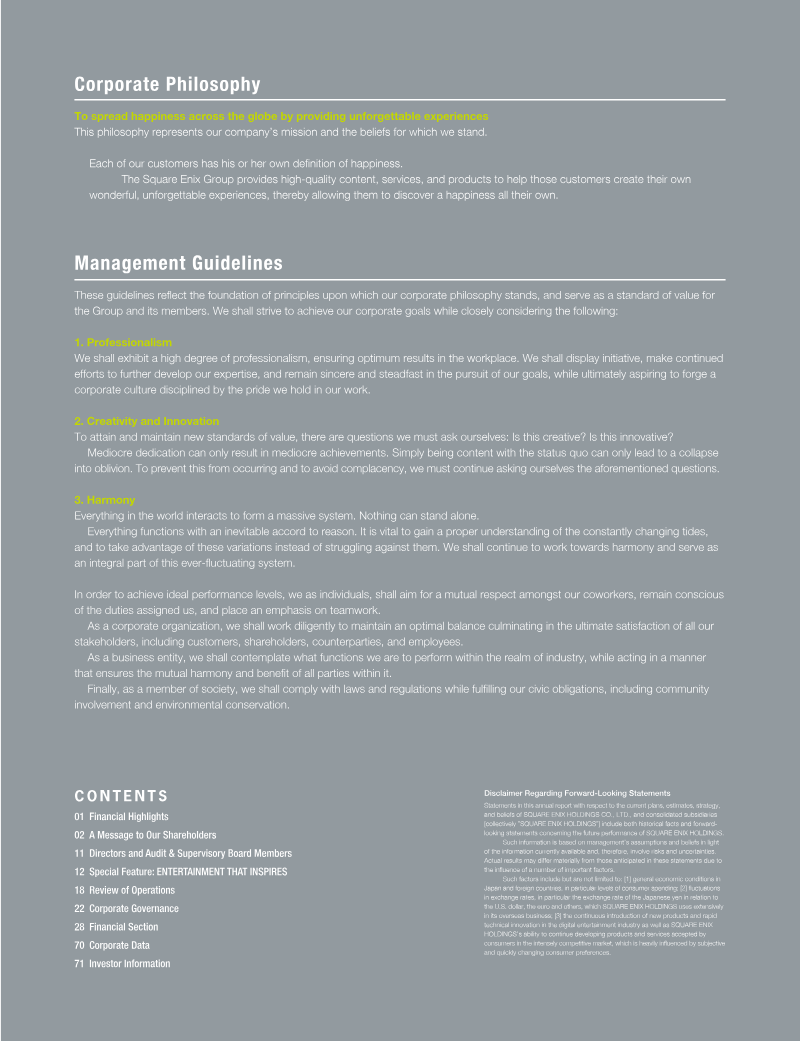
To spread happiness across the globe by providing unforgettable experiences To spread happiness across the globe by providing unforgettable experiences This philosophy represents our company’s mission and the beliefs for which we stand. The Square Enix Group provides high-quality content, services, and products to help those customers create their own Each of our customers has his or her own definition of happiness.
Square Enix
Report
Corporate Data: August 2025
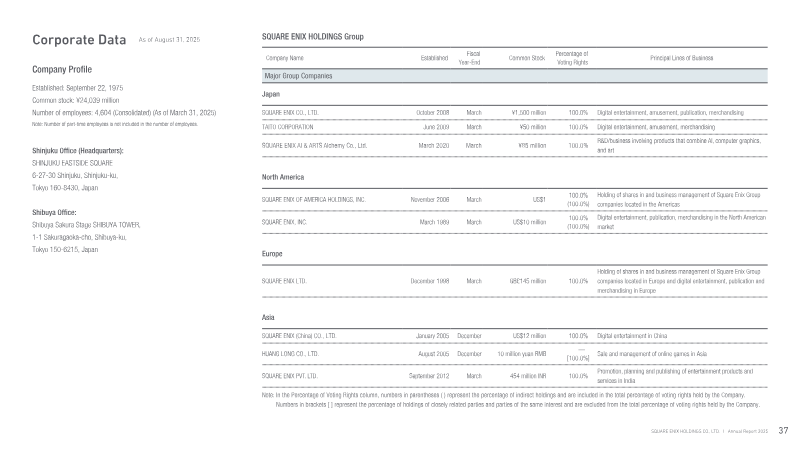
Corporate Data as of August 31, 2025 outlines the structure and financial standing of Square Enix Holdings Group. The parent company, established in 1975, reports consolidated common stock of ¥24 039 million and employs 4 604 full‑time staff as of March 31, 2025. The group’s core activities span digital entertainment, amusement, publication, and merchandising, with full voting control across all subsidiaries. Key subsidiaries include Square Enix Co., Ltd. (established 2008) with ¥1 500 million in common stock, and TAITO Corporation (established 2009) holding ¥50 million. The AI & ARTS Alchemy Co., Ltd. (established 2020) focuses on research and development in AI, computer graphics, and art. Regional holding entities—Square Enix of America Holdings Inc. (established 2006) and Square Enix Ltd. in the UK (established 1998)—maintain 100 % voting rights over North American and European operations, respectively. Square Enix (China) Co., Ltd. (established 2005) and Huang Long Co., Ltd. (established 2005) manage digital entertainment in China, while Square Enix Pvt. Ltd. (established 2012) handles promotion and publishing in India. The data covers Japan, North America, Europe, China, and India, reflecting a global footprint. No survey methodology is disclosed; figures derive from consolidated financial statements as of the stated dates. The report confirms complete ownership and voting control across all listed entities, underscoring Square Enix’s unified governance structure.
Square Enix