LegalVideo Games Europe
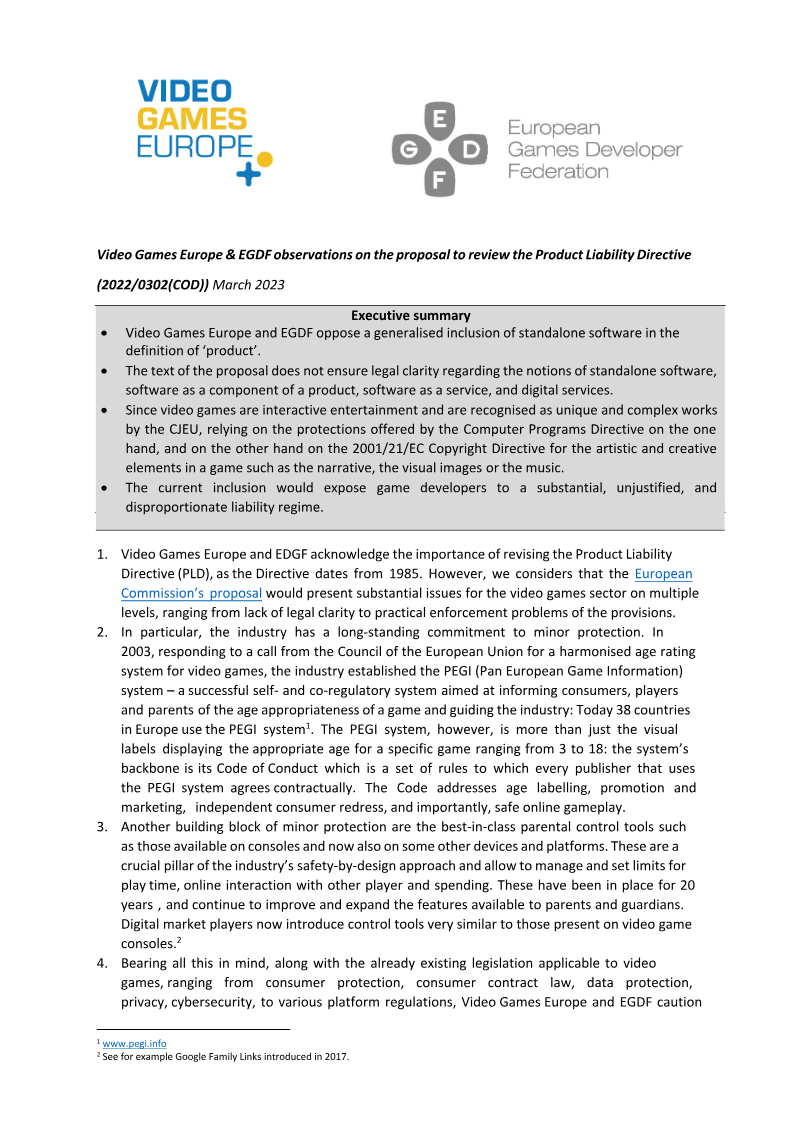
Video Games Europe & EGDF: Position on the Product Liability Directive Review
1 Mar 20235 pages~15 min full read
Video games and their developers argue that the European Commission’s proposal to revise the Product Liability Directive (PLD) would unjustly broaden liability by treating standalone software, including video games, as generic “products.” The core thesis is that video games are complex cultural works comprising software, music, narrative, graphics and user‑generated content, and therefore should not be subject to the strict, no‑fault liability regime designed for high‑risk physical goods. The position stresses that existing legal frameworks—such as the Computer Programs Directive, the 2001/21/EC Copyright Directive, the Digital Content Directive, the GDPR, and consumer‑rights legislation—already provide adequate protection, while the proposed PLD amendment would create legal uncertainty, overlap, and disproportionate exposure for developers.
Key findings highlight the sector’s long‑standing self‑regulation through the PEGI age‑rating system, now used in 38 European countries, and the deployment of parental‑control tools on consoles and other platforms for two decades. Survey data from the Commission’s impact assessment reveal low public support for compensating damages caused by intangible items that do not drive a device, with only 42 % agreeing to such liability for software apps and 48 % for the category that would include video games. The paper notes that the PLD’s definition of “defectiveness” relies on vague concepts such as “reasonably foreseeable misuse,” which could unfairly penalise iterative software development and frequent patching practices.
The scope of the argument covers the entire European Union, referencing 27 Member States and the broader digital market. Economic data underscore the sector’s significance: the European video‑games market generated approximately €23 billion in consumer spending in 2021, comprises over 5,100 studios with a combined turnover of €12 billion, and employs around 90 000 people. EGDF represents more than 2 500 developer studios and 45 000 employees across 22 countries. No primary survey was conducted; the analysis relies on existing EU impact‑assessment questionnaires and legal precedents from the Court of Justice of the EU.
Conclusions call for the exclusion of video games from the PLD’s definition of “product,” warning that the proposed liability regime could deter innovation, increase litigation risk, and undermine Europe’s digital and cultural future. The paper urges policymakers to retain the current, sector‑specific regulatory architecture and to avoid a one‑size‑fits‑all approach that fails to distinguish between high‑risk physical products and interactive digital entertainment.
Video Games Europe · 2026

Video Games Europe · 2026

Video Games Europe · 2026

Video Games Europe · 2026

Video Games Europe · 2026

Video Games Europe · 2026
Video Games Europe · 2025
Video Games Europe · 2025
Video Games Europe · 2025
Video Games Europe · 2025
Video Games Europe · 2025
Video Games Europe · 2025
8Bit · 2026

Ukie · 2025

Direcció General d’Innovació i Cultura Digital · 2025
PCF Group · 2025

Departement Cultuur · 2025
PCF Group · 2025
Polish Agency for Enterprise Development · 2025

AEVI · 2025

InGameJob · 2025

11 bit studios · 2024
PGDA – Pioneers of Game Development Austria · 2024

Austrian Professional Association of Management Consultancy · 2024