Updated Mar 17, 2026 by Video Games Europe
Legal · May 1, 2023
Published by Video Games Europe
Video Games Europe argues that imposing network fees on high‑bandwidth users would harm consumers, the broader Internet ecosystem and the European video‑games sector. The contribution to the European Commission’s exploratory consultation stresses that such fees are legally, technically and practically untenable, and directly conflict with the net‑neutrality principle enshrined in the Open Internet Regulation. It contends that content and application providers (CAPs) do not “free‑ride” on telecom infrastructure; instead, they generate demand that fuels competition and investment in connectivity, creating a mutually reinforcing virtuous cycle that benefits both ISPs and end‑users. The position paper highlights several concrete concerns. First, mandatory contributions would add a financial burden to video‑game publishers already obliged under the Digital Content Directive to deliver frequent updates and security patches, potentially requiring costly deep‑packet inspection to differentiate fee‑eligible traffic. Second, the introduction of traffic‑based fees threatens the equal treatment of data flows, jeopardising net neutrality and prompting opposition from civil‑society groups and a large cohort of European Parliament members. Third, the sector points to evidence from BEREC and ETNO that data‑traffic growth has not translated into proportional energy consumption, thanks to efficiency gains and renewable‑energy adoption; cloud‑based delivery models further reduce carbon footprints by limiting unnecessary downloads and hardware upgrades. Scope-wise, the analysis covers the European Union’s electronic‑communications market as of 2023, focusing on the video‑games industry, which comprises roughly 5,100 studios and publishers, generates an estimated €12 billion in annual turnover, employs over 90 000 people and recorded €23 billion in consumer spending in 2021. The contribution draws on industry membership data, BEREC sustainability reports and internal assessments rather than a formal survey, reflecting the collective view of 19 major publishers and national trade associations across 15 EU countries. The overarching conclusion is that network fees are unnecessary, would diminish Europe’s digital competitiveness, and could impede environmental progress, urging policymakers to preserve the current open‑Internet framework.

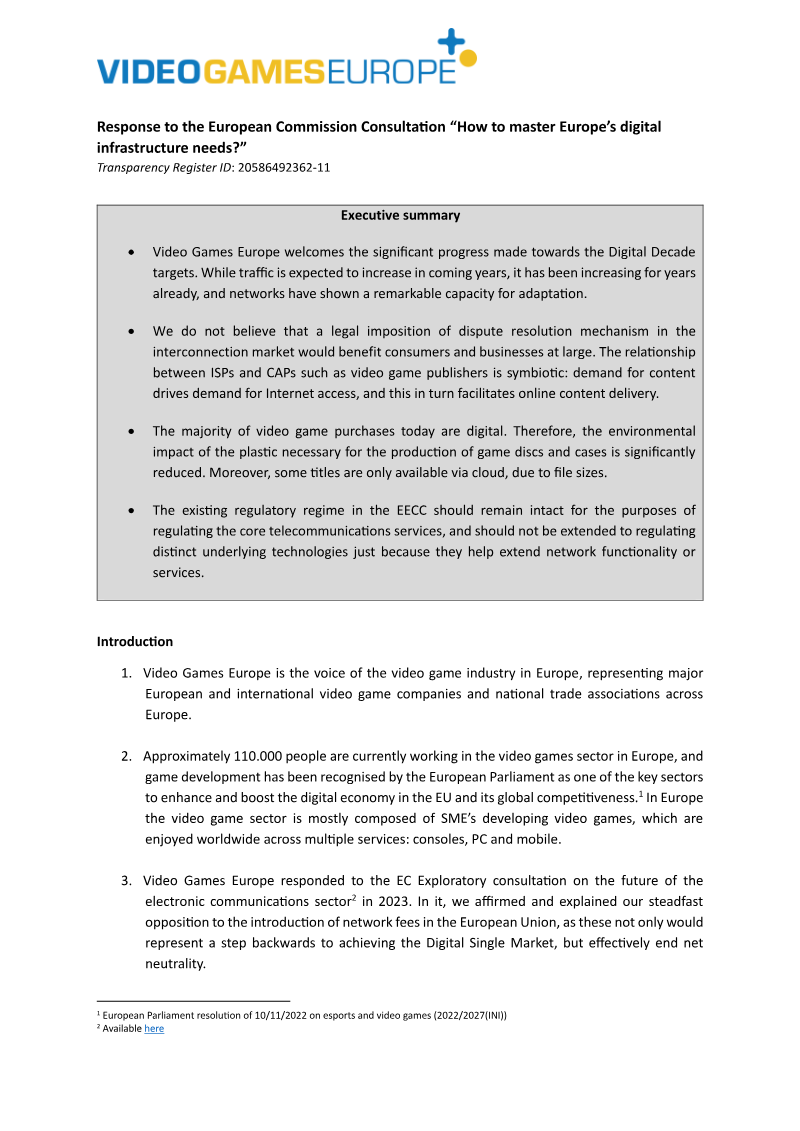
The future of the electronic communications sector and its infrastructure–Video Games Europereply EUROPE European Commission exploratory consultation: the future of the electronic communications sector and its infrastructure Video Games Europe contribution May 2023 Transparency register ID: 20586492362-11 Executive summary • Video Games Europebelieves that the introduction of network fees in the EU would not be of benefit to consumers and to the Internet ecosystem in general. • In addition to many legal, technical and practical difficulties, the introduction of network fees in the European Union would be incompatible with the principle of net neutrality adopted in the Open Internet Regulation. • Video Games Europe disagrees with the assumption that Content and Application Provers (CAP’s) free ride on connectivity infrastructure: Content generates demand for connectivity in a mutually reinforcing virtuous cycle, where competition in both markets is stimulated, to the ultimate benefit of consumers, CAPs and ISPs. • Content and security updates for video games are distributed via the internet, some of which are required by the Digital Content Directive: network fees would effectively impose a burden on video game publishers to carry out a legal obligation. • New technologies such as cloud have the potential to make a significant reduction in the carbon footprint generated by access/delivery of content such as video games. Its actual environmental impact is dependent on multiple variables outside the control of Content and Application Providers. Introduction
hnologies such as cloud have the potential to make a significant reduction in the carbon footprint generated by access/delivery of content such as video games. Its actual environmental impact is dependent on multiple variables outside the control of Content and Application Providers. Introduction Video Games Europe welcomes the opportunity to voice its views on certain aspects concerning the future of connectivity in the European Union. Our sector in Europe is mostly composed of SME’s developing video games, and the introduction of network fees would send a concerning sign to aspiring innovative businesses which rely on internet connectivity to operate. Video game development in Europe has been recognised by the European Parliament as one of the key sectors to enhance and boost the digital economy in the EU and its global competitiveness. Video Games Europe and its members have been attentively following the debate around network fees in recent months, and welcome the opportunity to provide written feedback to the European Commission’s Exploratory Consultation, beyond the constrictions set out in the Questionnaire in the Exploratory Consultation.
rope and its members have been attentively following the debate around network fees in recent months, and welcome the opportunity to provide written feedback to the European Commission’s Exploratory Consultation, beyond the constrictions set out in the Questionnaire in the Exploratory Consultation. Video Games Europe's reply to the consultation’s questionnaire is limited to a number of questions: given that the quantitative nature of certain questions render it impossible for an entity such as Video Games Europe to answer those, and certain questions are simply not targeted to content providers such as Video Games Europe's members.
The future of the electronic communications sector and its infrastructure–Video Games Europereply Section 4 represents the part in which Video Games Europe was able to provide the most responses: we are concerned by the calls from large telecom companies for direct contributions from large bandwidth users, including over-the-top media services (OTTs) and creative content providers, to cover the cost of telecom infrastructure. BEREC’s preliminary assessment of this matter, published in October 2022, concluded in this fashion, and we are of the opinion that the status quo has not changed. Such proposals not only erroneously correlate highbandwidth with high profit margins but, more fundamentally, would pose a threat to the sustainability of European creative sectors such as video games, without bringing tangible benefits for consumers and business, quite likely the contrary. Video Games Europe's concerns around the introduction of a mandatory contribution stem from multiple points: Not only there is no evidence of ‘free riding’ by content providers, nor has a market failure been identified in this regard, but the introduction of network fees would effectively extinguish the possibility of maintaining net neutrality in the EU.
andatory contribution stem from multiple points: Not only there is no evidence of ‘free riding’ by content providers, nor has a market failure been identified in this regard, but the introduction of network fees would effectively extinguish the possibility of maintaining net neutrality in the EU. Video games are subject to frequent updates, some of them legally required, which represents legally mandated traffic. Moreover, should network fees be introduced, given the increasingly global nature of the digital economy, such measure would mainly penalise Europe, notably its consumers and businesses, with no real benefits. Moreover, investment in data centers and other types of network infrastructure is already part of many of Video Games Europe's members’ modus operandi. The environmental impact of network fees should also be considered, as new technologies can make, and do make, substantial contributions to carbon intensity reduction, and the introduction of these fees could very well have a chilling effect on this progress. Lastly, consumer welfare is likely to be negatively impacted, as network fees could lead to increased prices for consumers, alongside lower quality/diminished quantity of content. We will subsequently expand on each of these points: 1. There is no evidence of ‘free riding’ by content providers The assertion that creative content providers, such as video game providers, disproportionately enjoy the benefits of the internet ecosystem without contributing to it must be critically assessed.
ently expand on each of these points: 1. There is no evidence of ‘free riding’ by content providers The assertion that creative content providers, such as video game providers, disproportionately enjoy the benefits of the internet ecosystem without contributing to it must be critically assessed. Large European telecommunications operators argue that growing demand for content and applications is a problem - rather than an economic opportunity. This myth has tended to cloud the European policy debate and needs to be addressed. Creative content providers invest significantly in content to the benefit of consumers, but also to ISPs – the popularity of creative content services is the main driver of selling and upselling of internet access services. A possible introduction of network fees could have unintended consequences on the significant investments made by the sector in a wide range of diverse creative and cultural content. One of the underlying assumptions of the ISP claims for payments from large Content and Application Providers (CAPs) is that the latter are “free-riding” on ISP infrastructures. Thus, CAPs would use this infrastructure without ISPs being (fully or partially) compensated for it and, therefore, costs incurred by ISPs would not be covered. A closer look suggests that there is no evidence of “free-riding” along the value chain. ISPs’ customers (consumers and businesses alike) buy internet connectivity and pay for sending and receiving traffic: Costs for deploying and
Video Games Europe argues that Europe’s digital infrastructure policy should reinforce, rather than reshape, the existing market dynamics that underpin the continent’s thriving video‑game ecosystem. Representing roughly 110 000 employees and a €24.5 billion industry in which 53 percent of Europeans play, the association stresses that the sector’s growth is driven by digital distribution, which already reduces the environmental burden of physical media and, in many cases, relies on cloud delivery to limit data transfer. Typical online gameplay consumes between 60 and 80 megabytes per hour, with even the most data‑intensive titles rarely exceeding 250–300 megabytes, a fraction of the traffic generated by video streaming services. The response highlights that network operators successfully managed the surge in traffic during the COVID‑19 lockdowns and that game publishers have collaborated with ISPs and content‑delivery networks to smooth peak loads through measures such as off‑peak download scheduling. It refutes claims that content providers “free‑ride” on ISP infrastructure, noting that publishers already pay for enhanced upload capacity and invest in their own CDN and data‑centre assets. Consequently, the relationship between content and application providers and ISPs is portrayed as symbiotic, fostering competition and consumer choice. Against proposals to impose network fees or extend the European Electronic Communications Code to cloud services, the association warns that such pre‑emptive regulation could undermine net neutrality, increase consumer prices, and jeopardise Europe’s digital competitiveness. It calls for regulatory stability to protect investment security and urges that any infrastructure deployment be guided by concrete market demand rather than aspirational targets. The position draws on industry data, BEREC assessments of network resilience, and the sector’s own mitigation practices, concluding that preserving the current regulatory framework will best support sustainable growth and innovation across Europe’s digital economy.
HOW TO Game developer studios in Europe 4 What EGDF does 5 ENABLE Number of people working in game development 7 Turnover of the national game development ecosystems 9 DIGITAL The shorter the value chain, the more growth in Europe 10 Games are the driving force of the digital revolution 11 Content drives innovation 12 GROWTH Creative E...
Video Games Europe submits a policy position urging the European Commission to retain the existing exemption for electronically supplied non‑audiovisual copyright‑protected content within the Geo‑Blocking Regulation. The argument rests on preserving commercial freedom for right‑sholders, safeguarding investment in high‑cost creative production, and avoiding administrative burdens that could undermine the sector’s competitiveness across the EU. Analysis of the Commission’s 2020 short‑term evaluation and subsequent 2024 staff documents indicates that cross‑border demand for video games is modest, with consumer surveys showing low interest in accessing titles from other Member States. Availability gaps are confined mainly to low‑demand or low‑rated games, while the prevailing licensing model is already largely non‑territorial and non‑exclusive. Modelling suggests that extending nondiscrimination rules could depress developer and publisher revenues, as any increase in consumption would likely be offset by price reductions, and could complicate national transparency requirements such as age‑rating systems. The scope of the assessment covers the entire European Union, drawing on industry‑wide data that 54 % of the European population engages in gaming, a sector employing over 116 000 people and generating €26.8 billion in revenue. The position paper references the Commission’s own evidence base rather than conducting an independent survey, relying on publicly available evaluation reports and the association’s annual Key Facts statistics. By maintaining the current exemption, the industry aims to ensure that creators retain control over digital distribution, thereby supporting continued investment in quality content and reinforcing Europe’s standing in the global video‑games market.
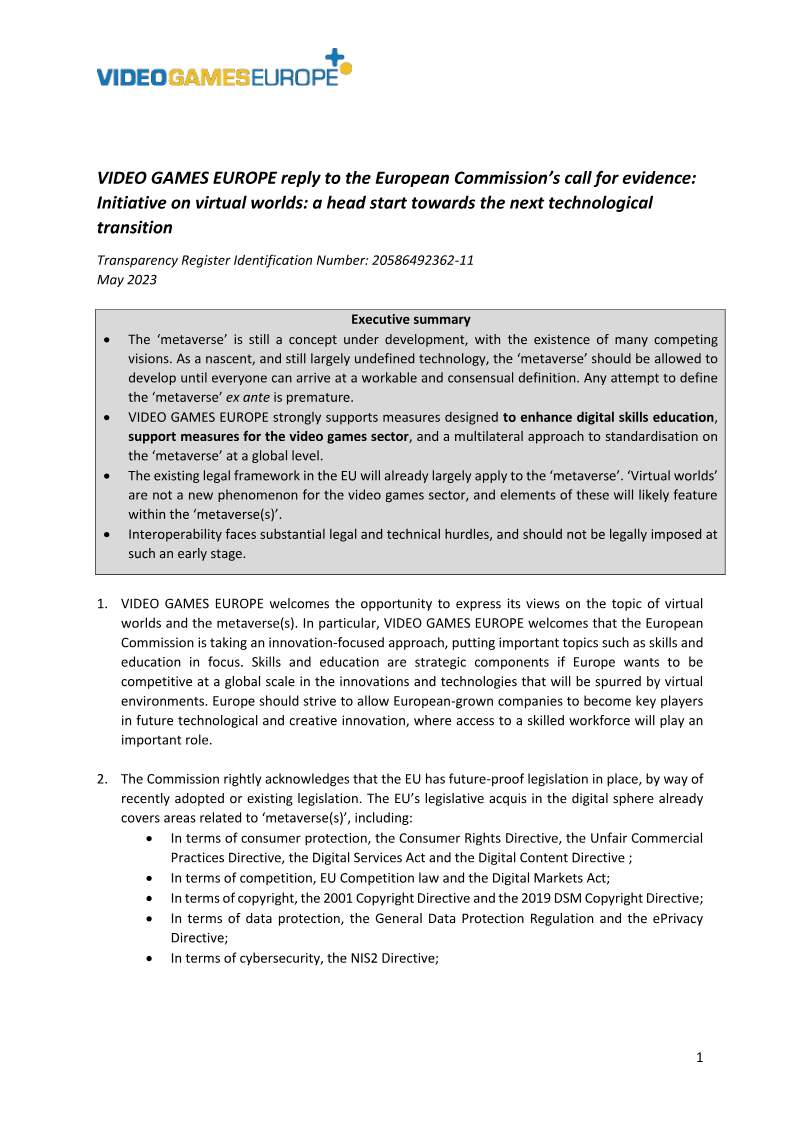
The response aims to shape EU policy on virtual worlds and the emerging metaverse by presenting the video games sector’s perspective, emphasizing that the concept remains fluid and should not be prematurely defined. It argues that existing EU digital legislation—covering consumer protection, competition, data protection, and cybersecurity—already applies to virtual environments, and that imposing legal interoperability at this early stage would hinder innovation. The submission stresses the strategic importance of digital‑skills education, urging a holistic pipeline from primary schools to higher education and the removal of immigration barriers to attract global talent. Historical evidence shows that virtual worlds have long existed in games, from the 1974 MazeWar prototype to contemporary platforms such as Roblox, Fortnite and Animal Crossing, demonstrating their role in fostering social capital and community resilience, especially during the COVID‑19 pandemic. Empirical data underline the sector’s economic weight: European consumer spending reached €23 billion in 2021, the industry comprises over 5,100 studios, generates more than €12 billion in annual turnover and employs roughly 90 000 people. A forecast for Sweden predicts a shortfall of 25 000 game developers by 2031, highlighting a broader talent gap across the EU. The text calls for expanded public‑funding mechanisms—Horizon Europe, Digital Europe, InvestEU—and the inclusion of video games in the General Block Exemption Regulation to enable SMEs to access support. It also advocates for greater awareness of existing R&I schemes, stronger public‑private partnerships, and the preservation of unlicensed spectrum for Wi‑Fi to sustain network capacity, noting that current fixed‑line and mobile traffic growth rates have stabilized below 20 % and 10 % respectively. Overall, the submission positions the video games industry as a catalyst for Europe’s digital transition while urging measured, standards‑based regulation that respects market dynamics.