LegalVideo Games Europe
European Commission Study About Business-to-Consumer Contractual Arrangements in the Data Economy
20233 pages~6 min full read
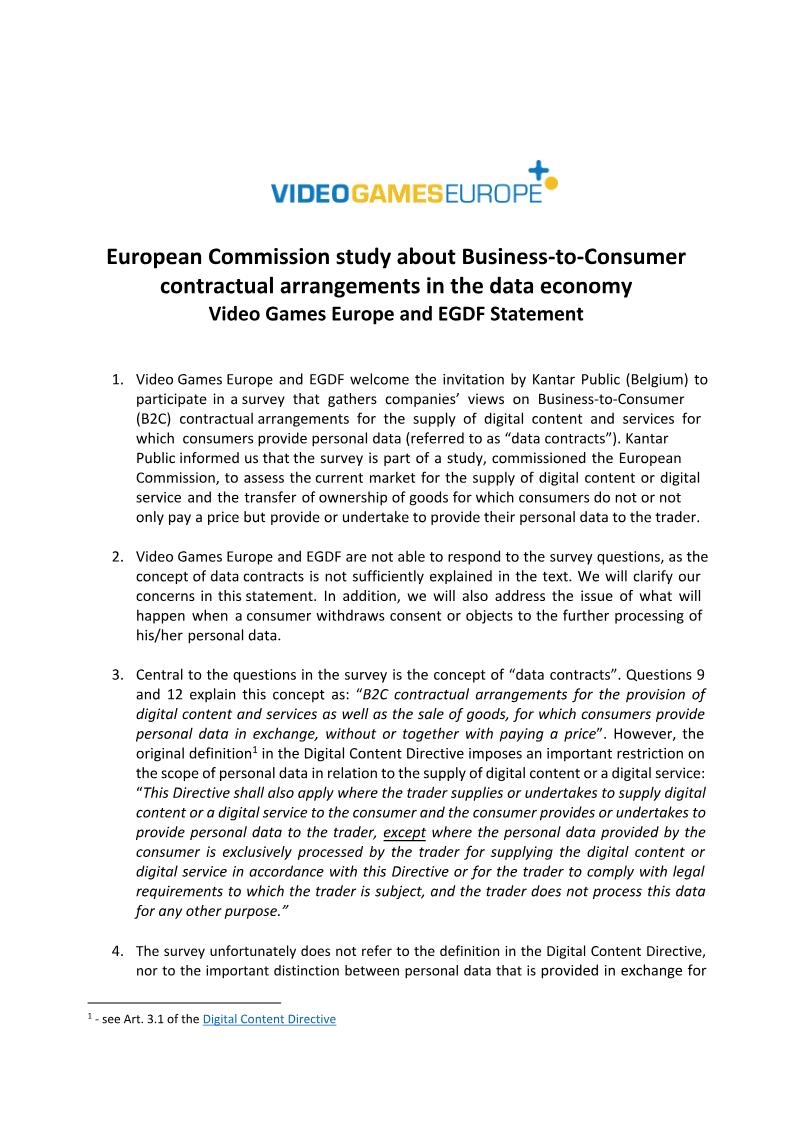
The statement submitted by Video Games Europe and the European Games Developer Federation (EGDF) seeks to clarify the interpretation of “data contracts” within the European Commission’s study on Business‑to‑Consumer (B2C) contractual arrangements in the data economy. It argues that the survey’s definition of data contracts—where consumers provide personal data in exchange for digital content or services, with or without payment—fails to reflect the Digital Content Directive’s narrower scope, which excludes personal data processed solely for the performance of the contract or legal compliance. Consequently, routine data processing required to deliver video‑game content, such as technical device information and account registration details, should not be treated as a separate means of access or a distinct contractual element.
The response highlights that most data‑processing activities in video games are performed on the basis of contractual necessity, legal obligations, or legitimate interests rather than consumer consent, rendering questions about consent withdrawal largely irrelevant. It stresses that treating essential processing as a “data contract” could distort market analysis and policy formulation. The statement also provides a snapshot of the European video‑games sector: roughly 5,000 developer studios and publishers, employing about 98,000 people, generating €23.3 billion in 2021, and representing the third‑largest global market for video games.
By situating its concerns within the broader regulatory framework, the statement calls for the survey to adopt the Digital Content Directive’s definition and to distinguish between data required for service delivery and data exchanged as a commercial consideration. This clarification aims to ensure that any forthcoming policy measures accurately reflect the realities of the European video‑games ecosystem.
Video Games Europe · 2026

Video Games Europe · 2026

Video Games Europe · 2026

Video Games Europe · 2026

Video Games Europe · 2026

Video Games Europe · 2026
Video Games Europe · 2025
Video Games Europe · 2025
Video Games Europe · 2025
Video Games Europe · 2025
Video Games Europe · 2025
Video Games Europe · 2025
Newzoo & Tebex · 2025
Ipsos · 2024
Video Games Europe · 2024
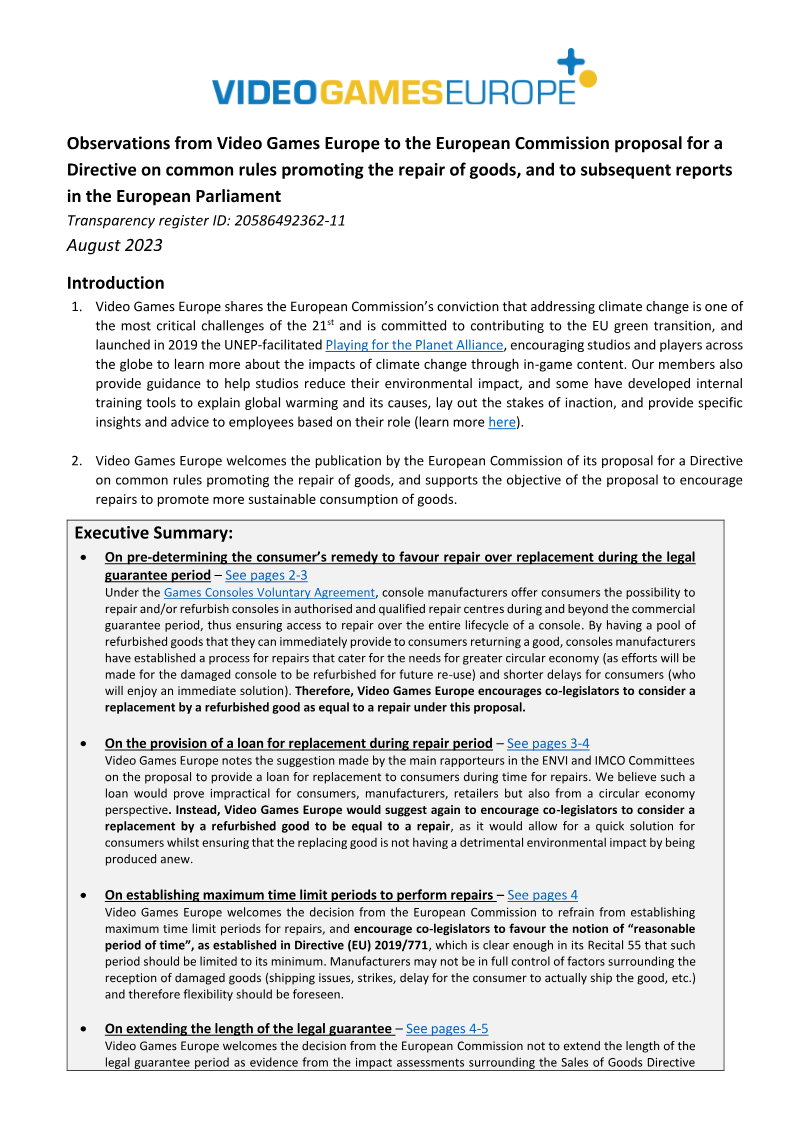
Video Games Europe · 2023
Video Games Europe · 2023
Video Games Europe · 2023
Video Games Europe · 2023
Video Games Europe · 2023
Video Games Europe · 2023
Video Games Europe · 2023
NIMBI – Danish Institute for Game Development · 2023
Video Games Europe · 2023