LegalVideo Games Europe
European Commission Proposal for a Regulation Laying Down Rules to Prevent and Combat Child Sexual Abuse
1 Feb 20237 pages~19 min full read
The position presented by Video Games Europe and the European Games Developer Federation seeks to shape the European Commission’s proposed regulation on child sexual abuse online by emphasizing that interactive video‑game environments already embody a robust, safety‑by‑design framework. It argues that the sector’s long‑standing tools, standards and cooperation mechanisms make online gaming one of the safest digital activities for children, and that regulatory measures should be calibrated to the low risk inherent in in‑game communications rather than applying a uniform, high‑risk model.
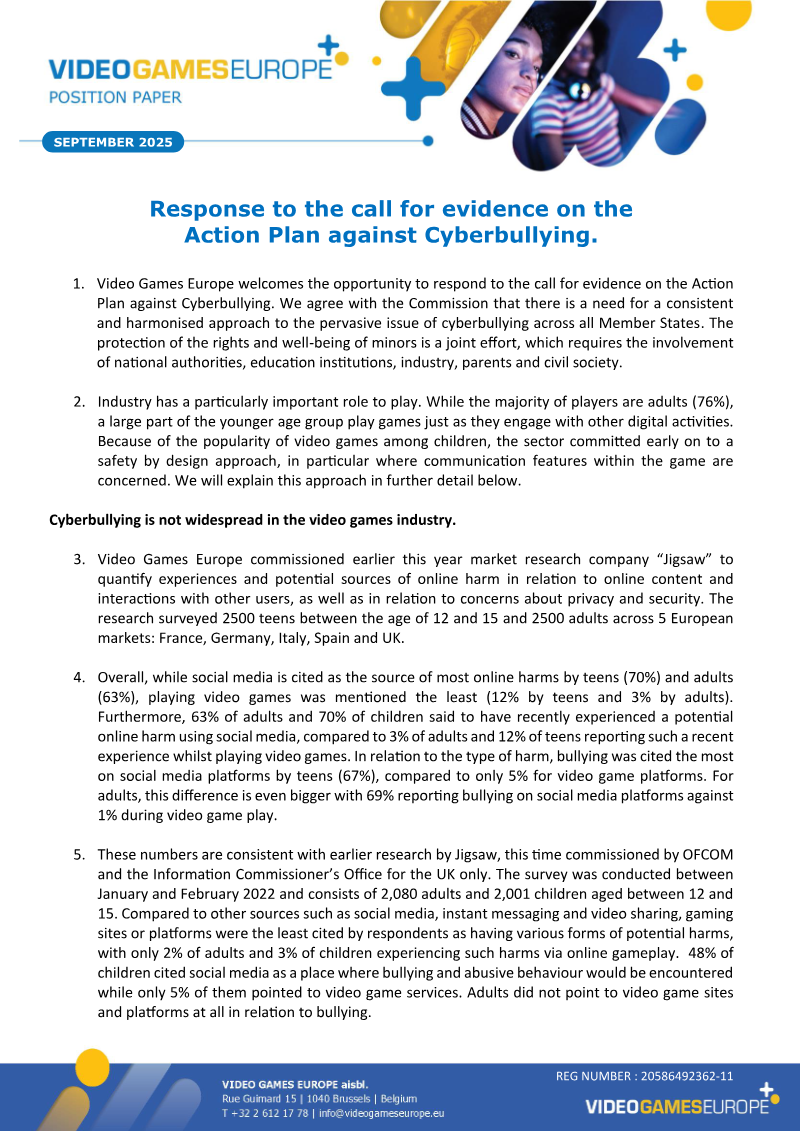
Across Europe more than half of the population engages in video‑game play, with children constituting a significant share. In‑game chat is typically short, text‑or voice‑based, pseudonymous, filtered, reportable and can be disabled, limiting opportunities for the exchange of illicit material. Empirical evidence shows a minimal incidence of abuse: a 2020 Ofcom/ICO survey of roughly 4,000 respondents found only 2 % of adults and 3 % of children reporting harms via gameplay, while an Interpol report noted no significant rise in cases of children targeted on game platforms. NCMEC’s 2021 Cybertipline data confirm that CSAM and grooming incidents on video‑game services are considerably lower than on platforms centred on photo or video sharing. An Ipsos poll further reveals that 60 % of parents restrict multiplayer access and, among the 40 % who allow it, 80 % supervise interactions.
The

Video Games Europe · 2026

Video Games Europe · 2026

Video Games Europe · 2026

Video Games Europe · 2026

Video Games Europe · 2026

Video Games Europe · 2026
Video Games Europe · 2025
Video Games Europe · 2025
Video Games Europe · 2025
Video Games Europe · 2025
Video Games Europe · 2025

Video Games Europe · 2025
AEVI · 2024
Video Games Europe · 2023

PCF Group · 2025

AEVI · 2025

Newzoo & Tebex · 2025

European Schoolnet · 2024
Video Games Europe · 2024
Ipsos · 2024
Video Games Europe · 2024
InGameJob · 2024

AEVI · 2024