Updated Mar 17, 2026 by Video Games Europe
Legal · October 1, 2025
Published by Video Games Europe
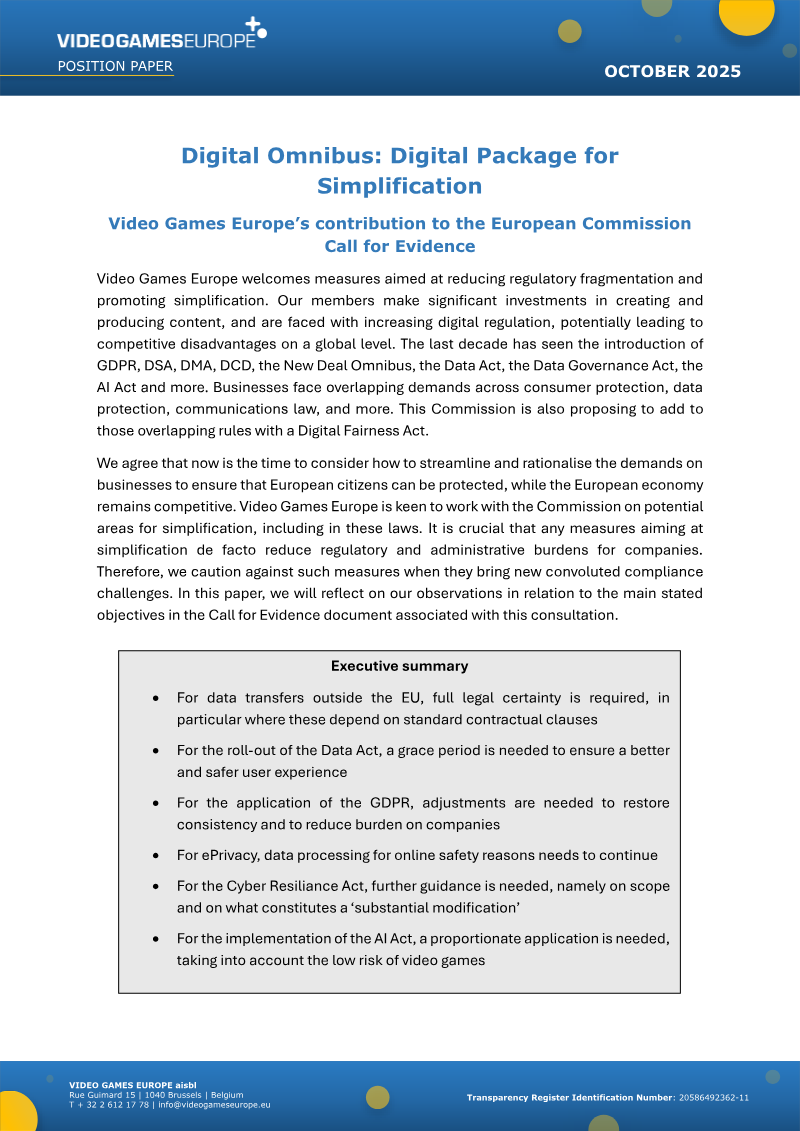
The paper argues that the European Union’s expanding digital regulatory landscape is creating overlapping and burdensome compliance requirements for the video‑games sector, threatening its global competitiveness. It calls for a coordinated “Digital Omnibus” that streamlines rules while preserving consumer protection, emphasizing that simplification must translate into tangible reductions in administrative and legal costs for companies. Key recommendations focus on six regulatory areas. First, greater legal certainty is needed for cross‑border data transfers, with clearer guidance on the use of Standard Contractual Clauses and the impact of their termination. Second, the rollout of the Data Act should include a grace period to accommodate long‑development cycles of consoles and to avoid data‑leak risks. Third, modest adjustments to the GDPR are urged to harmonise enforcement across Member States and to curb abusive data‑subject requests. Fourth, the ePrivacy framework should be modernised but retain the ability of game providers to process communications for safety, harassment prevention and cheating detection. Fifth, the Cyber Resilience Act requires precise definitions of “substantial modification” and practical guidance on CE marking for software distributed via app stores, with a shorter security‑update horizon for consoles. Sixth, the AI Act should be applied proportionately, recognising the low‑risk nature of most video‑games. The scope covers the EU digital market in 2025, targeting video‑game developers, publishers and platform operators. The position draws on industry data—Europe’s video‑games market is valued at €26.8 billion, supports 116 000 jobs, and reaches 54 % of Europeans—and on an OECD study estimating that full data localisation would cut global GDP by 4.5 % and reduce exports by 8.5 %. No primary survey is cited; the analysis is based on sector observations and existing economic research. The overall thrust is to achieve regulatory coherence that safeguards users while enabling the European video‑games industry to thrive internationally.
POSITION PAPER OCTOBER 2025 Digital Omnibus: Digital Package for Simplification Video Games Europe’s contribution to the European Commission Call for Evidence Video Games Europe welcomes measures aimed at reducing regulatory fragmentation and promoting simplification. Our members make significant investments in creating and producing content, and are faced with increasing digital regulation, potentially leading to competitive disadvantages on a global level. The last decade has seen the introduction of GDPR, DSA, DMA, DCD, the New Deal Omnibus, the Data Act, the Data Governance Act, the AI Act and more. Businesses face overlapping demands across consumer protection, data protection, communications law, and more. This Commission is also proposing to add to those overlapping rules with a Digital Fairness Act. We agree that now is the time to consider how to streamline and rationalise the demands on businesses to ensure that European citizens can be protected, while the European economy remains competitive. Video Games Europe is keen to work with the Commission on potential areas for simplification, including in these laws. It is crucial that any measures aiming at simplification de facto reduce regulatory and administrative burdens for companies. Therefore, we caution against such measures when they bring new convoluted compliance challenges. In this paper, we will reflect on our observations in relation to the main stated objectives in the Call for Evidence document associated with this consultation.
administrative burdens for companies. Therefore, we caution against such measures when they bring new convoluted compliance challenges. In this paper, we will reflect on our observations in relation to the main stated objectives in the Call for Evidence document associated with this consultation. Executive summary • For data transfers outside the EU, full legal certainty is required, in particular where these depend on standard contractual clauses • For the roll-out of the Data Act, a grace period is needed to ensure a better and safer user experience • For the application of the GDPR, adjustments are needed to restore consistency and to reduce burden on companies • For ePrivacy, data processing for online safety reasons needs to continue • For the Cyber Resiliance Act, further guidance is needed, namely on scope and on what constitutes a ‘substantial modification’ • For the implementation of the AI Act, a proportionate application is needed, taking into account the low risk of video games
Data transfers outside the EU: full legal certainty needed 1. Video Games Europe had the opportunity to respond to the Call for Evidence on the Data Union Strategy. Data is not just fundamental for the development and creation of new video game content; it also plays an essential role in ensuring that consumers can access and purchase this content and that they can enjoy a good and frictionless gameplay experience. 2. The video games industry today is a global business, and video game companies offer their services/products to video game players across the world. Our members are only able to deliver their services/products to their customers if they are in a position to process user data across borders. The industry, therefore, depends on international data flows and a harmonised legal framework that provides uniform rules across territories, in particular in relation to the transfer of personal data outside the EU. While the European Commission is making important efforts to create new adequacy agreements under the GDPR, such as the EU-U.S. Data Privacy Framework, data transfers often still take place under a legal framework based on Standard Contractual Clauses (SCCs) that require additional safeguards, transfer impact assessments, provision of information, etc.
s to create new adequacy agreements under the GDPR, such as the EU-U.S. Data Privacy Framework, data transfers often still take place under a legal framework based on Standard Contractual Clauses (SCCs) that require additional safeguards, transfer impact assessments, provision of information, etc. 3. We call on European policymakers to consider ways of increasing legal certainty in relation to these types of data transfers. This could be done by developing additional guidance on how SCCs should be used in a broader commercial context, such as clarifying the consequences of termination of SCCs for the underlying commercial contract, explaining the interaction of SCCs with processing operations that are conducted under the GDPR, or providing specific guidance on how to conduct transfer impact assessments. Furthermore, it should be confirmed that SCCs can be incorporated by reference in an underlying agreement without a separate signature if both parties accept the terms of the underlying agreement. Data Act: roll-out challenges and potential grace period
how to conduct transfer impact assessments. Furthermore, it should be confirmed that SCCs can be incorporated by reference in an underlying agreement without a separate signature if both parties accept the terms of the underlying agreement. Data Act: roll-out challenges and potential grace period 4. Data access and sharing can generate a wide range of benefits, including facilitating collaboration and the harnessing of new and existing data sources to foster datadriven innovation. The Data Union Strategy should contribute to facilitating such cross-border data sharing and leverage its collaborative benefits, which will foster the free flow of qualitative data and help establish the “Single Market for Data”. European video game companies are reliant on data flows to scale and grow. It is therefore essential that European policy makers continue their work on mechanisms supporting international data flows, and oppose data localisation policies which undermine the principle of free flow of data across borders, as these create barriers to the smooth functioning of the market. A recent OECD study quantified the economic impact of structural data localisation and restriction of data flows. According to this study, data autarky - or full fragmentation, where all economies fully
restrict their data flows - would result in global GDP losses of 4.5% and reductions in exports of 8.5%. 5. The Data Act is one of the cornerstones of the “Single Market for Data”. However, it adopted a limited timeframe during which manufacturers need to adapt their products, allowing easy access by design to various types of data. This limited time frame is problematic for products with long development cycles, such as video game consoles. Implementation of the Act has led to uncertainty about how to interpret the new rules, in particular in relation to (i) the differentiation between types of data, (ii) the identification and consideration for protection of business and trade secrets and (iii) the practical unclarities regarding its overlap with GDPR. 6. As part of its efforts to reduce the burden on companies, Video Games Europe calls on the Commission to consider granting additional lead-time to companies. Such a prolongation would need to come fast. This will allow companies to prepare the internal processes and roll out updates to their devices, which, in turn, will ensure better protection against data leaks and/or hacking, thereby guaranteeing a safer user experience. GDPR: consistent application and burden adjustments
HOW TO Game developer studios in Europe 4 What EGDF does 5 ENABLE Number of people working in game development 7 Turnover of the national game development ecosystems 9 DIGITAL The shorter the value chain, the more growth in Europe 10 Games are the driving force of the digital revolution 11 Content drives innovation 12 GROWTH Creative E...
The response to the public consultation on the Digital Fairness Act argues that the European Union’s existing consumer‑protection framework, together with the continent‑wide PEGI rating system and Germany’s USK scheme, already delivers the breadth, flexibility and enforcement capacity required to safeguard minors and ensure transparency for in‑game currencies and loot‑box‑type rewards. By emphasizing self‑ and co‑regulatory measures—clear real‑world cost calculations for virtual currencies, mandatory disclosure of reward probabilities, 48‑hour refunds for unused purchases and robust, default‑zero‑spend parental‑control settings—the industry contends that new, draconian legislation would jeopardise a sector that generated €26.4 billion in 2024. Empirical evidence underpins the argument that current safeguards are effective: only about 18 % of children are permitted to buy in‑game items, 95 % of purchases are supervised, 79 % of parents recognise PEGI labels, and 80 % are familiar with USK age ratings. Survey data also show that parental‑control tools now allow consent to data processing, limit communication and content sharing, and are audited by self‑regulatory bodies such as USK. Multilingual awareness campaigns have been deployed across 16 EU countries, partnering with family and media‑literacy organisations to promote joint play and responsible spending. The industry further maintains that the EU’s Consumer Rights Directive, Digital Content Directive, Data‑Protection Regulation, AI Act and Digital Services Act already cover “dark‑pattern” and vulnerability‑targeting practices. It calls for concrete, industry‑co‑created guidance rather than expanded definitions that could dilute legal certainty and impose disproportionate compliance costs, especially for subscription‑cancellation mechanisms. Reclassifying in‑game currencies as “digital representations of value” would strip existing protections and generate an impractical proliferation of contracts. Overall, the position presented seeks to preserve the balance between consumer information, the right of withdrawal and market innovation, urging legislators to enforce and refine current rules while supporting the video‑games sector’s self‑regulatory governance structures that span the EU and address both economic and child‑protection concerns.
The analysis contends that the existing EU consumer‑protection framework is already adequate for ensuring digital fairness in the video‑game sector and should be fully deployed before any new legislation is considered. It calls for a coordinated, holistic approach that aligns the 2021 Guidance on digital services and the enforcement powers granted by the Omnibus Directive, and urges the European Commission to publish clear, ex‑ante guidelines on fair commercial practices. The industry’s self‑regulatory PEGI system, which enjoys roughly three‑quarters consumer awareness and provides age‑appropriate ratings, is presented as a cornerstone of this coordinated framework. Evidence is offered that the current acquis effectively bans manipulative tactics such as bait‑and‑switch and false testimonials, with notable success in the gaming market. Coordinated actions by national consumer protection authorities on in‑app purchases during 2013‑14 and the Italian competition authority’s 2020 commitments on loot‑box transparency illustrate the system’s capacity to curb unfair practices. The analysis warns that forthcoming rules could duplicate or undermine these established mechanisms. A specific argument is made regarding in‑game currencies, which are characterised as non‑convertible digital content lacking real‑world monetary value. Accordingly, they should be exempt from “monetary equivalence” regulations, provided that transparency is achieved by displaying the real‑currency price at the point of purchase and clearly informing players of the transaction details. The overall recommendation is to rely on the existing EU consumer‑protection instruments, reinforced by industry self‑regulation, to safeguard digital fairness across the European video‑game market.
Video Games Europe, representing 17 major publishers and national trade associations across 15 European countries, urges trialogue negotiators to craft an e‑Privacy Regulation that aligns with GDPR consistency while preserving the sector’s capacity to innovate and protect users. The industry, valued at €23 billion in consumer spend in 2020 and growing 22 percent year‑on‑year, comprises roughly 5,100 developer studios and publishers with combined annual turnover of €12 billion and a workforce of about 90 000 employees. Key positions stress that in‑game communications, particularly chat rooms open to all players, must remain outside the definition of an interpersonal communication service, as clarified in Recital 11aa, to enable monitoring for cheating, hate speech, bullying, grooming and child sexual abuse. Requiring consent for such monitoring would be ineffective, especially for under‑age users, and could impede investigations. The industry also seeks broad adoption of the Council’s provisions in Article 8, allowing processing of terminal equipment information for performance optimisation, audience measurement, security, fraud prevention and software updates without individual consent, thereby avoiding consent fatigue and cumbersome parental authorisation. Video Games Europe opposes the introduction of mandatory privacy‑setting requirements in Article 10, arguing that they would stifle competition, concentrate power among a few software providers, and impose costly technical burdens on consoles. Finally, the association calls for Article 11 to be aligned with GDPR Article 23, expanding public‑interest exemptions to include protection of data subjects, enforcement of civil claims and IP enforcement, ensuring law‑enforcement access while safeguarding fundamental rights.