Updated Mar 17, 2026 by Video Games Europe
Legal · March 1, 2024
Published by Video Games Europe
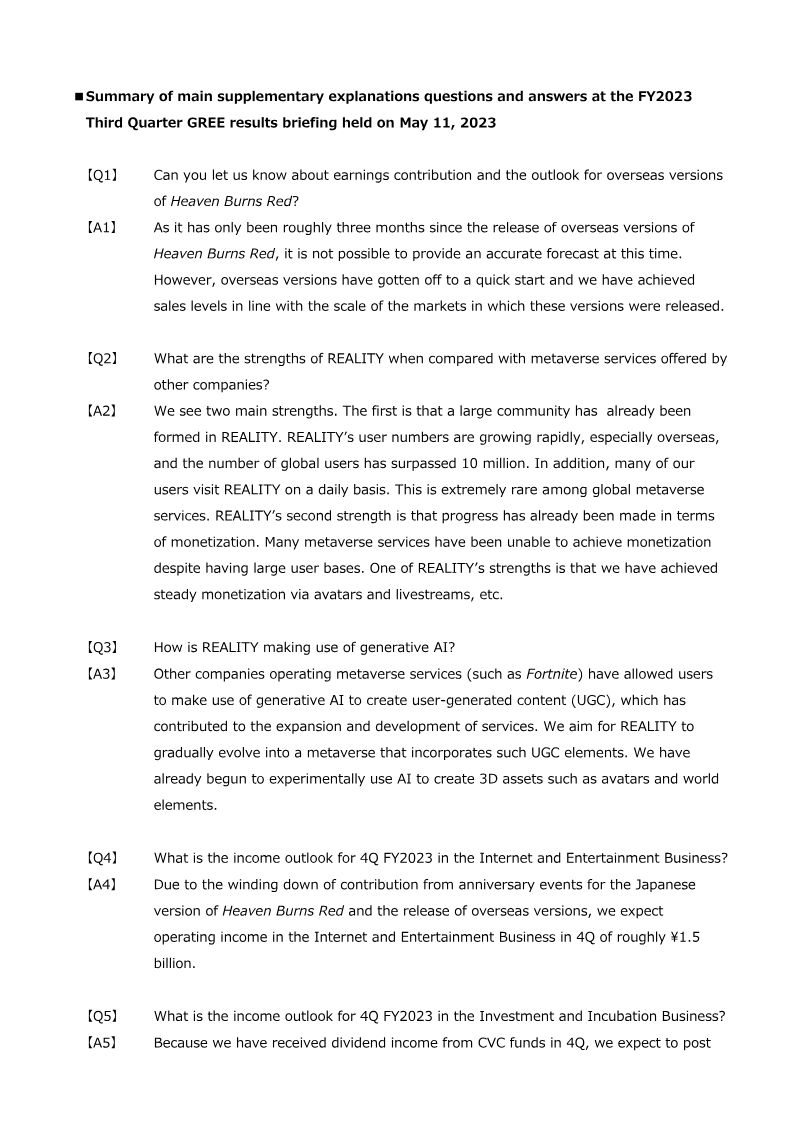
Video Games Europe submits a focused perspective on competition in virtual worlds and generative artificial intelligence, emphasizing that both technologies are central to the European video‑games sector’s ongoing innovation and consumer value. The contribution argues that regulatory interventions should be proportionate, evidence‑based, and designed to preserve the sector’s dynamism, warning that premature or overly prescriptive rules could impede the development of diverse business models and emerging services. The analysis traces the evolution of virtual worlds from early networked games such as Mazewar (1974) through the rise of MMORPGs in the late 1990s and the recent popularity of platforms like Roblox, Fortnite and Animal Crossing, highlighting the sector’s historic reliance on immersive, persistent environments. Competition is described as vibrant, driven by talent, proprietary technologies, intellectual‑property access, data, AI advances, connectivity and net‑neutrality. Over 5,500 companies operated in the EU in 2021, with roughly 500 new developers entering the market that year, illustrating a high level of market entry and diversification. The response notes a shift toward open standards and interoperability, urging support for multilateral standard‑setting bodies while cautioning against mandatory interoperability mandates that could stifle innovation. Regarding generative AI, the text observes that the technology is still nascent in game production but promises substantial productivity gains by enabling rapid creation of assets such as 3D models, dialogue and sound effects. It identifies key competitive factors—algorithms, data, training infrastructure, bias mitigation, skilled labour and regulatory guardrails—and stresses that existing frameworks for text‑and‑data mining and the forthcoming AI Act should remain the basis for policy, avoiding additional legislative changes without thorough impact assessment. Overall, the contribution underscores that the EU’s existing antitrust tools, including the DMA, are sufficient to address competition concerns in these fast‑moving domains, provided they are applied with continued stakeholder engagement.
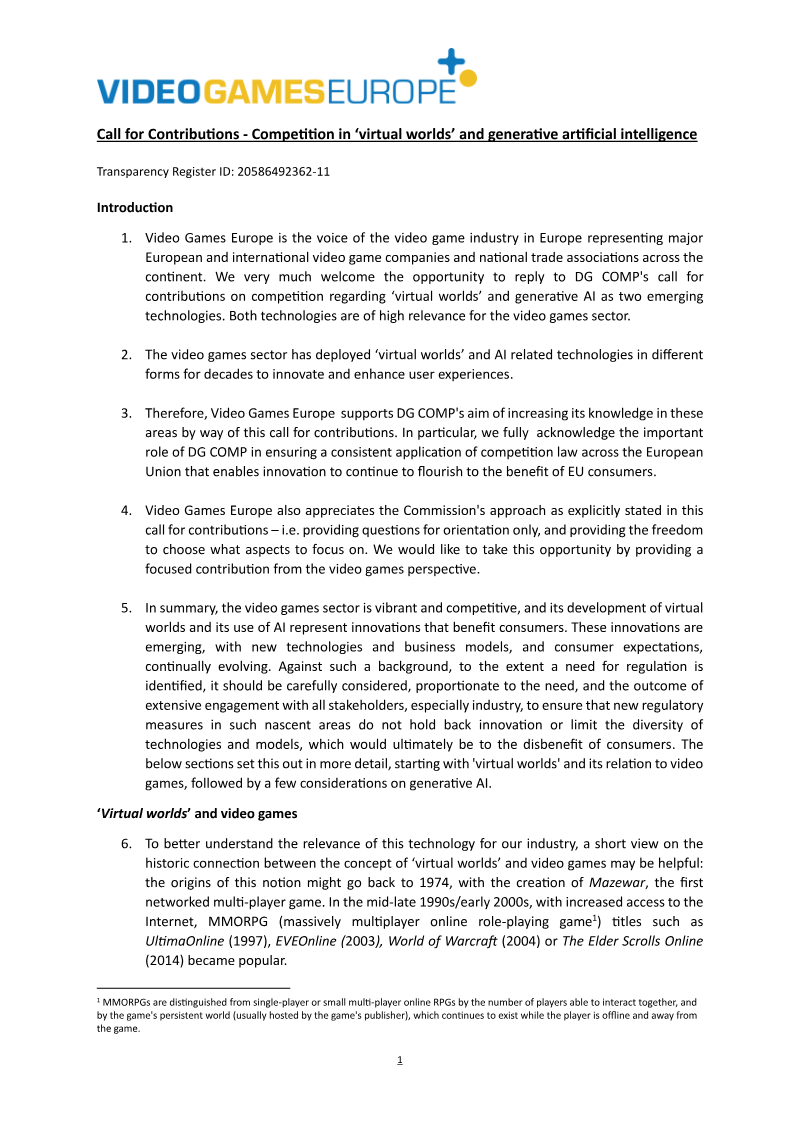
VIDEUGAMESEURUPE Call for Contributions - Competition in ‘virtual worlds’ and generative artificial intelligence Transparency Register ID: 20586492362-11 Introduction 1. Video Games Europe is the voice of the video game industry in Europe representing major European and international video game companies and national trade associations across the continent. We very much welcome the opportunity to reply to DG COMP's call for contributions on competition regarding ‘virtual worlds’ and generative AI as two emerging technologies. Both technologies are of high relevance for the video games sector. 2. The video games sector has deployed ‘virtual worlds’ and AI related technologies in different forms for decades to innovate and enhance user experiences. 3. Therefore, Video Games Europe supports DG COMP's aim of increasing its knowledge in these areas by way of this call for contributions. In particular, we fully acknowledge the important role of DG COMP in ensuring a consistent application of competition law across the European Union that enables innovation to continue to flourish to the benefit of EU consumers. 4. Video Games Europe also appreciates the Commission's approach as explicitly stated in this call for contributions – i.e. providing questions for orientation only, and providing the freedom to choose what aspects to focus on. We would like to take this opportunity by providing a focused contribution from the video games perspective.
the Commission's approach as explicitly stated in this call for contributions – i.e. providing questions for orientation only, and providing the freedom to choose what aspects to focus on. We would like to take this opportunity by providing a focused contribution from the video games perspective. 5. In summary, the video games sector is vibrant and competitive, and its development of virtual worlds and its use of AI represent innovations that benefit consumers. These innovations are emerging, with new technologies and business models, and consumer expectations, continually evolving. Against such a background, to the extent a need for regulation is identified, it should be carefully considered, proportionate to the need, and the outcome of extensive engagement with all stakeholders, especially industry, to ensure that new regulatory measures in such nascent areas do not hold back innovation or limit the diversity of technologies and models, which would ultimately be to the disbenefit of consumers. The below sections set this out in more detail, starting with 'virtual worlds' and its relation to video games, followed by a few considerations on generative AI. ‘Virtual worlds’ and video games
t the diversity of technologies and models, which would ultimately be to the disbenefit of consumers. The below sections set this out in more detail, starting with 'virtual worlds' and its relation to video games, followed by a few considerations on generative AI. ‘Virtual worlds’ and video games 6. To better understand the relevance of this technology for our industry, a short view on the historic connection between the concept of ‘virtual worlds’ and video games may be helpful: the origins of this notion might go back to 1974, with the creation of Mazewar, the first networked multi-player game. In the mid-late 1990s/early 2000s, with increased access to the Internet, MMORPG (massively multiplayer online role-playing game<sup>1</sup> ) titles such as UltimaOnline (1997), EVEOnline (2003), World of Warcraft (2004) or The Elder Scrolls Online (2014) became popular. 1MMORPGs are distinguished from single-player or small multi-player online RPGs by the number of players able to interact together, and by the game's persistent world (usually hosted by the game's publisher), which continues to exist while the player is offline and away from the game.
VIDEUGAMESEURUPE 7. Beyond MMORPGs, the breadth and availability of such permanent, immersive, and shared experiences have increased in recent years: the online platform Roblox (2006), games such as Fortnite (2017), and Animal Crossing: New Horizons (2020) have become increasingly popular. 8. Despite this historic connection, more recently the notion of a 'virtual world’ or 'metaverse’, terms which are often used to describe environments that are not limited to a classic game experience – but serve other user cases, including communication, e-commerce, or education. Competition in ‘virtual worlds’ 9. The call for contributions defines ‘virtual worlds’ as "a simulated, immersive environment – in its ultimate form amounting to a persistent, always on world that operates in real time and is accessible everywhere”. 10. From the perspective of video games as an industry that develops technical solutions that are at least partly used to create such an environment, we would like to point out that ‘virtual worlds’ is not currently a fully and clearly defined concept. There are many different forms of such experiences, different solutions, and the borders to other concepts (such as video games) are fluid. This dynamism will likely increase within the coming years, due to technical developments leading to a variety of new and unique experiences. Therefore, we believe there are significant challenges in having a definition of a concept that is constantly evolving.
pts (such as video games) are fluid. This dynamism will likely increase within the coming years, due to technical developments leading to a variety of new and unique experiences. Therefore, we believe there are significant challenges in having a definition of a concept that is constantly evolving. 11. Having said that, we fully appreciate that the Commission wants and needs to understand how competition related to ‘virtual worlds’ is playing out. The following (without prejudice to market definition) is a non-exhaustive list of some of the main drivers of competition in that space: • Talent and innovation; • Access to proprietary technologies; • Access to IP rights; • Access to data; • Developments in AI; • Connectivity and net neutrality; 12. A high-level comment on the level of competition in this area (from the perspective of an association with members that are directly competing with each other): this space is characterised by vibrant competition, with technology evolving rapidly, with both immersive experiences being created by all kinds of market operators, both big and small, and the challenge in predicting what services or experiences become most adopted. As there continues to be innovation in technologies and business models in this space, it would be too early to identify which kind of technical solutions and services will attract consumer interest in the medium or long term.
allenge in predicting what services or experiences become most adopted. As there continues to be innovation in technologies and business models in this space, it would be too early to identify which kind of technical solutions and services will attract consumer interest in the medium or long term. 13. The significant investment, versatility, diversity and dynamism of this technology results in a competitive environment characterized by constant change. Therefore, a regulatory approach (i.e. going beyond existing competition law) would risk limiting innovation in this area.
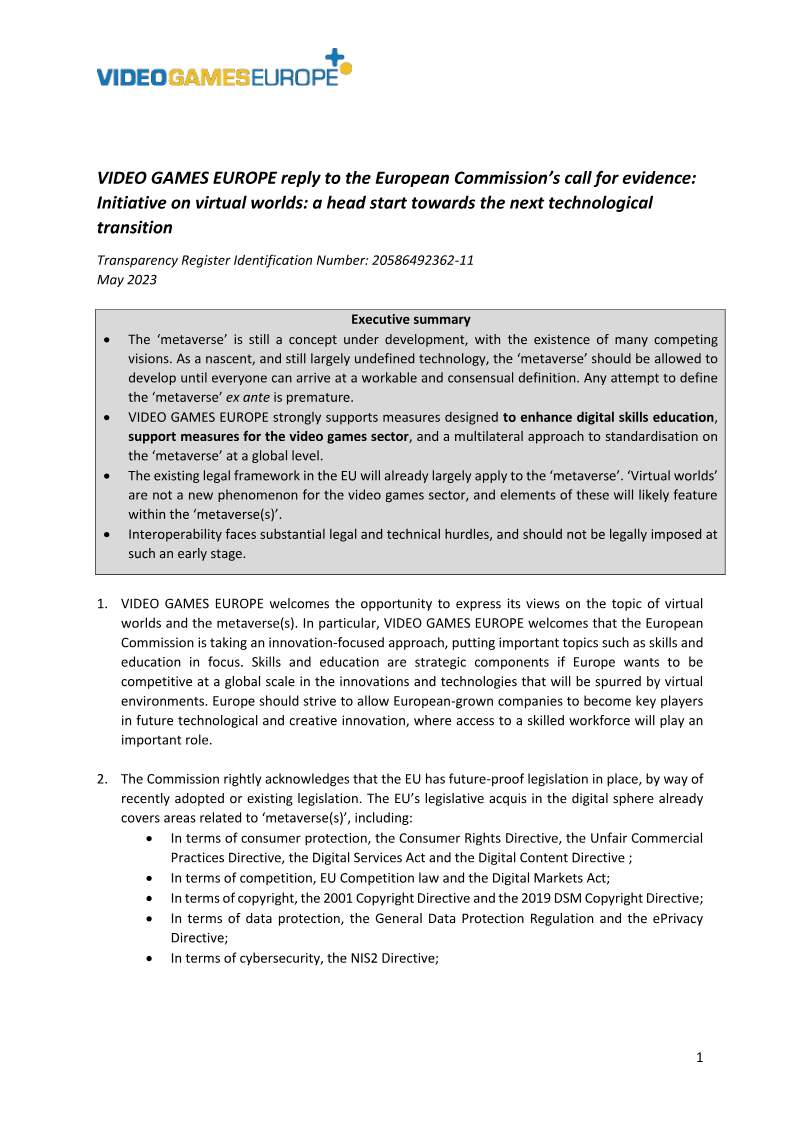
The response aims to shape EU policy on virtual worlds and the emerging metaverse by presenting the video games sector’s perspective, emphasizing that the concept remains fluid and should not be prematurely defined. It argues that existing EU digital legislation—covering consumer protection, competition, data protection, and cybersecurity—already applies to virtual environments, and that imposing legal interoperability at this early stage would hinder innovation. The submission stresses the strategic importance of digital‑skills education, urging a holistic pipeline from primary schools to higher education and the removal of immigration barriers to attract global talent. Historical evidence shows that virtual worlds have long existed in games, from the 1974 MazeWar prototype to contemporary platforms such as Roblox, Fortnite and Animal Crossing, demonstrating their role in fostering social capital and community resilience, especially during the COVID‑19 pandemic. Empirical data underline the sector’s economic weight: European consumer spending reached €23 billion in 2021, the industry comprises over 5,100 studios, generates more than €12 billion in annual turnover and employs roughly 90 000 people. A forecast for Sweden predicts a shortfall of 25 000 game developers by 2031, highlighting a broader talent gap across the EU. The text calls for expanded public‑funding mechanisms—Horizon Europe, Digital Europe, InvestEU—and the inclusion of video games in the General Block Exemption Regulation to enable SMEs to access support. It also advocates for greater awareness of existing R&I schemes, stronger public‑private partnerships, and the preservation of unlicensed spectrum for Wi‑Fi to sustain network capacity, noting that current fixed‑line and mobile traffic growth rates have stabilized below 20 % and 10 % respectively. Overall, the submission positions the video games industry as a catalyst for Europe’s digital transition while urging measured, standards‑based regulation that respects market dynamics.
The paper advocates a balanced approach to artificial‑intelligence deployment in the European video‑games sector, emphasizing that AI should be nurtured as a driver of creativity and economic growth while preserving the core objectives of the existing copyright framework. It argues that the industry’s reliance on technological innovation and a robust copyright regime is essential for long‑term investment, and that any regulatory response must protect creators, respect trade secrets and avoid unnecessary burdens on developers and players. AI has been embedded in games for more than a decade, from procedural terrain generation to advanced moderation tools, and generative models now promise to accelerate content creation, reduce production costs and enrich player experiences. The paper notes that most AI applications remain non‑generative, but where generative tools are used—whether for code, narrative or visual assets—they should be treated as ordinary creative aids: works that reflect a human author’s original choices retain copyright protection. It endorses the text‑and‑data‑mining exceptions of the EU’s DSM Copyright Directive as a suitable legal basis for training models, warning against additional EU legislation that could create uncertainty and distort competition. Risk‑based regulation is recommended, with low‑risk uses such as internal foundation models for short dialogue exempt from mandatory transparency or labeling. Mandatory disclosure should be limited to cases where it does not jeopardize trade secrets or impose disproportionate costs, and labeling obligations are deemed unnecessary in contexts where players already expect AI‑assisted content. The paper also highlights the need for international cooperation to harmonize standards and protect creators globally. The position reflects the perspective of a pan‑European industry body representing 19 game companies and 13 national trade associations, a sector valued at €24.5 billion with 53 % of Europeans identified as players. It calls on policymakers to engage continuously with stakeholders, to proceed cautiously with any legal changes, and to preserve the balance between innovation and creator rights that underpins the European video‑games ecosystem.
This research, conducted by Google Cloud and The Harris Poll in mid-2025, examines the transformative role of generative AI within the global games industry. Based on a survey of 615 developers across the United States, South Korea, Norway, Finland, and Sweden, the study finds that 97% of professionals believe generative AI is actively reshaping the sector. The primary thesis suggests that while the industry faces rising development costs and market saturation, AI serves as a critical tool for innovation, democratization, and operational efficiency. Key findings indicate that 90% of developers have already integrated AI into their workflows, primarily to automate repetitive tasks and accelerate playtesting, localization, and coding. A significant trend is the rise of AI agents—autonomous systems capable of reasoning and planning—which 44% of respondents use for content optimization and 34% for advanced NPC behavior. These technologies are shifting player expectations, with 89% of developers noting that gamers now demand more lifelike, responsive, and personalized experiences. Furthermore, 94% of developers anticipate that AI will lead to long-term reductions in development costs over the next three years. Despite this optimism, the industry faces notable hurdles regarding legal and ethical standards. Approximately 63% of developers expressed concerns over data ownership and intellectual property, while 35% cited worries regarding player data privacy. To navigate these challenges, the study recommends that studios start with small-scale pilots, align AI use with their core creative visions, and invest in staff upskilling. Ultimately, the data portrays AI not just as a productivity booster, but as a fundamental shift in game design that enables smaller studios to compete more effectively while fostering new levels of player immersion.
Europe’s video‑game sector has expanded by 16 % between 2019 and 2024, now delivering €24 billion in revenue and employing roughly 110 000 highly‑skilled workers. More than half of the continent’s gamers are under 20 years old, and nearly half of parents rely on the PEGI age‑rating system to ensure safe play. The industry’s dual nature—combining advanced technology with creative content—underpins a call for EU‑level measures that preserve an open, tax‑free single market, extend the Creative Europe programme, apply the General Exemption Regulation to games, and reinforce intellectual‑property protection while investing in digital‑skill education, particularly STEM pathways for girls. The PEGI framework, supported by co‑regulation, has already classified around 40 000 titles across 40 European countries, halving non‑compliance penalties and cutting energy‑consumption violations by roughly 20 %. Nevertheless, the sector faces a regulatory load of 850 new EU obligations (over 5 000 pages of rules) introduced between 2017 and 2022. A shift toward transparent self‑regulation is advocated, emphasizing clearer in‑game purchase disclosures, stronger parental‑control tools, and EU‑wide educational programmes to close digital‑skills gaps and attract diverse talent. Safety‑by‑design requirements now obligate all publishers to integrate PEGI‑based age classification, parental‑control portals, chat moderation, purchase limits and time‑spending caps, reflecting the predominance of minors among players. The climate‑and‑inclusion agenda shows progress: women represent 23.7 % of the video‑game workforce, surpassing the 17 % share in the broader ICT sector, and industry members are adopting gender‑equality guidelines and green initiatives such as the Green Game Jam. Coordinated self‑regulation, targeted public funding, and unified online‑safety strategies are presented as essential to sustain economic contribution, foster innovation, and position Europe as the leading hub for socially responsible game development.