Hero
Company
Documents about Hero

🚂 Full Steam Ahead Q2: 12 Steam Hits & which ones work on Mobile?
The second quarter of the year reveals a distinct trend in the gaming industry where mid-tier, non-AAA titles on Steam serve as a primary incubator for innovative gameplay concepts.
- Steam's most successful mid-tier titles prioritize addictive, loop-based core mechanics—such as inventory management and sorting—over high-fidelity production values.
- High-performing Steam releases, including Pratfall, Librarian, and Content Warning, demonstrate that revenue potential is increasingly driven by core gameplay engagement rather than traditional AAA complexity.
- The viral success of Make a Chameleon, which reached 60 million plays in two months, highlights the effectiveness of simple, streamable mechanics combined with community-driven tools like the Steam Workshop.
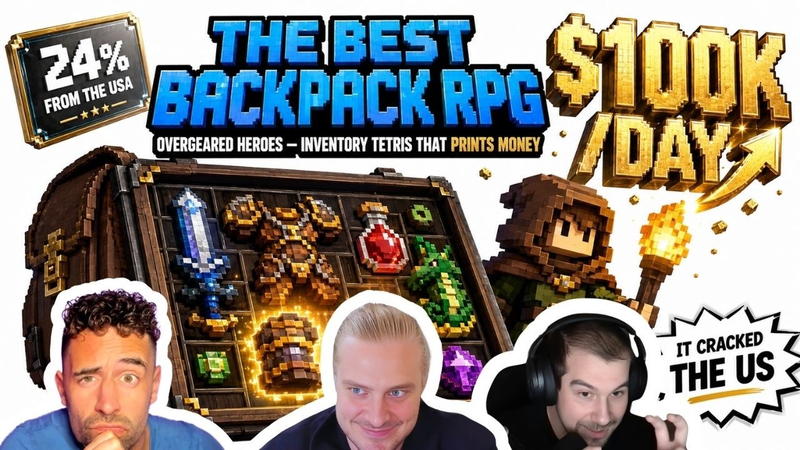
🎒 Overgeared Hero Breakdown: An Asian RPG That Actually Cracked the US market
Overgeared Hero represents a significant shift in the mobile RPG landscape by successfully bridging the gap between Asian-developed mid-core mechanics and the competitive United States market.
- Overgeared Hero generates approximately $100,000 in daily revenue, with the United States accounting for 24 percent of total earnings.
- The game achieves global market success by blending a traditional idle gacha chassis with an inventory-management roguelite core.
- Monetization is driven by a refined strategy of 12 rewarded ad placements rather than aggressive interstitial advertising, catering to a hardcore, strategy-focused audience.
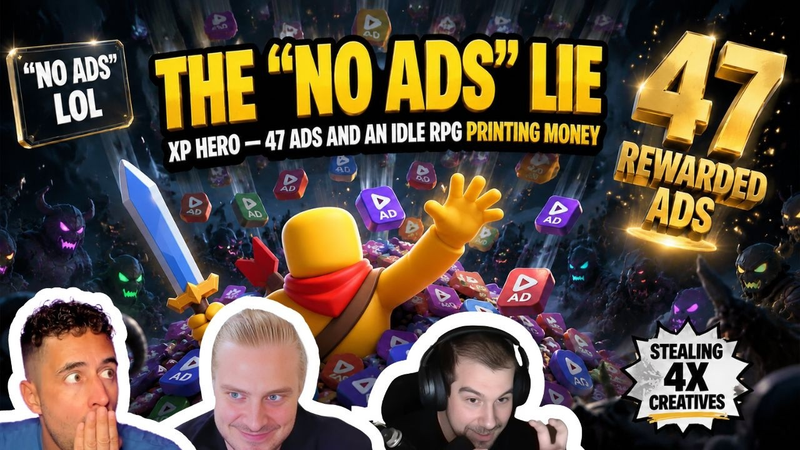
⚔️ 47 Rewarded Ad Placements and a "No Ads" Lie: Inside XP Hero's $400K/Day Idle RPG
XP Hero, an idle RPG developed by Supercent, represents a highly aggressive approach to mobile game monetization, currently generating an estimated $400,000 in daily revenue.
- Supercent’s idle RPG 'XP Hero' generates approximately $400,000 in daily revenue, with 53% of that income derived directly from a dense ecosystem of 47 rewarded ad placements and frequent interstitial ads.
- The game relies on a high-value cohort model where 20% of the player base generates 90% of total revenue, prioritizing aggressive short-term monetization over long-term retention.
- The developer utilizes an AI-driven creative strategy that produces over 1,300 marketing assets every three days to capture a broad audience quickly.

Listening to Players at Scale
Game studios increasingly rely on enterprise-grade intelligence systems to synthesize high-volume community feedback from platforms like Discord and Reddit into actionable development insights.
- Studios are integrating large language models, statistical analysis, and heuristics to synthesize millions of community messages from platforms like Discord and Reddit into actionable development data.
- Combining qualitative player sentiment with quantitative in-game telemetry provides a holistic view of player behavior, enabling more informed and data-driven product roadmaps.
- Advanced segmentation tools allow developers to distinguish between specific player archetypes, such as legacy users and newcomers, to tailor development strategies to different audience segments.
PlayStation: “We have a responsibility to the whole industry”
PlayStation operates a comprehensive ecosystem designed to support nearly 10,000 third-party partners, functioning as a primary engine for global industry growth.
- PlayStation supports an ecosystem of nearly 10,000 third-party partners, positioning itself as a primary driver for global industry growth through resource, marketing, and funding support.
- The company is actively expanding its geographic footprint by investing in emerging development hubs, specifically targeting China, India, and the Middle East to cultivate international talent.
- The 'China Hero Project' is utilized as a primary model for regional development, successfully accelerating the creation of unique content within the Chinese market.
Is Destiny doomed? King on AI, layoffs and more, plus March's top games, data, soft launches, more
The mobile games industry continues to navigate a complex landscape defined by shifting monetization strategies, the integration of artificial intelligence, and intense market competition.
- Microfun’s Gossip Harbor reached $100 million in monthly in-app purchase revenue for the first time in March, marking a significant increase from $82.5 million in February and positioning it to potentially overtake Candy Crush Saga as the top-grossing puzzle game.
- King VP Eva Ryott defended the company's use of AI as a supporting tool for level management rather than a direct replacement for staff, while noting that workforce adjustments following 200 layoffs were necessary to maintain competitive relevance.
- Candy Crush Saga has adopted a 2x2 matching mechanic, a feature King implemented within the last year to align with evolving market standards and compete against rivals like Royal Match and Gossip Harbor.
Butcher Hero Review: The Next Alien Invasion? Not quite yet!
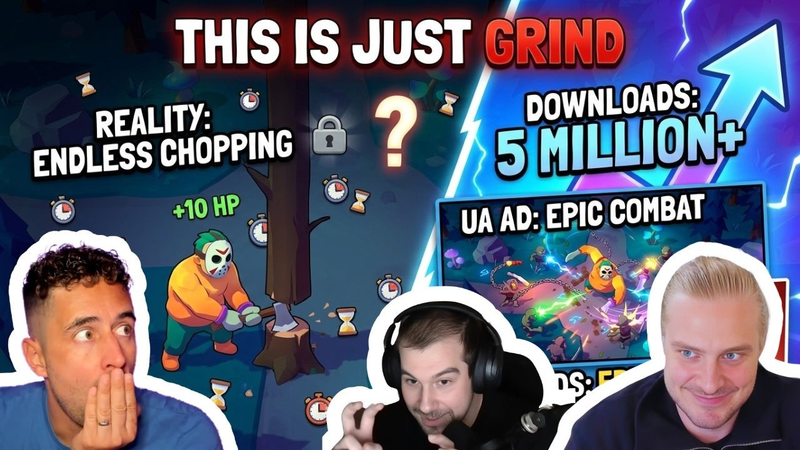
Butcher Hero, an idle RPG developed by Multicast, currently occupies a precarious position in the mobile gaming market.
- Multicast’s 'Butcher Hero' generates 20,000 to 30,000 daily downloads but suffers from high churn rates due to a repetitive, shallow gameplay loop.
- The title currently generates approximately $5,000 in daily ad revenue, a figure that highlights the limitations of its current design and monetization model.
- There is a significant disconnect between the game's effective marketing creatives and the actual user experience, which lacks the depth and variety of the developer's previous hit, 'Alien Invasion'.

Are guitar games coming back? The story of RedOctane's return
The gaming industry is currently undergoing a period of significant structural transformation, characterized by both corporate consolidation and a strategic pivot toward sustainable, community-driven development models.
- Embracer Group is reviving the RedOctane brand by merging original staff with open-source rhythm game developers to move away from the annual release model that previously caused market oversaturation.
- The new rhythm game strategy shifts toward a 'forever game' model, prioritizing long-term content updates and direct-to-consumer engagement over traditional retail cycles.
- Publishers are increasingly utilizing game bundles as a strategic tool to extend the lifecycle and reach of titles after initial launch momentum declines.

This is Why the Music Stopped - for Music Games
The music game genre, once a dominant force in the video game industry, has struggled to maintain relevance due to prohibitive licensing costs, market oversaturation, and shifting consumer habits.
- The music game genre collapsed rapidly after 2008, when it accounted for 18% of the U.S. video game market, due to the Great Recession and the decline of expensive, bulky plastic peripherals.
- High production costs are driven by complex music licensing, which requires individual negotiations with record labels and publishers rather than centralized licensing bodies.
- Retailers contributed to the genre's decline by reclaiming shelf space previously dedicated to hardware bundles, forcing a shift away from the physical-first model.

TWIG #321 AppLovin’s SHOCK Acquirer, Monster’s Gone WILD, and Guitar Hero’s $1B CORPSE
The global gaming industry is currently navigating a period of intense structural realignment, characterized by strategic consolidation and a pivot toward high-stakes intellectual property.
- Savvy Games Group’s $3.5 billion acquisition of Scopely signals a shift toward long-term institutional investment from Saudi Arabia, prioritizing permanent industry influence over short-term vanity projects.
- Tripledot acquired AppLovin’s game division for $900 million, reflecting a broader trend of unexpected market consolidation as companies seek to scale operations.
- Supercell is shuttering Space Ape to centralize operations in London, signaling a strategic pivot away from niche puzzle games toward ambitious, real-time action titles.
Fireside chat: How To Maximise Your Creative Win Rate - Zach van Driel & David Westerman.
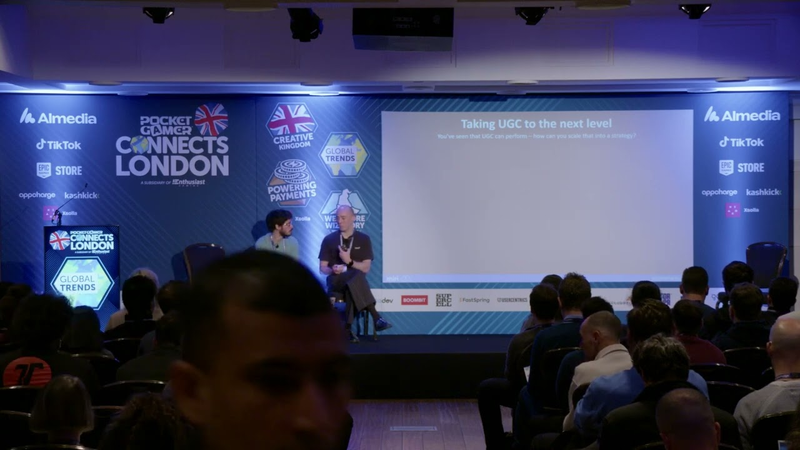
Maximizing creative win rates in mobile game user acquisition requires a strategic balance between maintaining high-performing hero creatives and exploring new concepts to combat inevitable creative fatigue.
- Hero creatives typically experience performance degradation within four to eight weeks, necessitating a structured lifecycle management strategy to combat creative fatigue.
- When performance is strong, marketing teams should maintain a 40/60 ratio between exploring new creative concepts and iteratively testing existing winning assets.
- Underperforming creative sets should be addressed by pivoting toward competitor analysis or re-imagining past winners through different execution styles, such as shifting from gameplay to user-generated content (UGC).
two & a half gamers session #33 - The UA (r)evolution, from fake ads to fake core gameplay in games
The mobile gaming industry is currently defined by a strategic shift toward the use of misleading advertisements and deceptive core gameplay mechanics to drive user acquisition.
- Fake ads—creative that depicts gameplay not present in the actual app—are used to drastically lower Cost Per Install (CPI), even though they often result in lower user retention.
- The math behind fake ads relies on volume: acquiring 100 players at a low CPI via misleading creative can yield more total conversions than acquiring 10 players at a high CPI through accurate gameplay footage.
- A current industry trend involves integrating the 'fake' gameplay into the actual game as a secondary feature, such as using hyper-casual mini-games to occupy players while waiting for timers in 4X strategy games.