Nippon Ichi Software
Game Co.16 documents
Documents
Article
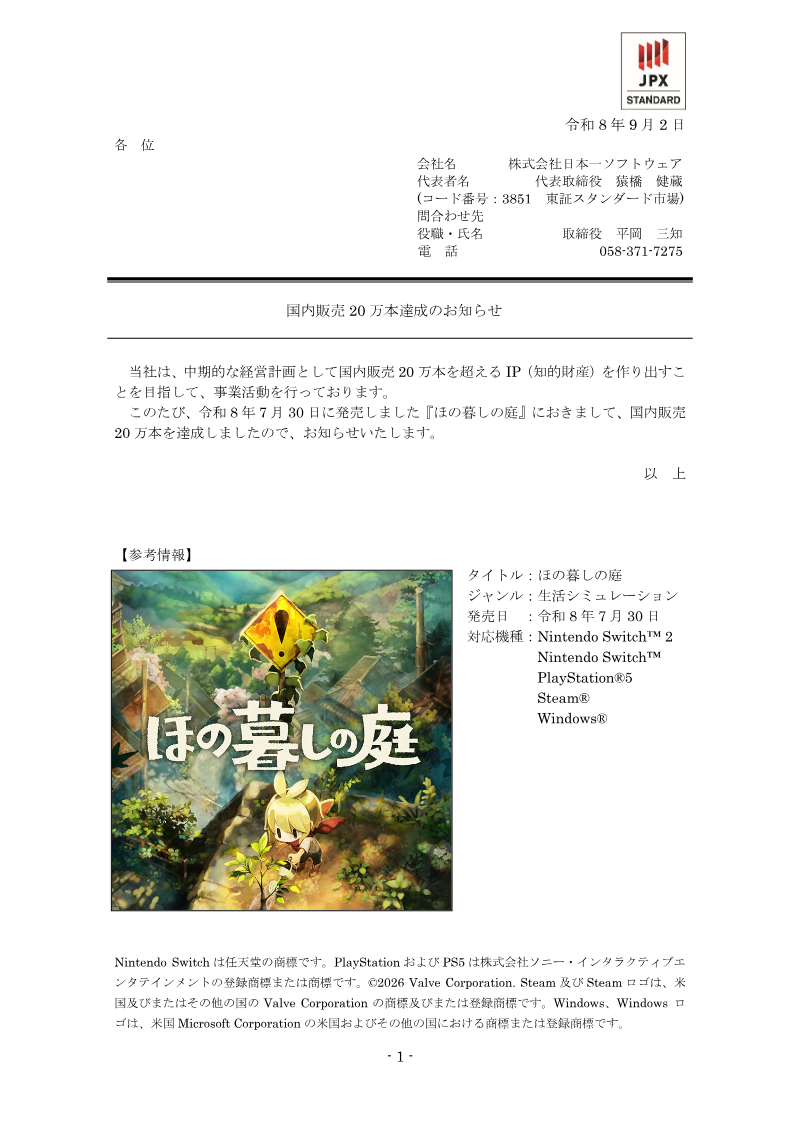
Domestic Sales Milestone Announcement: 200,000 Units
Nippon Ichi Software has achieved a significant commercial milestone with the domestic sales of its life simulation title, Hono-gurashi no Niwa, surpassing 200,000 units. This accomplishment aligns with the company’s broader medium-term management strategy, which prioritizes the cultivation and expansion of intellectual property capable of reaching this specific sales threshold within the Japanese market.
The title, released on July 30, 2026, demonstrates the company's successful execution of its growth objectives. The game is currently available across a diverse range of platforms, including Nintendo Switch, Nintendo Switch 2, PlayStation 5, Steam, and Windows, reflecting a multi-platform strategy designed to maximize accessibility and market penetration.
This sales performance serves as a key indicator of the company's ongoing efforts to strengthen its portfolio through high-performing intellectual property. By reaching this 200,000-unit benchmark, the firm validates its current development and distribution focus, reinforcing its position within the competitive landscape of the Japanese video game industry. The achievement underscores a commitment to sustainable growth by consistently delivering titles that resonate with domestic audiences.
- Nippon Ichi Software’s life simulation title, Hono-gurashi no Niwa, has surpassed 200,000 units in domestic sales.
- The title was released on July 30, 2026, and is available on Nintendo Switch, Nintendo Switch 2, PlayStation 5, Steam, and Windows.
- Reaching the 200,000-unit benchmark validates the company's medium-term strategy of cultivating intellectual property capable of hitting this specific domestic sales threshold.
- The multi-platform release strategy was utilized to maximize market penetration and accessibility across the Japanese gaming landscape.
- This sales milestone serves as a key performance indicator for the company's broader objective of strengthening its portfolio with high-performing intellectual property.
+2
Nippon Ichi Software
Financial13 pages
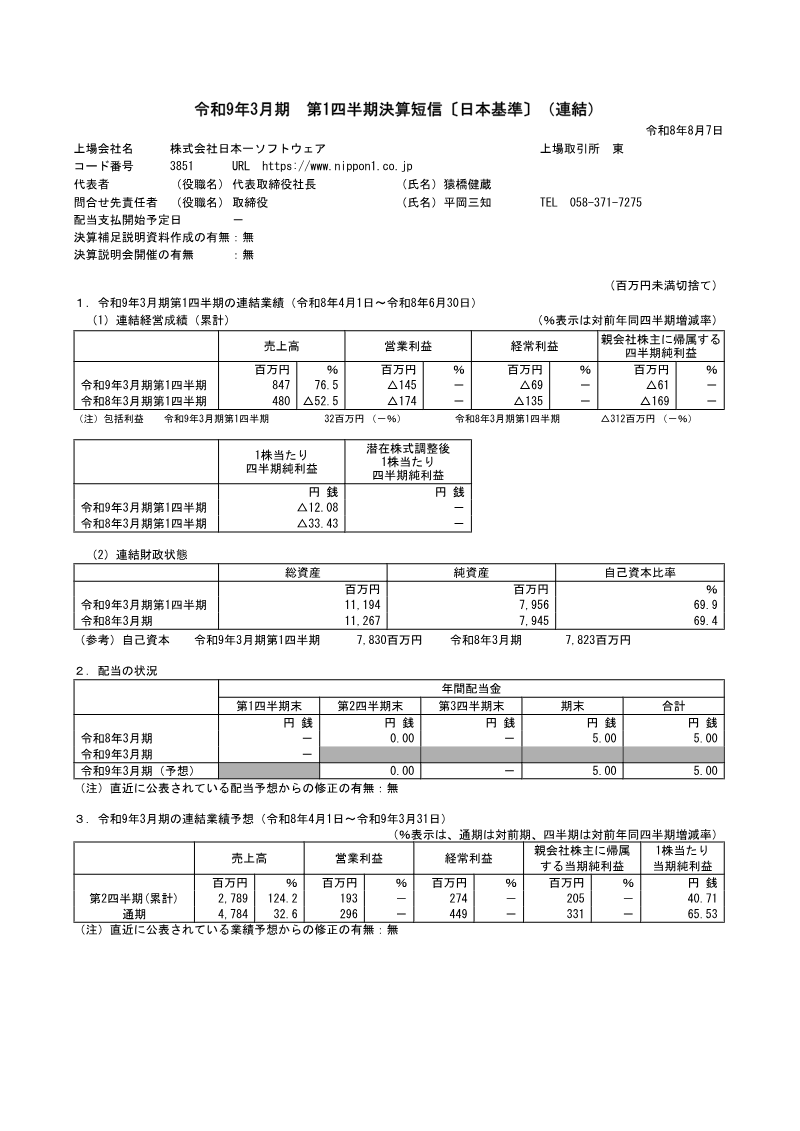
Q1 Financial Results: Fiscal Year Ending March 2027
Nippon Ichi Software’s financial results for the first quarter of the fiscal year ending March 2027 reflect a period of significant revenue growth alongside ongoing operational losses. For the three-month period ending June 30, 2026, the company reported net sales of 847 million yen, representing a 76.5% increase compared to the same period in the previous fiscal year. Despite this top-line growth, the company recorded an operating loss of 145 million yen, a slight improvement from the 174 million yen loss reported in the prior year’s first quarter. Net loss attributable to owners of the parent also narrowed to 61 million yen from 169 million yen.
The company operates primarily within the entertainment sector, focusing on the development and global distribution of game software across platforms such as PlayStation, Nintendo Switch, and Steam, alongside localized releases for North American, European, and Asian markets. The entertainment segment generated 809 million yen in sales, while the company’s secondary business, which manages university student dormitories in Gifu Prefecture, contributed 38 million yen in sales and achieved a modest operating profit of 1.8 million yen.
Financial stability remains consistent, with total assets reported at 11.19 billion yen and an equity ratio of 69.9%. Management maintains its previously announced full-year earnings forecast, projecting annual sales of 4.78 billion yen and an operating profit of 296 million yen. The company continues to prioritize the strengthening of development and sales capabilities while leveraging digital distribution and global market expansion to navigate a competitive landscape characterized by rapid technological shifts in cloud gaming, e-sports, and artificial intelligence.
- Nippon Ichi Software reported Q1 net sales of 847 million yen for the period ending June 30, 2026, marking a 76.5% increase year-over-year.
- Despite significant revenue growth, the company recorded an operating loss of 145 million yen, though this is an improvement over the 174 million yen loss in the same quarter of the previous year.
- Net loss attributable to owners of the parent narrowed to 61 million yen, down from 169 million yen in the prior year's first quarter.
- The entertainment segment accounted for 809 million yen of total sales, while the secondary dormitory management business contributed 38 million yen and a modest operating profit of 1.8 million yen.
- Management maintains its full-year forecast for the fiscal year ending March 2027, projecting annual sales of 4.78 billion yen and an operating profit of 296 million yen.
Nippon Ichi Software
Financial15 pages
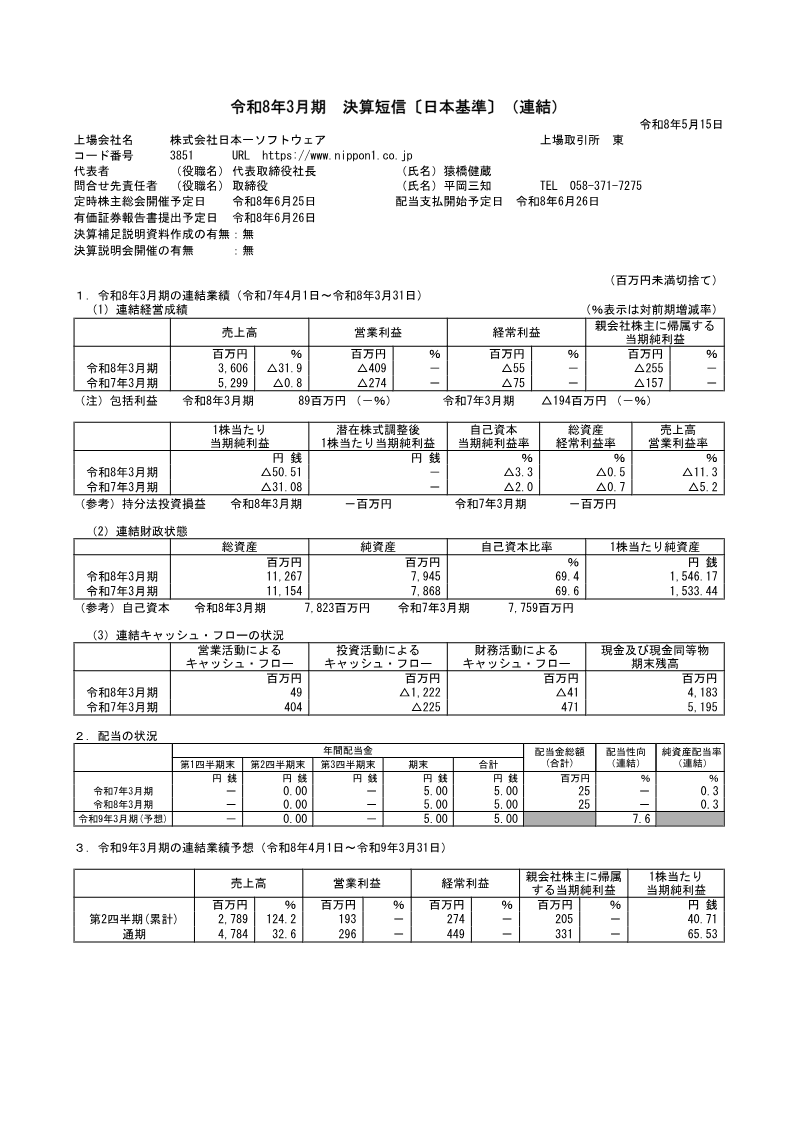
Financial Results for the Fiscal Year Ended March 31, 2026: Japan
The fiscal year ending March 31, 2026 (Reiwa 8) reported a consolidated revenue decline of 31.9 % to ¥3,606 million, driven by a sharp contraction in the entertainment segment. Operating loss widened to ¥409 million from ¥274 million, and ordinary loss rose to ¥55 million. Net loss attributable to parent shareholders reached ¥256 million, a 63 % increase from the prior year. The company’s equity base remained robust at ¥7,945 million with a 69.4 % equity ratio; total assets grew modestly to ¥11,267 million.
Cash‑flow analysis shows operating cash inflows fell dramatically to ¥50 million, reflecting the loss and a significant decline in accounts receivable. Investment activities produced a net outflow of ¥1,223 million, largely due to deposits and asset purchases. Financing cash use was modest at ¥42 million, driven by dividend payments of ¥25 million and debt repayments.
Dividend policy stayed unchanged: a 5 % payout ratio on retained earnings, with total dividends of ¥25 million. The board projected a 32.6 % revenue increase to ¥4,784 million for the following year, with operating profit turning positive at ¥296 million and net profit of ¥332 million. Forecasts rely on continued expansion in digital distribution, overseas localization, and student‑housing operations.
Geographically, the company operates primarily in Japan with international sales through PlayStation Network, Nintendo e‑Shop, Steam, and NIS America. The reporting period covers the Japanese market only; no foreign subsidiaries are listed. Methodologically, figures derive from audited consolidated financial statements under Japanese GAAP, with no changes in accounting policy or significant adjustments noted.
- Consolidated revenue fell 31.9% to ¥3,606 million for the fiscal year ending March 31, 2026, driven by a sharp contraction in the entertainment segment.
- Net loss attributable to parent shareholders increased by 63% to ¥256 million, while operating loss widened from ¥274 million to ¥409 million.
- Management projects a financial turnaround for the next fiscal year, forecasting a 32.6% revenue increase to ¥4,784 million and a net profit of ¥332 million.
- The company maintains a stable financial foundation with total assets of ¥11,267 million and a strong equity ratio of 69.4%.
- Operating cash inflows dropped significantly to ¥50 million, while investment activities resulted in a net outflow of ¥1,223 million due to asset purchases and deposits.
+1
Nippon Ichi Software
Financial12 pages
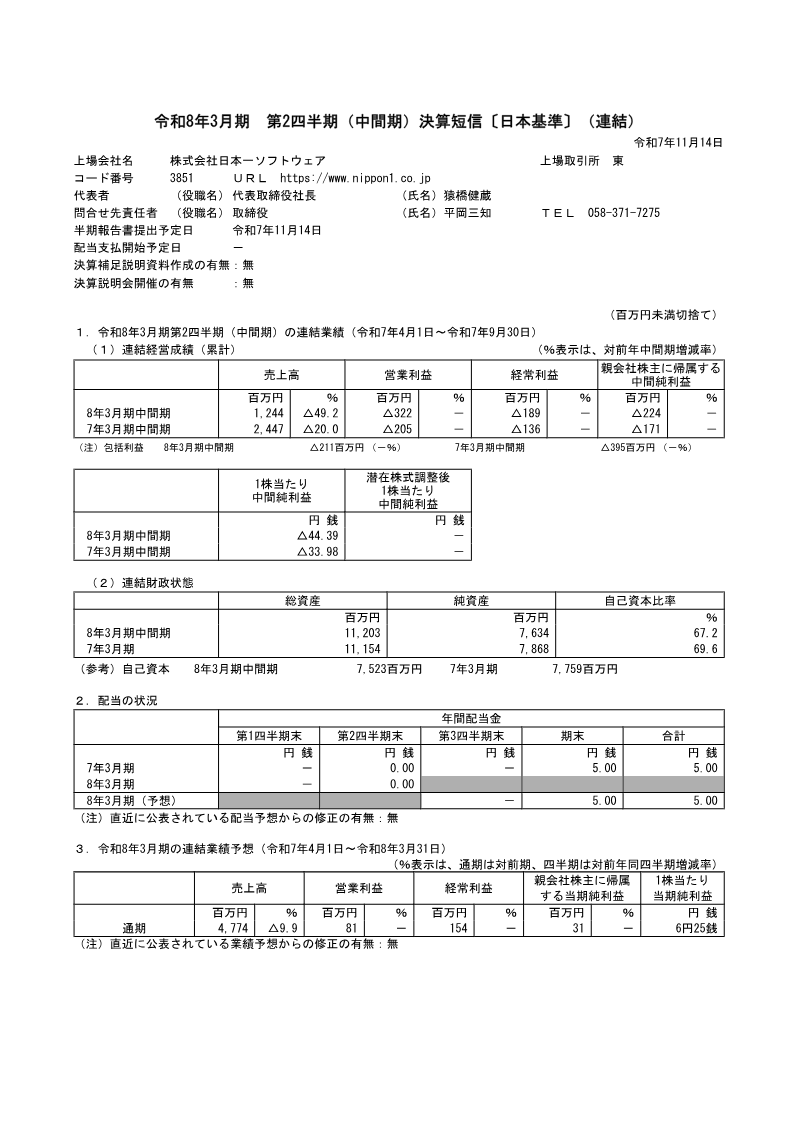
Financial Results for the Second Quarter: Japan (FY 2026/03)
The second‑quarter financial results for the fiscal year ending March 2026 show a sharp contraction in revenue and profitability. Consolidated sales fell 49.2 % to ¥1,244 million, while operating loss widened to ¥322 million from a ¥206 million loss the prior year. Ordinary loss increased to ¥189 million, and net loss attributable to equity holders reached ¥225 million. The company’s total assets rose modestly to ¥11,203 million, with equity declining to ¥7,635 million and the equity ratio falling from 69.6 % to 67.2 %. Cash balances dropped by ¥1,544 million to ¥3,652 million, reflecting significant outflows in investing activities (¥1.48 billion) and modest financing inflows (¥290 million).
Segment analysis indicates that the entertainment business, which includes game development and digital distribution, posted a 50.6 % decline in sales to ¥1,184 million and an operating loss of ¥96 million. The student‑dormitory and other services segment grew sales by 25.1 % to ¥60 million but still incurred an operating loss of ¥8 million. Cash‑flow statements reveal that operating activities generated a negative cash flow of ¥306 million, while investing activities consumed ¥1.48 billion mainly due to deposits and asset purchases.
The company forecasts a full‑year revenue of ¥4,774 million, representing a 9.9 % decline from the previous year, with operating and ordinary losses expected to widen further. No changes are anticipated in dividend policy for the year, and no material accounting policy adjustments were made during the period. The results reflect broader industry pressures such as inflation‑driven consumer restraint and competitive dynamics in the gaming market.
- Consolidated sales for Q2 FY2026/03 plummeted 49.2% to ¥1,244 million, resulting in a widened operating loss of ¥322 million compared to ¥206 million in the prior year.
- The core entertainment business, encompassing game development and digital distribution, saw a 50.6% revenue decline to ¥1,184 million and an operating loss of ¥96 million.
- Cash balances dropped by ¥1,544 million to ¥3,652 million, driven by a negative operating cash flow of ¥306 million and significant investing outflows of ¥1.48 billion.
- Full-year revenue is projected to fall 9.9% to ¥4,774 million, with management anticipating that operating and ordinary losses will continue to widen.
- The company's financial position weakened as equity declined to ¥7,635 million and the equity ratio dropped from 69.6% to 67.2%.
Nippon Ichi Software
Financial13 pages
Consolidated Financial Results: Q3 Fiscal Year 2026
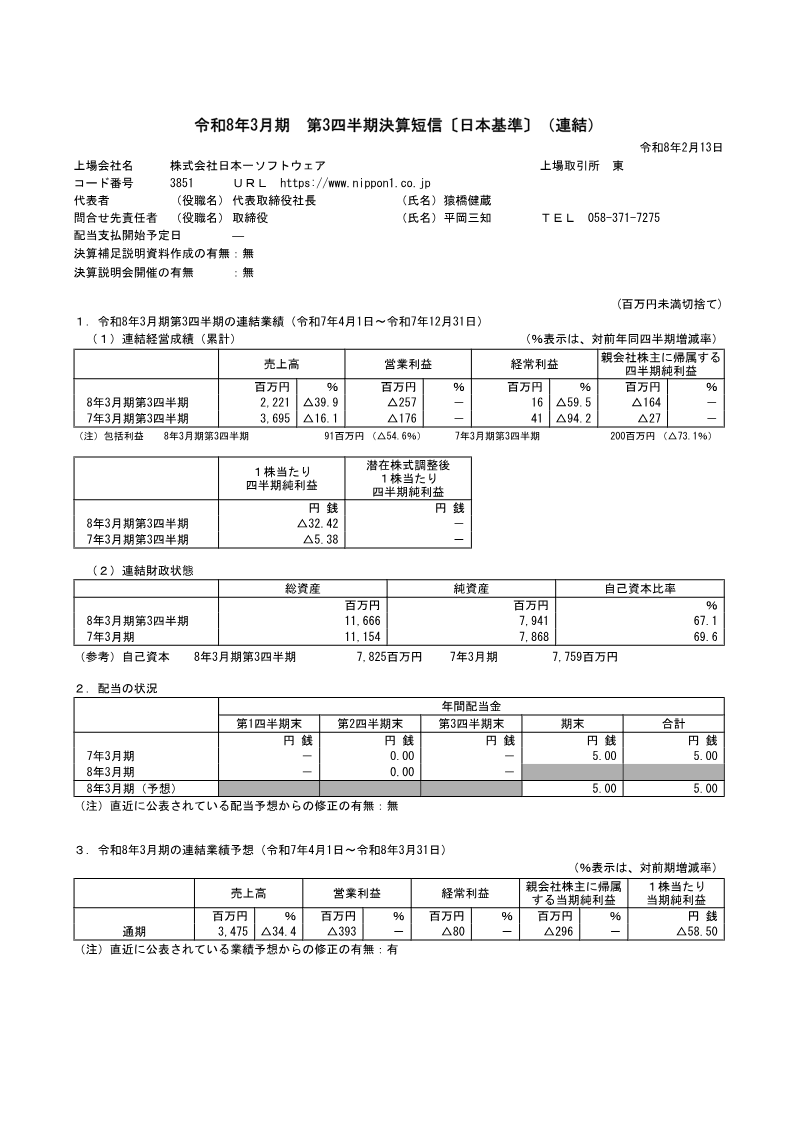
The quarterly consolidated financial results for the period ending March 2026 reveal a sharp contraction in revenue and profitability across the company’s entertainment and student‑housing segments. Total sales fell 39.9 % to ¥2,221 million, while operating loss widened to ¥257 million from a prior‑year loss of ¥176 million. Ordinary profit dropped 59.5 % to ¥16 million, and net loss attributable to parent shareholders rose to ¥164 million from ¥27 million. Segment analysis shows the entertainment business generated ¥2,132 million in sales but incurred a loss of ¥257 million; the student‑housing unit posted higher sales of ¥89 million but a smaller loss of ¥16 million. The company’s total assets increased to ¥11,667 million, driven mainly by cash and inventory gains, while liabilities rose to ¥3,725 million. Shareholders’ equity grew modestly to ¥7,942 million, with a 67.1 % equity ratio.
The company forecasts a full‑year decline in sales of 34.4 % to ¥3,475 million and operating loss of ¥393 million, with net loss projected at ¥80 million. Dividend policy remains unchanged, with no interim dividend announced for the quarter and a forecast of ¥5 million per share in the year. No significant accounting policy changes or material adjustments were reported, and the auditor issued a clean review opinion on the interim financial statements. The results reflect broader industry pressures, including inflation‑driven consumer restraint and competitive dynamics in the gaming market.
- Total sales for Q3 FY2026 fell 39.9% to ¥2,221 million, while the net loss attributable to parent shareholders widened significantly to ¥164 million from ¥27 million in the prior year.
- The entertainment segment, which accounts for the vast majority of revenue at ¥2,132 million, incurred an operating loss of ¥257 million.
- Full-year projections indicate a 34.4% decline in total sales to ¥3,475 million and an anticipated net loss of ¥80 million.
- Operating losses deepened to ¥257 million compared to a ¥176 million loss in the same period last year, while ordinary profit plummeted 59.5% to ¥16 million.
- Total liabilities rose to ¥3,725 million, though the company maintains a solid financial foundation with an equity ratio of 67.1% and total assets of ¥11,667 million.
+2
Nippon Ichi Software
Financial13 pages
Q1 Financial Results: Q1 2026
The quarterly report for the first quarter of fiscal 2026 presents a sharp contraction in revenue and profitability for Nippon One Software. Total sales fell to ¥480 million, a 52.5 % decline from the same period in fiscal 2025, while operating loss widened to ¥174.6 million from a ¥256.1 million loss previously. Ordinary loss reached ¥135.4 million, and net loss attributable to parent shareholders rose to ¥169.2 million, a 93.9 % increase year‑on‑year. Earnings per share declined to ¥–33.43 after potential adjustments.
Balance‑sheet metrics show a modest decline in total assets to ¥10.8 billion, with shareholders’ equity falling to ¥7.53 billion and the equity ratio slipping from 69.6 % to 68.6 %. Cash and cash equivalents increased by ¥380 million, offsetting reductions in accounts receivable and contract assets. Short‑term borrowings rose by ¥100 million, while long‑term debt decreased slightly.
Segment analysis attributes the majority of losses to the entertainment business, which recorded a ¥59.9 million operating loss against sales of ¥450 million (54.4 % drop). The student dormitory and other business, though smaller in revenue, improved its operating loss from ¥9.0 million to ¥3.5 million.
Management forecasts for the remainder of fiscal 2026 remain unchanged, projecting total sales of ¥4.77 billion and a net loss of ¥169.2 million for the year, with no adjustment to guidance. The report notes continued uncertainty in the gaming market due to inflationary pressures and global economic volatility, while highlighting ongoing efforts to strengthen development, sales, and productivity.
- Nippon One Software reported a 52.5% year-on-year revenue decline to ¥480 million for Q1 2026, with net loss attributable to parent shareholders rising 93.9% to ¥169.2 million.
- The company's primary entertainment segment drove the poor performance, recording a ¥59.9 million operating loss on a 54.4% drop in sales.
- Total operating loss for the quarter reached ¥174.6 million, while earnings per share fell to ¥–33.43.
- Management maintained its full-year fiscal 2026 guidance, projecting total sales of ¥4.77 billion and a net loss of ¥169.2 million.
- Balance sheet health saw a slight decline as shareholders’ equity fell to ¥7.53 billion and the equity ratio dropped to 68.6%.
Nippon Ichi Software
Legal4 pages
Announcement Regarding the Allocation of Stock Options (Stock Acquisition Rights)
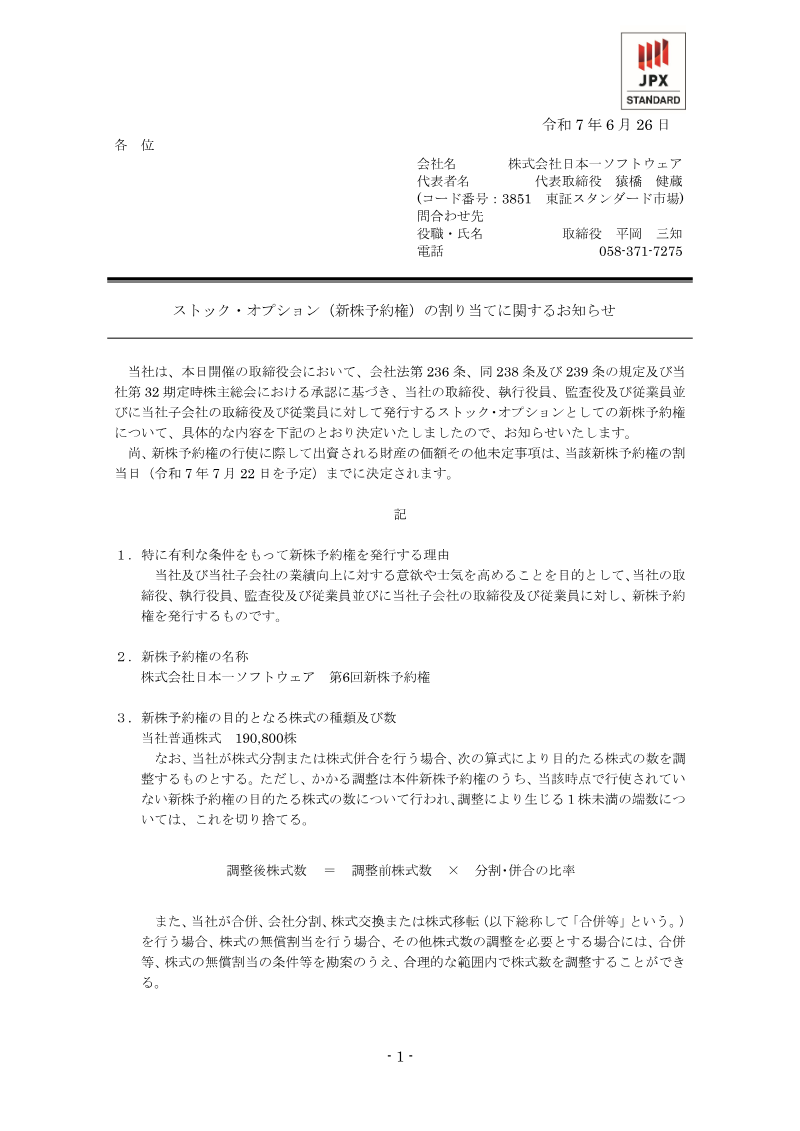
The announcement sets out the terms under which Nippon Ichi Software Co., Ltd. will issue new share subscription rights to its directors, executive officers, auditors, employees and the same categories at its subsidiaries. The primary aim is to boost motivation and morale and to align the interests of key personnel with the company’s performance, in accordance with the Companies Act and the approval obtained at the 32nd ordinary shareholders’ meeting.
A total of 1,908 subscription rights will be granted, each covering 100 ordinary shares for a combined target of 190,800 shares. Allocation is divided among 560 rights for directors, 43 for executive officers, 70 for auditors, 1,123 for employees, 40 for subsidiary directors and 72 for subsidiary employees. Recipients comprise five directors, one executive officer, three auditors, 121 employees, three subsidiary directors and 23 subsidiary employees. No cash contribution is required at grant, and the exercise price will be calculated as the average closing price of the company’s ordinary shares for the month preceding the allocation date, multiplied by 1.05 and rounded up, with a floor at the allocation‑day closing price.
The allocation date is set for 22 July 2025, and the exercise window runs from 1 August 2028 to 31 May 2035. Capital increases resulting from exercised rights are limited to half of the statutory increase ceiling, with the remainder allocated to capital reserves. Rights may be reclaimed free of charge if the holder ceases to meet the eligibility conditions or in the event of mergers, share exchanges or other reorganisations, and any transfer of rights requires board approval. The framework applies to the company’s listed shares on the Tokyo Stock Exchange and its subsidiaries, reflecting a corporate‑wide incentive program spanning the next decade.
- Nippon Ichi Software Co., Ltd. is issuing 1,908 stock acquisition rights, representing a total of 190,800 ordinary shares, to align the interests of personnel with company performance.
- The allocation covers 156 recipients, including directors, executive officers, auditors, and employees across the parent company and its subsidiaries.
- The exercise price for the shares will be set at 105% of the average closing price of the company's shares for the month preceding the 22 July 2025 allocation date, with a floor at the allocation-day closing price.
- The exercise window for these stock options is set to span nearly seven years, beginning on 1 August 2028 and ending on 31 May 2035.
- The distribution of rights is heavily weighted toward employees, who will receive 1,123 of the 1,908 total rights, while directors receive 560 and auditors receive 70.
+3
Nippon Ichi SoftwareFeb 2026
Financial13 pages
Reiwa 8 Fiscal Year Q3 Consolidated Financial Results (Japanese GAAP)
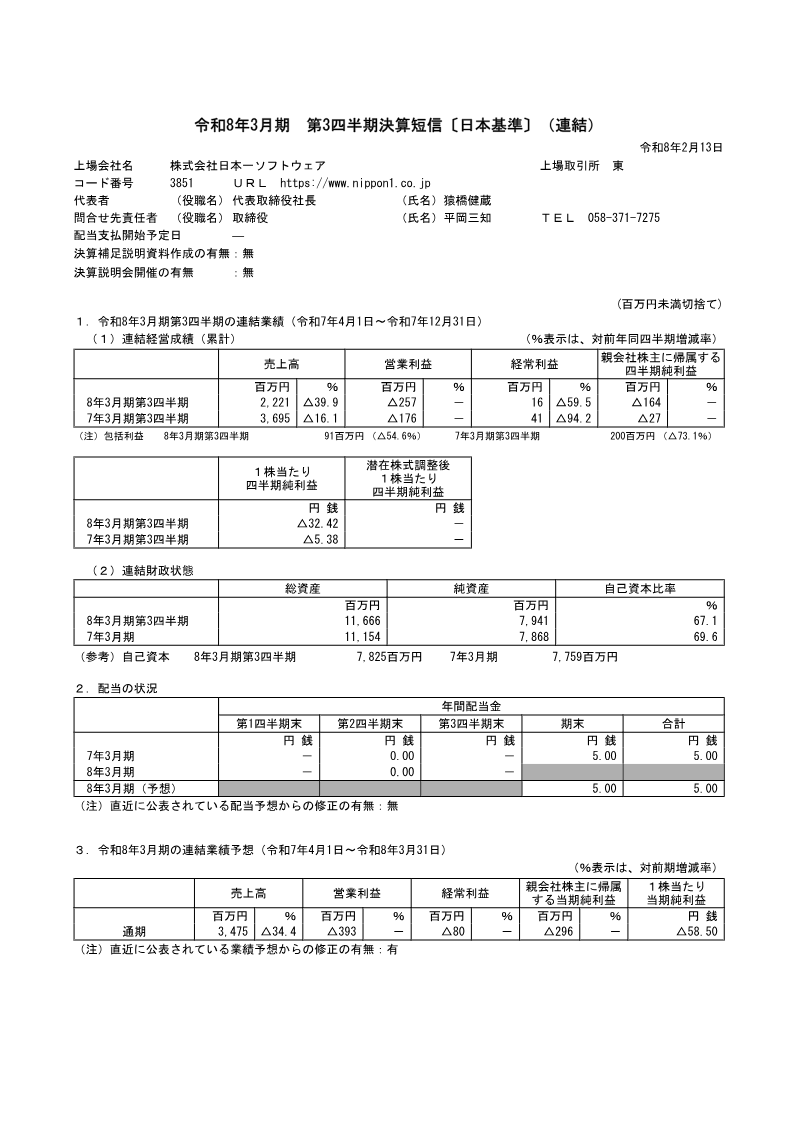
Nippon Ichi Software’s consolidated financial results for the third quarter of the fiscal year ending March 31, 2026, reveal a period of significant financial contraction and operational transition. Covering the nine-month period from April 1, 2025, to December 31, 2025, the data shows net sales fell 39.9% year-over-year to 2,221 million yen. The company reported an operating loss of 257 million yen and a quarterly net loss attributable to the parent of 164 million yen, representing a marked downturn compared to the previous year’s performance.
The entertainment segment, which accounts for the vast majority of revenue, saw sales decline by 41.2% to 2,132 million yen. Despite the downturn, the company continued development on several 2026 titles, including Kyouran Makaism and Curse Warrior, while releasing Disgaea 7 Complete for the Nintendo Switch 2 in Western markets through its subsidiary, NIS America. A smaller secondary segment involving the operation of student dormitories in Gifu Prefecture saw a 24.0% increase in sales but remained loss-making at the operating level.
The financial position remains stable with a 67.1% equity ratio and total assets of 11.6 billion yen, though the company has revised its full-year forecasts downward. Projections for the fiscal year ending March 2026 now anticipate a 34.4% decrease in annual sales to 3,475 million yen and a net loss of 296 million yen. These results are attributed to a challenging consumer environment and shifting release schedules. The methodology follows Japanese GAAP, and the figures have undergone a voluntary quarterly review by independent auditors.
- Nippon Ichi Software reported a 39.9% year-over-year decline in net sales to 2,221 million yen for the nine-month period ending December 31, 2025.
- The company shifted to a loss-making position, recording an operating loss of 257 million yen and a quarterly net loss of 164 million yen.
- The core entertainment segment drove the downturn with a 41.2% revenue decline to 2,132 million yen, despite the release of Disgaea 7 Complete for the Nintendo Switch 2 in Western markets.
- Management has revised full-year forecasts downward, now projecting a 34.4% annual sales decrease to 3,475 million yen and a net loss of 296 million yen for the fiscal year ending March 2026.
- The company’s secondary business, a dormitory operation in Gifu Prefecture, grew sales by 24.0% but failed to reach profitability at the operating level.
Nippon Ichi SoftwareFeb 2026
Financial2 pages
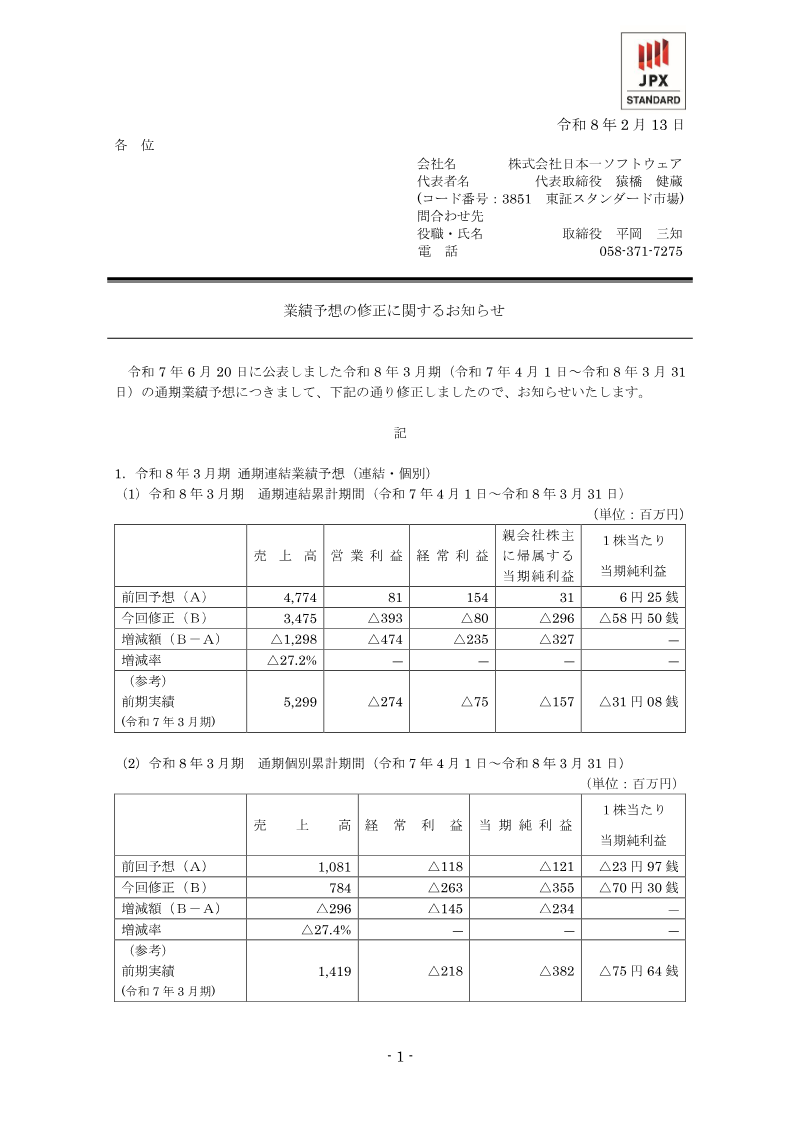
Notice Concerning Revision of Earnings Forecast: Japan
The notice announces a downward revision of the full‑year earnings outlook for the fiscal year ending March 2026 for a Japanese software publisher listed on the Tokyo Stock Exchange Standard market. The revised consolidated forecast projects net sales of ¥3,475 million, a 27.2 % decline from the prior estimate of ¥4,774 million, and operating profit of ¥‑393 million, down ¥474 million from the earlier ¥‑81 million projection. Ordinary profit is now expected at ¥‑80 million, a reduction of ¥235 million, while earnings per share fall from ¥6.25 to ¥‑0.58. The standalone forecast shows a similar contraction, with net sales cut to ¥784 million (‑27.4 %) and operating loss widening to ¥‑263 million, compared with the previous ¥1,081 million and ¥‑118 million respectively.
The revision is attributed primarily to weaker-than‑anticipated sales of new titles in both domestic and overseas markets, despite steady download revenues from existing games. Higher selling, general and administrative expenses, adverse foreign‑exchange effects from a depreciating yen, and a special loss for retirement allowances at an overseas subsidiary further depress profitability.
The forecast reflects information available as of the announcement date and acknowledges that actual results may vary due to unforeseen factors. The scope is limited to the company’s consolidated and individual financial performance for the 12‑month period from April 2025 to March 2026, covering its core software and game publishing operations in Japan and abroad.
- The company has issued a downward revision for the fiscal year ending March 2026, projecting net sales of ¥3,475 million, a 27.2% decline from the previous estimate of ¥4,774 million.
- Operating profit is now forecasted at a loss of ¥393 million, representing a significant deterioration from the previously projected loss of ¥81 million.
- Earnings per share have been revised downward from an expected profit of ¥6.25 to a loss of ¥0.58.
- The primary driver for the poor performance is weaker-than-anticipated sales of new software titles in both domestic and international markets.
- Profitability has been further constrained by rising selling, general, and administrative expenses, unfavorable foreign-exchange impacts from a weak yen, and a special loss related to retirement allowances at an overseas subsidiary.
+1
Nippon Ichi SoftwareFeb 2026

Financial26 pages
Nippon Ichi Software Semi-Annual Report: 33rd Period (FY2026)
Nippon Ichi Software, Inc. reports its consolidated financial results for the first half of the 33rd fiscal period, covering April 1, 2025, through September 30, 2025. The primary purpose of the disclosure is to provide a semi-annual update on the group’s financial standing, operational performance, and cash flow status. The scope of the report encompasses the core entertainment business, centered on video game development and global publishing, as well as a secondary segment involving the management of student dormitories in Gifu Prefecture.
Financial data indicates a challenging period for the group. Net sales fell to 1,244 million yen, representing a 49.2% decrease compared to the same period in the previous year. This decline contributed to an operating loss of 322 million yen and a net loss attributable to owners of the parent of 224 million yen. The entertainment segment specifically saw a transition from a prior-year profit to an operating loss of 95 million yen, despite the release of titles such as Fuuraiki 5 and Renju. The report attributes the overall performance to the timing of software releases and ongoing development costs for upcoming titles like Kyoran Makaism.
The group maintains a solid capital position with a self-equity ratio of 67.2% and total assets valued at 11.2 billion yen. Cash and cash equivalents decreased by approximately 1.5 billion yen during the period, largely driven by investment activities, including 2.05 billion yen placed into time deposits. Management emphasizes a strategy focused on strengthening development capabilities and expanding global localization efforts across platforms including PlayStation Network, Nintendo eShop, and Steam to return to profitability. The financial statements were prepared in accordance with Japanese accounting standards and underwent an interim review by Tokai Kaikeisha Audit Corporation.
- Nippon Ichi Software reported a 49.2% year-over-year decline in net sales to 1,244 million yen for the first half of fiscal year 2026.
- The company recorded an operating loss of 322 million yen and a net loss of 224 million yen for the period ending September 30, 2025.
- The entertainment segment shifted to an operating loss of 95 million yen, attributed to the timing of software releases and development costs for upcoming titles like Kyoran Makaism.
- Despite the losses, the group maintains a strong financial foundation with a self-equity ratio of 67.2% and total assets valued at 11.2 billion yen.
- Cash and cash equivalents decreased by approximately 1.5 billion yen, primarily due to 2.05 billion yen being reallocated into time deposits.
+1
Nippon Ichi SoftwareNov 2025
Financial2 pages
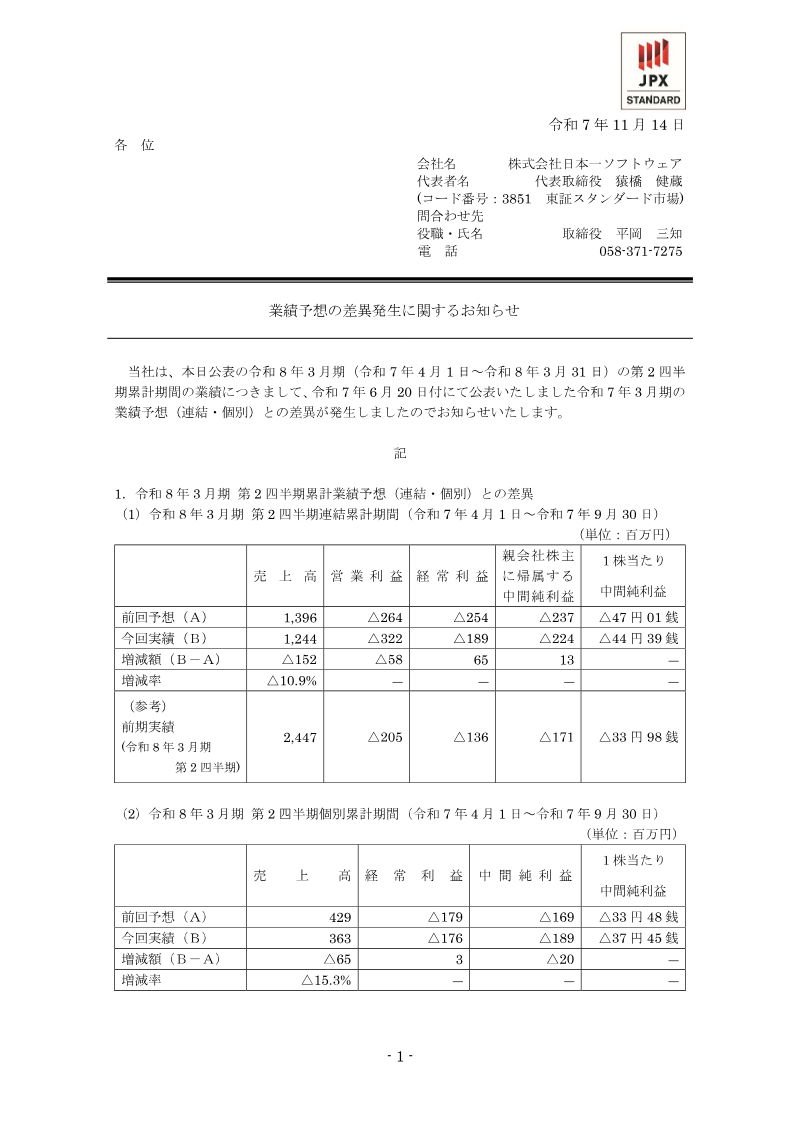
Notice Regarding Differences in Earnings Forecasts
The notice serves to inform shareholders of a variance between the company’s actual second‑quarter performance for the fiscal year ending March 2026 and the forecast issued on 20 June 2025. For the consolidated period April 1 to 30 September 2025, net sales reached ¥1,244 million, 10.9 % below the prior estimate of ¥1,396 million, while operating profit fell to a loss of ¥322 million versus the projected ¥264 million loss. Net profit attributable to the parent’s shareholders declined to ¥44 million per share from the forecasted ¥47 million. On a standalone basis, sales were ¥363 million, 15.3 % lower than the ¥429 million expected, and net profit per share slipped to ¥45 million from ¥48 million. The primary driver of the shortfall was weaker domestic demand for newly released titles, which reduced unit sales below expectations. Conversely, a stronger yen depreciation generated foreign‑exchange gains that lifted both ordinary profit and net profit relative to the forecast.
Despite the quarterly miss, the company retains its full‑year outlook unchanged. The revised full‑year consolidated forecast anticipates sales of ¥4,774 million, a 9.9 % decline year‑on‑year, with operating profit turning positive to ¥81 million after a prior loss, ordinary profit of ¥154 million, and net profit attributable to shareholders of ¥31 million. On a standalone basis, full‑year sales are projected at ¥1,081 million, down 23.8 % YoY, with ordinary loss of ¥118 million and net loss of ¥121 million. The company commits to updating the outlook promptly should subsequent developments warrant revision.
- The company missed its Q2 fiscal 2026 consolidated net sales target by 10.9%, reporting ¥1,244 million against a forecast of ¥1,396 million.
- Operating losses for the second quarter widened to ¥322 million, exceeding the projected loss of ¥264 million.
- Weaker-than-expected domestic demand for new game titles was the primary driver for the revenue shortfall and reduced unit sales.
- Foreign-exchange gains resulting from yen depreciation partially offset the quarterly performance gap, helping to lift ordinary and net profit figures relative to forecasts.
- Despite the Q2 miss, the company has maintained its full-year consolidated outlook, which projects ¥4,774 million in sales and an operating profit of ¥81 million.
+1
Nippon Ichi SoftwareNov 2025
Financial12 pages
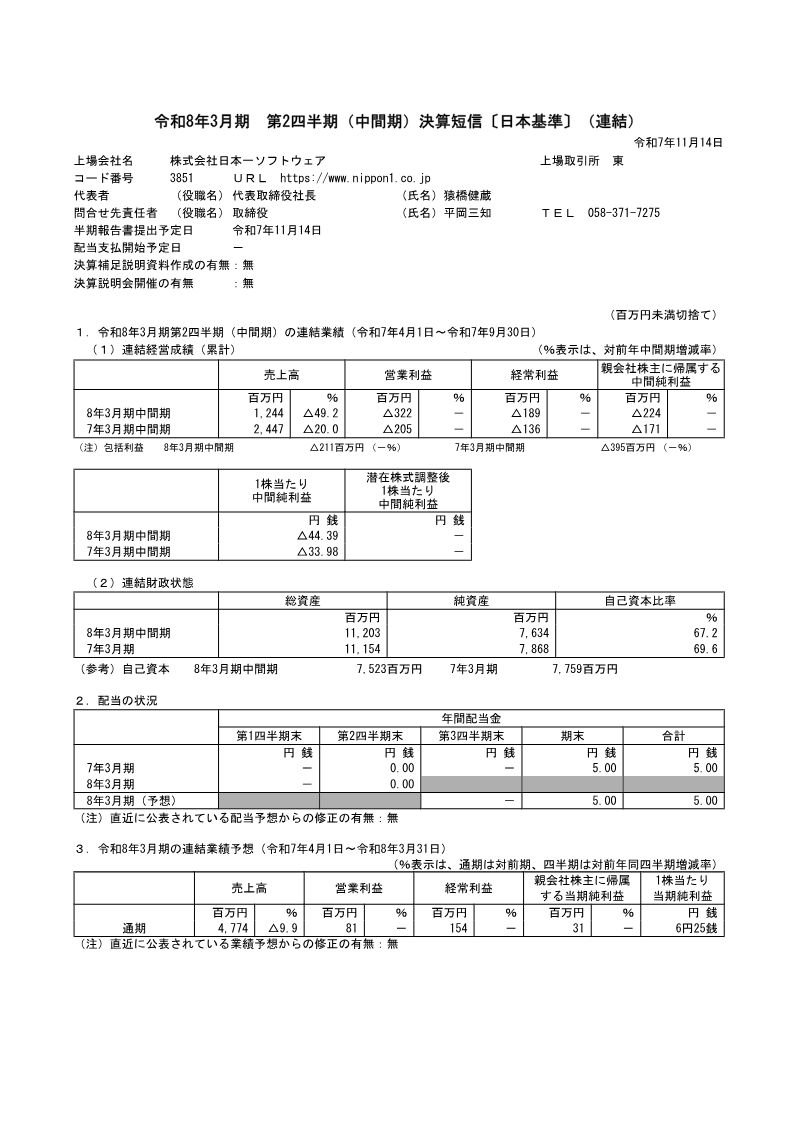
Fiscal Year Ending March 2026: Second Quarter Interim Financial Results (Japanese Standards) (Consolidated)
Nippon Ichi Software reported a significant downturn in its consolidated financial results for the first half of the fiscal year ending March 2026, covering the period from April 1, 2024, to September 30, 2024. Net sales fell by 49.2% year-over-year to 1.24 billion yen. The company recorded an operating loss of 322 million yen and a net loss attributable to owners of the parent of 224 million yen, deepening the losses compared to the same period in the previous fiscal year.
The entertainment segment, which constitutes the core of the business, saw sales drop by 50.6% to 1.18 billion yen, resulting in a segment loss of 95 million yen. This decline occurred despite the release of titles such as Fuuraiki 5 and Renju, alongside ongoing localization and global distribution efforts on platforms like PlayStation Network, Nintendo eShop, and Steam. The company also operates a smaller student dormitory business in Gifu Prefecture, which saw a 25.1% increase in sales but remained unprofitable with an 8 million yen operating loss.
The financial position remains stable with a 67.2% equity ratio and total assets of 11.2 billion yen. Cash and cash equivalents decreased by 1.54 billion yen during the period, primarily due to significant outflows for time deposits and investments in tangible fixed assets. Despite the weak interim performance, the company maintained its full-year forecast for the fiscal year ending March 2026, projecting 4.77 billion yen in sales and a return to profitability with 31 million yen in net income. The dividend forecast remains unchanged at 5 yen per share.
- Nippon Ichi Software reported a 49.2% year-over-year decline in net sales to 1.24 billion yen for the first half of the fiscal year ending March 2026.
- The company recorded a consolidated operating loss of 322 million yen and a net loss of 224 million yen for the six-month period ending September 30, 2024.
- The core entertainment segment experienced a 50.6% drop in sales to 1.18 billion yen, resulting in a segment loss of 95 million yen despite the release of titles like Fuuraiki 5 and Renju.
- Management has maintained its full-year forecast, projecting 4.77 billion yen in sales and a return to profitability with 31 million yen in net income for the fiscal year ending March 2026.
- Cash and cash equivalents decreased by 1.54 billion yen during the period, driven primarily by outflows for time deposits and investments in tangible fixed assets.
+1
Nippon Ichi SoftwareNov 2025