Loading the document
1 free read left. Create a free account for unlimited reading + AI research.
Create free accountArticle KPMG
1 free read left. Create a free account for unlimited reading + AI research.
Create free accountArticleKPMG
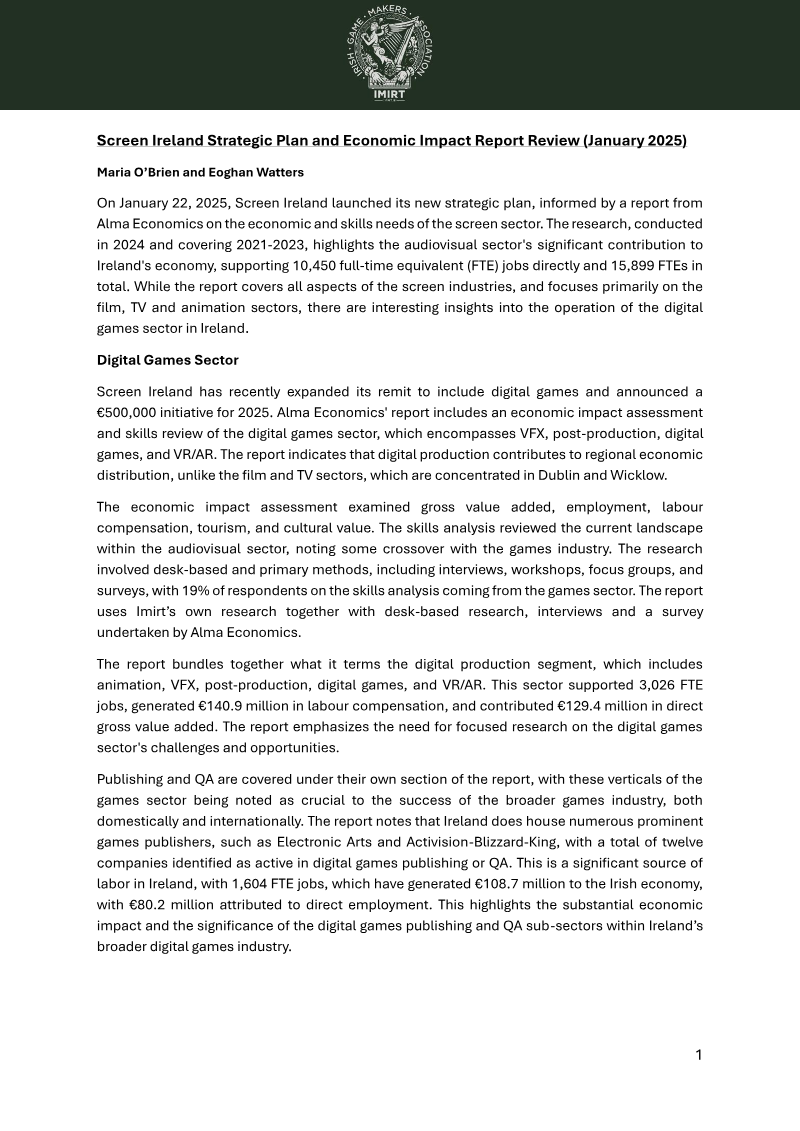
The paper's headline figures put the sector's current footprint at around 2,400 FTEs, with development, gametech and publishing as the largest sub-sectors.
Ireland has an opening to strengthen its position as a high-value European hub for game development, gametech, publishing and live operations, but capturing a larger share of global growth depends on resolving constraints around talent, scale, finance and visibility through a coordinated national approach. The argument rests on a maturing global industry in which value increasingly comes from live operations, post-release monetisation and platform services rather than unit sales. Titles are supported for a decade or more through subscriptions, battle passes, downloadable content and in-game advertising, while rising development costs and publisher consolidation reshape competition among governments seeking high-value activity.
Ireland's digital games sector is small by global standards but strategically placed, directly employing 2,400 full-time equivalents and generating over €570m in turnover in 2024, with development, gametech and publishing the largest sub-sectors. The analysis maps an integrated value chain from development and tools through QA, localisation, publishing, distribution, live operations, monetisation and player engagement, illustrating participation by firms such as Havok, Demonware, Keywords Studios, Electronic Arts, Riot Games and Playrix. Core strengths include Ireland's cloud, software and AI infrastructure, spill-overs from a strong animation and film sector (exemplified by Kilkenny's Lighthouse Studios), a long FDI track record, and supportive policy through the extended Digital Games Tax Credit and R&D incentives.
Key challenges are talent shortages and cost pressures from multinational competition, housing costs and salary arbitrage; limited scale-appropriate financing such as bridge finance and risk-sharing tools; and an ecosystem less mature than the UK, France and Poland, which pair tax incentives with dedicated funds, training pipelines and market visibility.
The recommended strategy is specialisation rather than replicating the largest hubs, focused on four areas: live operations and post-launch services, gametech and platforms, high-value and co-development, and publishing with European market access. Delivery requires a national talent strategy, financial instruments suited to games IP, coordinated international promotion, and alignment with animation, film, AI and digital policy. The analysis is qualitative and strategic, drawing on limited quantitative data beyond sector employment and turnover.
Each row is a game or company this document names, each column a document, oldest first. A mark means that document names it. Select a row to see those documents.
GAMEHEARTS · 2026