1 free read left. Create a free account for unlimited reading + AI research.
Create free accountReport Interactive Games and Entertainment Association
1 free read left. Create a free account for unlimited reading + AI research.
Create free accountReportInteractive Games and Entertainment Association
The figures cover 1 July 2023 to 30 June 2024.
Stability. Revenue dipped 1.9 percent to $339.1 million in FY2024, while employment held roughly steady at 2,465 people.
The Australian Game Development Survey 2024 provides an annual snapshot of the country's game development sector for the financial year running from 1 July 2023 to 30 June 2024. Produced by the Interactive Games & Entertainment Association (IGEA) with research conducted by Bond University, the report tracks key indicators including revenue, employment, studio characteristics, diversity, and industry challenges. Its central message is one of stability amid global headwinds: revenue dipped slightly to $339.1 million, a decrease of 1.9 percent, while employment held roughly steady at 2,465 people, and the sector remains heavily export-oriented, with 93 percent of revenue generated outside Australia.
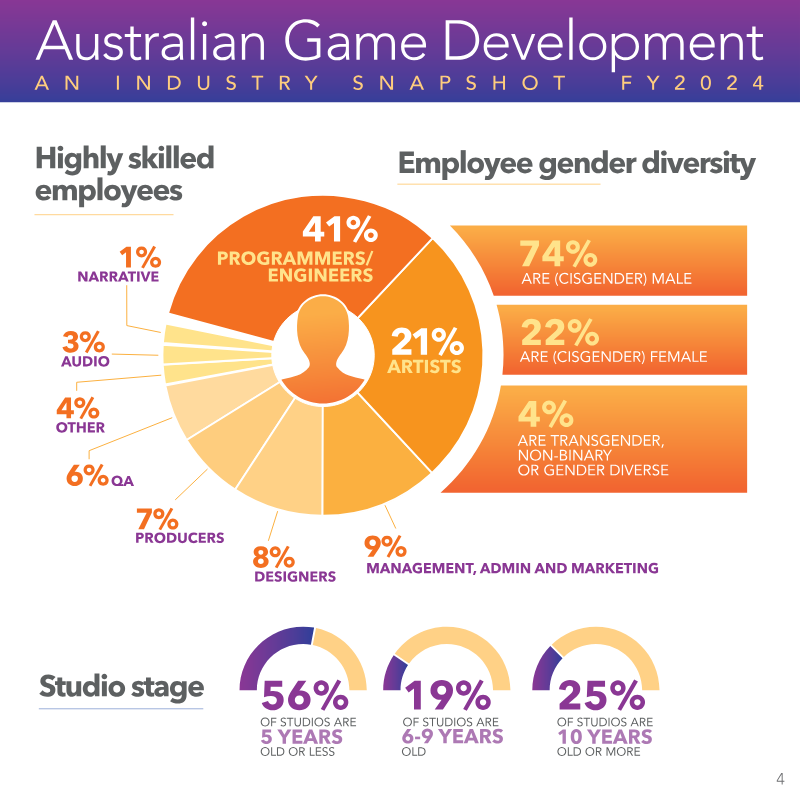
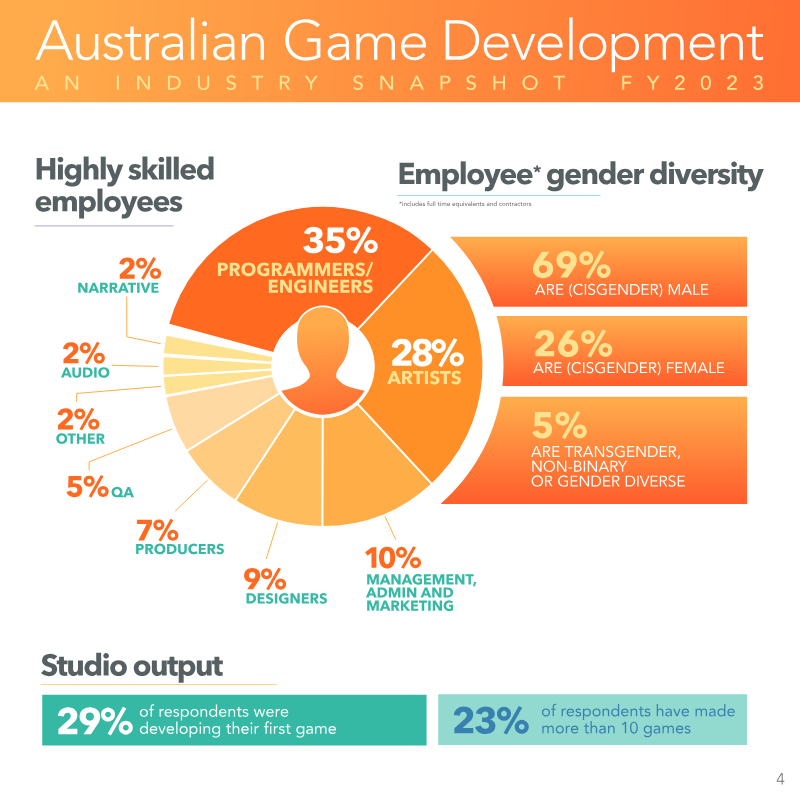
The survey's findings point to a maturing yet still renewing industry. Eighty-five percent of studios develop their own intellectual property, and while 56 percent of studios are five years old or younger, 25 percent have operated for more than a decade. Nearly half of studios (47 percent) employ five or fewer staff. Forward-looking indicators are cautiously positive, with 53 percent of studios predicting income growth in the coming year and 81 percent predicting revenue to increase or remain stable. Roughly a quarter of respondents had made their first claim under the Digital Games Tax Offset, introduced in June 2023, and over a third planned to use it in FY2025. Gender diversity figures show women representing 22 percent of employees and gender-diverse individuals representing about 4 percent, with both categories showing slight declines year on year.
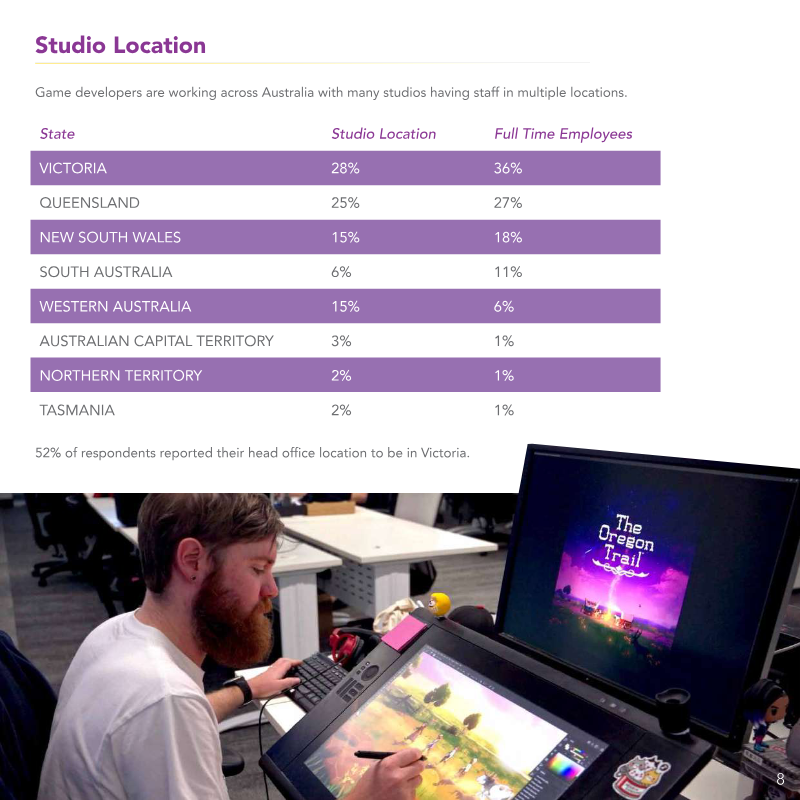
Methodology is an important qualifier. Over 400 studios were contacted, but only 137 completed usable responses, and participation was voluntary, so the figures are explicitly presented as a base rate rather than a comprehensive census. Geographically, Victoria and Queensland host the largest shares of studio locations and staff, with coverage spanning all states and territories. The top challenges identified for the sector were securing international and local publisher deals and attracting early-stage development funding.

New Zealand Game Developers Association · 2026
Interactive Games & Entertainment Association · 2026


Interactive Games & Entertainment Association · 2025
Interactive Games & Entertainment Association · 2025
Interactive Games and Entertainment Association · 2024
Interactive Games & Entertainment Association · 2024
Interactive Games & Entertainment Association · 2023


Interactive Games & Entertainment Association · 2020


Interactive Games & Entertainment Association · 2020

Interactive Games and Entertainment Association · 2019
Interactive Games and Entertainment Association · 2019
Interactive Games and Entertainment Association · 2015
GAMEHEARTS · 2026