Digital Games
Company
Documents about Digital Games

Towards a “Filipino” Video Game: Teaching Filipino Culture and Identity for Video Game Development
Christoffer Mitch C. Cerda, writing in the Transactions of the Digital Games Research Association (November 2021), reflects on teaching the Filipino module of CS179.15A, an interdisciplinary game design course at his university, during the first semesters of AY 2015-2016 and AY 2017-2018.
- Filipino players mostly play foreign-made games, which the author links partly to limited market access, since video games are expensive and accessible mainly to middle and upper classes.
- Filipinos reportedly spent $572 million on video games in 2019, citing Newzoo, with mobile free-to-play games growing in popularity due to low cost.
- The author reports that a Filipino player may read the paring pugot in Nightfall: Escape as representing the Spanish friars, while a non-Filipino player may wrongly conclude it represents the Gomburza.
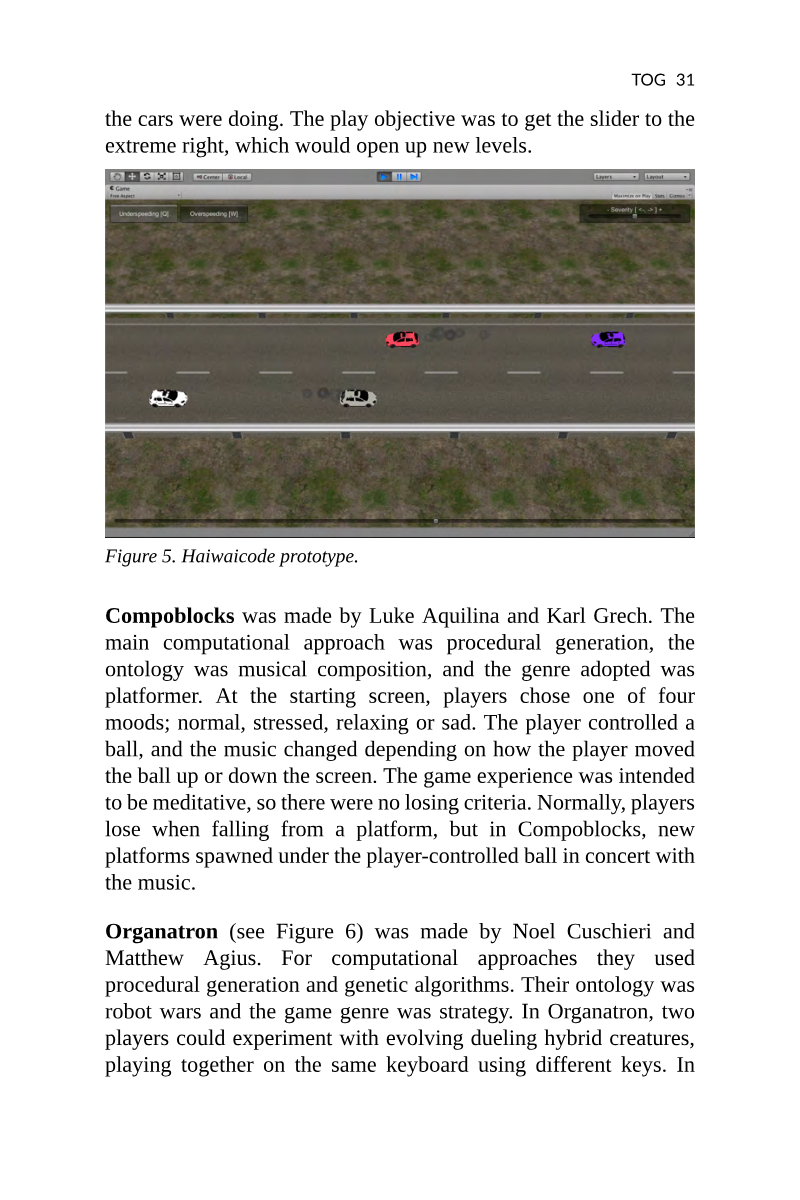
TOG: A Model for Innovation-Centric Design in Games and Expressive Interactive Media
The paper by Mirjam Palosaari Eladhari and Hartmut Koenitz, published in Transactions of the Digital Games Research Association (November 2021, Vol. 5 No 3, pp.
- The TOG model is built on three components: Technology, Ontology, and Game Genre. The authors present it as a way to spur conceptual innovation and experimentation with computational expression.
- The authors define the techno-artistic minimum as the threshold an artifact must reach to be a viable video game prototype, where technology and artistry form a minimal alliance.
- In the reflection phase, expressive effect is placed on a scale from overestimation of a system's capabilities to underestimation, with the match between perception and ability called the 'techno-experiential balance'.
Generating Lode Runner Levels by Learning Player Paths with LSTMs
This arXiv paper, presented at the 16th International Conference on the Foundations of Digital Games (FDG'21), by researchers at the University of Alberta, proposes a procedural content generation method for Lode Runner levels.
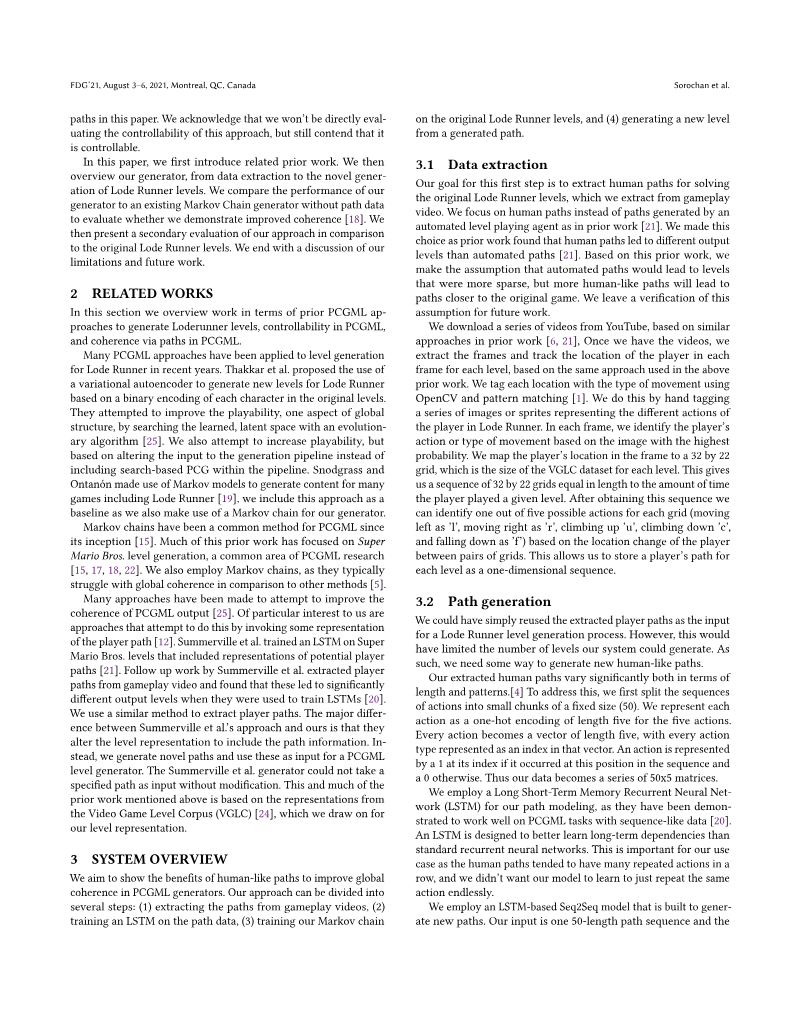
- The authors extracted player paths from gameplay video of 66 Lode Runner levels, drawn from a 4.5-hour video containing 150 completed levels.
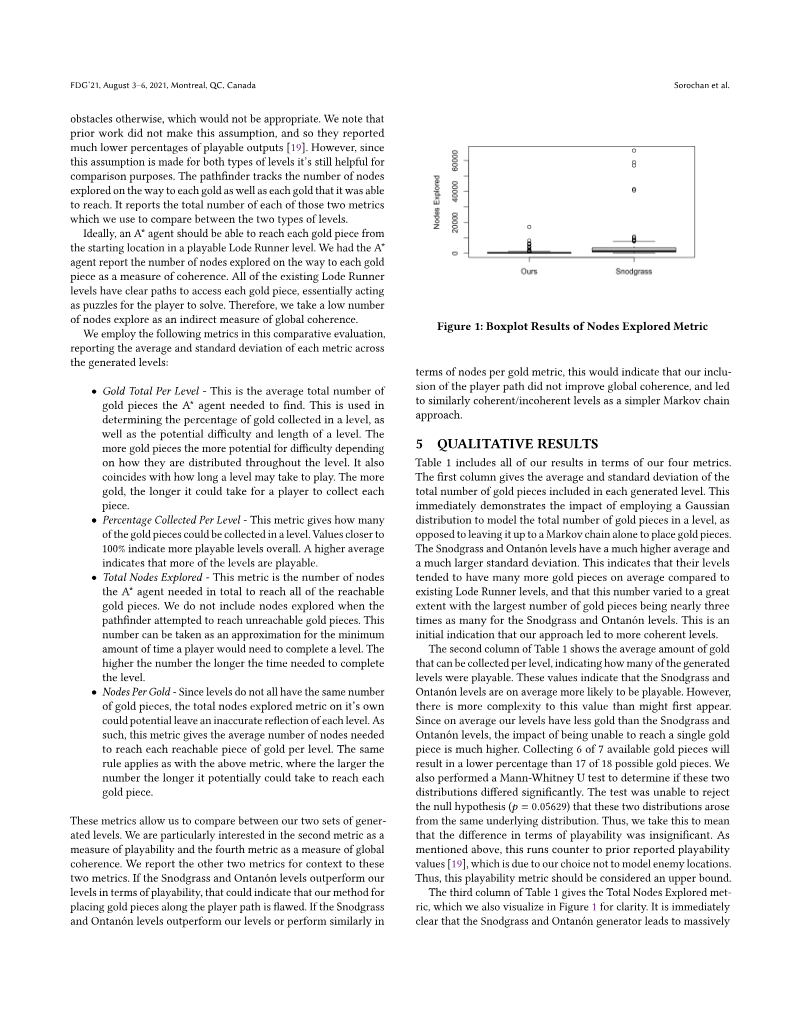
- Their method averaged 7.65±2.98 gold pieces per level, compared with 18.76±15.07 for the Snodgrass and Ontanón levels.
- Nodes explored per gold piece averaged 116.44±264.82 for the authors' levels versus 220.62±477.89 for the Snodgrass and Ontanón levels.
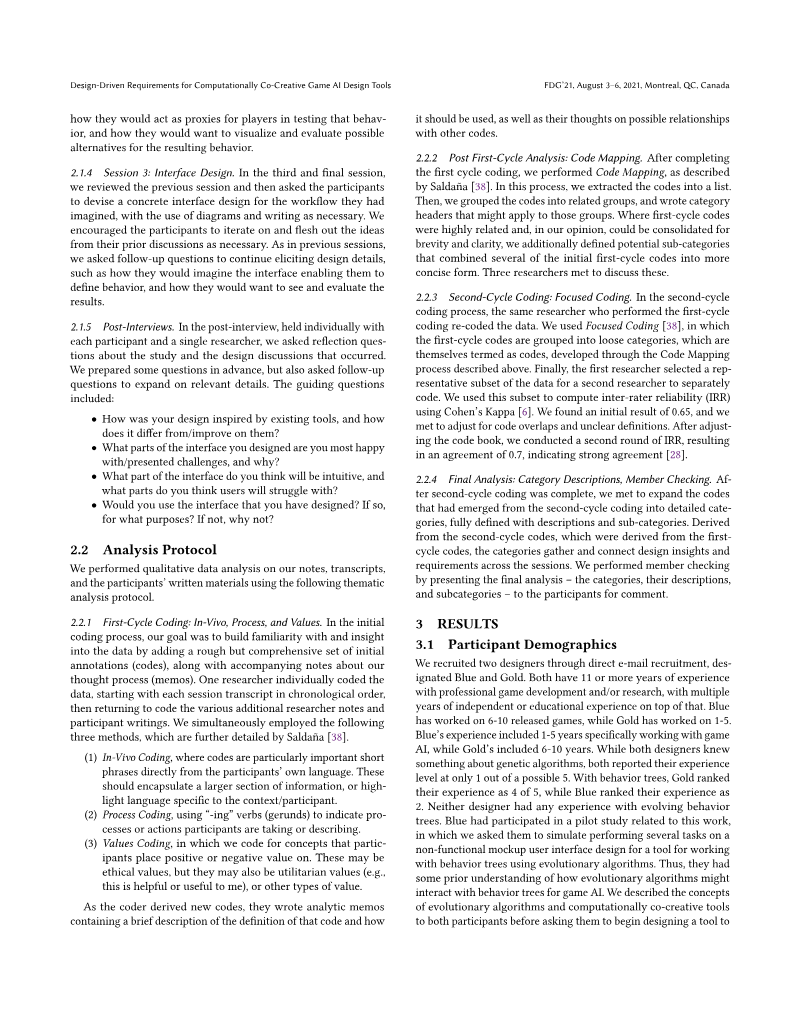
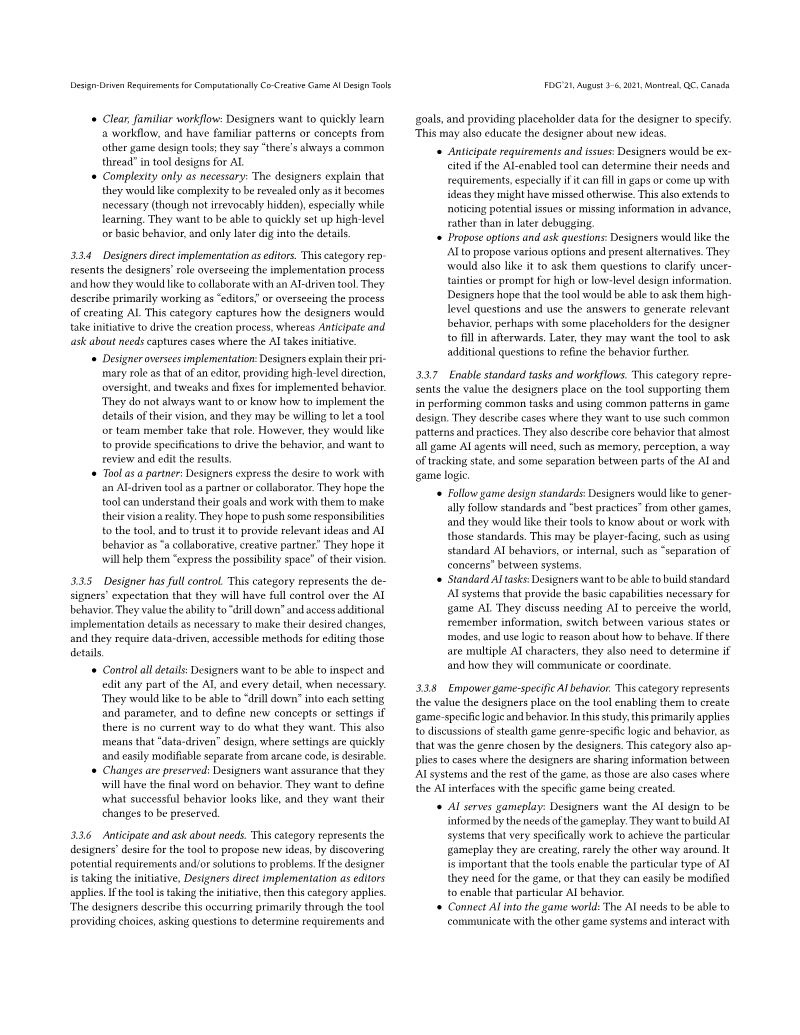
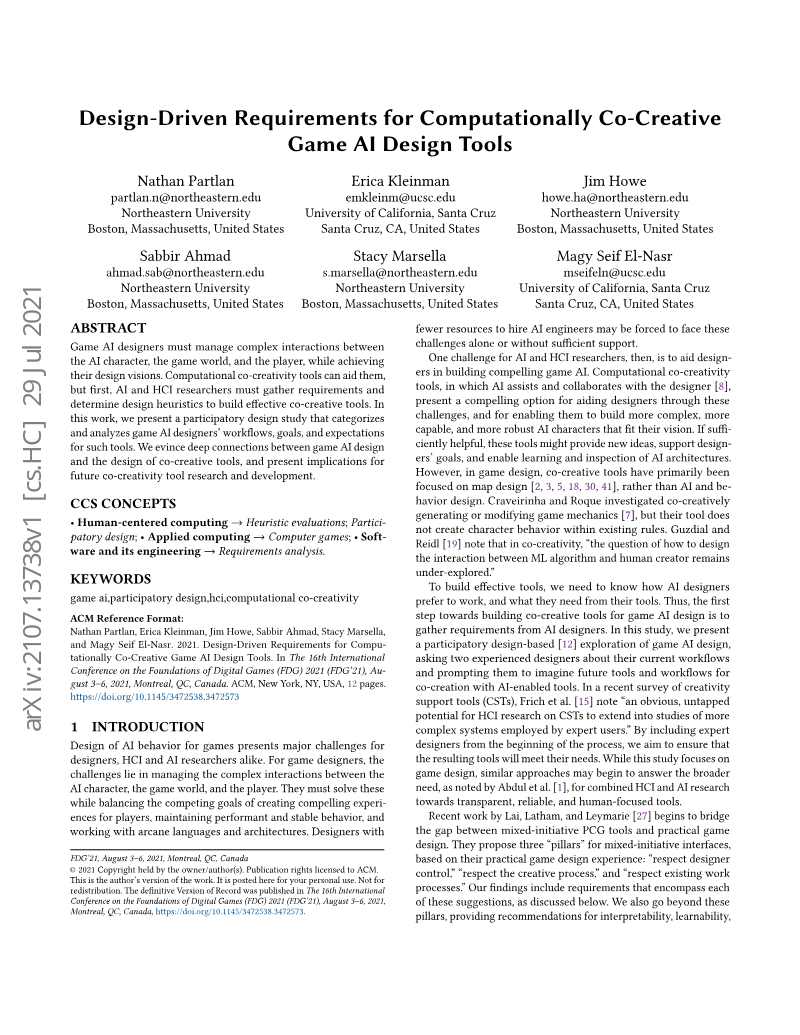
Design-Driven Requirements for Computationally Co-Creative Game AI Design Tools
This paper reports a participatory design study by Partlan, Kleinman, Howe, Ahmad, Marsella, and Seif El-Nasr, published at the 2021 Foundations of Digital Games conference.
- The analysis organized designer requirements into 13 categories, each with 2-3 subcategories, spanning designer-facing and player-facing concerns.
- Designers stated that player experience, rather than perfect AI, is the final arbiter of success, and that players should be able to find AI behavior satisfying even when it is flawed.
- Designers wanted assurance that they keep final control, with the ability to lock in behavior they liked so that it is not iterated on further.
Detecting Spam Game Reviews on Steam with a Semi-Supervised Approach
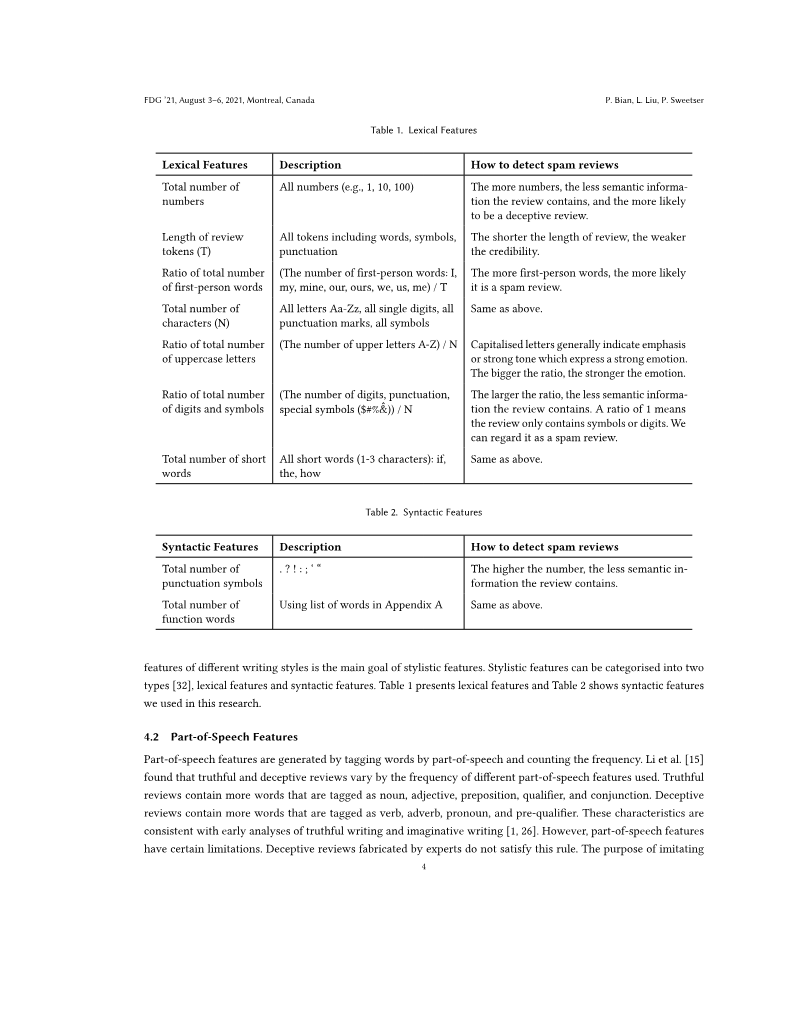
The authors of this Foundations of Digital Games (FDG '21) paper from the Australian National University study how to detect spam reviews of video games on Steam.
- The authors' method labelled 5,021 of 33,450 unlabelled Steam reviews as spam, approximately 15%, which they say falls within the expected 10-20% range.
- On the Gold-standard dataset, the best PU-bagging F1 score was 80.0%, with 100 positive samples, below the 83.7% reported by Hernandez et al. at the same size.
- The authors state their method performed better than the comparison work when there were fewer positive samples.

Inaudible Systems, Sonic Users: Sound Interfaces and the Design of Audibility Layouts in Digital Games
Eduardo Harry Luersen's article, "Inaudible Systems, Sonic Users," analyzes digital game sound design as a user interface, employing a media-archaeological perspective to trace its evolution and cultural implications.
- Luersen (2021) argues that game sound functions as a sonic user interface deserving the same critical scrutiny that visual interfaces have received, and that immersion is a historically constructed effect inherited from stereophonic and surround cinema systems rather than a natural property of hearing.
- The analysis distinguishes two lineages of game sound: immersive, cinema-derived models that place the player at the center of a spherical auditory space (linked to an anthropocentric, 'homophilic' design bias), and arcade/platform-style models built on repetitive looping feedback sounds descended from coin-operated machines, exemplified by Pong (1972).
- Tracing arcade conventions further back, the author links current sonic success and failure signals to Prohibition-era electromechanical devices and pinball scoring sounds, showing how these sonic signs came to encode player achievement.
The Musical Ludo Mix of Taiko no Tatsujin
Costantino Oliva's paper, published in the Transactions of the Digital Games Research Association in March 2021 (Vol. 5 No 2, pp.
- The author argues that the musical literacy conveyed by Taiko no Tatsujin extends beyond media references to taiko drumming culture, which the paper describes as a largely oral, non-notated practice.
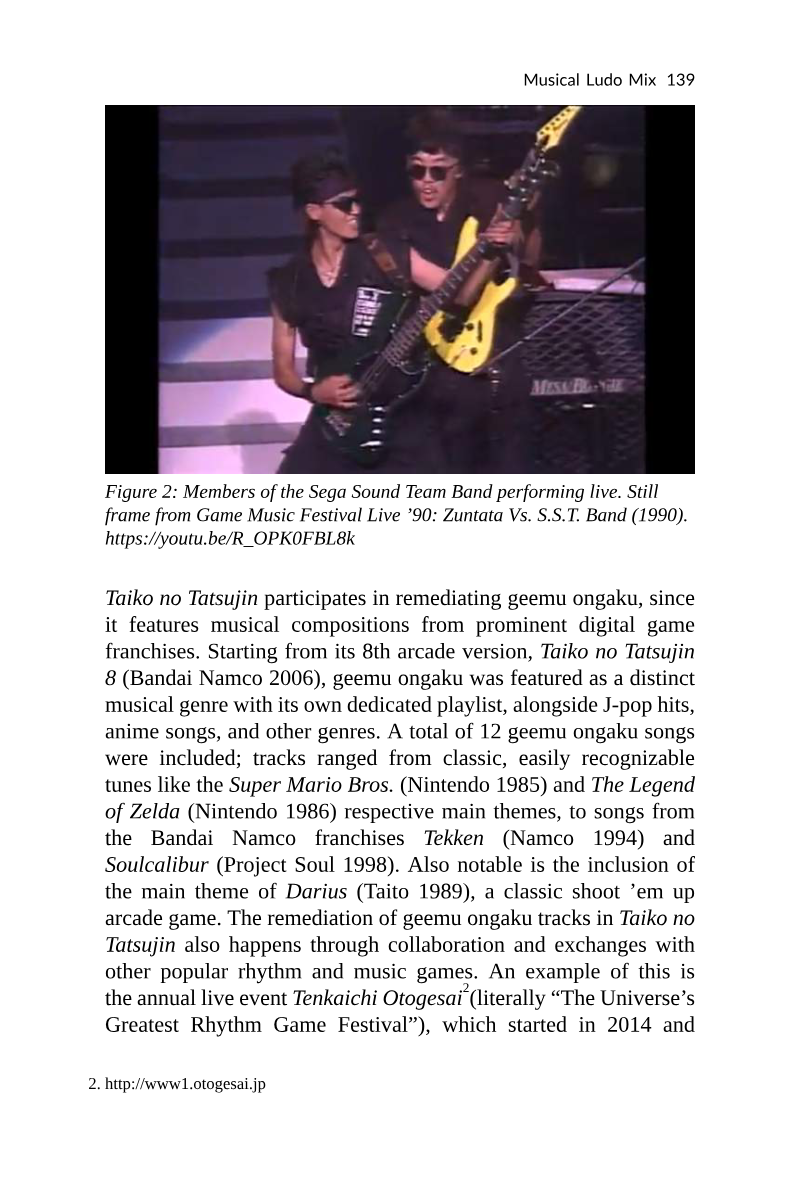
- The paper reports that by the end of the 1990s, over 350 CDs of game music were available on the Japanese market, citing Yamakami and Barbosa.
- Starting with Taiko no Tatsujin 8 in 2006, game music was featured as a distinct genre with its own dedicated playlist, containing 12 geemu ongaku songs.
Characters in Fire Emblem Three Houses: A Ludo Mix Perspective
Joleen Blom's article, published in the Transactions of the Digital Games Research Association (March 2021, Vol. 5 No 2, pp.
- The article describes dynamic game characters as creating tension in ludo mixes because the player's agency over a character's identity conflicts with that character's appearances in other works.
- The author argues that the kyara lets the IP owner avoid clashes in character coherence between a source work and other ludic works.
- Three Houses' macrostructure is described as a four-branch narrative tree with four main outcomes, selected by the house the player chooses to lead.
The Ludo Mix and the Loss of In-Game Narrative: A Case Study of the Final Fantasy XV Universe
This article, published in the Transactions of the Digital Games Research Association (March 2021, Vol. 5 No 2, pp.
- Tabata gave the reason for the transmedia approach as avoiding having to ship the story as multiple games, which the author notes presupposes that a single story needs multiple games.
- The article reports that Insomnia, which is perhaps even more relevant to the plot of the game, is prominently featured in the film and anime but has been relegated to a mere dungeon in the main game.
- The author states that the Final Fantasy XV Universe includes a CGI feature film, an anime series, an audio drama, a novel, manga, six separate games, and episodic DLC.
Game Designers and the Ludo Mix: Constructing an Aesthetic Experience
This paper by Laureline Chiapello, published in the Transactions of the Digital Games Research Association (March 2021, Vol. 5 No 2, pp.
- The author argues that ludo mixes ought to be seen as grand experiences rather than grand narratives, shifting focus from story to a whole experience.
- In the first phase, students mostly transposed anime elements into games in a straightforward manner, ending with "a bunch of mechanics" rather than cogent game systems.
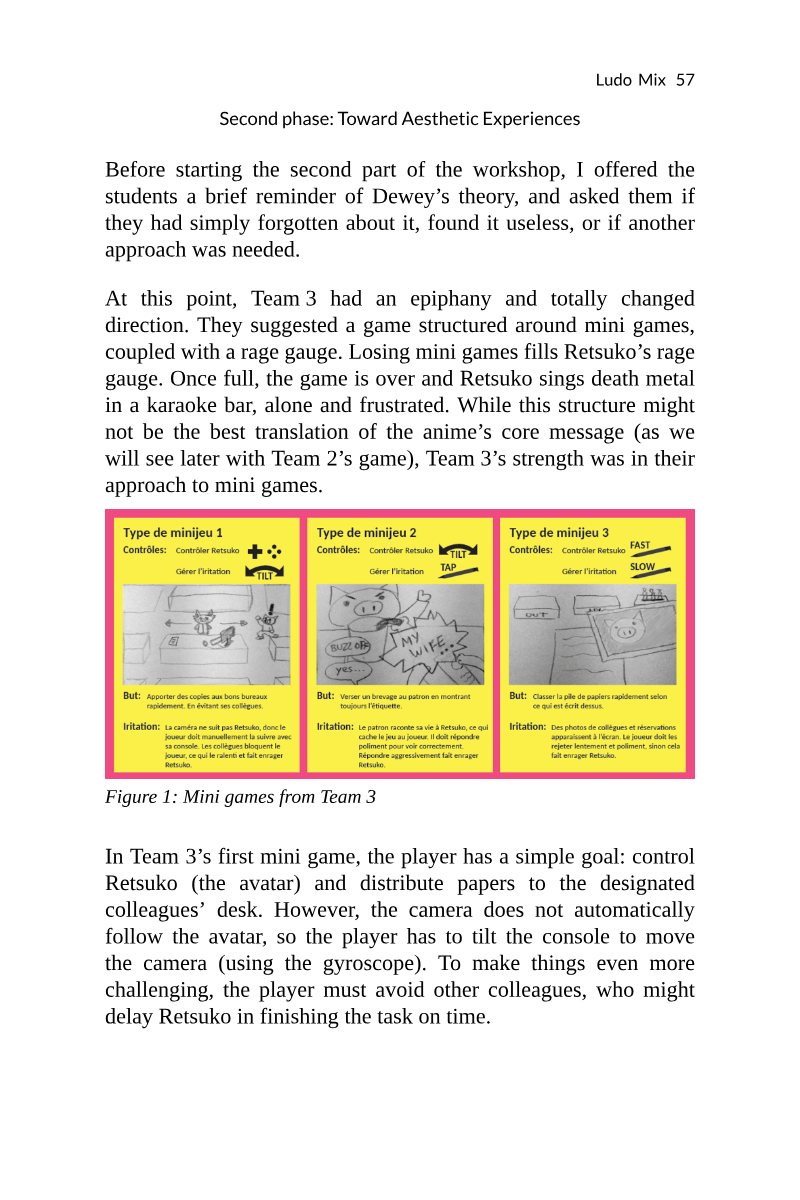
- After a reminder of Dewey's theory, one team restructured its game around mini-games coupled with a rage gauge, where losing mini-games fills Retsuko's rage gauge.
The Führer's Facial Hair and Name Can Also Be Reinstated in the Virtual World: Taboos, Authenticity and the Second World War in Digital Games
Legal and cultural taboos shape how the Second World War, and especially Nazism and the Holocaust, are represented in digital games, and those taboos have been shifting.
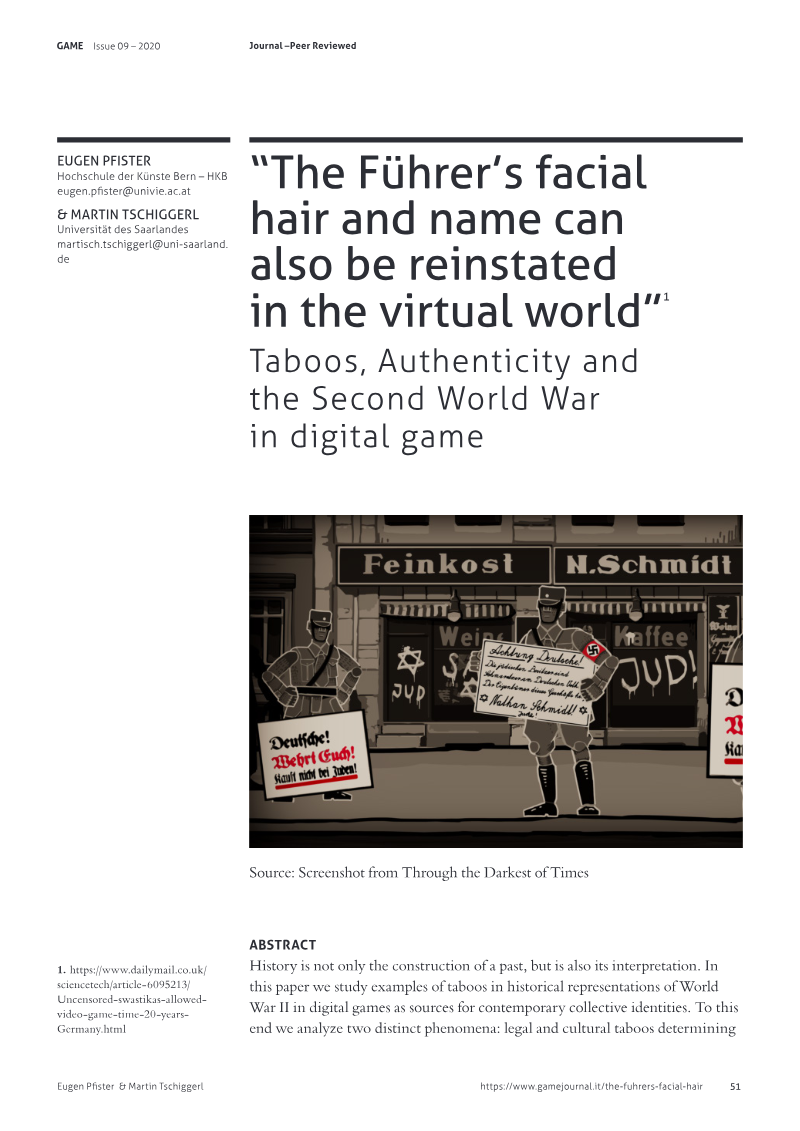
- German and Austrian bans on Nazi symbols, extended to games by a 1998 court ruling, led publishers to pre-emptively censor content through cosmetic changes such as covered swastikas and renamed characters, which the authors argue can depoliticize Nazi material rather than prompt critical engagement.
- Earlier controversies such as the 1980s KZ-Manager and the 2010 Sonderkommando Revolt mod drew sharp backlash and withdrawal, while a clear paradigm shift became visible in the late 2010s, partly attributed to the pulp, fantasy, or explicitly historical framing of titles like Wolfenstein: The New Order and Through the Darkest of Times.
- Players have internalized official taboos and generate additional taboos of their own around 'authentic' historical representation, so enforcement of standards comes substantially from the player community rather than only from regulators or publishers.
The Game Itself?: Towards a Hermeneutics of Computer Games
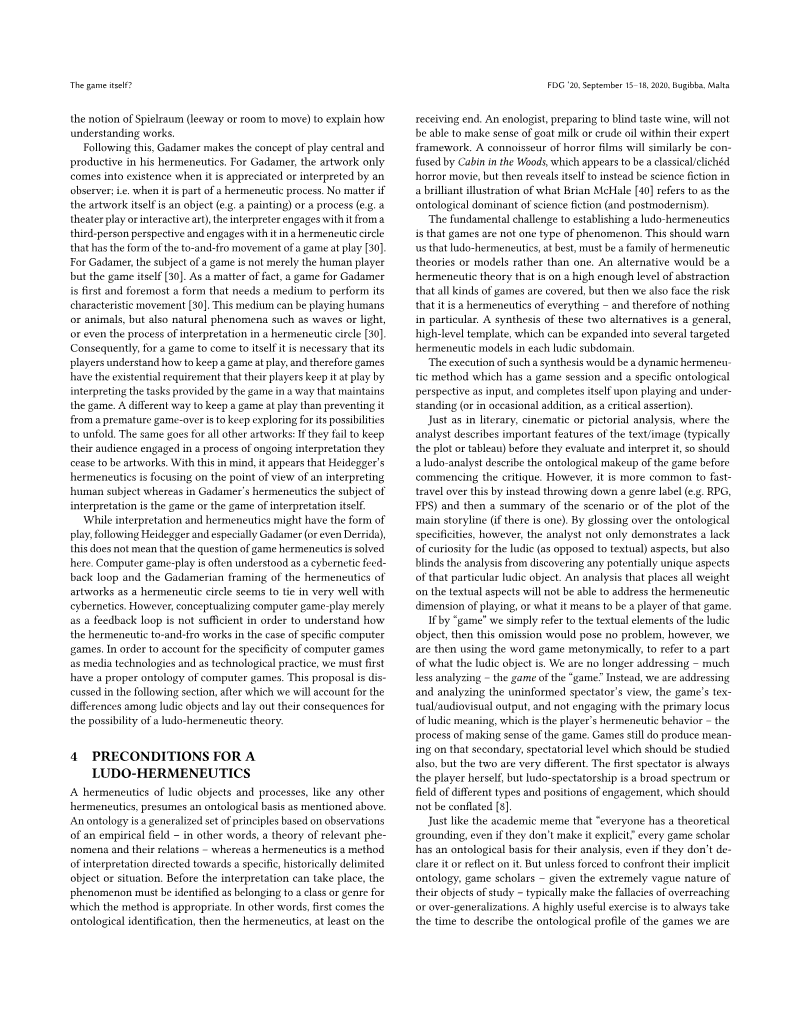
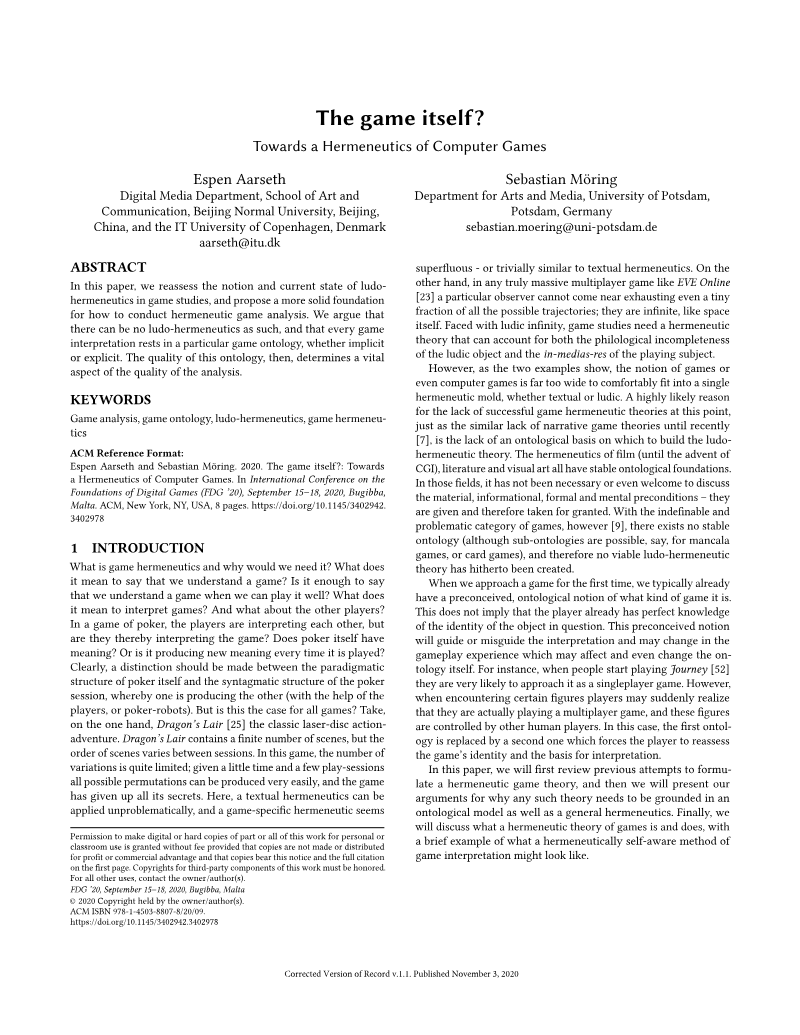
The paper by Espen Aarseth and Sebastian Möring, published at the 2020 International Conference on the Foundations of Digital Games (FDG '20) in Malta, reassesses hermeneutic approaches to game studies.
- The authors argue that there can be no ludo-hermeneutics as such, because games are not one type of phenomenon and any theory must be a family of models.
- Identifying the game's ontological nature is presented as the first step of ludo-hermeneutics and the only step that is necessarily required.
- The authors assume a game ontology laid out in Calleja and Aarseth, in which a game is a four-dimensional field of mental activity, a semiotic system, a mechanical system and a materiality.