Digital Games
Company
Documents about Digital Games
The Game Itself?: Towards a Hermeneutics of Computer Games
The paper by Espen Aarseth and Sebastian Möring, published at the 2020 International Conference on the Foundations of Digital Games (FDG '20) in Malta, reassesses hermeneutic approaches to game studies.
- The authors argue that there can be no ludo-hermeneutics as such, because games are not one type of phenomenon and any theory must be a family of models.
- Identifying the game's ontological nature is presented as the first step of ludo-hermeneutics and the only step that is necessarily required.
- The authors assume a game ontology laid out in Calleja and Aarseth, in which a game is a four-dimensional field of mental activity, a semiotic system, a mechanical system and a materiality.

Towards a Taxonomy of AI in Hybrid Board Games
The paper by Gómez-Maureira, Barbero, Freese and Preuss, published at the 2020 Foundations of Digital Games conference (FDG '20), proposes a first taxonomy of artificial intelligence in hybrid board games, which the authors define as games that combine intentionally designed digital and physical modalities to create a game…
- The authors define hybrid board games as games that combine intentionally designed digital and physical modalities to create a game experience for players.
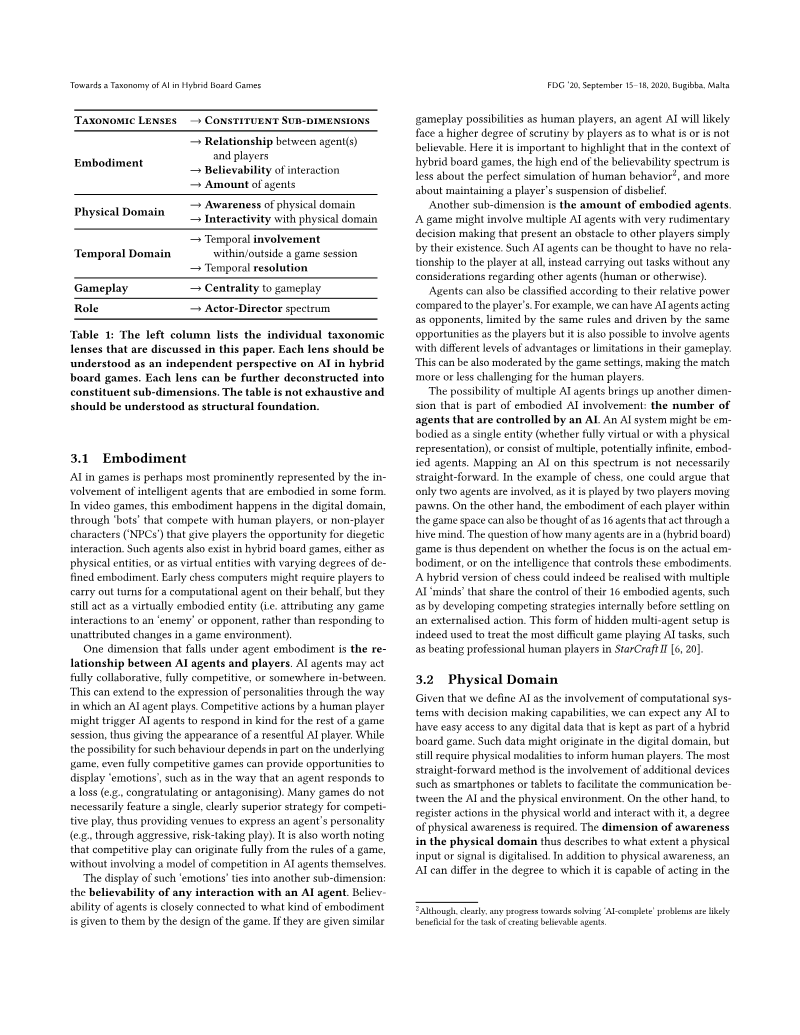
- The authors propose five taxonomic lenses for AI in hybrid board games: embodiment, physical domain, temporal domain, gameplay, and role.
- The authors argue that the temporal lens distinguishes AI involvement before, during, or after a game session, and that it is better framed as ordinal categories than as a continuous spectrum.

10 Years of the PCG Workshop: Past and Future Trends
This paper by Antonios Liapis, from the Institute of Digital Games at the University of Malta, celebrates the first ten years of the international workshop on Procedural Content Generation (PCG), hosted by the Foundations of Digital Games conference.
- Level generation was the most common type of content generated, with the document reporting it in 51% of the workshop's papers.
- Only 32 of the 95 papers included an empirical evaluation, with most instead offering a couple of generated samples and a qualitative discussion.
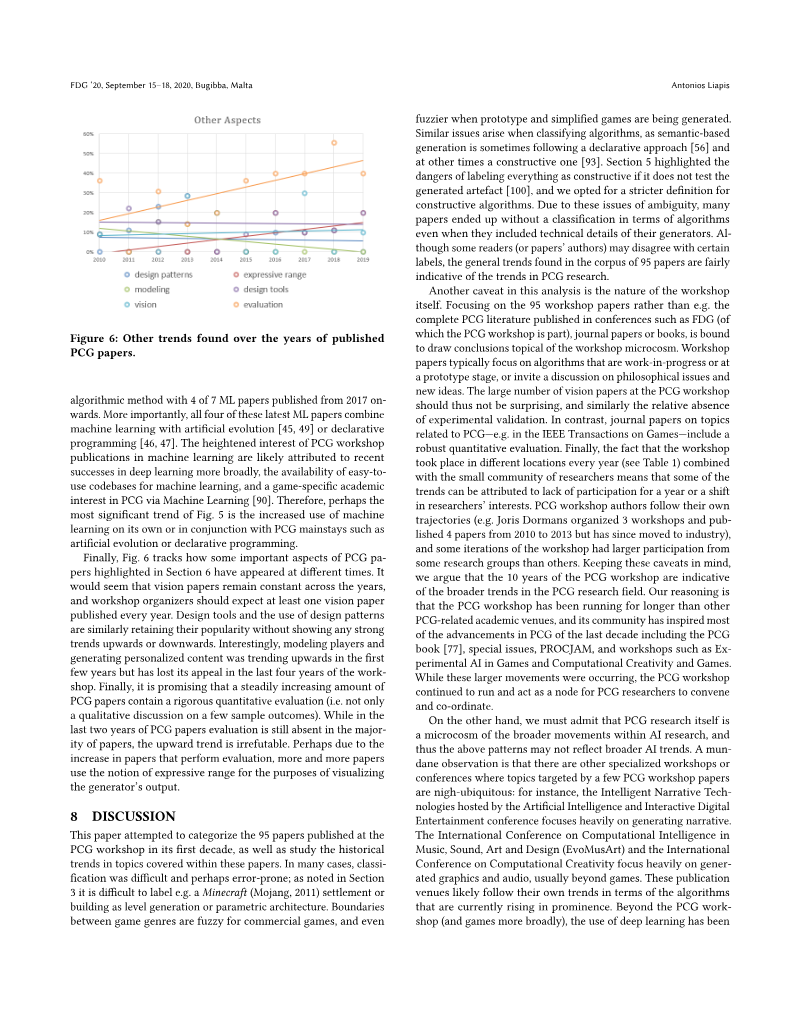
- Machine learning is described as the most upwards-trending algorithmic approach, with four of seven ML papers published from 2017 onwards.
Collaborative Agent Gameplay in the Pandemic Board Game
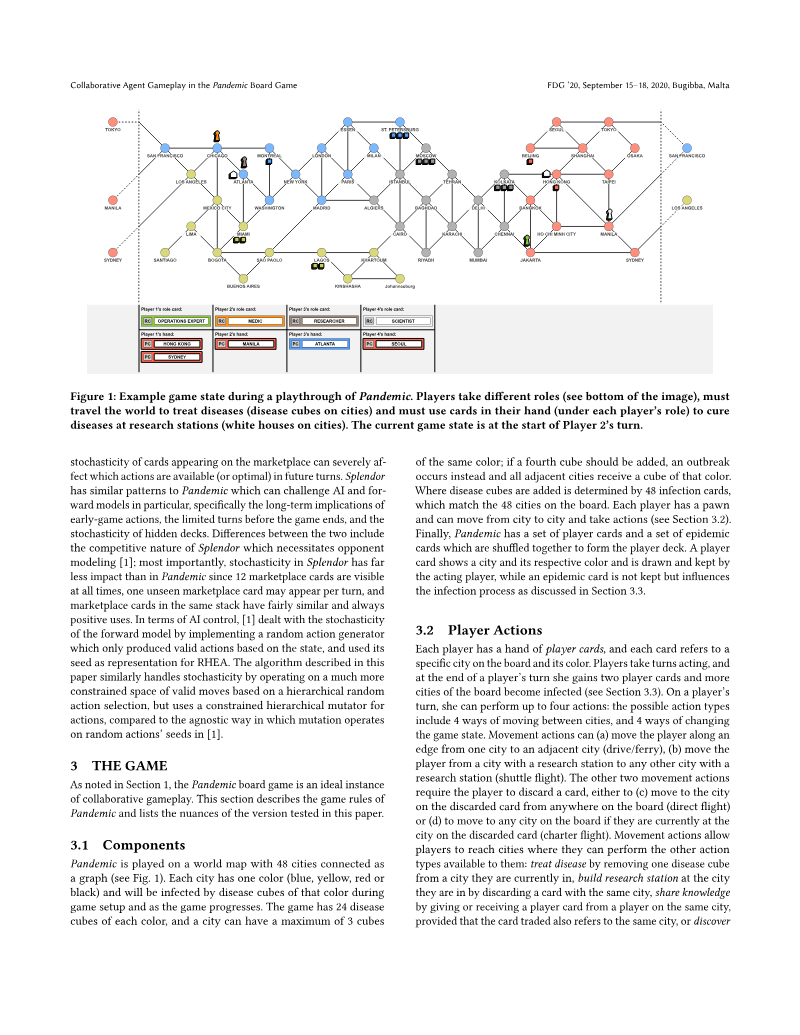
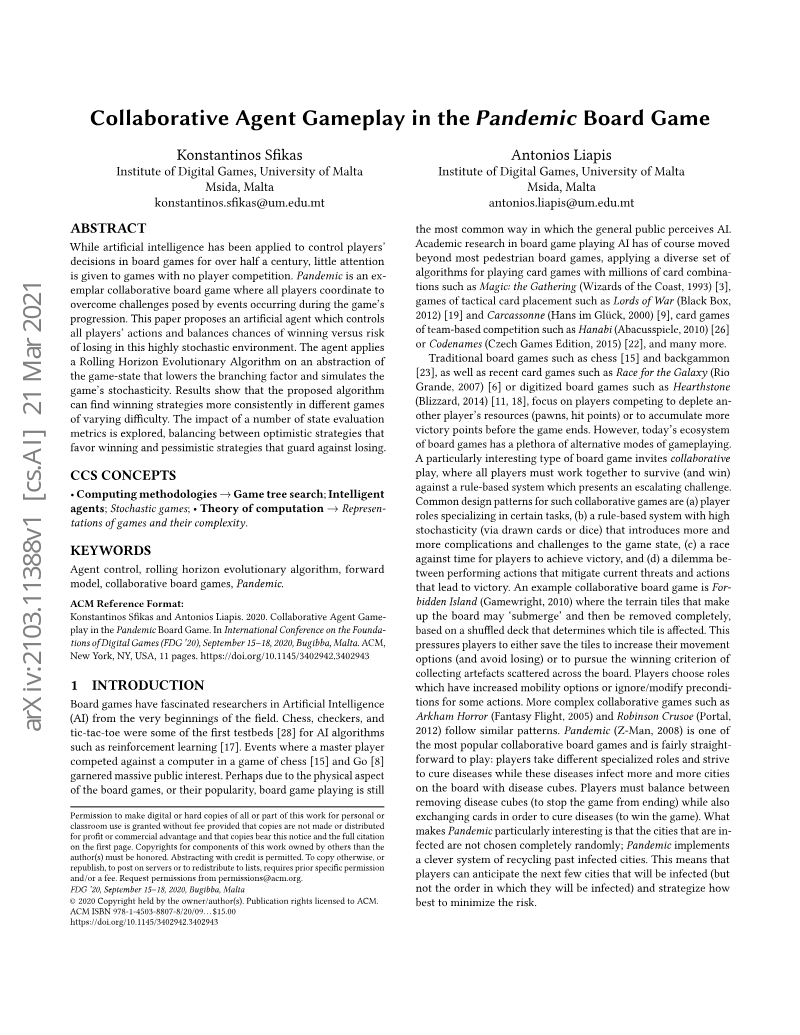
The paper by Konstantinos Sfikas and Antonios Liapis of the Institute of Digital Games, University of Malta, studies AI control of all players in Pandemic, a collaborative board game where players work together against escalating threats.
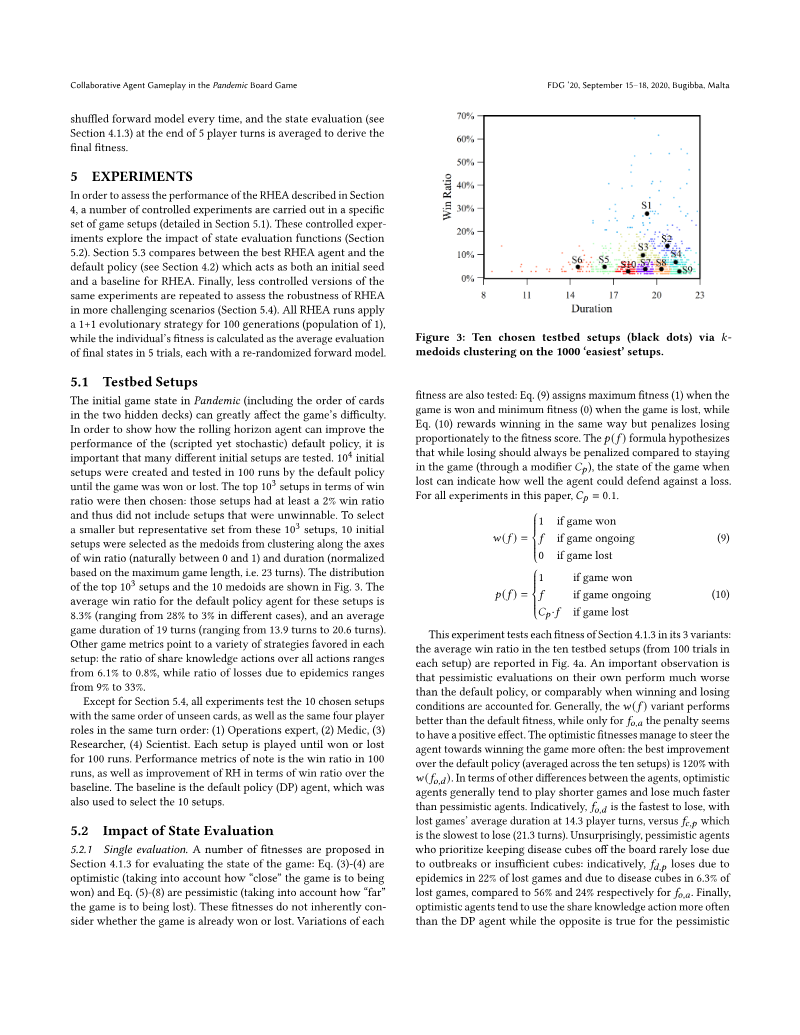
- The best RHEA agent achieved an average win ratio of 29.3% across the ten setups, which the authors report as a 302% improvement over the default policy.
- Optimistic and pessimistic state evaluations performed differently when used alone, but combining them in a naive aggregate often performed better than the conditional variants.
- A simple reordering of player roles dropped the baseline's win rate by 68%, while RHEA's dropped by 25%.
A Hybrid Approach to Procedural Generation of Roguelike Video Game Levels
Alexander Gellel and Penny Sweetser, of the Australian National University, present a prototype level generator for roguelike dungeon-style levels, described in a paper for the 2020 International Conference on the Foundations of Digital Games.
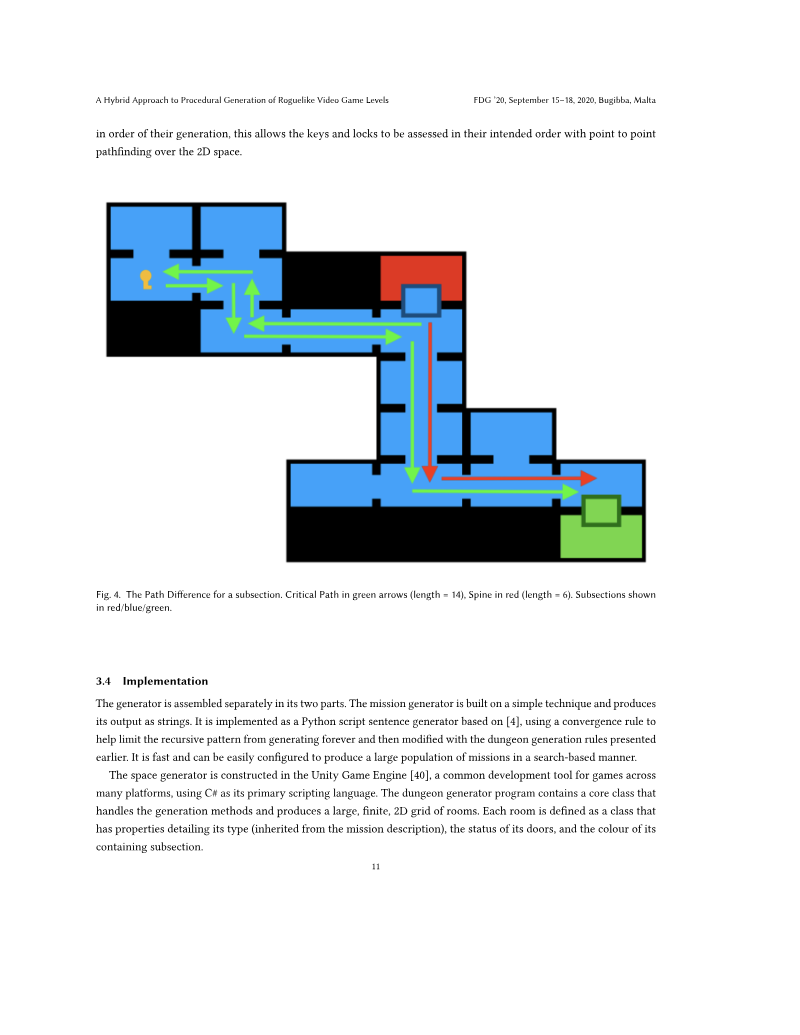
- The baseline Random Neighbour Search generated completable levels only 53.2% of the time in the authors' tests, while both Subsection Search variants reached 100% completability.
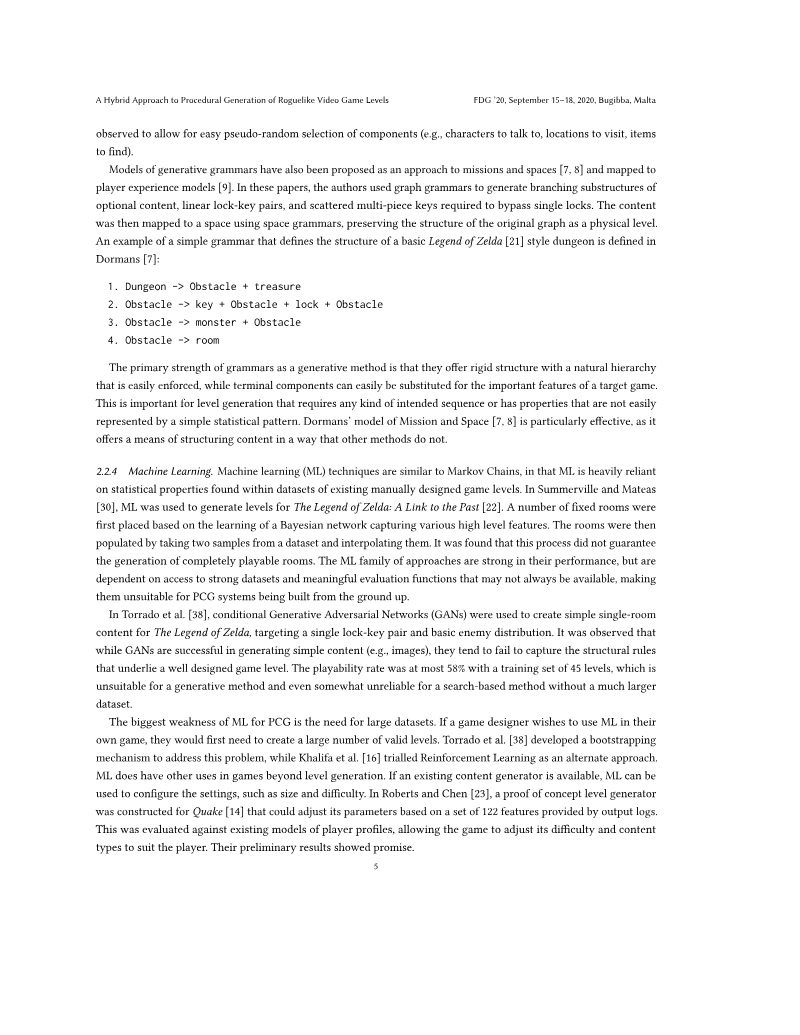
- The authors combined context free grammars for mission structure with a cellular automata-inspired process for physical space, arguing the two complement each other's weaknesses.
- The authors' grammar-based generator generated 100% of lock-key pairs appropriately in automated evaluation across numerous sample sets.
Do Game Bots Dream of Electric Rewards?: The Universality of Intrinsic Motivation
This paper by Penny Sweetser and Matthew Aitchison of the Australian National University, presented at the 2020 International Conference on the Foundations of Digital Games (FDG '20) in Malta, draws together theories of reinforcement, rewards, motivation, flow, play, games, gamification and machine learning.
- The authors cite Kohn's analysis of decades of research, which concludes that rewards are unethical and ineffective, because interest in the behaviour diminishes and people stop when rewards stop.
- The authors state that the most commonly used forms of gamification are points, levels, leaderboards and achievements, which they describe as reward-based gamification.
- Citing Nicholson, the authors note that gamification often uses the least interesting part of a game, the points system, despite assuming that calling an activity a game makes it more engaging.
Visuospatial Abilities Training with Digital Games in a Primary School
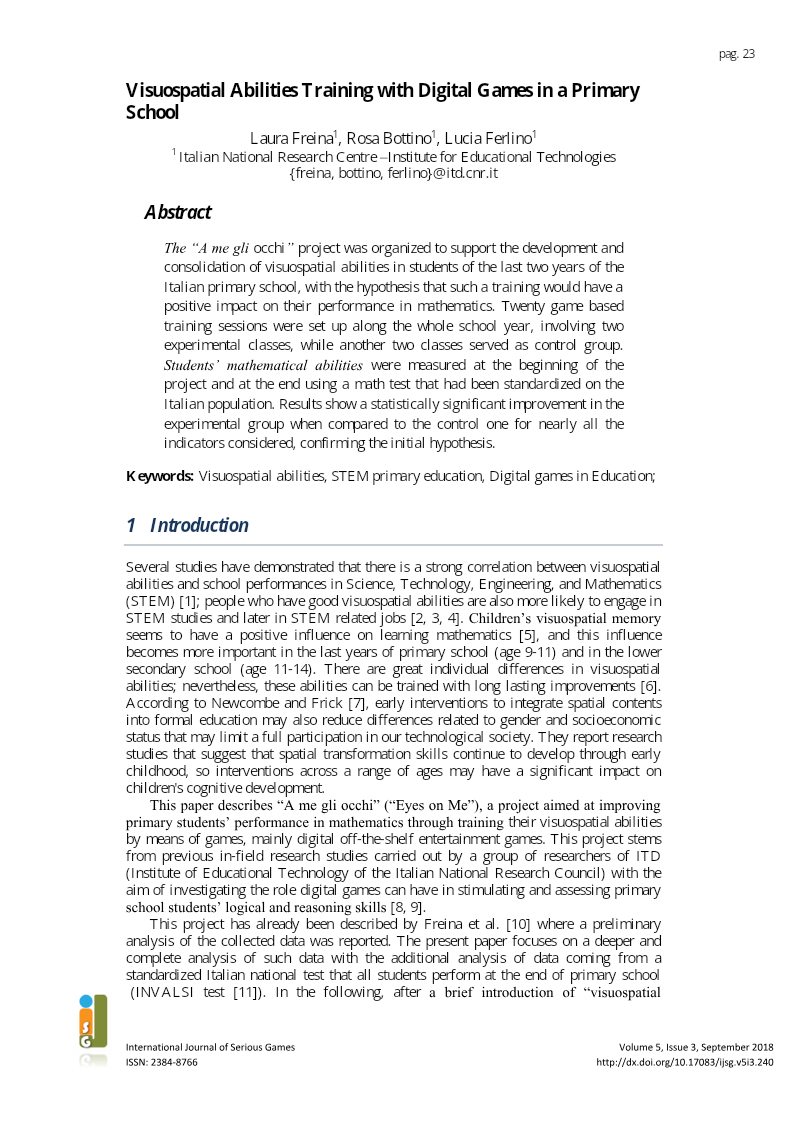
The A me gli occhi project establishes a clear link between targeted visuospatial training via digital games and enhanced mathematical performance among primary school students.
- Targeted visuospatial training through digital games significantly improves mathematical performance in primary school students aged nine to eleven.
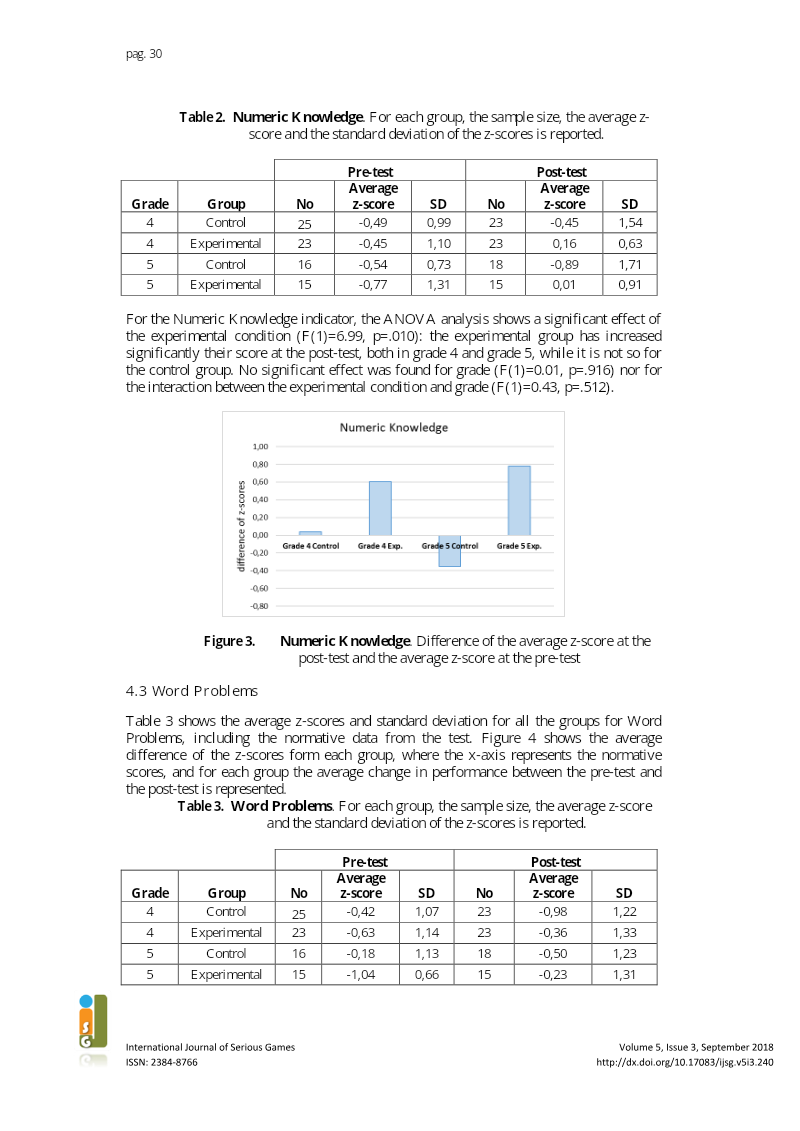
- Students participating in the 'A me gli occhi' project outperformed traditional curriculum methods in standardized assessments, showing gains in numeric knowledge, word problems, and written operations.
- Fifth-grade students demonstrated the most notable progress, particularly in the execution of complex written operations.

To Dream a Game: Dreams as Interactive-Narrative Devices in Digital Games
Frank Bosman's 2020 study examines dreams and dreamlike states, including hallucinations, visions, hypnosis, and virtual reality, as interactive-narrative devices in digital games.
- Dream sequences in digital games are almost always lucid because the medium's mandatory interactivity gives players control over dreamlike segments, with the exception of non-interactive cutscenes.
- Citing Gackenbach's research, the article reports that gamers, particularly hard-core players, tend to have more lucid and control dreams, more bizarre dreams, and more violent or nightmarish dreams, which they experience with less distress.
- Bosman proposes a working definition of dreams as a temporarily diminished-consciousness state experienced involuntarily, and applies it through close reading and game-immanent analysis of playable texts.
The Street Fighter Lady: Invisibility and Gender in Game Composition
Andy Lemon and Hillegonda C Rietveld's article, published in the Transactions of the Digital Games Research Association (December 2019), examines the invisibility of Yoko Shimomura, the female composer of the music for the 1991 arcade game Street Fighter II (Capcom).
- Shimomura's authorship was obscured because credit was often to a composition team in which its members remain anonymous, and she used abstract pseudonyms in the credits.
- On successive releases of both game soundtracks and in-game ROM data for Street Fighter, rather than its individual composers the Capcom Sound Team is credited as a whole.
- The authors state that Shimomura's arcade compositions were mainly ported to home computers by male music arrangers and coders, so players often knew the cover artist rather than the original composer.
Horizon Zero Dawn: The Educational Influence of Video Games in Counteracting Gender Stereotypes
Dalila Forni's article, published in the Transactions of the Digital Games Research Association (December 2019, Vol. 5 No. 1, pp.
- The author cites Behm-Morawitz and Mastro (2009) as finding that playing games with sexualized or objectified women negatively affects women's feelings of self-efficacy and their judgement of female physical capabilities.
- The author argues that the damsel in distress and the moving body were the two main female character models that resulted from a male-dominated video game perspective.
- The author describes Aloy as physically pleasant but not objectified or sexualized, with clothing and armor that are quite realistic and rarely show her body.
Mafia and the Representation of Italians
This academic essay by Giulio Pitroso, published in the Transactions of the Digital Games Research Association (December 2019, Vol. 5 No 1, pp. 45-76), analyzes how video games represent Italians and the Italian Mafia.
- The author describes The Godfather (US Gold, 1991) as the archetypal model for Mafia games and lists five elements that characterize it as a prototype of the genre.
- The essay states that the Sicilian Mafia has always had a hegemonic role in representing the Italian Mafia, and that most Italian Mob games centre on American and Sicilian versions.
- The author notes that the Italian Mob games analysed are almost all set in American or fictional American cities, which the author links to an American perspective on Sicily.
Hardware Design and Representation of Graphics in Videogames: A Case Study, the Sega Saturn
Marco Liboà's article, published in the Transactions of the Digital Games Research Association (December 2019, Vol. 5 No. 1, pp.
- The Saturn's VDP2 could simulate a 3D space with 2D planes, using parallax scrolling and rotated backgrounds to stand in for the arcade's 3D elements.
- The surface of the Virtua Fighter Remix ring was rendered as a rotated bitmap on RBG0 instead of sprites, reducing the number of polygons drawn on the screen and freeing some VDP1 resources for more detailed characters.
- Texture mapping in Virtua Fighter Remix came at the cost of dynamic lighting, which the original port had included.