Digital Games
Company
Documents about Digital Games

Digital Arts, Digital Games and Volumetry: State-of-the-Art and Current Scenario
It positions digital games as a facet of digital arts and examines how volumetric video technology is used, or could be used, in digital games and game art.
- The authors state that volumetric video differs from standard video because viewers can move through a three-dimensional rendered space, which gives it an interactive condition.
- Citing Viola and Cesar (2022), the authors note that volumetric media transmission requires very large data volumes, with a point cloud video of around one million points needing 5Gbps.
- The authors note that most research on volumetric videos has been conducted in the 2020s, because the technology required extensive digital resources that were previously confined to military and industrial use.
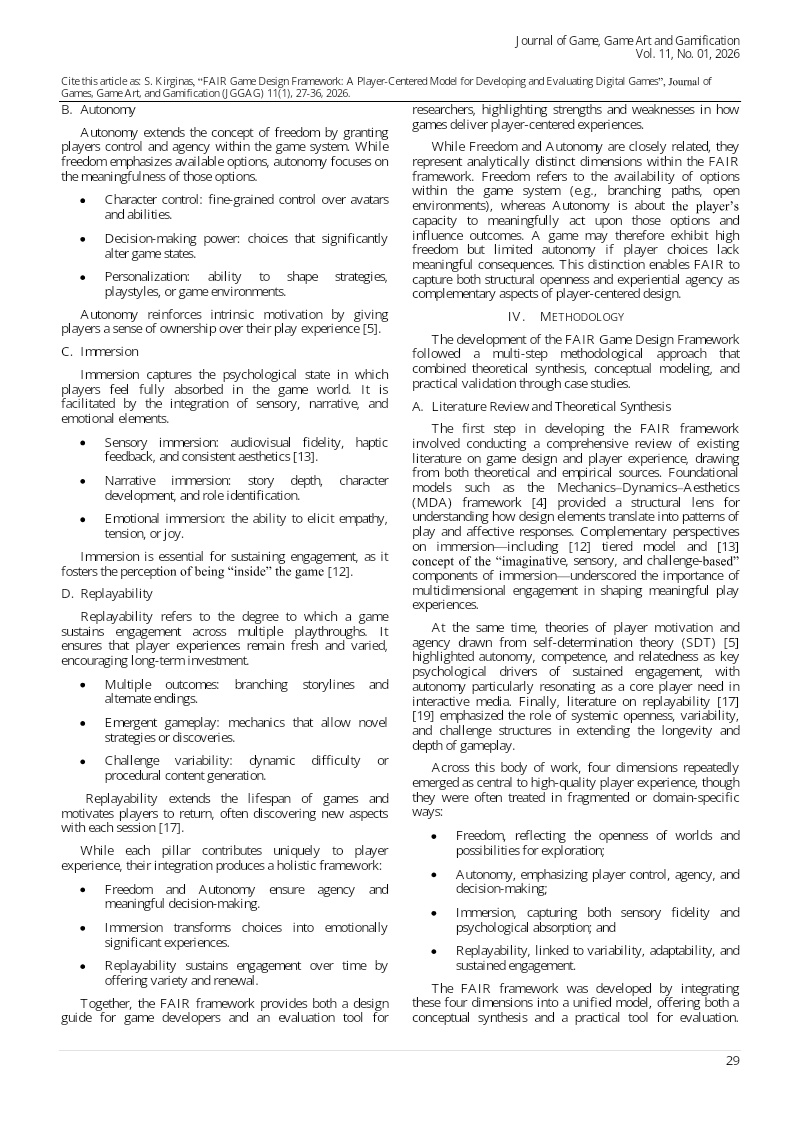
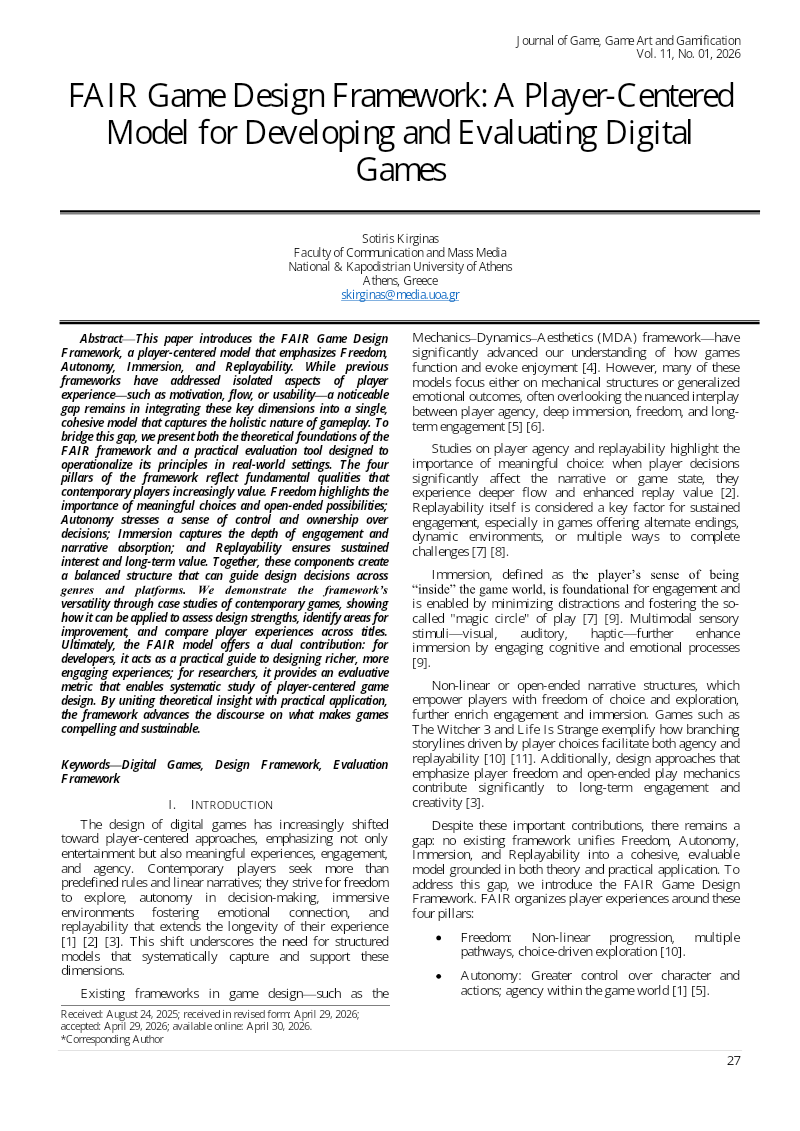
FAIR Game Design Framework: A Player-Centered Model for Developing and Evaluating Digital Games
It organizes player-centered game design and evaluation around four pillars: Freedom, Autonomy, Immersion, and Replayability.
- The FAIR framework was developed to integrate four dimensions that the author says were previously treated in isolation.
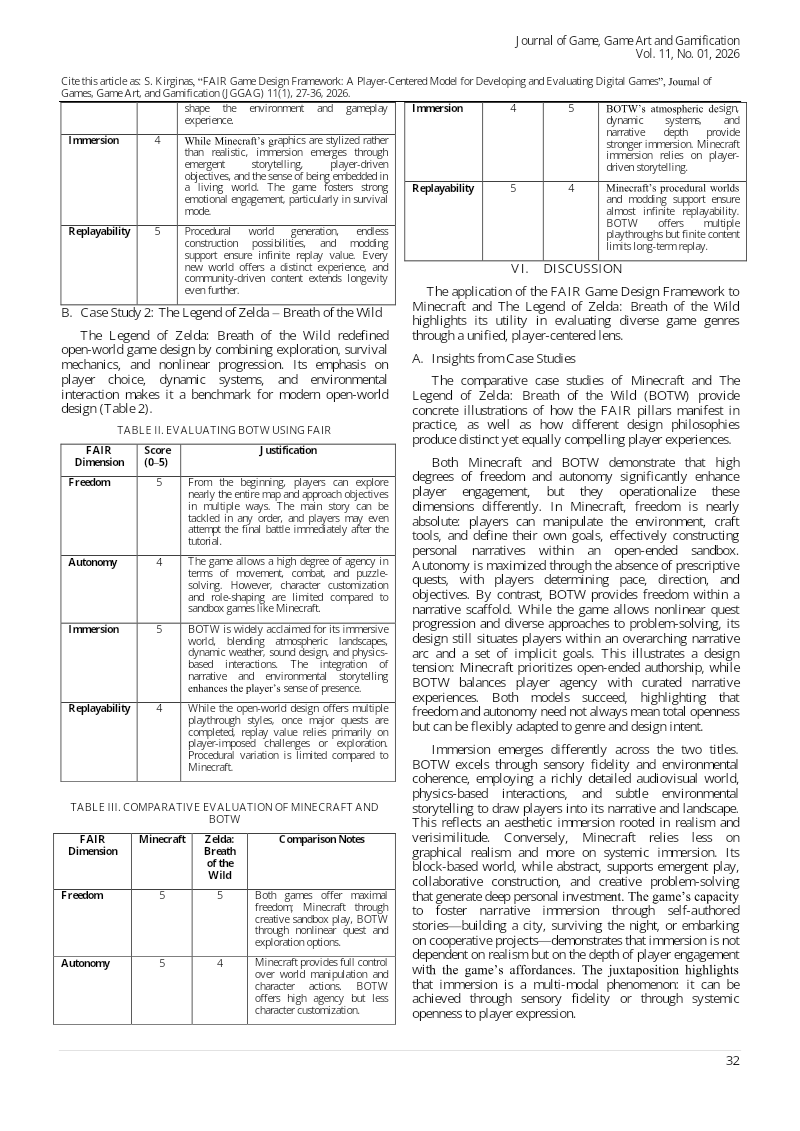
- Each FAIR pillar is evaluated on a 0-5 ordinal scale, where 0 means the pillar is absent and 5 means exemplary integration.
- Minecraft was scored 5 for Freedom and 5 for Replayability, while Breath of the Wild was scored 5 for Freedom and 4 for Replayability.
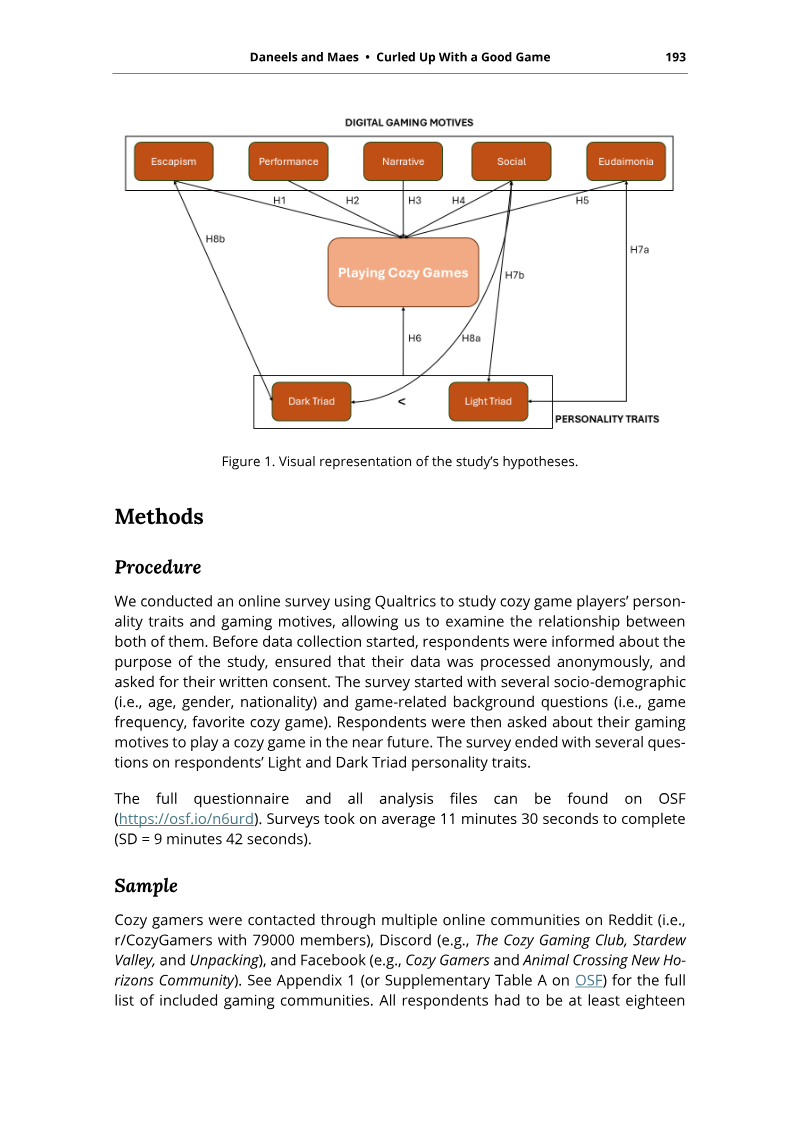
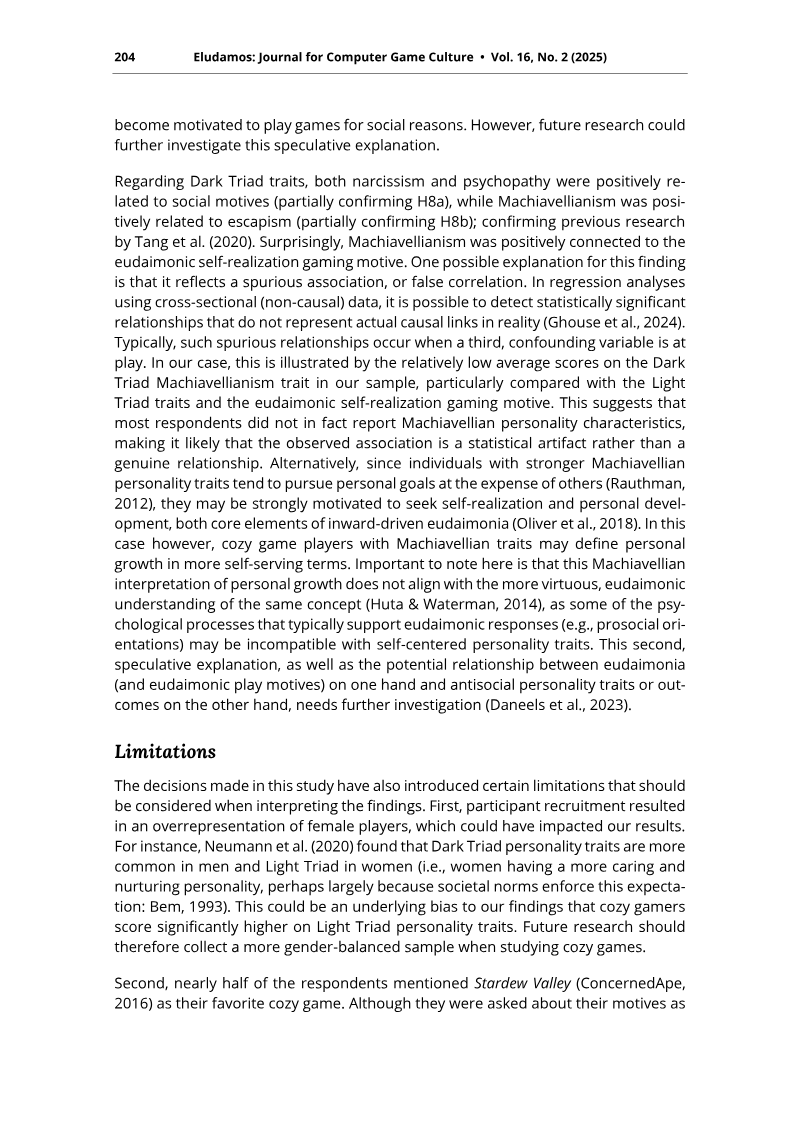

Curled Up With a Good Game: A Survey Study on Personality Traits and Game Motives of Cozy Game Players
This study was published in Eludamos: Journal for Computer Game Culture (Vol. 16, No. 2, 2025). The study by Rowan Daneels and Kato Maes examines who plays cozy games and why.
- Moral self-reflection was the highest-rated motive for playing cozy games.
- Social motives were the only motive scored below the scale midpoint, and the authors suggest the scale's exclusion of NPC interactions may explain this.
- Escapism and eudaimonic meaningful affect were both rated as important motives for playing cozy games.

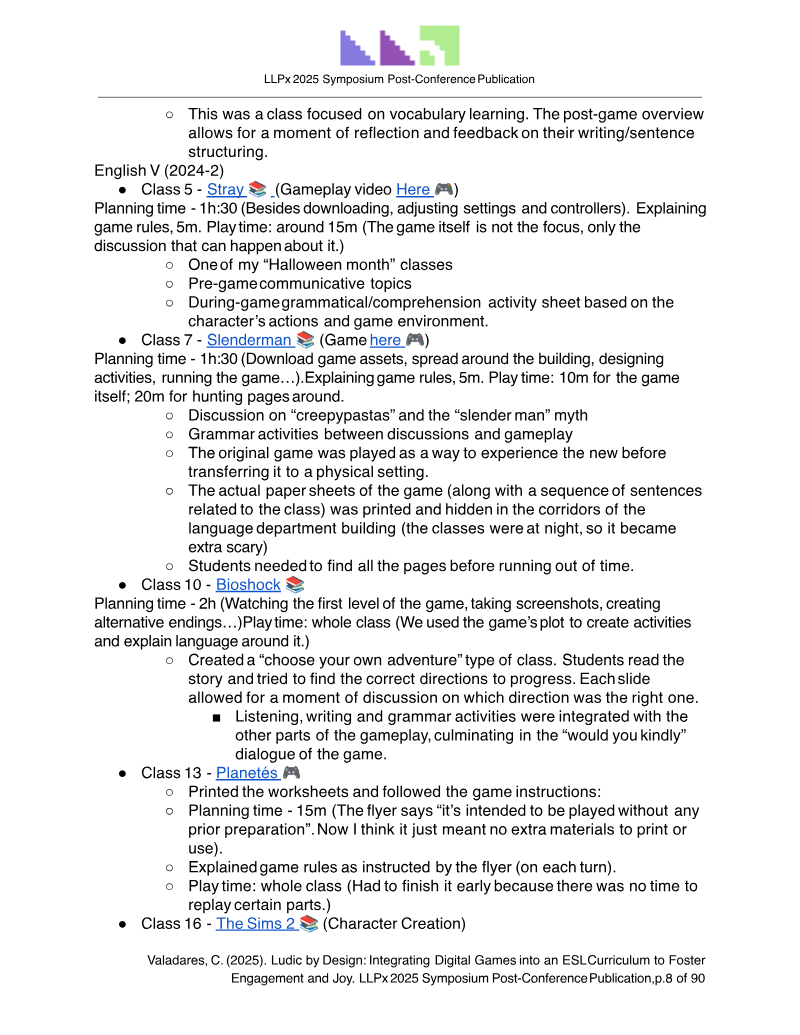
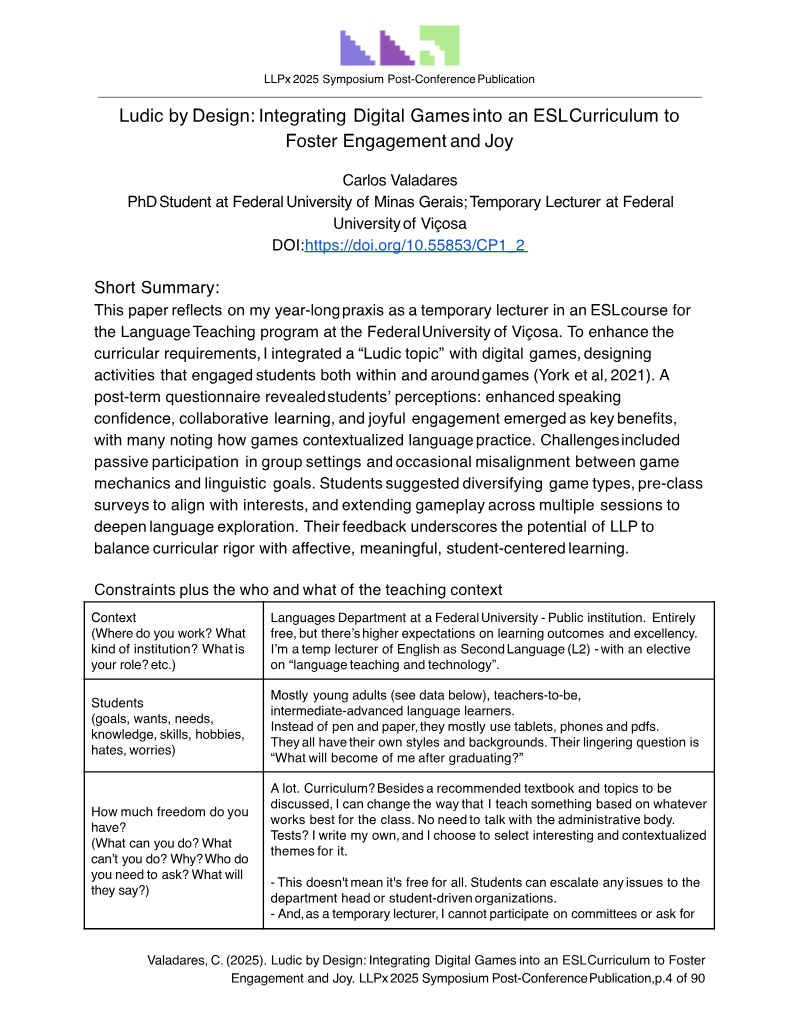
Ludic by Design: Integrating Digital Games into an ESL Curriculum to Foster Engagement and Joy
This analysis examines the integration of digital games into an English as a Second Language (ESL) curriculum at a public university in Brazil.
- Integrating digital games like 'Papers, Please' and 'Keep Talking and Nobody Explodes' into an ESL curriculum significantly improved student speaking confidence, peer collaboration, and vocabulary contextualization.
- A year-long action research study at a Brazilian public university found that a ludic-centered approach reduced the pressure of language acquisition, making the learning process feel more natural for undergraduate students.
- Student feedback from 12 of 19 participants highlighted that real-time interaction and immersive storytelling were the most effective game elements for bridging the gap between theoretical study and practical application.
Environmental Storytelling and Active Spectatorship in Walking Simulators and Exploration Theatre
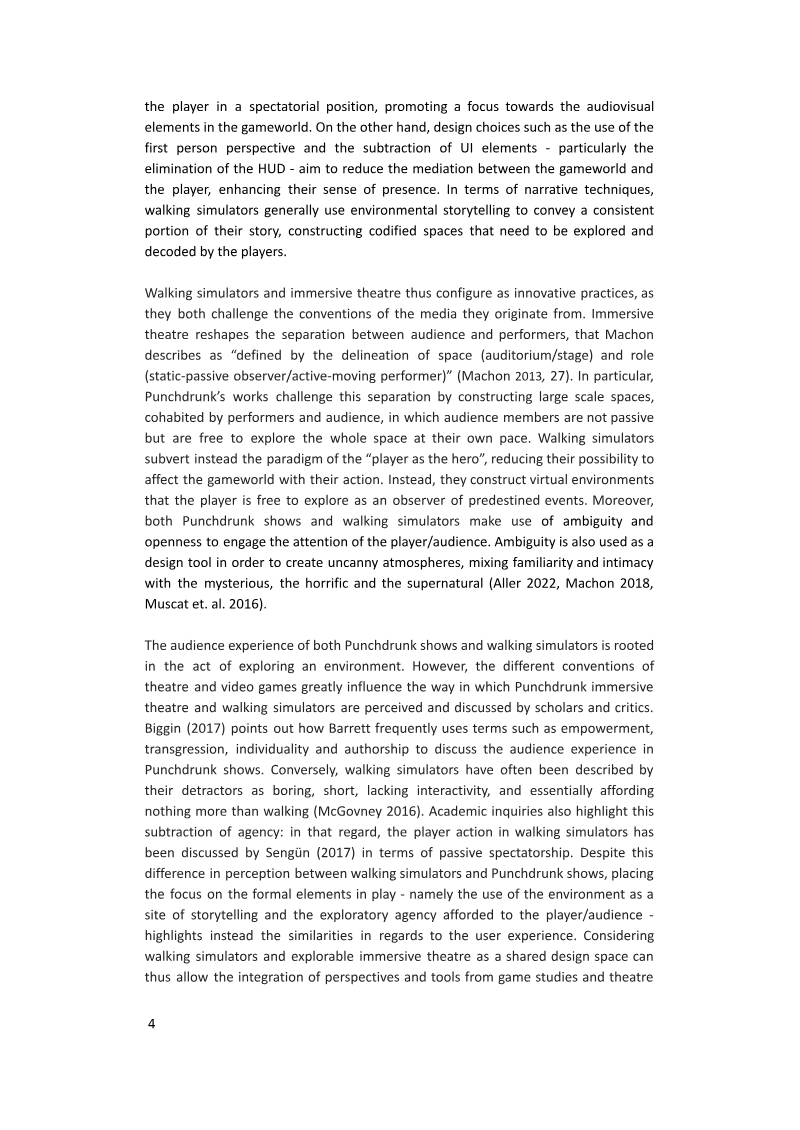
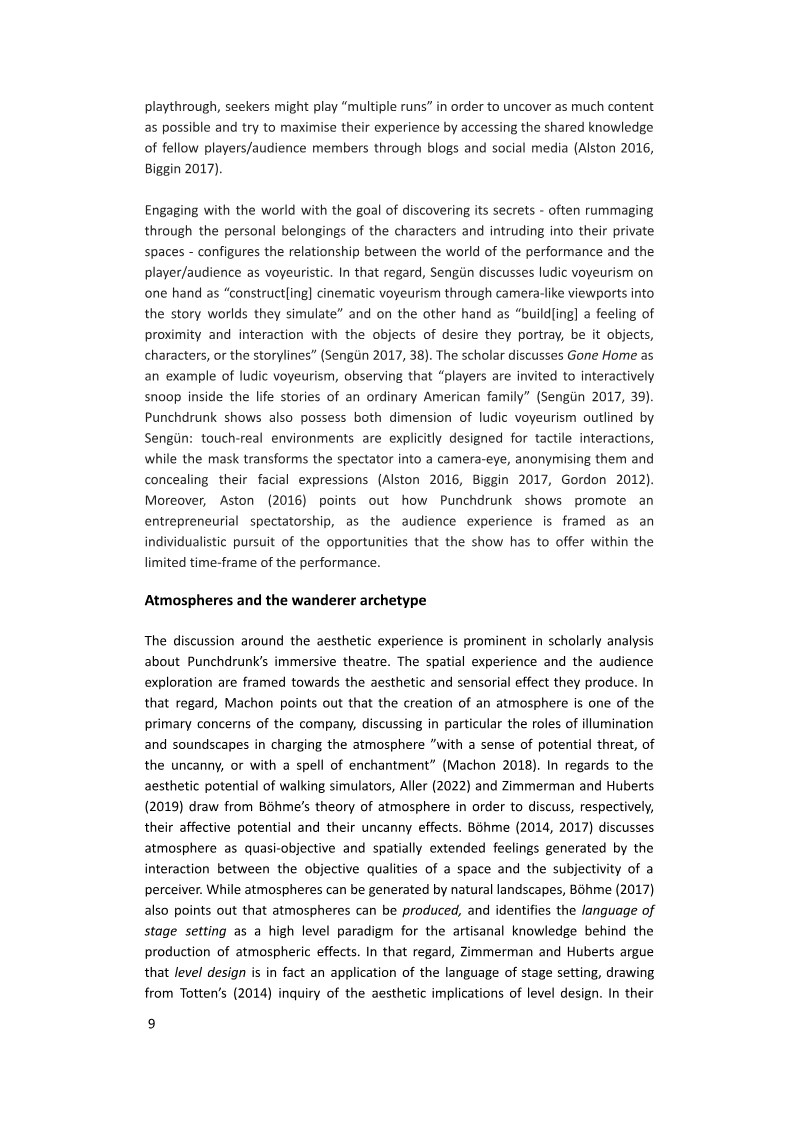
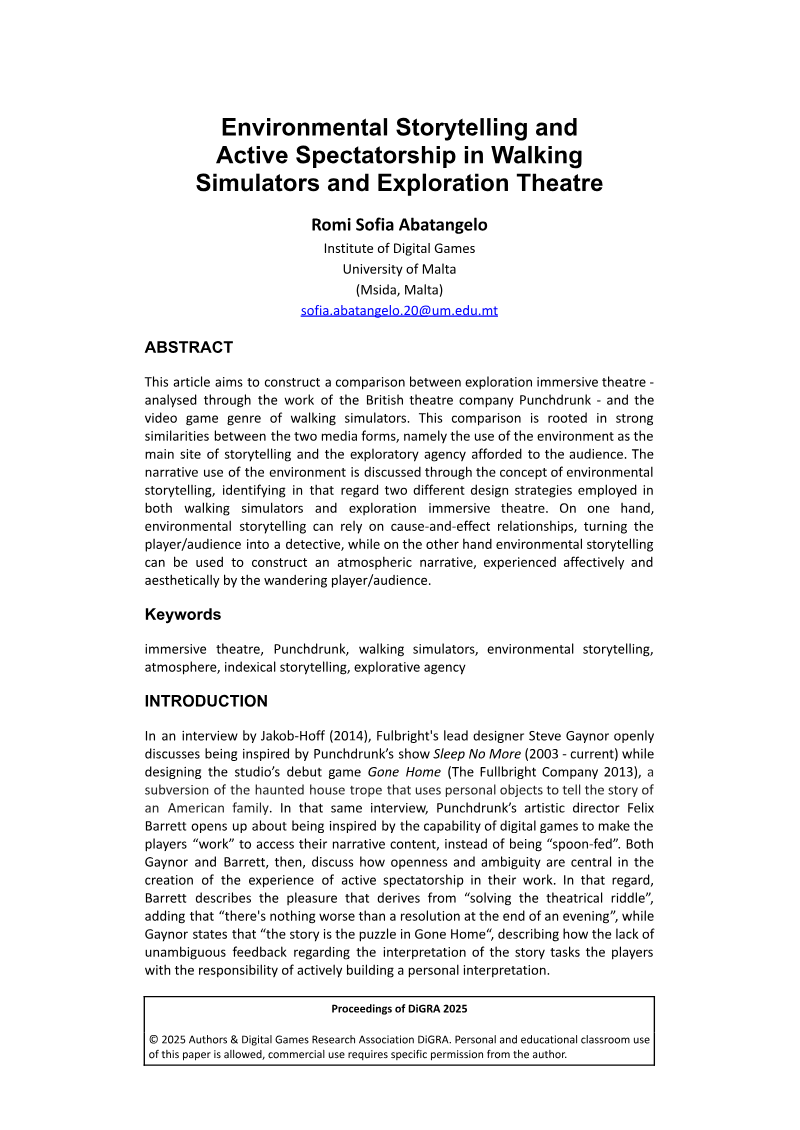
This article by Romi Sofia Abatangelo of the Institute of Digital Games, University of Malta, compares exploration-based immersive theatre, analysed through the work of the British company Punchdrunk, with the video game genre of walking simulators.
- Walking simulators and Punchdrunk shows are compared as sharing a design space because both use the environment as the main site of storytelling and give the audience or player exploratory agency.
- The article identifies two environmental storytelling strategies: cause-and-effect clues that turn the participant into a detective, and atmospheric narrative experienced affectively by a wandering participant.
- Walking simulators are described as subtracting ludic elements such as explicit tasks, goals and challenges, which places the player in a spectatorial position.
Print-and-Play and Digital Games for a Playful Assessment of Colour Vision Deficiencies
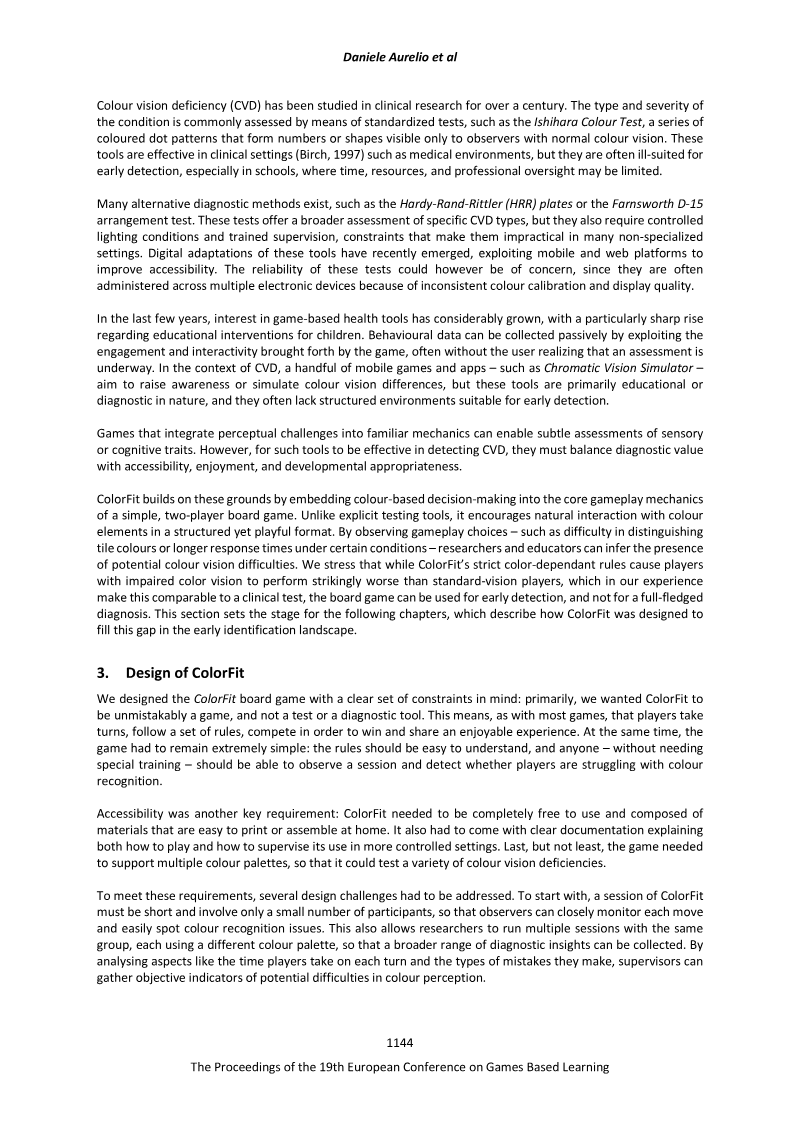
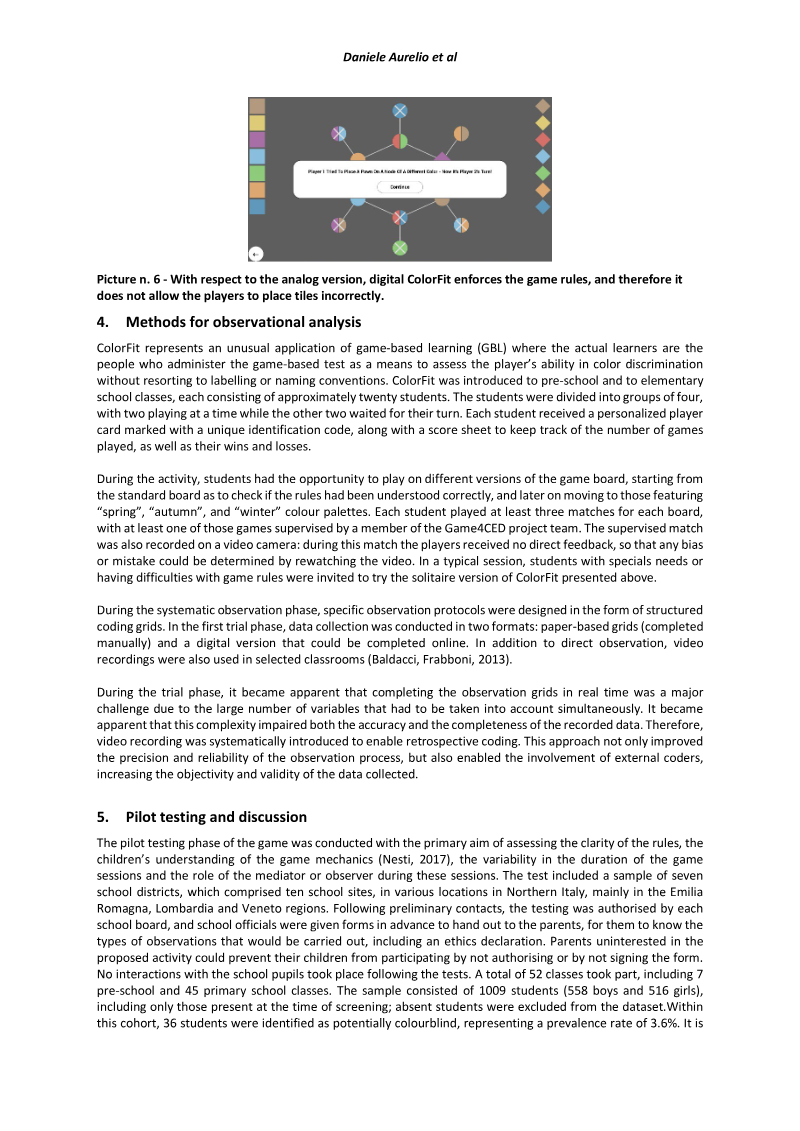
This document outlines the design, implementation, and pilot testing of ColorFit, a print-and-play and digital board game developed by the Game4CED group for the early detection of color vision deficiencies (CVD) in children.
- ColorFit is a two-player tile-placement and colour-matching board game designed as a playful, low-pressure screening aid for colour vision deficiencies (CVD) in children, supporting early detection rather than full diagnosis.
- The paper argues CVD often goes undetected in Italy until primary school, when colour-coded learning causes classroom and self-esteem difficulties, and that clinical tests like the Ishihara plates are intimidating for young children and poorly suited to schools.
- A pilot with 1,009 students (558 boys, 516 girls) across 52 mostly primary classes in northern Italy identified 36 students (3.6%) as potentially colour blind, below the national estimate of about 8.5% for males.
The Reach of Digital Games and Their Potential as Global Communication Tools
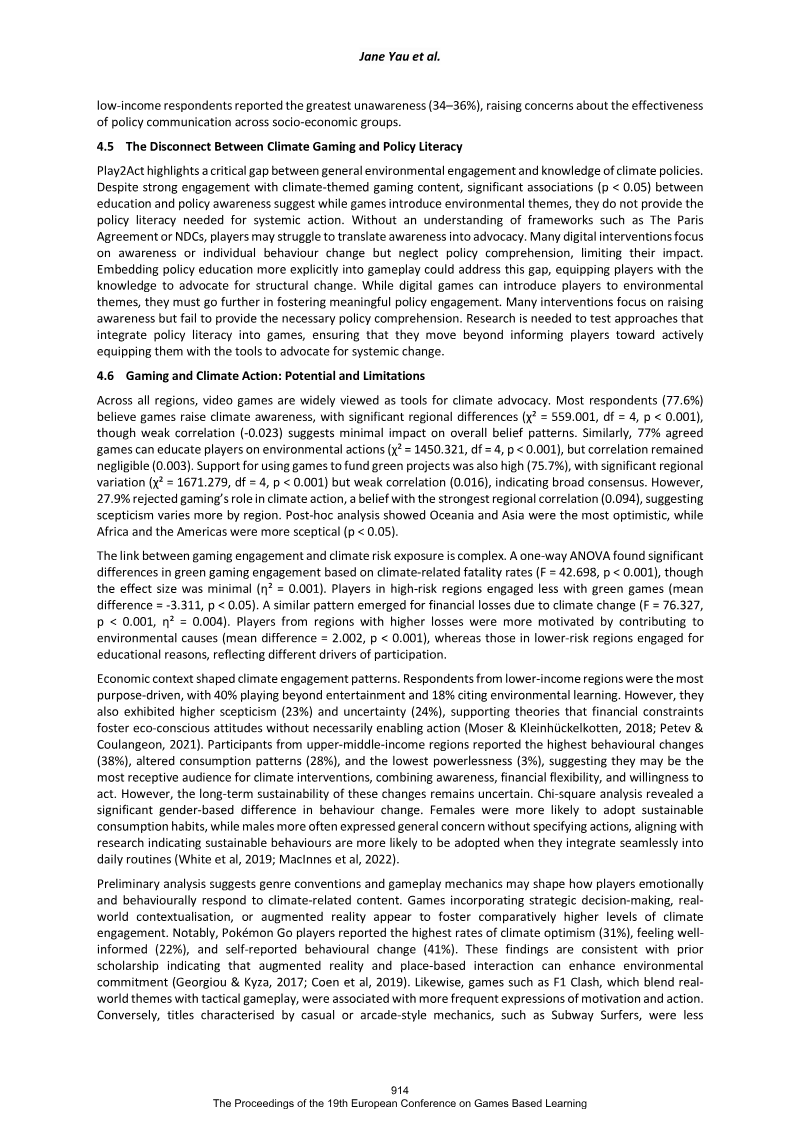
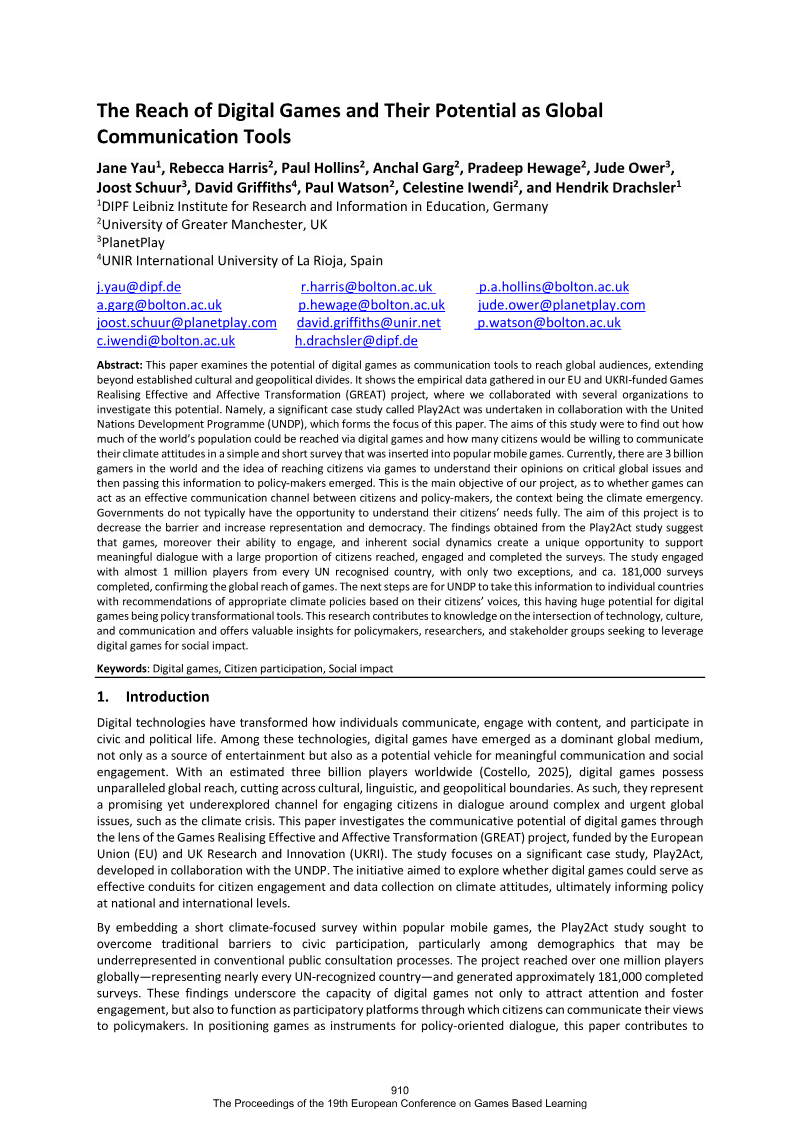
The paper examines whether digital games can act as communication channels between citizens and policymakers, using the Play2Act case study conducted with the United Nations Development Programme (UNDP) as part of the EU and UKRI-funded GREAT project.
- Play2Act engaged 933,852 players across 228 countries and territories, including 188 UN-recognised nations, with North Korea and Eritrea as the exceptions.
- A total of 204,796 respondents answered at least one question, and 181,087 finished the survey, resulting in a 15.2% overall completion rate.
- Awareness of the Paris Agreement varied by region, with over 50% of European respondents recognising it compared with 41% in Asia and 37% in Africa.



Enhancing the Digital Games Tax Credit (Section 481A)
This pre-budget submission from Imirt, the Irish Game Makers Association, argues that Ireland's Digital Games Tax Credit under Section 481A, introduced in November 2022, has signalled support for the video games sector but has not stimulated substantial domestic growth or foreign direct investment because of structural limits…
- Ireland's Digital Games Tax Credit under Section 481A, introduced in November 2022, has signalled support for the games sector but has not stimulated substantial domestic growth or foreign direct investment due to structural limits in its eligibility criteria.
- Imirt, the Irish Game Makers Association, is positioning Ireland as a candidate for a games hub, citing its storytelling and animation heritage, technical talent, English-speaking EU status, and links to US tech and entertainment markets.
- Imirt faces intense competition from other EU states and the UK in attracting games investment to Ireland.
Fighting Against Return: A Taxonomy of Time Loops in Digital Games
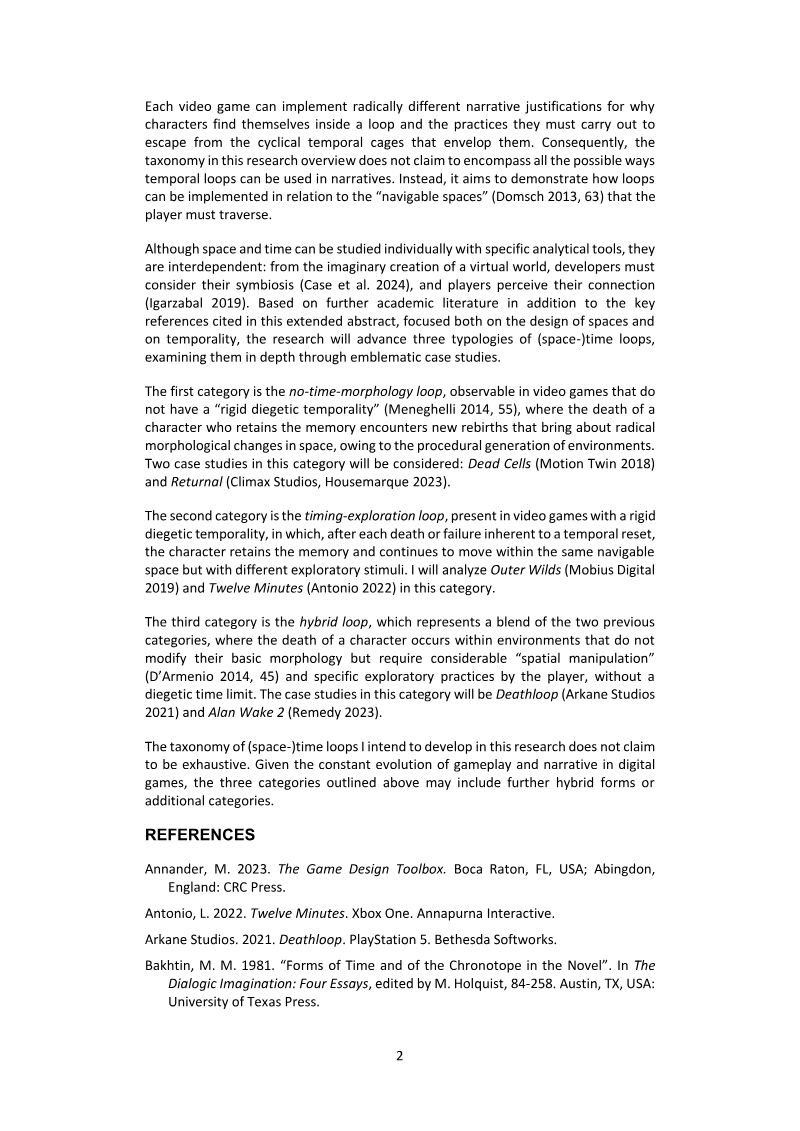
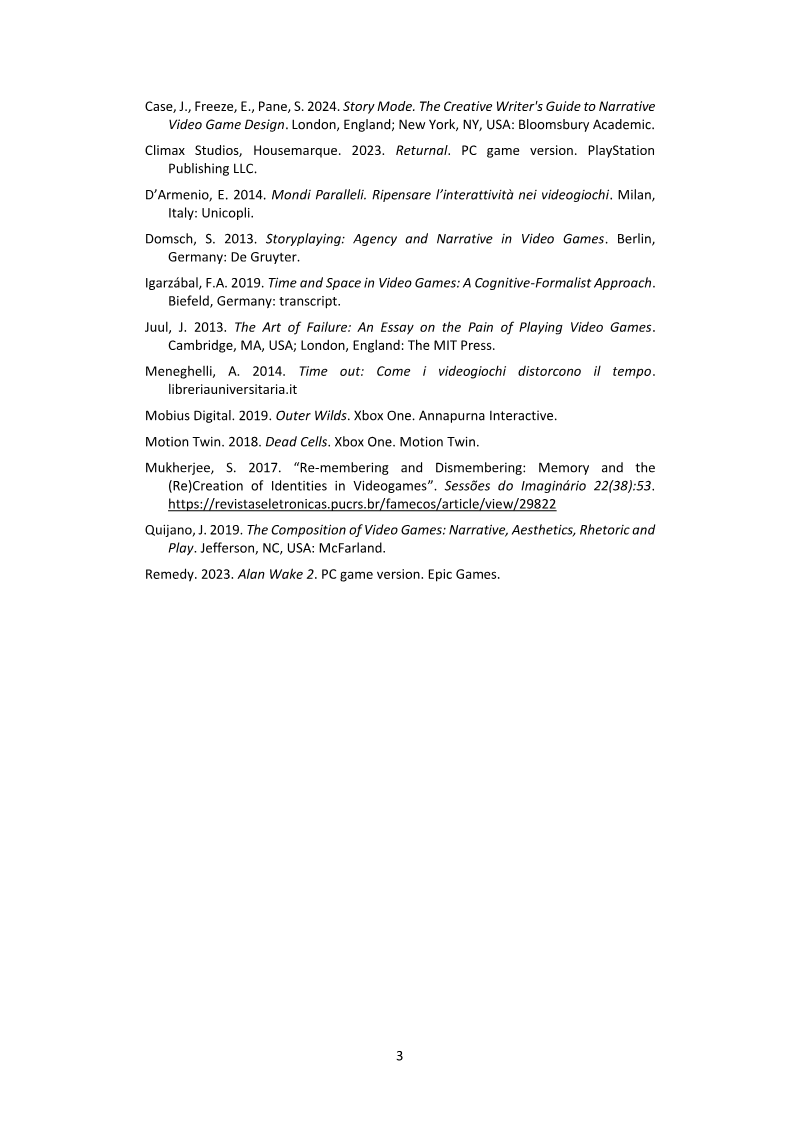
This research outlines a foundational taxonomy for time loops in digital games, specifically focusing on instances where character rebirth occurs after a "game over" state.
- The report proposes a taxonomy of time loop configurations in digital games, focused on how characters are reborn after a game over, and argues that loops are a foundational structure of play.
- It links Juul's 'failure-improvement cycle' to narrative cases where the character forgets previous deaths while the player remembers, and introduces the term 'Meta-Loop' for loops that extend from mechanical repetition into narrative progression.
- The author argues that the implementation of loops is inseparable from the navigable spaces players traverse.
Planting World Seeds: Procedural Content Generation, Labour and Conceptual Art in Digital Games
The document "Planting World Seeds: Procedural Content Generation, Labour and Conceptual Art in Digital Games" analyzes the distinct forms of Procedural Content Generation (PCG) in digital games, differentiating between "Runtime PCG" and "Development PCG" to explore their implications for automation, aesthetics, and labor…
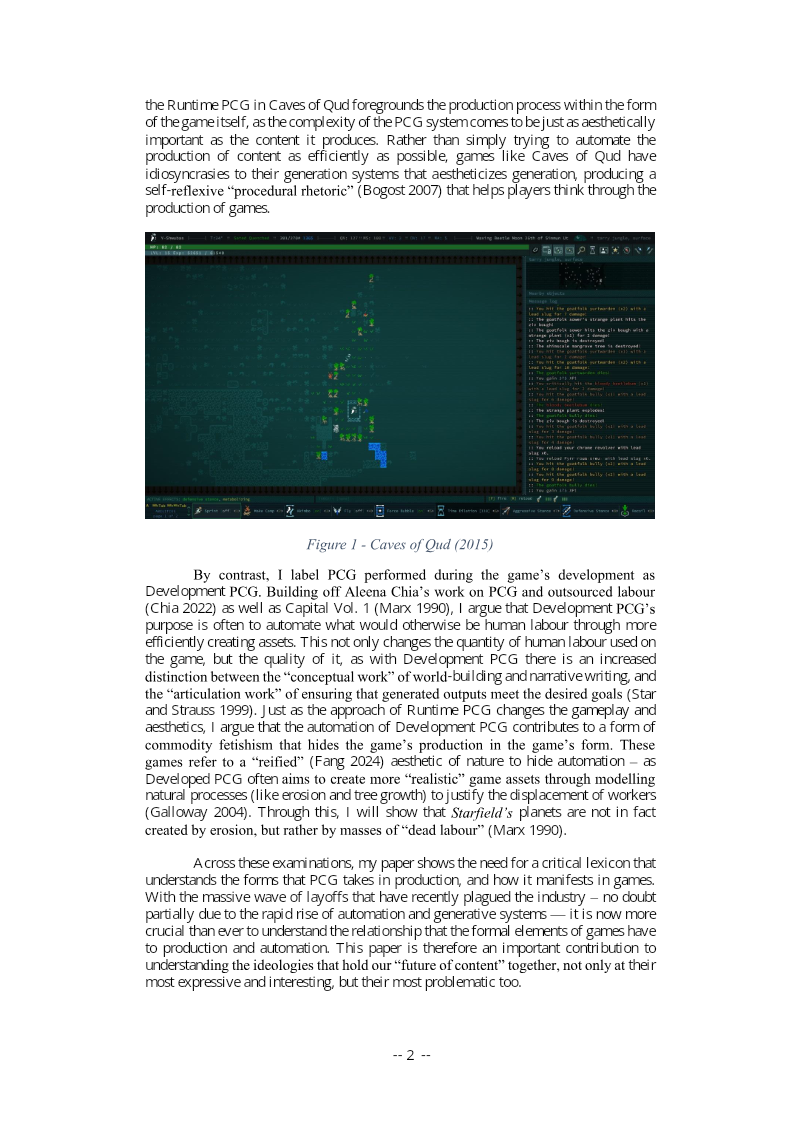
- The paper argues that 'procedural content generation' conflates two distinct forms: Runtime PCG, where worlds are generated during play and foreground the production process, and Development PCG, where assets are generated during production and never directly seen by players.
- The central claim is that Development PCG primarily automates human labour, separating conceptual world-building from the articulation work needed to make generated outputs meet production goals.
- Drawing on Marx and scholarship on automation and outsourced labour, the author contends that Development PCG often adopts a 'reified' aesthetic of nature, modelling erosion and tree growth so generated assets appear realistic and thereby concealing the labour involved.
Uncanny Homecoming: The Temporality of Dwelling and Return in Digital Games
The document explores the concept of "uncanny homecoming" in digital games, focusing on how different temporalities shape player experiences of in-game home places.
- The paper argues that the feeling of returning to a game home that no longer feels like home can be understood through the concept of the uncanny, drawing on Royle's 'unhomely at the heart of hearth and home' and a Derrida-inspired hauntological framework.
- Its central contribution is a taxonomy of five kinds of uncanny homecoming: narrative, progression, negated, abandoned, and nostalgic homecoming.
- Progression homecoming occurs when a player revisits a previously inhabited place, such as Candlekeep in Baldur's Gate or Kokiri Forest in Ocarina of Time, and finds it changed, a disjuncture grounded in the player's alterbiography.
Communicative Artificial Intelligence for Nonplayer Characters in Digital Games: Mapping the Field
This document maps the current state of communicative artificial intelligence (AI) for non-player characters (NPCs) in digital games, arguing for increased critical and theoretical research in this emerging field.
- The paper's central thesis is that LLM-driven NPC dialogue may fundamentally change how players communicate with gameworlds, so it deserves scrutiny through established frameworks like the philosophy of fiction rather than being treated as a detached technology.
- Drawing on Hepp et al.'s definition of communicative AI (automation for communication, embeddedness in digital infrastructures, entanglement with human practices) and Barad's concept of entanglement, the author argues such systems cannot be understood apart from the human communication data used to train them.
- The analysis centers on Van de Mosselaer and Gualeni's 'implied designer' concept, warning that AI-generated dialogue could erode players' sense of intentionality and make a gameworld feel less alive.