Creative
Company
Documents about Creative
2014 CESA General Consumer Survey Report: Japan
The 2014 CESA General Consumer Survey Report provides a comprehensive analysis of gaming habits and lifestyle trends among the Japanese population.
- The 2014 CESA Consumer Survey estimates there are 44.2 million active game players in Japan across all platforms, including home consoles, PCs, mobile devices, and arcades.
- Smartphone and tablet gaming is the largest segment by player base, with 26.72 million active users identified in the 2013-based study.
- For home consoles, the report estimates 57.5 million owners, 32.07 million active users, and 14.62 million consistent, long-term players.
2013 CESA Consumer Survey Report: Japan
The 2013 CESA Consumer Survey Report provides a comprehensive analysis of gaming habits, lifestyle trends, and hardware usage among the Japanese population.
- Approximately 29.1 million people in Japan, or 25.9% of the total population, are estimated to be active home console game users.
- The most widely owned home game consoles are the Nintendo DS/DS Lite (42.6%) and the Wii (42.1%), while the Wii U, released at the end of 2012, held a 2.0% ownership rate.
- Social gaming reached an estimated 16 million users in Japan, with 14.8% of the general population participating in social games across six major platforms, led by Mobage/Yahoo!Mobage.
2010 CESA Consumer Survey Report: Japan and South Korea
The 2010 CESA Consumer Survey Report provides a comprehensive analysis of gaming habits and lifestyle trends in Japan, with additional comparative data from South Korea.
- The number of active home console game users in Japan reached 36.05 million in 2009, representing 33.2% of the population and a 3.8 percentage point increase from 2008, attributed to the 'nesting consumption' (stay-at-home) trend.
- The Nintendo DS/DS Lite was the most widely owned and used hardware, while the Wii saw a significant increase in usage, rising to 25.3% among active users compared to 16.8% in the previous year.
- 12% of active home console users utilized their gaming devices for non-gaming internet activities, primarily for video streaming (52.3%), information searches (50.0%), and browsing websites (47.7%), with the Wii being the most common device for these tasks.
New European Parliament Report: Europe's Video Game Industry's Role in the Creative and Cultural Economy
The European Parliament’s Culture Committee has adopted a formal report recognizing the video game and esports sector as a vital component of the European Union’s creative and digital economy.
- The European Parliament has officially recognized the video game industry as a vital component of the European creative and cultural economy.
- The sector employed over 98,000 people in 2020, representing a 7.6% growth in jobs compared to 2019, with a heavy concentration in small and medium-sized enterprises (SMEs).
- Europe’s video game market generated €23.3 billion in revenue in 2021, maintaining stability despite shifting market conditions.
The State of Creative Optimization: 2025 Edition
Hybrid monetization models, which integrate both in-app purchases and in-app advertising, have emerged as the superior strategy for maximizing revenue in the global mobile gaming market.
- Return on Ad Spend (ROAS) serves as a critical short-term cash flow metric for managing payback periods, but Lifetime Value (LTV) remains the primary long-term indicator for evaluating an app's overall investment potential.
- Hybrid monetization models significantly impact performance; for example, Android Mid-core games achieve a 146% ROAS on hybrid models compared to 93% on pure In-App Purchase (IAP) models at Day 90.
- In-App Advertising (IAA) models for non-gaming apps enable rapid revenue capture, with approximately 90% of total revenue for the first three months generated within the first 30 days.
The State of Creative Optimization: 2026 Edition
The mobile advertising landscape in 2026 is defined by an intense focus on creative optimization, where the ability to scale production through artificial intelligence has become a prerequisite for market competitiveness.
- The top 2% of video creatives in gaming accounted for 60.7% of ad spend in Q2 2026, up from 53.5% in Q1 2025, indicating increasing concentration on winning video ads. Conversely, the top 2% of image creatives in gaming saw their share of spend decrease from 51.5% to 46.6% in the same period, suggesting a wider distribution of spend across image variations.
- Video and image ad performance diverges significantly across different app categories and creative elements; what works for one format often fails for the other, necessitating distinct creative strategies.
- In Action & Strategy games, 'Exciting' tones dominate video ads, but for image ads on DSPs, 'Dramatic' tones are more effective (54.1% vs. 45.9% for 'Exciting'). Video in this genre heavily utilizes 'Gameplay' (up to 47.9% of Ad Networks' spend), while image ads lean towards 'Promotional' content (46.5% of DSPs' image spend).
Ubisoft Appoints Christoph Hartmann to Lead Creative House 2 and Its Growing Portfolio of Franchises
Ubisoft has appointed industry veteran Christoph Hartmann as the General Manager of Creative House 2, a strategic division central to the company’s revised operating model.
- Ubisoft has appointed industry veteran Christoph Hartmann as General Manager of Creative House 2, a strategic division overseeing its tactical and competitive franchises.
- The Creative House 2 portfolio includes major intellectual properties such as Tom Clancy’s The Division, Ghost Recon, Splinter Cell, and the newly acquired title March of Giants.
- Hartmann will coordinate development across key internal studios, including Massive, Ubisoft Montreal, Ubisoft Paris, and Ubisoft Toronto.
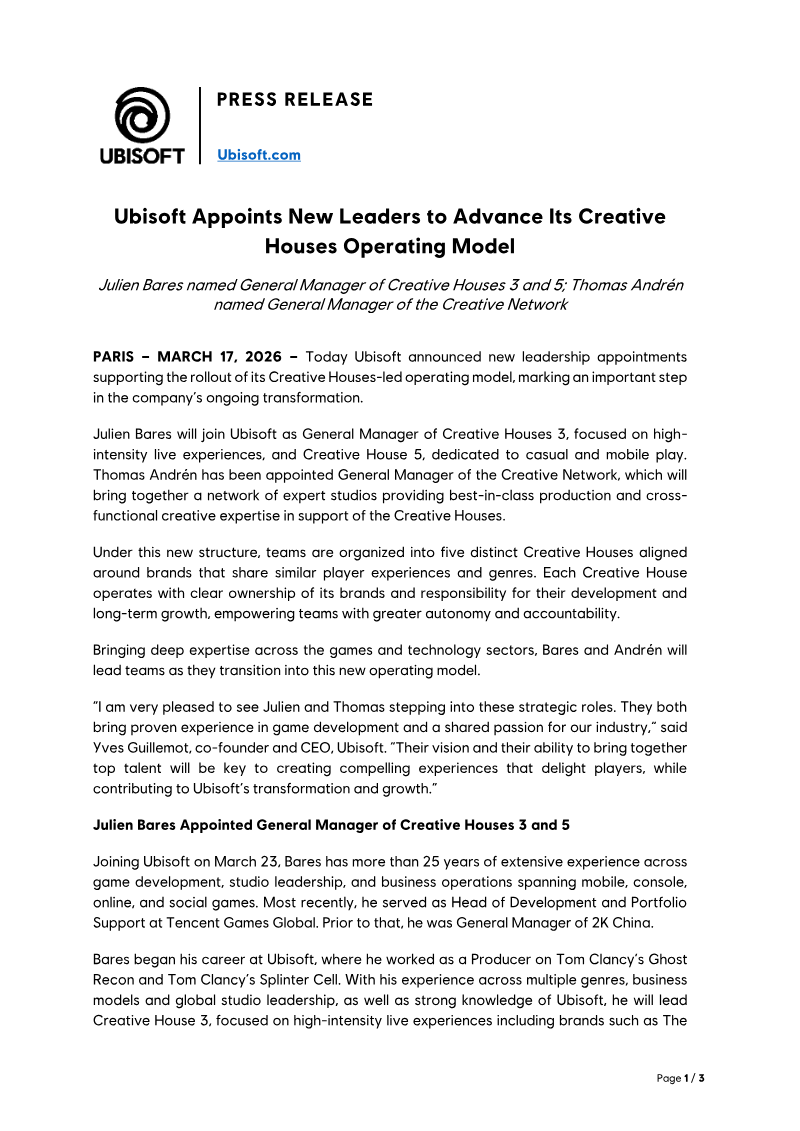
Ubisoft Appoints New Leaders to Advance Its Creative Houses Operating Model
Ubisoft is advancing its organizational transformation by appointing new leadership to oversee its Creative Houses operating model.
- Ubisoft is restructuring its development teams into five distinct Creative Houses, each granted greater autonomy and accountability for specific brand portfolios.
- The new organizational model aims to streamline production by aligning studios based on shared player experiences and genre-specific expertise.
- Julien Bares, formerly of Tencent Games Global and 2K China, has been appointed General Manager of Creative Houses 3 and 5, overseeing live service titles like The Crew and For Honor, as well as casual and mobile brands like Just Dance.

Play19: Creative Gaming Festival – A Conversation with Valentina Birke
The Play19 Creative Gaming Festival, held in Hamburg in November 2019, served as a platform to explore the intersection of human psychology and interactive media under the thematic banner of "Of Monsters and Games."
- The Play19 Creative Gaming Festival, held in Hamburg in November 2019, focused on the intersection of human psychology and interactive media through the theme 'Of Monsters and Games.'
- The Creative Gaming Award prioritized projects featuring unconventional design, specifically rewarding innovations in control schemes, eye-tracking technology, and narrative experimentation.
- The festival served as a professional development hub, offering specialized industry panels and workshops on emotional monster design and advanced storytelling techniques.

Creative Transfer Games: Hamburg
The Creative Transfer program provides financial assistance to German game developers and studios seeking to expand their professional reach through attendance at national and international industry conventions.
- The Creative Transfer program provides German independent game studios with subsidies covering up to 80% of travel expenses for industry conventions.
- Eligible studios must be headquartered in Germany and maintain a staff of no more than 20 permanent employees.
- Funding caps are set at 1,000 euros for domestic events and 2,000 euros for international gatherings.

Road to gamescom 2020: Offers for Hamburg Game Developers and Companies
The Road to gamescom 2020 initiative, managed by Gamecity Hamburg in collaboration with the Hamburg Kreativ Gesellschaft, was designed to support local game developers and companies in accessing the European games market.
- Gamecity Hamburg and Hamburg Kreativ Gesellschaft launched the 'Road to gamescom 2020' initiative to provide local developers with professional exposure and networking access to the European games market.
- The program offered free exhibition space at the Indie Arena Booth for up to six selected developers, alongside a specialized networking program for up to five additional participants.
- Applicants were required to be commercially oriented, maintain a Hamburg-based headquarters or branch, and possess a playable game version to be eligible for selection.

New Event: Game Starter - Hamburg
Gamecity Hamburg introduced a specialized event format titled Game Starter, designed to bridge the gap between established industry professionals and individuals entering the games sector.
- Gamecity Hamburg launched 'Game Starter,' a new event series designed to connect industry newcomers and students with established game development professionals.
- The inaugural session featured a panel of three industry experts: Christin Matt (InnoGames), Martin Wilkes (Daedalic), and Maurice Hagelstein (Tiny Roar).
- Panelists provided actionable insights by detailing their career paths, the daily realities of professional game development, and advice for those entering the industry.