Advertising reports and market data
544 game industry reports, presentations and talks about advertising from writers such as PocketGamer.biz, Two & a Half Gamers and Tenjin, newest from 2026. Every document has a summary and key insights with the page they come from, and 4,059 charts and tables are extracted as data.
Key figures
The Southeast Asian mobile gaming market saw a 19.7% year-over-year increase in active advertisers in 2026, signaling a rapidly maturing ecosystem.
SocialPeta, 2026 · 2026 Southeast Asia Mobile Game Marketing Report, p. 7
In-game advertising significantly outperforms traditional metrics for younger audiences, driving an 86% boost in brand affinity among under-18s and increasing brand recall by 7 points and purchase intent by 9 points for those under 34.
Anzu, 2026 · Gaming the Future: How to Make an Impact With Younger Generations, p. 17
Generative AI adoption has reached 95% among marketers, who primarily use the technology for the creation and optimization of advertising assets.
Smartly, 2026 · 2026 Digital Advertising Trends Report, p. 19
In-game advertising featuring prizes (49%) and video content (40%) generates the strongest purchase intent, particularly for electronics, tech, and gaming accessories.
Decision Lab, 2026 · Gaming and Esports in Vietnam: A New Arena for Brands, p. 48
India’s digital advertising market surpassed $4 billion in 2025 and is projected to exceed $5 billion in 2026.
Sensor Tower, 2026 · State of Digital Advertising India 2026, p. 10
Documents

S08, E03: Amazon and Agentic Commerce (with Adam Epstein)
Agentic commerce currently functions more as a theoretical aspiration than a mass-market reality, as the prevailing retail infrastructure remains fundamentally incompatible with the open integration of third-party AI agents.
- Amazon is leveraging its $80 billion advertising business to pivot from transaction-based take rates toward an ad-driven monetization model for AI-integrated retail.
- To prevent losing traffic to external AI tools, Amazon is integrating its proprietary advertising stack—including the Amazon DSP and responsive e-commerce creative units—directly into third-party platforms like ChatGPT.
- Amazon’s strategy of embedding its ad stack into external interfaces allows the company to maintain closed-loop purchase tracking and monetize consumer intent outside of its own ecosystem.

🎯 20 years' experience: Luis de la Camara on WHY the networks know your users better than YOU!
Mobile game developers must shift their user acquisition strategy from adversarial competition with ad networks to a collaborative model that leverages the superior data capabilities of demand-side platforms.
- Mobile developers must transition from adversarial competition with ad networks to a collaborative model that leverages the superior user-behavior data held by demand-side platforms (DSPs).
- Studios should prioritize direct-response performance marketing over broad awareness campaigns to avoid the risks associated with inflated cost-per-install (CPI) metrics.
- Analyzing eCPM decay curves allows developers to distinguish between players driven by in-app purchases and those driven by ad-based revenue, enabling more precise audience segmentation.
2026 Southeast Asia Mobile Game Marketing Report
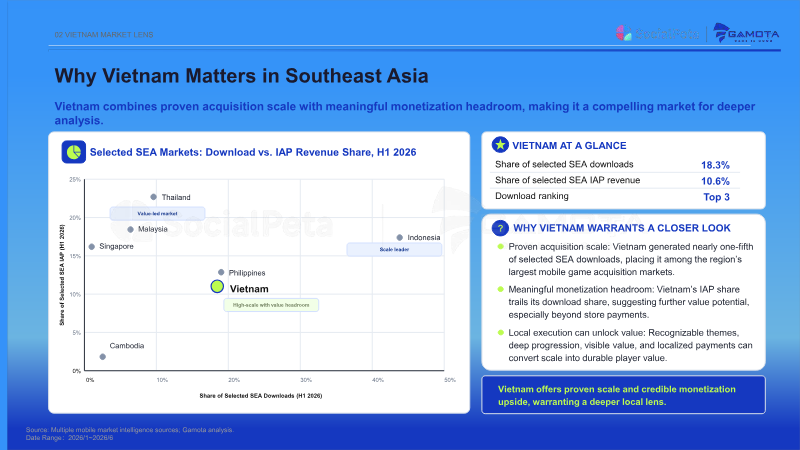
The Southeast Asian mobile gaming landscape in 2026 reflects a maturing ecosystem defined by a 19.7% year-over-year increase in active advertisers.
- The Southeast Asian mobile gaming market saw a 19.7% year-over-year increase in active advertisers in 2026, signaling a rapidly maturing ecosystem.
- Video content dominates user acquisition, comprising 73.7% of all advertising creatives, with a shift toward mid-length formats featuring live-action hooks and AI-generated visuals.
- Indonesia leads the region in total download volume, while Thailand maintains the highest revenue per user through in-app purchases.

💰 You Hit $1,000/Day in Ad Revenue. Now Here Are the 5 Tricks Ad Networks hope you NEVER Learn
Achieving a daily ad revenue milestone of $1,000 marks a critical transition point for mobile game publishers, where incremental optimizations yield significant financial returns.
- Implement dynamic bid floors to counter DSP 'bandit models,' which can recover 5–20% of lost revenue by shifting the publisher from a price taker to a price setter.
- Maintain presence across at least six to seven major ad networks—including AppLovin, Meta, Google, Unity, and Mintegral—to maximize demand, with each additional high-quality network typically contributing a 5–10% revenue increase.
- Monitor ad-display and ad-hidden callbacks to identify and block user-hostile creative formats, as networks often extend rewarded videos to 120–190 seconds without publisher consent.

S8, E01: Articulating a bull case for the open web (with Gareth Glaser)
The open web represents a significantly undervalued advertising market, currently constrained by legacy infrastructure that prioritizes outdated branding models over the performance-driven strategies that define modern digital marketing.
- The open web is significantly undervalued, with average CPMs ranging from $6 to $15 on platforms like Facebook compared to a fraction of that on the open web, representing a massive potential for economic growth if monetization strategies are modernized.
- The historical development of open web advertising was stunted by an over-reliance on agency holding company budgets and rebates, which favored established walled gardens over the technical innovation required for performance marketing.
- Prebid.js, an open-source framework used by 99% of web publishers, was a critical turning point that allowed publishers to bypass Google Ad Manager's monopolistic advantages, resulting in publisher revenue increases of approximately 70%.

How to Build AI Workflows for App Marketing with MCPs & Skills
The Model Context Protocol (MCP) serves as a transformative architectural standard for mobile app marketing, functioning as a universal interface that bridges fragmented data ecosystems.
- Model Context Protocol (MCP) acts as a universal 'USB port' for AI, allowing LLMs like Claude or ChatGPT to securely interface with external marketing and development tools without requiring the user to switch between dashboards.
- By connecting multiple MCP servers—such as Tenjin for attribution, RevenueCat for subscriptions, and App Store Connect for operations—marketers can perform cross-platform analysis and automated tasks within a single chat interface.
- AI 'skills' are reusable, scriptable workflows that allow users to automate repeatable processes like performance audits, review management, and app store metadata updates, effectively replacing expensive third-party management software.
S07, E35: OpenAI's advertising ambitions (with Asad Awan)
OpenAI is actively architecting an advertising model for ChatGPT that shifts away from traditional keyword-based interruptions toward intent-driven, conversational discovery.
- OpenAI operates under five core advertising principles: democratizing AI access, maintaining strict independence between organic model answers and paid placements, ensuring user privacy, providing opt-out options via paid plans, and prioritizing user value over time-spent metrics.
- OpenAI has scaled its advertising business rapidly, achieving a $1 billion annual revenue run rate in less than 200 days since initiating its careful ads pilot.
- The conversational interface allows for deeper intent discovery than traditional keyword-based search by leveraging user context, constraints, and preferences to deliver highly personalized, relevant ad creative.

🚨📢 BREAKING NEWS: AppLovin Just Cut Off Everyone's Data: The MeowDoku Studio Got Sued & more
The mobile gaming industry is currently undergoing significant shifts in data privacy, intellectual property enforcement, and cross-media expansion.
- AppLovin has restricted access to user-level ad data on its MAX mediation platform, shifting to aggregated reporting to prevent competitors from using its ad stream to train rival bidding algorithms.
- Oakever, the studio behind the popular title MeowDoku, is facing significant legal challenges, including a copyright infringement loss to Hungry Studio and a lawsuit from Avia Games regarding unauthorized advertising assets.
- The mobile gaming industry is seeing a shift in intellectual property dynamics, as evidenced by Sega and Netflix partnering to develop film and television projects based on the Sonic and Crazy Taxi franchises.
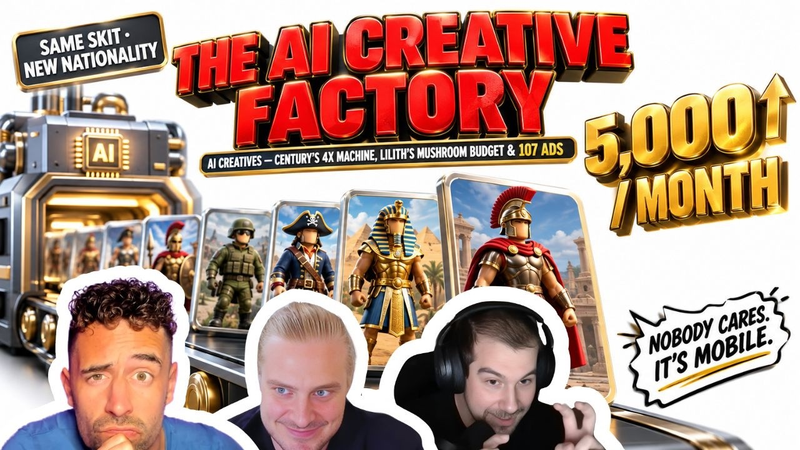
🧠 Everything Is AI Now: Mel Gibson From Wish Is Selling You a 4X Game
Mobile game publishers are undergoing a fundamental transformation in user acquisition strategy, shifting toward an AI-first production model to maintain dominance in a saturated market.
- Mobile game publishers are shifting to an AI-first production model to generate thousands of unique advertisements per month, a volume unattainable through traditional creative workflows.
- The strategy prioritizes rapid iteration and high-intensity hooks over gameplay accuracy, as seen in titles like Bulldozer Master and Pizza Ready to drive massive daily download figures.
- Studios are using generative AI to perform regional localization by swapping actor nationalities and integrating viral memes or pop-culture tropes at scale.
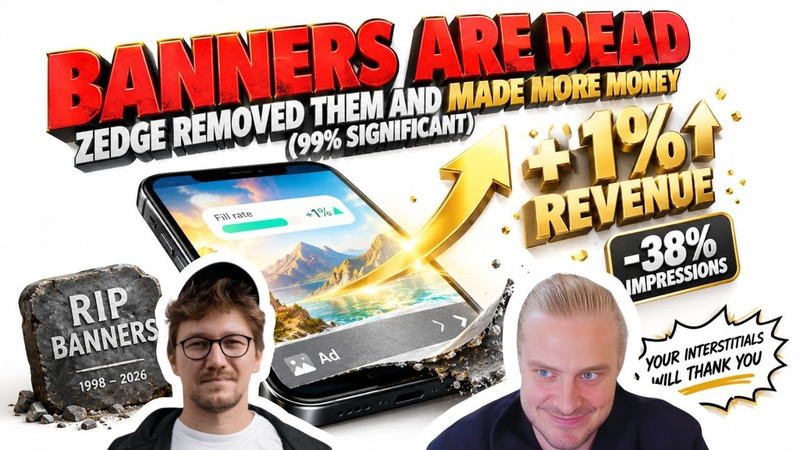
🪦 Are Banners Dead? Zedge Removed Them, Cut 38% of Impressions, and Made MORE Money
A recent experiment conducted by Zedge, a personalization app with 721 million installs, challenges the long-standing industry assumption that banner advertisements are a necessary component of mobile monetization.
- Zedge removed all banner advertisements from its app, resulting in a 38% reduction in total ad impressions while simultaneously increasing overall revenue by 1%.
- The removal of banners led to a 1.77% improvement in primary user engagement metrics, suggesting that banner-free environments foster better user retention.
- Eliminating banners consolidated ad demand into higher-value formats like interstitial and rewarded video ads, which saw significant gains in fill rates and performance.

S07, E33: An oral history of mobile user acquisition (with Nebojsa Radovic)
The evolution of mobile user acquisition has undergone a fundamental transformation, moving from the labor-intensive, manual operations of the mid-2010s to a lean, AI-driven landscape.
- Mobile user acquisition has shifted from manual, high-headcount operations—where competitive advantage relied on custom reporting and publisher-level targeting—to automated, AI-driven environments where success depends on creative volume and signal engineering.
- Algorithmic platforms like Google's UAC have democratized access to global audiences, making it easier for developers to launch games but significantly increasing competition and making profitable growth harder to achieve.
- Modern UA performance is heavily dependent on 'signal engineering,' which requires feeding high-quality data (such as 20+ daily purchases per campaign) into algorithms to exit learning phases and optimize LTV.
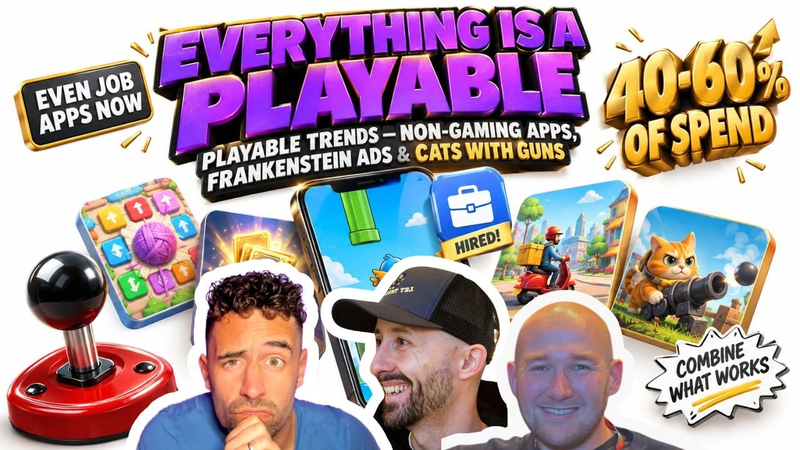
🎮 Playables Are Now 40-60% of Creative Spend: Here's what's working ńow
Playable advertisements have emerged as a dominant force in digital marketing, currently accounting for 40% to 60% of total creative spend across the gaming and non-gaming sectors.
- Playable advertisements now represent 40% to 60% of total creative spend across both gaming and non-gaming sectors.
- The industry is shifting toward 'Frankenstein playables,' which synthesize multiple proven, high-engagement mechanics like yarn puzzles and rescue scenarios into a single ad unit.
- Non-gaming sectors, including finance and social apps, are adopting gamified elements like obstacle-avoidance and item-catching to drive user engagement through low-friction interactions.