Frontier Developments
Game Co.31 documents
UK game developer. Planet Coaster/Zoo, Elite Dangerous, Jurassic World Evolution. Founded by David Braben (Elite).
Documents
Financial21 pages
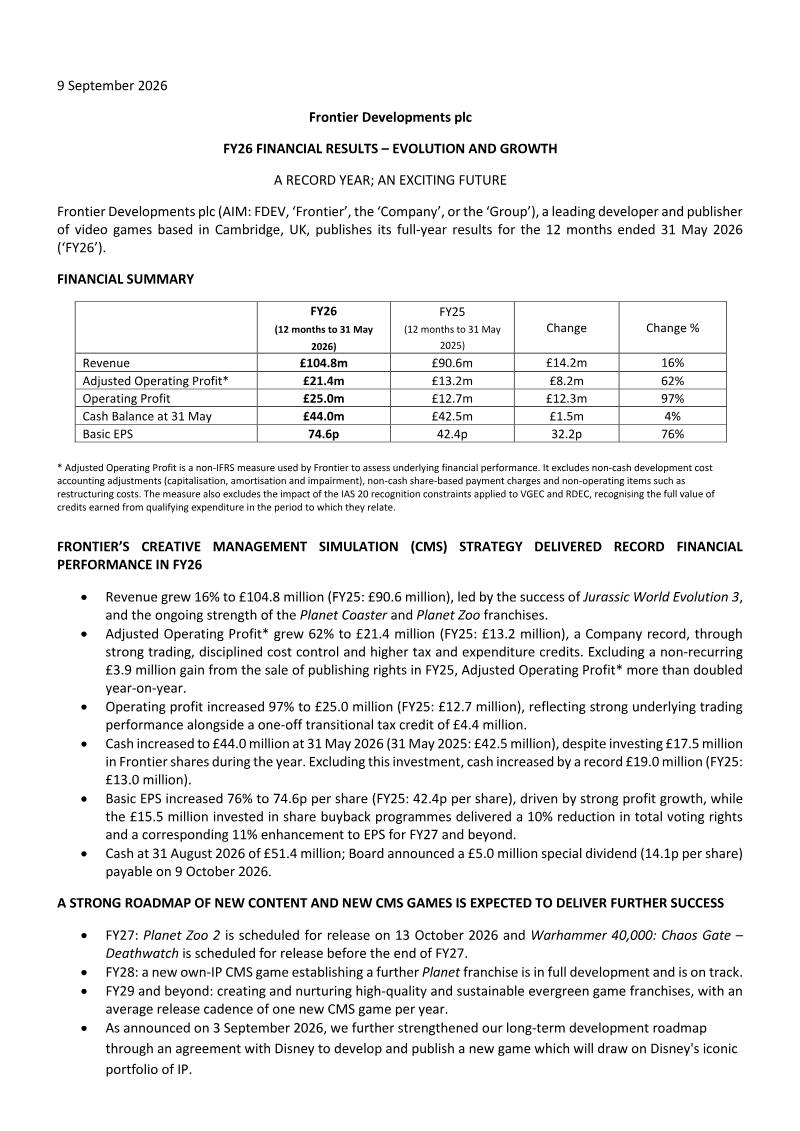
FY26 Financial Results: Evolution and Growth
Frontier Developments achieved record-breaking financial performance in fiscal year 2026, characterized by a 16 percent revenue increase to £104.8 million and a 62 percent surge in adjusted operating profit to £21.4 million. This growth was primarily fueled by the commercial success of the Creative Management Simulation portfolio, most notably the launch of Jurassic World Evolution 3. The company’s strategic focus on disciplined cost management, combined with the transition to the Video Game Expenditure Credit scheme and increased Patent Box tax relief, significantly bolstered bottom-line results. Consequently, basic earnings per share rose substantially to 74.6p, up from 42.4p in the prior year.
The organization maintains a robust financial foundation, ending the period with £51.4 million in total cash and cash equivalents. This liquidity supported a £15.5 million share buyback program and the declaration of a £5 million special dividend, while net assets grew by 12 percent to £107.0 million. With no debt and intangible assets valued at £56.0 million—supported by proprietary technology and ongoing development—the company remains in a strong position to sustain its operations through at least September 2027.
Looking forward, the development roadmap emphasizes long-term franchise expansion and sustained investment in new intellectual property. Upcoming releases, such as Planet Zoo 2, and a newly established partnership with Disney serve as the cornerstones of this growth strategy. By balancing aggressive investment in game development with rigorous fiscal oversight, the company is positioned to leverage its current momentum to secure its standing within the global gaming market throughout the coming fiscal periods.
- Frontier Developments reported record FY26 revenue of £104.8 million, a 16% increase, and a 62% surge in adjusted operating profit to £21.4 million.
- Basic earnings per share rose to 74.6p from 42.4p, driven by the success of the Creative Management Simulation portfolio and the launch of Jurassic World Evolution 3.
- The company maintains a debt-free balance sheet with £51.4 million in cash and cash equivalents, supporting a £15.5 million share buyback and a £5 million special dividend.
- Fiscal performance was bolstered by disciplined cost management and tax benefits, including the Video Game Expenditure Credit scheme and Patent Box tax relief.
- The company has secured operational funding through at least September 2027, with net assets growing 12% to £107.0 million.
+2
Frontier Developments
Legal59 pages
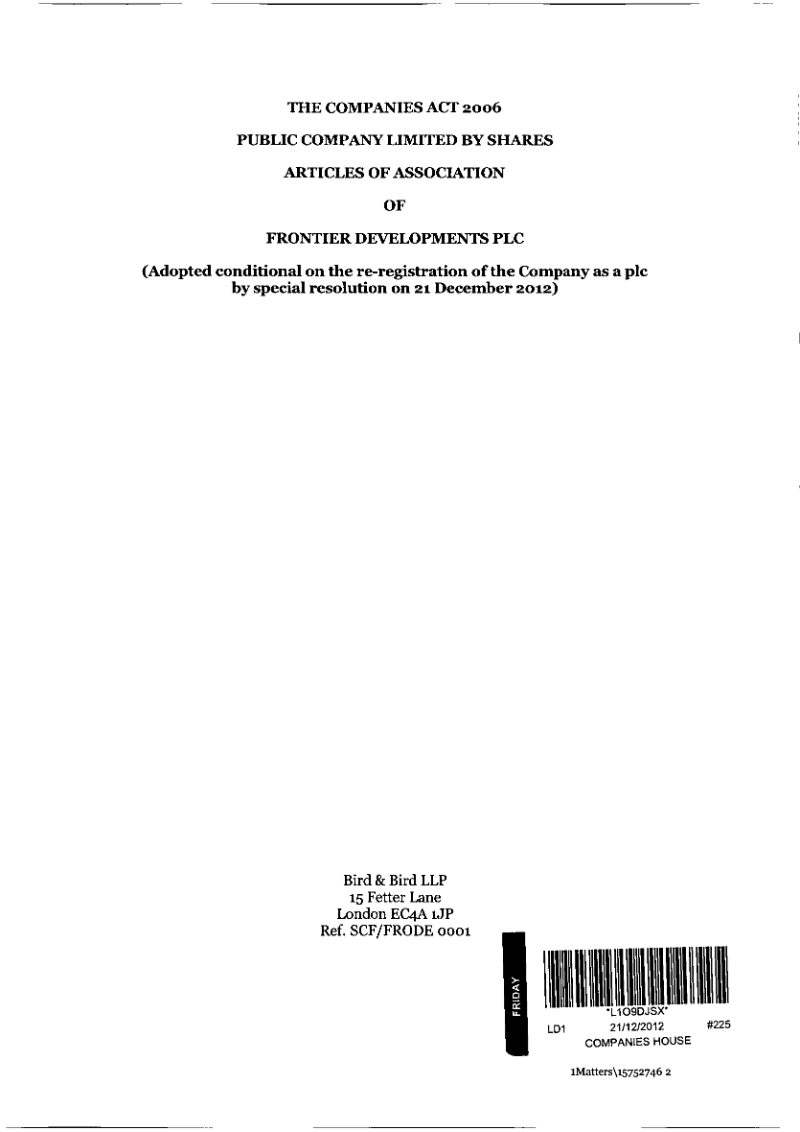
Articles of Association: Frontier Developments PLC
Frontier Developments PLC operates under a comprehensive governance framework established upon its re-registration as a public limited company in December 2012. These regulations supersede standard model articles, providing a bespoke administrative structure that dictates the company’s share capital management, director responsibilities, and shareholder rights. The framework is designed to ensure operational stability and board authority, specifically regarding the issuance, transfer, and forfeiture of shares, as well as the management of corporate records and general meeting procedures.
The governance model grants the Board of Directors significant discretionary power to manage the company’s financial and operational affairs. This includes the authority to delegate duties to committees, establish overseas registers, and manage borrowing limits, which are capped at the greater of £20 million or twice the Adjusted Capital and Reserves. Furthermore, the articles provide clear protocols for the declaration of dividends, the handling of untraced shareholder assets, and the mitigation of director conflicts of interest. The Board is also empowered to utilize modern communication methods for shareholder notices and is protected by specific indemnification clauses for liabilities incurred during the execution of their duties.
By centralizing decision-making authority and establishing rigorous protocols for voting, capital calls, and record-keeping, the company maintains a structured approach to corporate oversight. The articles ensure that the Board retains control over the company’s equity and financial obligations while providing a transparent, albeit highly discretionary, mechanism for shareholder engagement and corporate administration. This legal foundation serves as the primary instrument for maintaining the company’s internal order and regulatory compliance within the United Kingdom’s public limited company framework.
- Frontier Developments PLC operates under a bespoke governance framework established in December 2012 that supersedes standard model articles to centralize board authority.
- The Board of Directors maintains a borrowing limit capped at the greater of £20 million or twice the company’s Adjusted Capital and Reserves.
- The governance model grants the Board significant discretionary power over share capital management, including the authority to issue, transfer, and forfeit shares.
- The articles establish formal protocols for managing corporate records, declaring dividends, and handling assets belonging to untraced shareholders.
- Board members are protected by specific indemnification clauses for liabilities incurred while executing their official duties.
Frontier Developments

Legal16 pages
Notice of Annual General Meeting: 2026
Frontier Developments PLC is convening its 2026 Annual General Meeting to formalize corporate governance structures and ratify strategic financial initiatives. The primary objective is to secure shareholder approval for 16 resolutions, including the adoption of fiscal year 2026 financial statements, which reflect a robust performance characterized by a 16% revenue increase to £104.8 million and a 62% surge in adjusted operating profit to £21.4 million. These results underscore the company’s operational stability as it navigates a transition period, most notably the shift of founder David Braben into a non-executive role effective October 2026.
A central component of the meeting involves managing the company’s capital structure and regulatory obligations. Shareholders are asked to authorize the allotment of equity securities and the market purchase of up to 10% of issued share capital, totaling 3,553,068 ordinary shares. Because these buybacks could inadvertently push the voting interest of the David Braben Concert Party beyond the 30% threshold, the company has obtained a conditional waiver from the Takeover Panel. This waiver exempts the concert party from mandatory takeover offer requirements under Rule 9 of the Takeover Code, a move supported by the independent directors who confirm that no changes to business strategy or management are intended.
Beyond capital management, the meeting addresses administrative adjustments to board compensation. The proposal to increase the aggregate fee cap for non-executive directors from £200,000 to £500,000 is designed to account for inflationary pressures and an expanded board size. These governance updates, paired with recent strategic developments such as the sale of publishing rights for Stranded: Alien Dawn and a new development agreement with Disney, position the company to maintain its market trajectory while ensuring regulatory compliance and leadership continuity.
- Frontier Developments reported strong fiscal year 2026 performance with revenue growing 16% to £104.8 million and adjusted operating profit surging 62% to £21.4 million.
- Founder David Braben will transition to a non-executive role effective October 2026 as part of the company's leadership evolution.
- Shareholders are asked to authorize a share buyback program of up to 10% of issued share capital, totaling 3,553,068 ordinary shares.
- The company secured a Takeover Panel waiver to prevent the David Braben Concert Party from triggering a mandatory takeover offer under Rule 9 of the Takeover Code following the proposed share buybacks.
- The board proposes increasing the aggregate fee cap for non-executive directors from £200,000 to £500,000 to accommodate an expanded board and inflationary pressures.
Frontier Developments

Financial86 pages
Annual Report and Accounts 2026
Frontier Developments achieved record financial results for the 2026 fiscal year, characterized by a 16% revenue increase to £104.8 million and a 62% surge in adjusted operating profit to £21.4 million. This performance validates the company’s strategic focus on its "Create, Publish and Nurture" model, which prioritizes the long-term development of genre-leading creative management and simulation franchises. The firm’s financial health is underpinned by a robust liquidity position, with cash and equivalents totaling £51.4 million as of August 2026, supporting its status as a going concern through September 2027.
The company’s growth was bolstered by disciplined cost management and the transition to the new Video Games Expenditure Credit regime, which contributed £10.0 million in operating income. Capital allocation remained a priority, evidenced by a £15.4 million share buyback program that reduced the share count by 10% and the subsequent announcement of a £5 million special dividend. These financial achievements occurred alongside a significant leadership transition, with Jo Cooke assuming the role of CEO as founder David Braben moved to a non-executive position.
Governance and risk management remain central to the company’s operational framework. The Board employs a structured, tiered system to mitigate strategic, financial, and cultural risks, while maintaining a commitment to sustainability and climate-related reporting. Independent audits confirmed the accuracy of financial statements, including the capitalization of development costs and revenue recognition practices. By aligning executive remuneration with long-term shareholder interests and maintaining a focus on high-performing, inclusive teams, the organization positions itself to navigate ongoing macroeconomic volatility and competitive pressures within the global video game industry.
- Frontier Developments achieved record fiscal 2026 results with revenue rising 16% to £104.8 million and adjusted operating profit surging 62% to £21.4 million.
- The company maintains a strong liquidity position with £51.4 million in cash and equivalents, ensuring it remains a going concern through September 2027.
- Capital allocation initiatives included a £15.4 million share buyback that reduced the share count by 10% and the declaration of a £5 million special dividend.
- Operating income was bolstered by £10.0 million in credits from the new Video Games Expenditure Credit regime alongside disciplined cost management.
- The company underwent a major leadership transition in 2026, with Jo Cooke appointed as CEO while founder David Braben moved to a non-executive role.
+2
Frontier Developments
Financial18 pages
Trading Update: FY26 Provisional Financial Results
Frontier Developments reports record financial performance for the 2026 fiscal year, driven by a strategic pivot toward the Creative Management Simulation (CMS) genre. The company achieved £104.8 million in revenue, representing a 16% increase over the previous year, and a record adjusted operating profit of £19 million. This growth is attributed to a successful strategic reset initiated in 2023, which prioritized the development and long-term support of core CMS franchises.
The company’s portfolio strategy centers on nurturing existing intellectual property through regular updates and paid downloadable content (PDLC), which now accounts for 89% of total revenue. Key franchises, including Jurassic World Evolution, Planet Zoo, Planet Coaster, and Elite Dangerous, have demonstrated strong long-tail performance. Notably, the Planet Zoo franchise has generated £156 million in revenue since its launch, with PDLC contributing 45% of that total. The company maintains a disciplined development pipeline, aiming to release one new CMS title per financial year to ensure consistent growth.
Financial health remains robust, with cash reserves reaching £44 million by the end of May 2026. The company’s methodology for assessing performance emphasizes adjusted operating profit, a non-IFRS measure that accounts for the full benefit of tax and research and development credits while excluding non-cash development cost adjustments. Looking ahead to fiscal year 2027, the company intends to continue its focus on player retention and technology platform investment. Management expresses confidence in the current trajectory, citing strong early performance in the new fiscal year and a clear roadmap for expanding its CMS portfolio.
- Frontier Developments achieved record FY26 financial results with £104.8 million in revenue, a 16% year-over-year increase, and a record adjusted operating profit of £19 million.
- The company’s strategic pivot to the Creative Management Simulation (CMS) genre has proven successful, with 89% of total revenue now derived from paid downloadable content (PDLC) for existing franchises.
- The Planet Zoo franchise has generated £156 million in total revenue since launch, with 45% of that figure attributed specifically to PDLC sales.
- Frontier maintains a disciplined development pipeline with a target of releasing one new CMS title per financial year to ensure consistent growth.
- The company ended the 2026 fiscal year in a strong liquidity position with £44 million in cash reserves.
+1
Frontier Developments
Financial4 pages
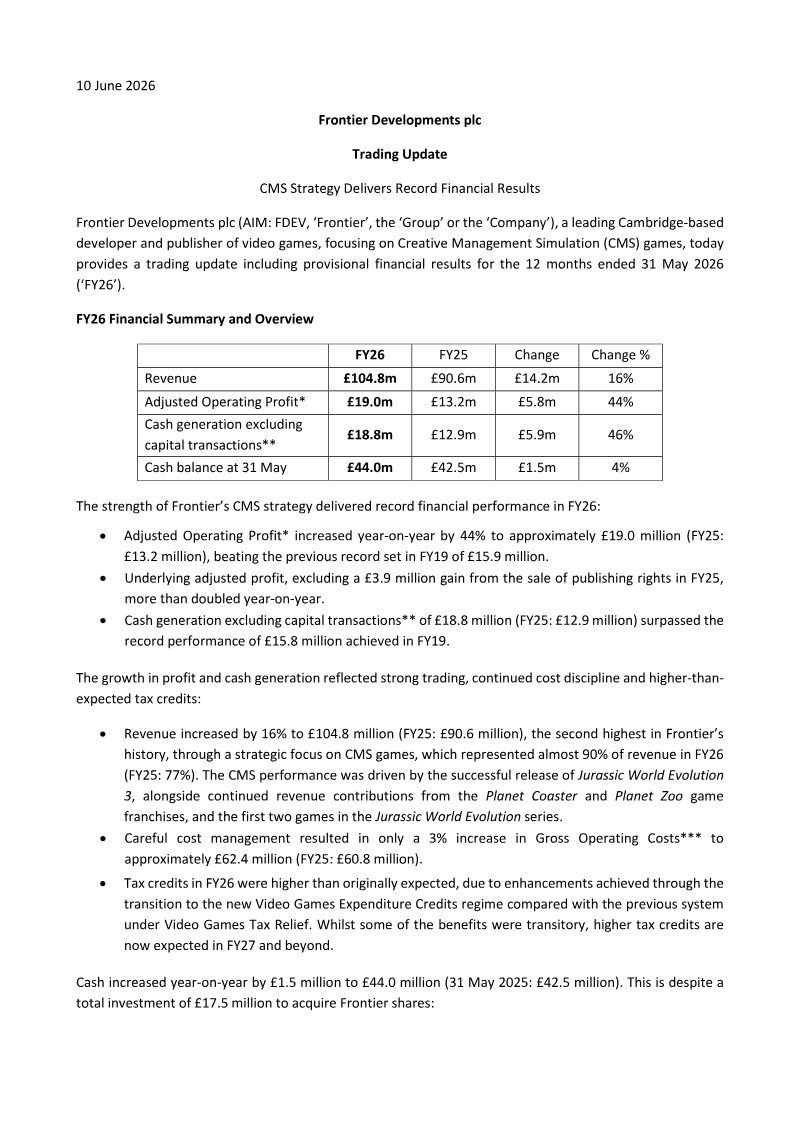
Trading Update: FY26
Frontier Developments achieved record financial results for the fiscal year ending 31 May 2026, driven by a strategic focus on the Creative Management Simulation (CMS) genre. The company reported a 16% increase in annual revenue to £104.8 million, while adjusted operating profit rose 44% to £19.0 million. This performance was bolstered by disciplined cost management, which limited gross operating cost growth to 3%, and favorable transitions to new video game tax credit regimes.
The company’s financial success is anchored in its CMS strategy, which accounted for nearly 90% of total revenue. Key contributors included the release of Jurassic World Evolution 3 and the sustained performance of the Planet Coaster and Planet Zoo franchises. Despite investing £17.5 million in share buybacks and employee benefit trust acquisitions, the company maintained a strong cash position of £44.0 million, reflecting a 4% year-on-year increase.
Looking ahead to FY27, the company maintains a positive outlook supported by a robust release pipeline. Upcoming titles include Planet Zoo 2, scheduled for October 2026, and Warhammer 40,000: Chaos Gate - Deathwatch. Furthermore, the company is developing a new, original CMS intellectual property for release in FY28. This strategy of launching one major CMS title annually, combined with ongoing support for existing evergreen franchises, is intended to ensure long-term, sustainable growth. The company remains confident in its ability to meet future performance expectations based on current engagement metrics and the strength of its upcoming portfolio.
- Frontier Developments achieved record FY26 results with £104.8 million in revenue, a 16% year-on-year increase, and a 44% rise in adjusted operating profit to £19.0 million.
- The Creative Management Simulation (CMS) genre is the company's primary growth engine, contributing nearly 90% of total annual revenue.
- Disciplined cost management limited gross operating cost growth to 3%, while the company maintained a strong cash position of £44.0 million despite £17.5 million in share buybacks and trust acquisitions.
- The company’s FY27 release pipeline includes Planet Zoo 2, scheduled for October 2026, and Warhammer 40,000: Chaos Gate - Deathwatch.
- Frontier Developments is developing a new, original CMS intellectual property targeted for release in FY28 to support its strategy of launching one major CMS title annually.
+2
Frontier Developments
Financial13 pages
FY25 H1 Results: Frontier Developments
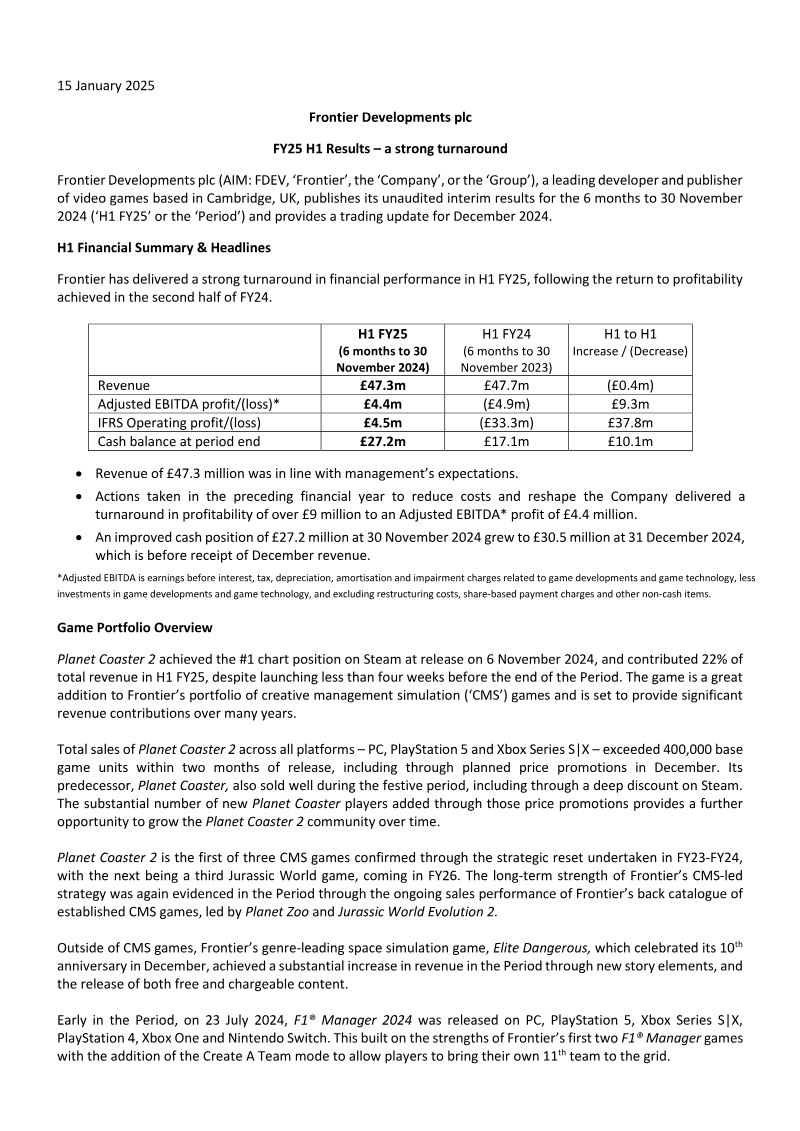
Frontier Developments plc reported a robust turnaround in its first half of FY25, with revenue of £47.3 million nearly matching the £47.7 million recorded in H1 FY24. Adjusted EBITDA swung from a loss of £4.9 million to a profit of £4.4 million, driven by a £9 million improvement in operating costs following an organisational review and the closure of Frontier Foundry. IFRS operating profit also reversed to £4.5 million from a loss of £33.3 million, largely due to reduced intangible amortisation and restructuring charges.
The portfolio’s performance was anchored by the launch of Planet Coaster 2, which captured 22% of total revenue and sold over 400,000 base units across PC, PS5, and Xbox within two months. Back‑catalogue CMS titles—Planet Zoo, Jurassic World Evolution 2, and the original Planet Coaster—contributed £24.6 million (52% of revenue) with a 97% sustain rate. Elite Dangerous saw increased PDLC sales, and F1® Manager 2024 added a new Create A Team mode. Paid downloadable content accounted for 31% of revenue, up from 29% in H1 FY24.
Cash reserves rose to £27.2 million at period end, climbing to £30.5 million by 31 December after the Planet Coaster 2 launch, supporting a positive cash‑flow outlook. The company projects FY25 revenue and profitability in line with expectations, citing continued growth from CMS titles and planned releases such as a third Jurassic World game in FY26.
- Frontier Developments achieved a significant financial turnaround in H1 FY25, swinging to an adjusted EBITDA profit of £4.4 million from a £4.9 million loss in the prior year.
- Operating costs decreased by £9 million following an organizational restructuring and the closure of the Frontier Foundry publishing label.
- Planet Coaster 2 was a primary revenue driver, contributing 22% of total H1 revenue and selling over 400,000 units within its first two months.
- The company's back-catalogue of CMS titles—Planet Zoo, Jurassic World Evolution 2, and the original Planet Coaster—remains a core pillar, generating £24.6 million and maintaining a 97% sustain rate.
- Revenue remained stable at £47.3 million, nearly matching the £47.7 million reported in H1 FY24, while paid downloadable content increased to 31% of total revenue.
+1
Frontier Developments
Financial29 pages
FY23 Financial Results: Frontier Developments
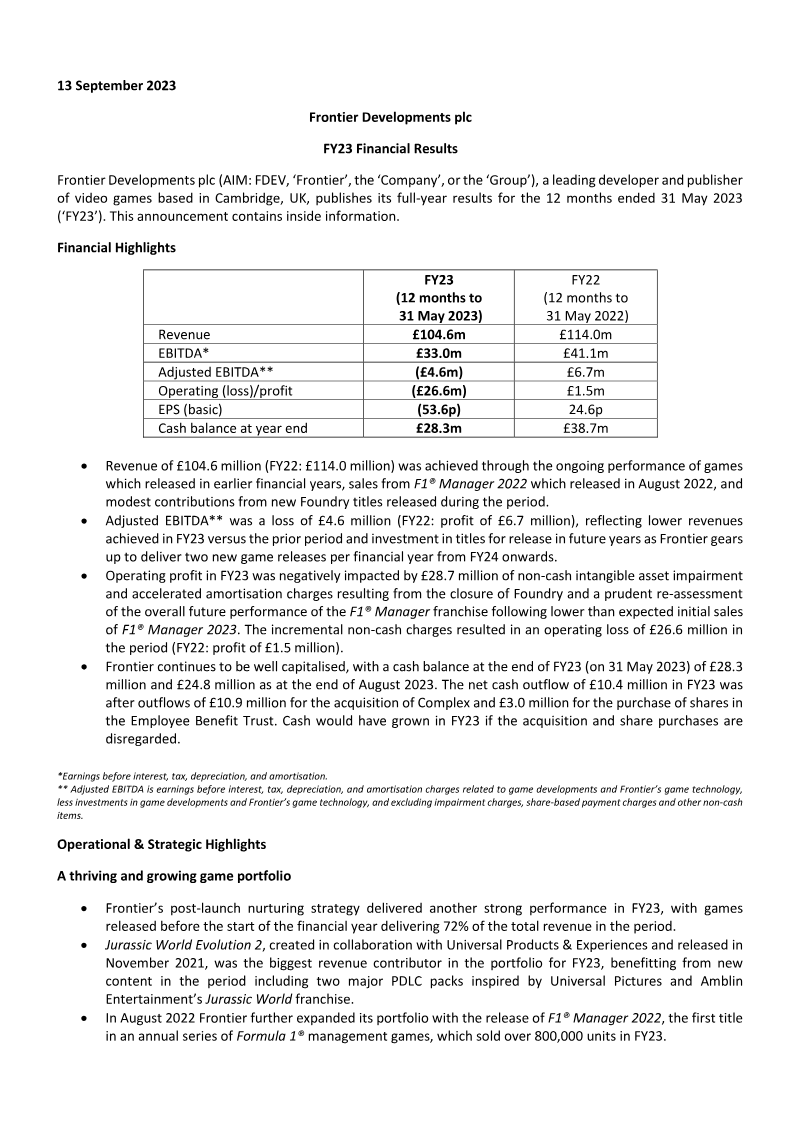
Frontier Developments plc (AIM: FDEV, ‘Frontier’, the ‘Company’, or the ‘Group’), a leading developer and publisher of video games based in Cambridge, UK, publishes its full-year results for the 12 months ended 31 May 2023 (‘FY23’). This announcement contains inside information.
- Frontier Developments reported a significant financial downturn in FY23 (ending May 31, 2023), with revenue decreasing to £104.6 million from £114.0 million in FY22, and an operating loss of £26.6 million compared to a £1.5 million profit in FY22.
- The company's Adjusted EBITDA shifted from a £6.7 million profit in FY22 to a £4.6 million loss in FY23, primarily due to lower revenues and increased investment in future game titles.
- A major factor contributing to the operating loss was £28.7 million in non-cash intangible asset impairment and accelerated amortisation charges, resulting from the closure of the Foundry publishing label and a re-assessment of the F1® Manager franchise's future performance.
- Sales of F1® Manager 2022 were below original expectations, and F1® Manager 2023's initial sales in July 2023 also underperformed compared to its predecessor, leading to a £15.0 million impairment charge against the franchise's intangible assets.
- Frontier has ceased acquiring new third-party titles for its Foundry label, refocusing all efforts on its internally developed game portfolio.
+2
Frontier Developments
Financial22 pages
FY23 Financial Results
The FY23 financial results show a contraction in revenue to £104.6 million, an 8 % decline from the previous year, driven largely by lower sales of the F1® Manager series. Adjusted EBITDA swung from a £6.7 million profit in FY22 to a £4.6 million loss, while the IFRS operating loss widened to £26.6 million. Non‑cash intangible charges of £28.7 million—primarily the closure of Foundry (£13.7 m) and a £15 million impairment on the F1® Manager franchise—were key contributors to the loss. Cash reserves fell from £38.7 million to £28.3 million, reflecting higher operating expenses and capitalised development costs.
The portfolio remains dominated by legacy titles, with 72 % of revenue generated from pre‑FY23 releases such as Jurassic World Evolution 2. New initiatives include the acquisition of Complex Games in November 2022 and the planned launch of Warhammer Age of Sigmar: Realms of Ruin, a real‑time strategy title slated for November 2023. The company has refocused on Creative Management Simulation games, closing Foundry and reallocating resources to two new CMS projects. Leadership reviews aim to improve return on investment.
For FY24, market consensus expects revenue of £108 million and an adjusted EBITDA loss of £9 million. The company anticipates that the new RTS release, alongside continued support for existing titles and undisclosed revenue streams, will offset the F1® Manager shortfall. The strategy shift toward core CMS titles and tighter cost management underpins confidence in returning to profitable performance over the medium term.
- FY23 revenue declined 8% to £104.6 million, driven primarily by underperformance in the F1® Manager series.
- The company reported an adjusted EBITDA loss of £4.6 million, a significant reversal from the £6.7 million profit recorded in FY22.
- Total operating losses reached £26.6 million, heavily impacted by £28.7 million in non-cash intangible charges, including a £15 million impairment on the F1® Manager franchise and £13.7 million from the closure of Foundry.
- Cash reserves decreased from £38.7 million to £28.3 million due to elevated operating expenses and capitalised development costs.
- Legacy titles released prior to FY23, such as Jurassic World Evolution 2, continue to drive the business, accounting for 72% of total revenue.
+4
Frontier Developments

Report96 pages
Annual Report and Accounts 2023
FRONTIER REALMS ANNUAL REPORT AND ACCOUNTS 2023 GROWING AND EVOLVING ANNUAL REPORT HEADLINES CONTENTS Frontier is a leading independent developer and publisher of video games See a summary of our progress in FY23 including 01 Headlines founded in 1994 by David Braben, co-author of the iconic Elite game.
- Frontier Developments PLC acquired Complex Games, developers of Warhammer 40,000: Chaos Gate – Daemonhunters, in November 2022, gaining expertise in turn-based strategy games.
- The company's gross research and development spend increased to £52.9 million in FY23, up from £47.5 million in FY22.
- Planet Zoo, released in 2019, is on its 15th PDLC pack (Oceania Pack, due September 2023) and supports animal conservation initiatives with partners like Edinburgh Zoo and San Diego Wildlife Alliance.
- Adjusted EBITDA (loss)/profit for FY23 was (£4,595k), a decrease from (£6,677k) in FY22.
- From FY24, the company will amortize other intangible assets more rapidly in the first 12 months post-release, which may negatively impact reported operating profit short-term but not Adjusted EBITDA.
+2
Frontier Developments
Financial18 pages
FY24 Interim Financial Results: 1 June 2023 to 30 November 2023
The interim financial results for the six‑month period ending 30 November 2023 demonstrate a mixed performance driven largely by strong back‑catalogue sales, particularly within the creative management simulation (CMS) segment. Total revenue fell 17 % to £47.7 million, with 72 % derived from pre‑period titles; CMS games contributed £26.3 million, representing 55 % of revenue and an 81 % sustain rate versus the previous year. New‑game launches underperformed, with F1 Manager sales down 34 % and Warhammer Age of Sigmar: Realms of Ruin missing launch targets. Gross profit declined 9 % to £33.0 million, while gross margin improved by six percentage points to 69 %. Operating costs rose modestly; research and development expense increased 1 % to £24.7 million, sales and marketing rose 21 %, and general & administrative costs grew 2 %. Adjusted EBITDA swung to a loss of £4.9 million from a £0.6 million profit in the prior period, largely due to higher operating costs and lower revenue.
Cash balances stood at £17.1 million on 30 November, down from £19.9 million at year‑end, reflecting ongoing investment in development and restructuring. An organisational review announced in October targets a 20 % reduction in annual operating costs, with phase one completed and phase two slated for February. The company maintains FY24 revenue guidance of £80‑95 million and an adjusted EBITDA loss target of £9 million, achievable at the upper end of the revenue range.
Geographically, the results cover the UK‑listed Frontier Developments plc; time coverage is H1 FY24 (June–November 2023). Methodology relies on standard IFRS accounting, with adjustments to derive adjusted EBITDA excluding restructuring, impairment and share‑based payments. The report underscores a strategic pivot toward CMS titles across FY25‑27, with planned console releases of two PC games and an own‑IP CMS title in FY25.
- Frontier Developments reported a 17% revenue decline to £47.7 million for H1 FY24, with adjusted EBITDA swinging to a £4.9 million loss compared to a £0.6 million profit in the prior period.
- The company is pivoting its strategy toward Creative Management Simulation (CMS) titles, which accounted for 55% of total revenue and maintained an 81% sustain rate year-over-year.
- Financial performance was heavily reliant on back-catalogue sales, which generated 72% of total revenue, while new launches underperformed, specifically F1 Manager (down 34%) and Warhammer Age of Sigmar: Realms of Ruin.
- To address rising costs and declining profitability, the company initiated an organisational review targeting a 20% reduction in annual operating costs, with the second phase scheduled for February 2024.
- Gross profit fell 9% to £33.0 million, though gross margin improved by six percentage points to 69% despite increased sales and marketing expenses.
+3
Frontier Developments
Financial20 pages
FY24 Financial Results
The FY24 financial results demonstrate a strategic pivot toward core creative management simulation (CMS) titles, yielding a 15 % revenue decline to £89.3 million but an improved gross margin of 69 %. Cost‑of‑sales fell by 25 % to £28.0 million, while research and development spending dropped 12 % to £45.0 million, supporting a 9 pp increase in gross margin versus FY23. Operating expenses were trimmed by 9 % to £65.3 million, largely through a 20 % reduction in annual operating costs following an organisational review that re‑shaped teams and eliminated redundant functions. The sale of the RollerCoaster Tycoon 3 publishing rights generated a £4.9 million gain, contributing to an adjusted EBITDA of £0.9 million for the year and a return to profitability in H2, where adjusted EBITDA rose from a loss of £4.0 million (H1 FY23) to a profit of £5.8 million (H2 FY24). Cash balance increased from £28.3 million to £29.5 million, reflecting stronger cash flow generation.
Geographically the portfolio remains UK‑centric with releases across PC, PlayStation 5 and Xbox Series X/S platforms. The fiscal period covers FY24 (April 2023‑March 2024) and includes a detailed half‑year comparison. Methodology relies on adjusted EBITDA, excluding non‑cash items such as IAS 38 amortisation and impairment charges, restructuring costs, and share‑based payments. The report highlights a robust pipeline featuring Planet Coaster 2 (autumn 2024) and a third Jurassic World game slated for FY26, underpinning confidence in achieving £88 million revenue and profitability targets for FY25.
- The company returned to profitability in H2 FY24 with an adjusted EBITDA of £5.8 million, a significant recovery from the £4.0 million loss recorded in H1 FY23.
- Revenue declined 15% to £89.3 million as the company pivoted toward core creative management simulation (CMS) titles.
- Gross margin improved by 9 percentage points to 69%, driven by a 25% reduction in cost-of-sales to £28.0 million.
- Operating expenses were reduced by 9% to £65.3 million, supported by a 20% cut in annual operating costs following an organisational restructuring.
- The sale of RollerCoaster Tycoon 3 publishing rights generated a £4.9 million gain, helping to bolster the year-end cash balance to £29.5 million.
+4
Frontier Developments