This industry analysis provides a mid-2026 update on the mobile game user acquisition (UA) landscape, focusing on shifting creative trends, network performance, and monetization strategies. The primary thesis emphasizes that successful UA in the post-IDFA era relies less on channel diversification and more on format depth—specifically the strategic use of playable ads—and the integration of hybrid monetization models.
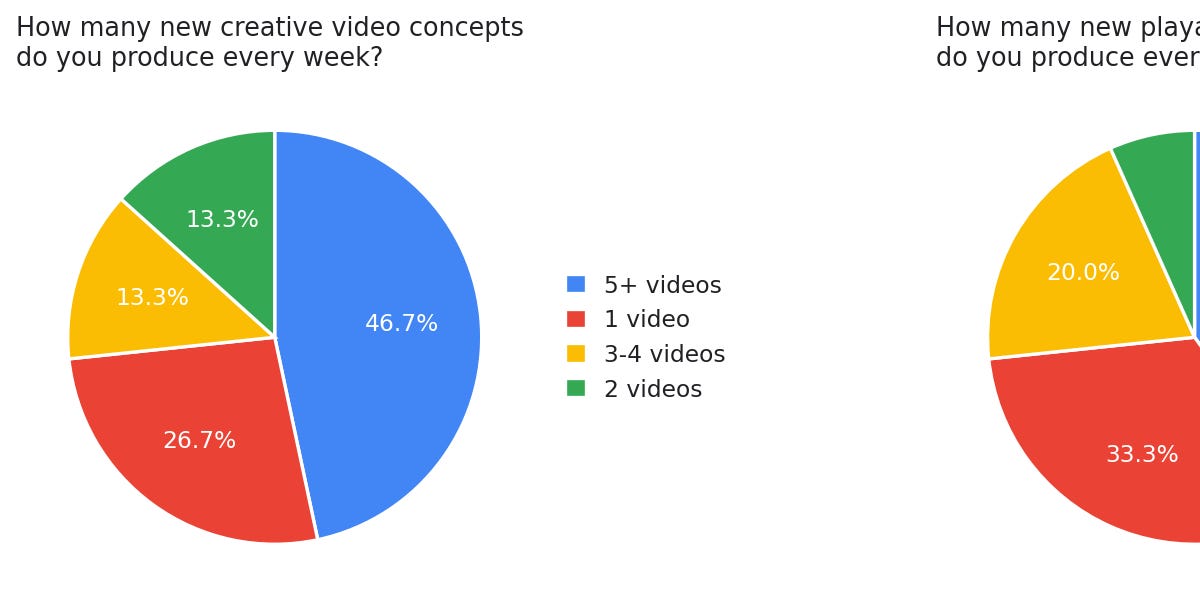
Key findings from the H1 2026 UA Landscape Survey indicate that while UA teams frequently manage over ten channels, budgets remain heavily concentrated within Meta, Google, and AppLovin. Notably, AppLovin has emerged as the leading iOS channel. A significant portion of the industry, roughly 53%, reports zero spend on TikTok, suggesting a broader struggle with measurement and attribution across secondary networks. The analysis highlights that successful scaling is increasingly driven by AI-generated creative pipelines, with top-performing studios producing thousands of ads monthly to maintain engagement and optimize transitions into gameplay.
Methodologically, the insights are derived from industry-wide survey data and performance observations of major mobile titles. The analysis advocates for a structured UA sequence: prioritizing format depth (statics, videos, and playables) before expanding into SDK networks, provided that measurement infrastructure is robust. Furthermore, the report identifies revenue mix diversification—specifically the adoption of hybrid IAA and IAP models—as a critical de-risking strategy for developers. The findings suggest that the competitive advantage in the current market belongs to studios capable of high-volume creative production and efficient, data-driven LiveOps, rather than those relying on larger teams or increased budgets.
The August 2026 analysis of mobile game advertising highlights the shifting role of playable ads, which have transitioned from supplementary creative assets to the foundational elements of user acquisition strategies. As mobile gaming platforms increasingly rely on SDK networks and automated creative workflows, the industry is moving toward higher-volume, AI-driven production methods to maintain competitive performance.
Key trends identified for August 2026 emphasize the importance of cultural relevance and technical innovation. Advertisers are successfully leveraging broader market hype—such as the anticipation surrounding major console releases—to capture user interest through thematic alignment. Furthermore, creative teams are moving beyond basic core-mechanic recreations by introducing experimental variations that enhance user engagement. A significant development is the emergence of AI-driven "vibe coding," which allows for the generation of complex, interactive ads without manual coding. This shift enables teams to iterate rapidly, running multiple concepts in parallel to optimize performance.
The analysis underscores that the era of simple, static 2D tap-and-click playables is being superseded by sophisticated, automated workflows. By integrating AI tools into the development process, studios can achieve the necessary creative volume to succeed in modern video-led funnels. These findings suggest that the future of mobile user acquisition lies in the ability to balance core gameplay loops with rapid, AI-assisted experimentation to keep pace with evolving audience expectations.
This analysis provides insights into mobile game user acquisition (UA) and creative strategy, focusing on current trends in the post-IDFA landscape as of September 2026. The primary objective is to offer actionable advice for UA managers and developers regarding ad billing models, creative testing, and emerging platform features.
A key finding centers on the dual-billing strategy for AppLovin, where advertisers are increasingly utilizing both CPM and CPI models. Data indicates that 44% of games now employ CPM billing, representing a 5.7x year-over-year increase. Advertisers who integrate CPM alongside existing CPI campaigns see a median total spend increase of 22%, demonstrating that CPM acts as an additive scale dial rather than a cannibalizing force. The analysis suggests that 63% to 79% of spend in these dual-billing setups targets the same creative assets, allowing campaigns to compete effectively across different inventory pools.
The scope of the analysis covers the global mobile gaming market, with specific observations on Meta’s ad inventory. Notably, interactive playable ads have been identified in the Reels placement, a significant shift from the previous video-only format. Advertisers are encouraged to prepare vertical MRAID builds to capitalize on this potentially cost-effective, high-growth inventory. Additionally, the analysis highlights the role of AI in creative production, noting that simple, high-volume creative testing—such as the "cat-themed" idle RPG trend—remains highly effective for driving acquisition.
Methodologically, the insights are derived from industry observations, performance data from specific game titles, and professional experience in managing UA campaigns. The findings emphasize that while AI and automated bidding tools are essential for modern growth, success remains contingent on rigorous testing and the strategic layering of different billing models to maximize return on ad spend.
The mobile game industry is currently exploring new monetization and retention strategies through Almedia’s LINK, a platform that incentivizes players to remain active by offering rewards funded entirely by the service provider. The primary thesis is that by integrating a rewards-based layer into existing game titles, publishers can generate incremental revenue from their current user base without increasing user acquisition costs or introducing intrusive ad formats. The model functions by paying developers a cost-per-acquisition (CPA) for every player who links their account to the rewards platform, regardless of whether the user is new or existing.
Key performance data from early adopters, such as the publisher Ovivo, indicates significant potential for this model. Across 24 titles, the integration achieved a 15% install-to-link conversion rate, resulting in 66,000 links between October and December 2025. Furthermore, linked users demonstrated a 28% increase in day-21 retention and a 5% increase in day-30 ad revenue compared to non-linked users. Financial projections suggest that a game with 100,000 monthly installs could generate between $45,000 and $75,000 in additional monthly revenue through this channel.
The implementation process is designed for flexibility, allowing developers to integrate the service via a lightweight SDK or through a simpler, non-SDK method involving basic API calls and deeplinks. While the platform is currently active in 16 markets, including major Tier 1 and select Tier 2 regions, developers are advised to utilize A/B testing and holdout groups to verify the actual lift in lifetime value and ensure the rewards mechanism does not cannibalize existing in-app purchase revenue. By focusing on long-term engagement rather than one-off incentives, the model aims to create a sustainable economic flywheel for both the publisher and the rewards platform.
This analysis provides actionable guidance for mobile game user acquisition (UA) managers, focusing on campaign structure, geographic segmentation, and the evolving role of playable advertisements in the post-IDFA landscape. The core thesis emphasizes that granular control over spend and creative strategy is essential for maintaining profitability, as automated worldwide campaigns often lead to inefficient spending and wasted attribution fees on low-monetizing regions.
Key findings highlight that effective UA requires a tiered geographic approach rather than a "one-size-fits-all" worldwide strategy. For mid-core and IAP-driven games, a three-bucket structure—Tier 1 (high LTV/high CPI), Tier 2 (solid LTV), and Tier 3 (volume-focused)—is recommended, with specific exclusions for regions where attribution costs exceed potential revenue. For ad-monetized casual games, these tiers shift to prioritize eCPM-driven markets, while strategy and RPG titles require more complex, multi-campaign setups to account for the distinct LTV profiles of Asian and Gulf markets.
The analysis further identifies a significant shift in creative trends, with playable ads now accounting for 40% to 60% of creative spend. The integration of AI in playable production has enabled rapid iteration, allowing developers to test various mechanics and art styles systematically. Notably, Meta’s Reels placement has quietly begun supporting interactive playables, presenting a significant opportunity for advertisers to capture early, cost-effective inventory.
Methodologically, these insights are derived from industry-wide observations, real-world account performance data, and comparative analysis of UA metrics across major platforms like Meta and AppLovin. The findings underscore that successful UA management is a dynamic process requiring quarterly adjustments based on localized LTV data and evolving platform capabilities.
This industry analysis provides a mid-2026 update on mobile game user acquisition (UA) strategies, emphasizing the shift toward playable ads and the dominance of specific ad networks. The primary thesis posits that playable ads have transitioned from a niche creative format to the essential backbone of successful UA campaigns, particularly when integrated into video-led funnels and AI-driven workflows.
Key findings indicate a significant shift in iOS ad spend, with AppLovin emerging as the primary platform for 40% of surveyed respondents, surpassing Meta’s 33% share. This trend is attributed to the effectiveness of AppLovin’s Axon engine and the increasing necessity of a robust playable pipeline. Data suggests that for the most active teams, playable ads now account for 40% to 60% of total creative budgets. Furthermore, evidence suggests that interactive playable ads are beginning to appear in Meta’s Reels placement, signaling a potential expansion of inventory for advertisers who prioritize vertical MRAID builds.
The analysis covers the global mobile gaming landscape as of September 2026, focusing on UA managers, indie developers, and CMOs. The methodology relies on industry survey data, comparative performance metrics from recent game launches, and observational analysis of ad placement trends. The findings underscore that while traditional static and video assets remain relevant, the integration of AI-generated content and interactive playables is now critical for maintaining competitive CPIs and ROAS. The report concludes that successful monetization in the current market requires a combination of optimized level pacing, aggressive creative testing, and the strategic use of unified platforms for LiveOps and CRM.
The H1 2026 Brutally Honest User Acquisition Report provides a pragmatic assessment of the mobile gaming landscape, focusing on shifting channel efficacy and evolving creative strategies. By synthesizing real-world campaign data with insights from 115 industry professionals, the analysis aims to move beyond superficial industry trends to offer actionable intelligence for UA managers. The participants represent a diverse spectrum of the market, with annual advertising budgets ranging from $50,000 to over $70 million, ensuring the findings reflect both boutique and large-scale operational realities.
Key observations for the first half of 2026 highlight a significant transformation in how budgets are allocated. Playable advertisements have emerged as a dominant force, consuming a larger share of creative budgets as developers prioritize interactive engagement. Simultaneously, the report identifies a notable shakeup within the mobile measurement partner (MMP) ecosystem and confirms the continued momentum of rewarded user acquisition. Conversely, the data reveals that at least one previously utilized advertising channel has experienced a complete decline, signaling a shift in platform viability.
The analysis emphasizes the integration of AI and automation as critical components of modern UA workflows, while also documenting the primary concerns currently facing industry practitioners. By framing the provided percentages as directional indicators rather than absolute certainties, the report maintains a grounded, analytical perspective. Ultimately, the findings serve as a strategic guide for navigating the complexities of modern mobile game marketing, emphasizing the necessity of data-driven decision-making in an increasingly volatile digital environment.
This industry newsletter provides actionable insights into mobile user acquisition (UA) and creative strategy in a post-IDFA environment. The primary thesis emphasizes that success in modern UA relies on rigorous funnel configuration and data-driven creative testing rather than simple reward-based incentives. By analyzing a dataset of 12 million installs and approximately 3,000 campaigns, the findings indicate that the number of progression steps and the timing between them are the strongest predictors of quality, showing a correlation of +0.51 with S5+ rates, whereas reward value shows negligible impact.
The analysis highlights a critical shift in Meta’s ad inventory, noting that the Reels placement has quietly introduced interactive, playable ads. This development suggests a significant opportunity for advertisers to leverage vertical MRAID builds to capture lower-cost inventory. Furthermore, the content examines the performance of mid-core RPGs, specifically citing a case study of a title generating $100,000 daily. This success is attributed to a diversified channel mix—moving beyond traditional Facebook and Unity placements into AppLovin—and a high-volume creative strategy that produced 2,700 assets in 30 days.
Methodologically, the insights are derived from personal game performance data, industry benchmarks, and proprietary playbooks. The guidance for operators is to map 8 to 12 meaningful progression events, ensuring the second step occurs within 8 to 13 hours of installation and the fifth step by day 2.5. The newsletter concludes that failing to maintain a sufficiently long funnel—reaching at least 75% of the break-even window—is a configuration error that undermines the ability to accurately assess channel performance.
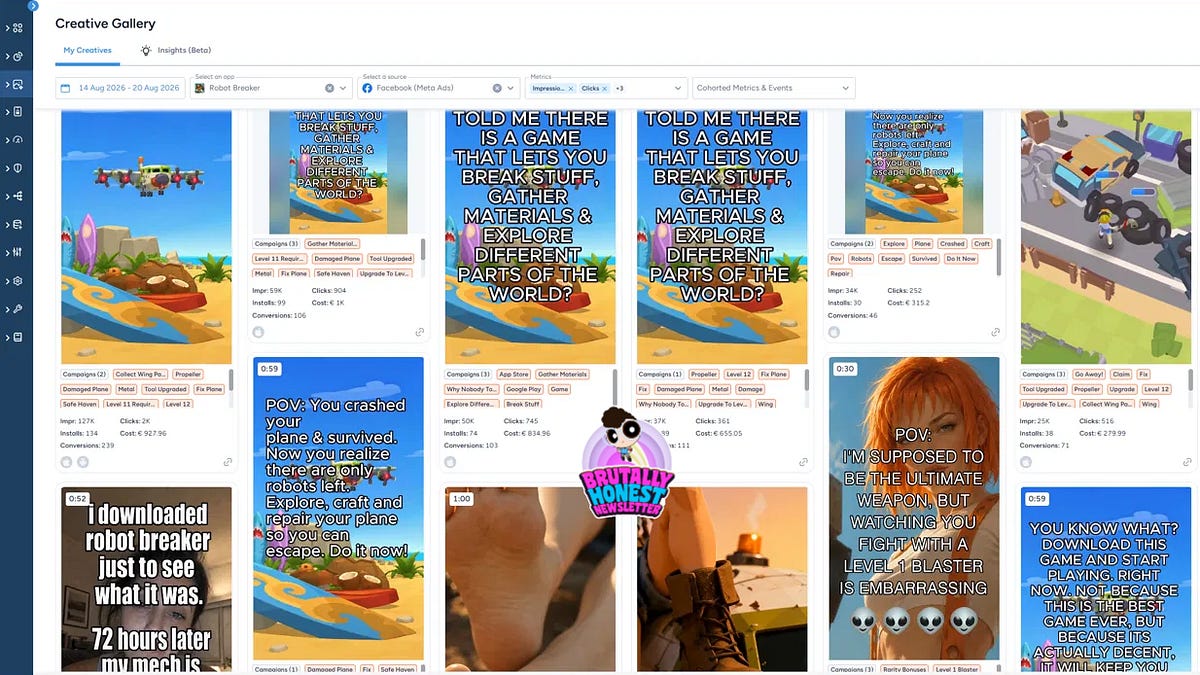
The primary purpose of this analysis is to demonstrate how granular creative performance data can inform user acquisition (UA) strategy and production cycles. By examining 360 unique creatives over a 30-day period for the mobile game Robot Breaker, the analysis highlights the critical distinction between high-conversion metrics, such as Install Per Mille (IPM), and actual business profitability, measured by Day 1 Return on Ad Spend (ROAS). The central thesis posits that relying solely on algorithmic engagement metrics is insufficient; instead, marketers must synthesize creative-level revenue data with visual performance tags to identify which concepts warrant further investment.
The study covers a €41k spend across four major networks, resulting in 6,342 installs and a blended IPM of 3.80. Key findings reveal a significant mismatch between engagement and ROI: while playables achieved an IPM of 21.75—vastly outperforming video at 2.75—they did not always correlate with the highest financial returns. For instance, on Facebook, plane-led creative concepts yielded a 46% D1 ROI compared to 36% for character-led ads, despite the latter having a higher IPM. Furthermore, the analysis identifies that animated-real footage blends consistently underperformed, suggesting that production resources should be reallocated toward proven, high-ROI formats like character-led playables for AppLovin and plane-led, 40-60 second animated videos for Facebook.
Methodologically, the analysis utilizes an automated creative intelligence dashboard to tag visual elements, such as dominant subjects and video hooks, without manual input. This approach allows for the identification of specific creative patterns that drive both algorithmic favorability and actual revenue. The conclusion emphasizes that effective UA management requires a disciplined, data-driven approach to production, where creative brainstorming is limited to iterating on proven winners rather than testing random concepts.
This industry newsletter provides expert analysis on mobile user acquisition (UA) and creative strategy, focusing on the evolving landscape of playable ads and monetization in the post-IDFA era. The primary thesis emphasizes that playable ads have transitioned from a secondary format to a foundational element of high-performance UA, particularly when integrated into video-led funnels and AI-driven creative workflows.
Key findings highlight the emergence of interactive playable ads within Meta’s Reels inventory, a significant development for advertisers given the platform's scale. The analysis also examines the success of the idle RPG title XP Hero, which generates approximately $500,000 in daily revenue through a combination of aggressive ad placements and creative arbitrage. By adopting and adapting successful 4X strategy game creatives, the developers achieved high-volume output—producing roughly 1,300 creatives in three days—demonstrating the efficacy of AI-assisted production and cross-genre creative borrowing.
The scope of the analysis covers global mobile gaming trends as of August 2026, with a specific focus on tier-one traffic markets. The methodology relies on professional observation, industry case studies, and performance data from platforms like AppLovin and Mintegral. The content serves as a strategic guide for CMOs and UA managers, advocating for the use of specialized tools such as Kinoa for real-time LiveOps and Layer.ai for iterative creative development. Ultimately, the industry outlook suggests that success in 2026 requires a rigorous, data-backed approach to creative volume and the strategic integration of interactive ad formats to maintain competitive growth.
This industry analysis focuses on optimizing user acquisition (UA) and creative strategies within the mobile gaming sector as of August 2026. The primary thesis emphasizes that successful scaling requires a disciplined approach: validating product economics through small-scale testing before aggressively increasing spend. By prioritizing retention and monetization metrics over initial cost-per-install (CPI) figures, developers can identify products truly deserving of scale, avoiding the common pitfall of scaling too slowly once a winner is identified.
Key findings highlight the evolving relationship between CPI and lifetime value (LTV). Contrary to the assumption that scaling always increases acquisition costs, data suggests that CPI can remain stable or even decrease during aggressive growth phases if the underlying product economics are sound. The analysis also underscores the critical importance of creative volume, noting that top-performing titles often fail to scale effectively due to insufficient creative iteration. For instance, a title generating significant daily revenue may still underperform long-term if it fails to maintain a high volume of fresh, unique ad concepts to combat audience fatigue.
The scope of this analysis covers the global mobile gaming market, with specific attention to trends in playable ads and the integration of AI-driven workflows. The methodology relies on industry observations, case studies of specific titles like Bus Traffic Fever, and expert commentary on UA performance. The findings conclude that the most effective growth strategy involves a "traffic credit card" mentality—protecting cash during the validation phase and then rapidly capturing profitable traffic once the model is proven. This approach, supported by robust LiveOps and creative testing, remains essential for navigating the complexities of the post-IDFA mobile advertising landscape.
The July 2026 analysis of playable ad trends highlights the transition of interactive advertisements from secondary creative assets to the primary foundation of mobile user acquisition strategies. As the industry shifts toward video-led funnels and AI-driven creative production, playable ads have become essential for scaling campaigns across SDK networks, particularly within the Applovin ecosystem. The core thesis posits that successful user acquisition now relies on high-volume, diverse creative mechanics that prioritize immediate engagement over traditional app-store-style representation.
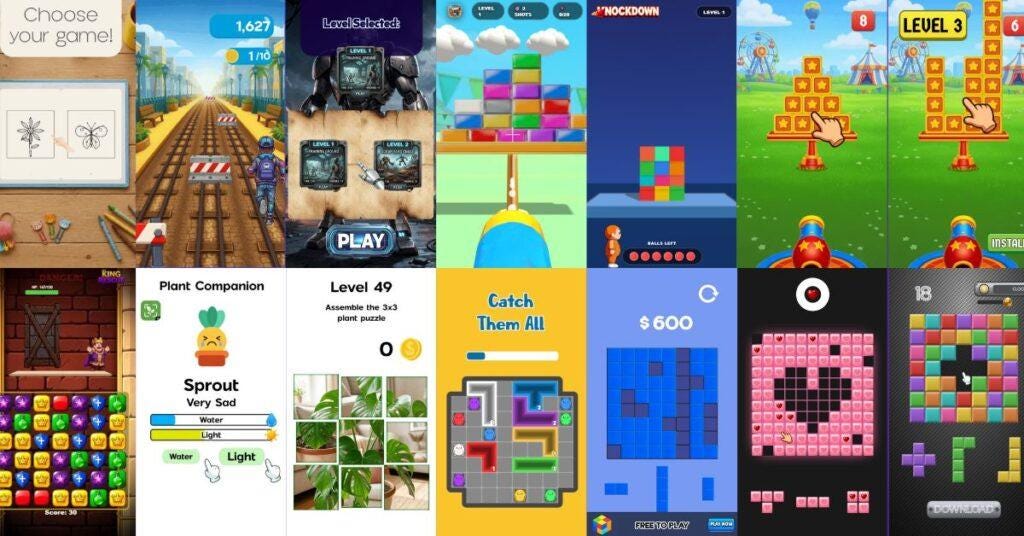
Key findings from the July period identify three primary strategic shifts in playable design. First, developers are increasingly looking outside the mobile gaming sector for inspiration, successfully adapting familiar, non-gaming mechanics—such as the Tetris-style logic used in defensive strategy puzzles—to broaden audience appeal. Second, there is a notable trend of integrating culturally relevant, non-gaming themes, such as football-inspired interactions, into disparate game genres to create a sense of familiarity and freshness. Finally, the analysis emphasizes the efficacy of multi-mechanic games, which allow publishers to isolate specific, satisfying gameplay loops for individual ads rather than attempting to represent the entire app experience in a single interaction.
This assessment reflects the broader evolution of the mobile gaming landscape in mid-2026, where the ability to rapidly iterate on diverse, tutorial-friendly mechanics provides a distinct competitive advantage. By focusing on granular, highly engaging mini-game experiences, publishers can effectively lower barriers to entry and improve conversion rates, moving away from rigid, genre-specific templates toward a more fluid and experimental approach to creative development.