2015
Company
Documents about 2015
Current and Future Opportunities for 3D Printing in Modern Board Games
3D printing, or additive manufacturing, is examined here as an emerging force in modern board games, where its current use is driven largely by hobbyists rather than publishers.
- Hobbyists, not publishers, currently drive 3D printing in board games: community members create and share models mainly for customization and organization, while designers and publishers are only beginning to use the technology for prototyping.
- Quality, durability, material range, copyright concerns, and high per-part costs are identified as the main barriers to mass production of 3D-printed board game components.
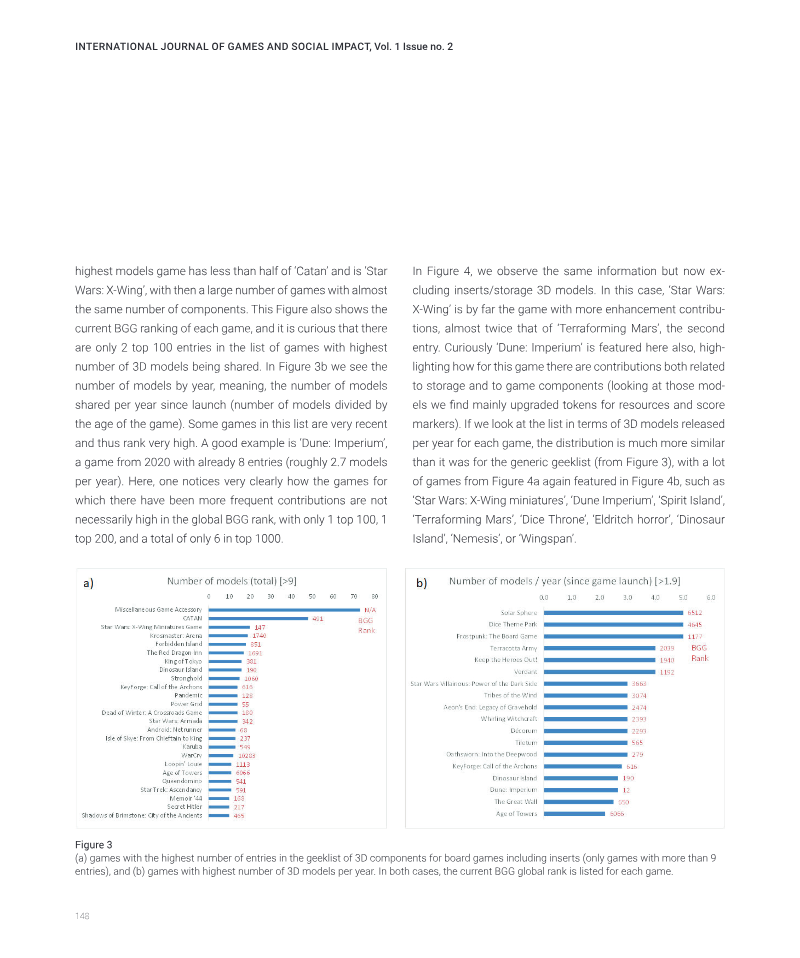
- Of roughly 3,013 available 3D board game models on BoardGameGeek, only about 377 (around 12.5 percent) are non-insert upgrade components, with storage and organization inserts making up the large majority.

"Public Interest" and the (Potential) Social Impact of Board Games: The Role of the "Strategic Twist", Definition and Scope
Paulo Antunes's paper examines the "strategic twist" in modern board game design and asks whether this shift carries significance for the public interest.
- The paper defines the 'strategic twist' along two dimensions: the orientation of games toward strategic play, and the strategic transformation of the surrounding games milieu.
- The author's central thesis is that board games can have social impact, but only if that impact is realized through community participation, production conditions, and fostering critical, participatory culture.
- The analog games industry shifted after the post-Catan renaissance from pure randomness and player elimination toward strategy, control, and meaningful player choice, which the author frames as dialectical evolution rather than rupture.
How Rusty Lake's 'Immersive Puzzle' Worlds Sell Millions
The success of independent studio Rusty Lake demonstrates how niche, atmospheric puzzle games can achieve massive scale through consistent world-building and community engagement.
- Rusty Lake has achieved over 75 million lifetime downloads across 15+ titles since 2015, successfully transitioning from free-to-play mobile origins to a premium-focused business model.
- PC platforms now drive 60% of Rusty Lake's premium sales, significantly outpacing mobile's 35% share.
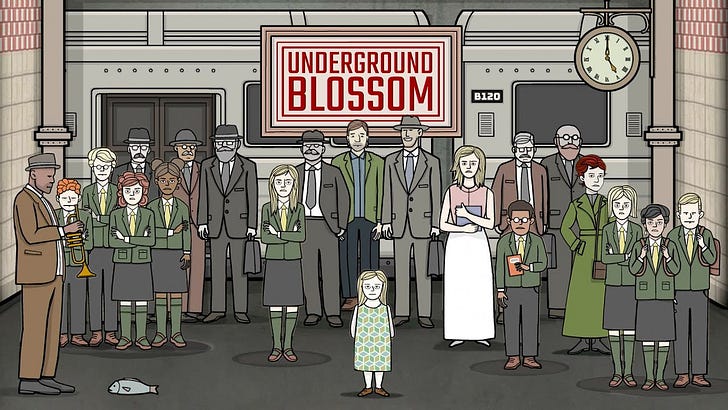
- The studio’s recent releases demonstrate strong commercial viability for short-form narrative puzzles, with 'The Past Within' exceeding one million Steam units and 'Underground Blossom' selling 250,000 units in its first month.

Three Questions to: Tiny Roar on Their Partnership with AONIC
The Hamburg-based game development studio Tiny Roar, founded in 2015, has entered into a strategic partnership with the Swedish investor AONIC, which has become the studio’s majority shareholder.
- Swedish investor AONIC has become the majority shareholder of the Hamburg-based indie studio Tiny Roar as of July 2023.
- The partnership provides Tiny Roar with financial stability and access to an in-house publishing division within the AONIC collective.
- The deal allows Tiny Roar to shift its focus toward longer development cycles and increased budgets, moving away from the need to prioritize short-term survival projects.
Translating Witcher: Investigating Conflict and Cooperation Between Localization Industry and Gaming Communities
This paper examines the tension and collaboration between fan communities and the game localization industry, using the Turkish localization of CD Projekt Red's Witcher series as a case study.
- The study uses the Turkish localization of CD Projekt Red's The Witcher series as a case study, drawing on Henry Jenkins' concept of fan poaching and frameworks of fan productivity and free labour to argue that gaming communities substantively shape localization practices.
- The first two Witcher games (2007 and 2011) were fan-translated in cooperation with the developer, which supplied documentation and script files, whereas The Witcher 3: Wild Hunt (2015) was localized by the professional studio 23 Studios after release without Turkish support.
- Community reaction to the official Witcher 3 Turkish translation was markedly negative, driven by practical objections such as replacing accepted terminology with more domesticated language and by a sense of betrayal that fans were bypassed despite their advocacy.
Building and Rebuilding the Anthropocene in Cities: Skylines
This paper examines the city-building game Cities: Skylines (Colossal Order, 2015) through an ecocritical lens, arguing that the genre reveals the forms of power driving the climate crisis.
- The paper argues that Cities: Skylines (Colossal Order, 2015) appears to offer omniscient control over city planning, but beneath this fantasy lies an ecological power in which growth and capitalist logics destabilise environments and ecosystems.
- Drawing on Eugene Thacker's 'world-without-us' concept, the analysis shows the game's pristine opening landscapes invite players to turn an impersonal planet into a personalised 'world-for-us' through civic construction.
- The central finding is that the game reproduces contemporary patterns of ecological power rather than offering alternatives, channelling players toward unsustainable and destructive engagements with nature.
Breaking Character: Contesting Marginalisation Through Critical Bricolage
Rob Gallagher's paper examines how artists have appropriated characters from mainstream videogame franchises to comment on marginalisation, gendered representation, and the limits of player agency.
- Gallagher argues that artists such as Cassie McQuater (browser game Black Room, 2018) and Tabitha Nikolai (collage series Character Select Screen, 2015) reframe Capcom's Street Fighter character Cammy to expose gaming culture's misogyny and cisheteronormativity while opening her to feminist, queer, and trans readings.
- McQuater turns Cammy's attack animations into ornamental, non-playable gestures, freeing the character from the control of presumptively male players, though this shift can itself read as objectification.
- Nikolai frames Cammy's brainwashed-clone backstory as a vessel for a masculine consciousness, a move the paper reads as surfacing trans resonances and the anxieties games encode around passivity and control.
A Typology of Videogame Rewards
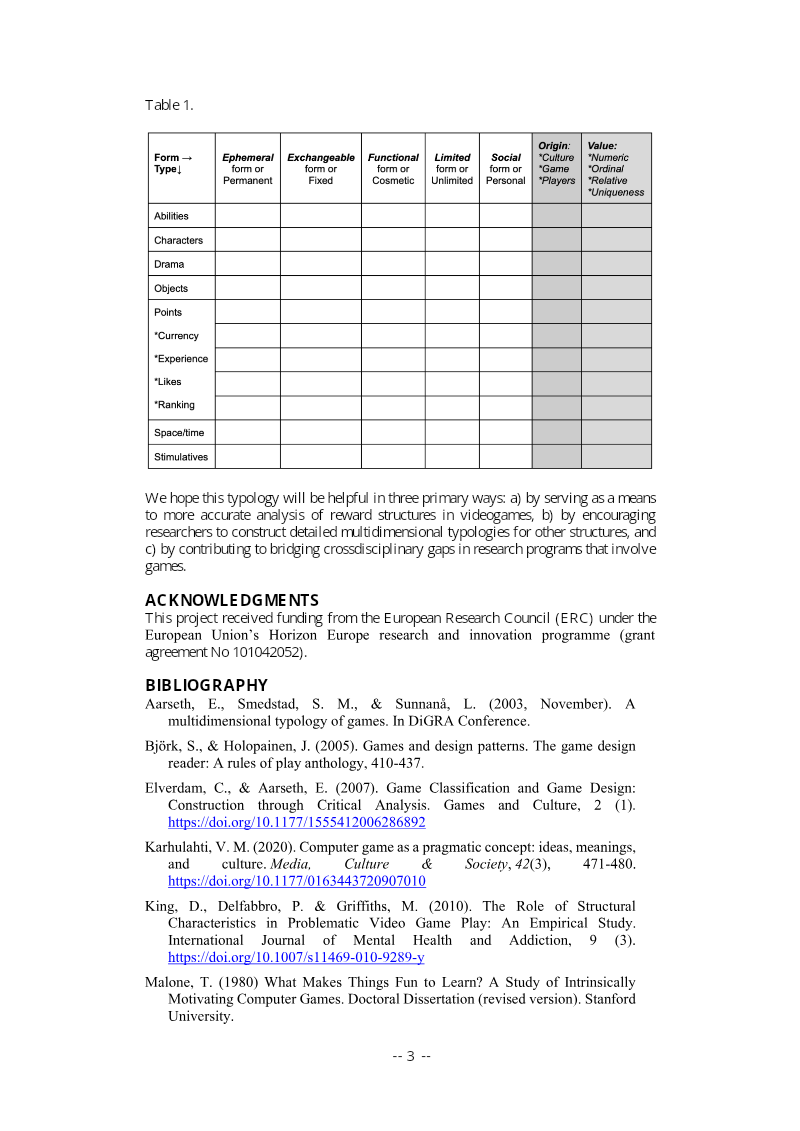
Karhulahti and Aarseth propose a multidimensional typology of rewards in videogames, aiming to provide a more comprehensive structural framework than earlier classifications.
- Karhulahti and Aarseth propose a multidimensional typology of videogame rewards, arguing that holistic game taxonomies become unwieldy, so they focus on the single structural level of rewards.
- The typology rests on four dimensions: seven basic reward types (abilities, characters, drama, objects, points with four subtypes, space/time, and stimulatives), form, origin, and value.
- Form is described through five paired categories (ephemeral or permanent, exchangeable or fixed, functional or cosmetic, limited or unlimited, social or personal), each with further subfeatures.
Super Memory Makers: Livestreaming and/as Videogame Play Archives
This paper examines livestreamed and player-produced gameplay of Super Mario Maker as a source of "incidental archives" of videogame play, using the game's rise and eventual decline as its case study.
- The paper argues that the vast volume of high-performance content in Super Mario Maker, such as speedruns and virtuosic feats, risks obscuring the more exploratory, autotelic forms of play the game encourages, producing a distorted historical record of how the game was actually played.
- Super Mario Maker launched on the Wii U in September 2015, with Nintendo reporting 2.2 million player-created courses within the first month and 7.2 million within eight months.
- Nintendo discontinued the upload features of the original Super Mario Maker in March 2021, while existing courses remained accessible at the time of writing, raising questions about what happens to player-produced content once a service ends.
Polarized Pills vs. Gaming Thrills: Empirical Exploration of r/TheRedPill and r/TheBluePill Users in r/gaming
This study examines how users active in the manosphere subreddits r/TheRedPill and r/TheBluePill participate in the general gaming community r/gaming, with the aim of determining whether this crossover reflects political activism or simply entertainment.
- Users from r/TheRedPill and r/TheBluePill participate in the general gaming community r/gaming at notable rates: roughly a quarter of r/TheRedPill users and nearly a third of r/TheBluePill users also commented there, while only 1,131 users were active in all three communities, which the authors read as evidence of meaningful boundaries between them.
- Gender issues are a shared focus for both manosphere communities, but r/TheRedPill commenters use aggressive, delegitimizing rhetoric and frame gaming mainly as a front in a broader political culture war, linked chiefly to gender and to society and economics.
- r/TheBluePill commenters engage in more ambiguous, meme-oriented discussion with a notably higher tendency toward humor, and their concerns center on perceived injustices in gaming such as monetization and predatory market practices.



First Impressions: Effects of Representation on Video Game Covers
This study examines how representation on digital video game covers shapes players' first impressions and, in turn, their purchasing and consumption decisions.
- Players of color felt significantly less represented by characters on game covers than white participants did (mean 2.06 vs. 3.74 for at least one character; 1.82 vs. 3.40 for many characters), even though both groups rated overall representation adequacy and quality similarly, pointing to a gap in personal identification rather than general fairness judgments.
- Participants of color paid significantly more attention to cover content (p = 0.044) and rated it far more important when characters shared their ethnicity (3.43 vs. 2.23, p < 0.001), suggesting covers carry greater weight for these players.
- Respondents broadly agreed that characters of color are inadequately represented on covers, and the most common open-ended complaint, cited by 57 percent, was a general lack of diverse representation.



Coming Out While Going Fast: Queer Conviviality in Speedrunning Live Streams
Johanna Brewer's study examines how openly queer and transgressive speedrunners who live stream their gameplay cultivate what she terms "queer conviviality," a culture of mutual support that extends into material community action.
- Visibility of queer characters in US games remains very low: an analysis of over 4,000 titles released 2010–2015 found only about 1 percent featured queer or trans characters or non-heterosexual interactions, versus 12 percent of queer characters on television by the 2021 season.
- Queer and trans speedrunners on Twitch often come out for the first time on stream, frequently after harassment elsewhere in gaming culture, and events such as Games Done Quick are described as comparatively welcoming.
- Author Johanna Brewer terms the mutual-support culture among queer speedrunners "queer conviviality" and positions its collaborative, queer-temporal practices as a model for inclusive, communal change in game studies and HCI.