2015
Company
Documents about 2015

Demystify the Concept of Beginner Village in Chinese Role-Playing Games: A Discourse Analysis
This discourse analysis examines the concept of the "beginner village" in Chinese role-playing games, a term commonly applied to the starting areas of these games even when those areas depict modern or futuristic settings.
- The term "beginner village" in Chinese RPGs emerged only with the rise of Chinese MMORPGs at the start of the 21st century, and was initially used for starting areas even in modern or futuristic settings.
- In its early MMORPG-era meaning, the beginner village denoted historical, low-technology settings and bustling social hubs with large player communities, helping detach players from reality and immerse them in the game world.
- From the 2010s onward, game journalism extended the term to the starting areas of single-player RPGs, shifting its emphasis from the village itself to the beginner contrasted with the skilled player.
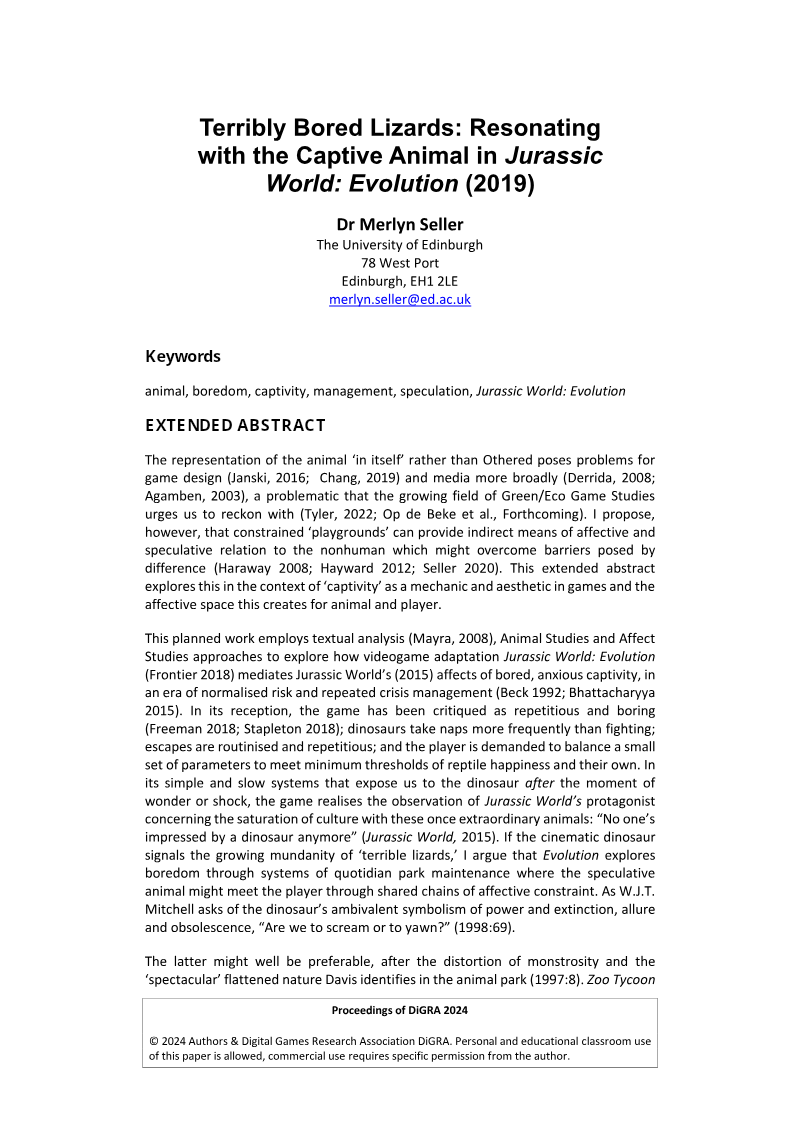
Terribly Bored Lizards: Resonating with the Captive Animal in Jurassic World: Evolution
This document is a scholarly paper from the Proceedings of DiGRA 2024 that uses textual analysis and Animal Studies and Affect Studies approaches to examine how Jurassic World: Evolution (Frontier, 2018) represents captive animals.
- The paper argues that Jurassic World: Evolution (Frontier, 2018) uses constrained, repetitive park-management systems so that players grow bored with the dinosaurs rather than encountering them 'in themselves,' and it reads this monotony as a deliberate design choice that creates a space of 'resonance' with the nonhuman.
- Critics frequently described Evolution as repetitious and boring, noting that dinosaurs nap more often than they fight, escapes are routinised, and players must balance a narrow set of happiness parameters for animals and visitors.
- The author characterises the dinosaur as an ambivalent figure that resists Janski's typology of game animals as opponents, background assets, or resources, instead being simultaneously enemy, tool, actual animal, and speculative construction.
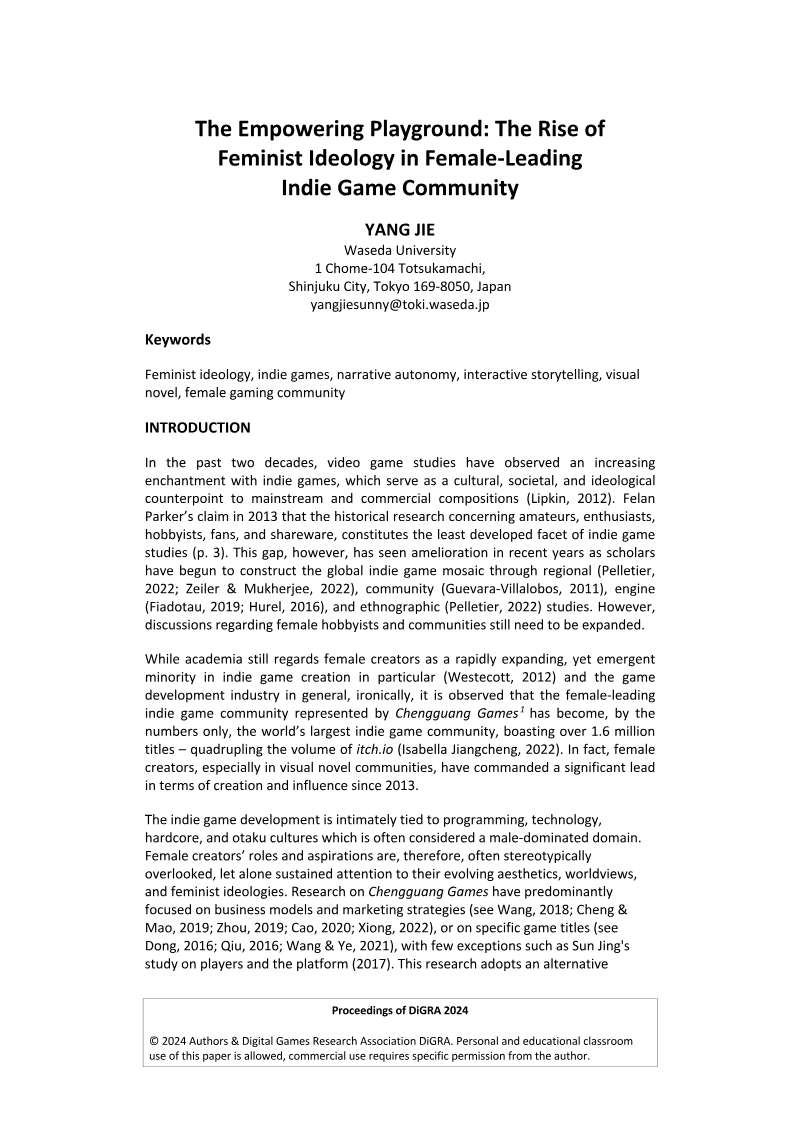
The Empowering Playground: The Rise of Feminist Ideology in Female-Leading Indie Game Community
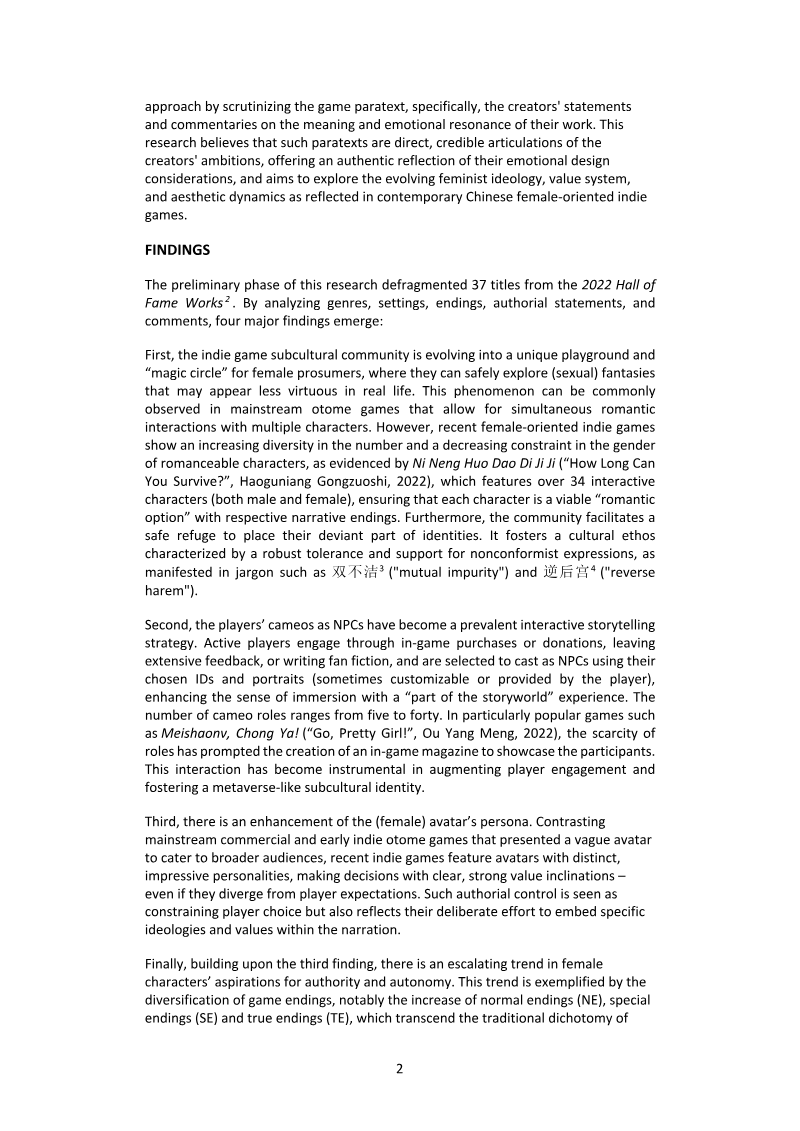
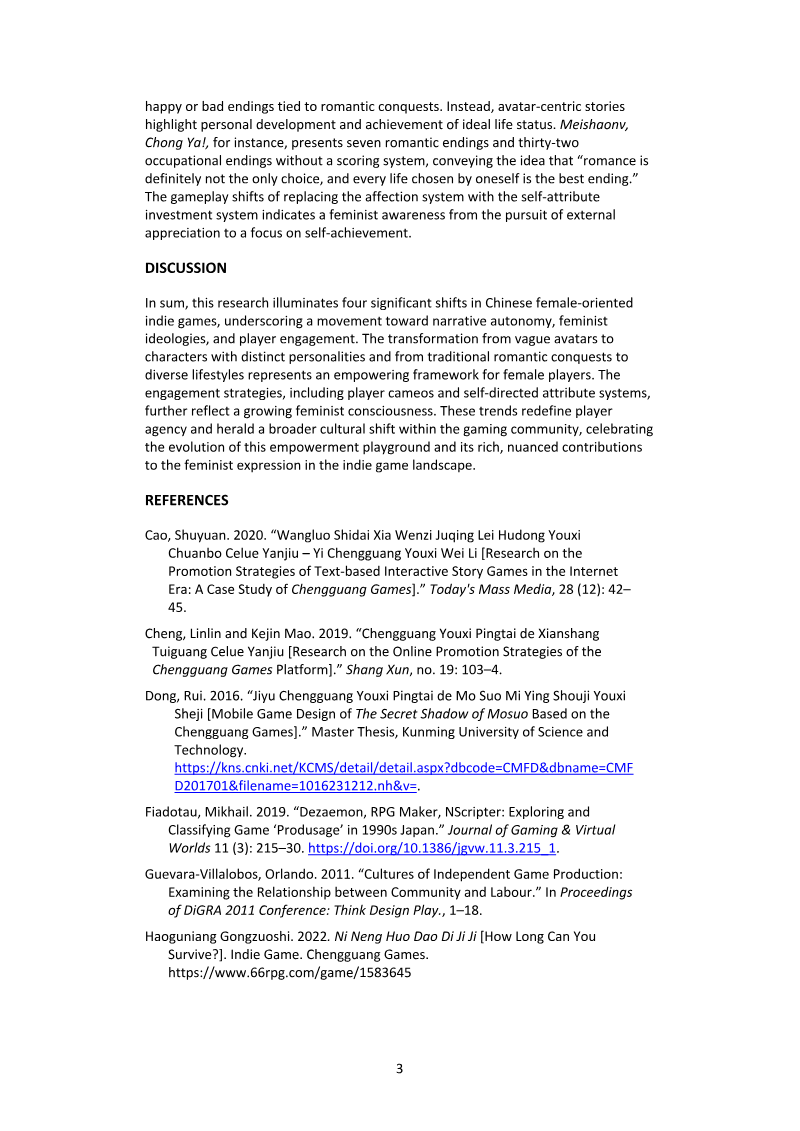
This paper examines how feminist ideology and female-oriented values are expressed in contemporary Chinese indie games produced within Chengguang Games, a female-led visual novel community and distribution platform often described as the world's largest indie game community by title count.
- The study analyzes 37 titles from the 2022 Hall of Fame Works on Chengguang Games, a female-led visual novel community and distribution platform described as the world's largest indie game community by title count, with plans to extend the examination to works from 2015 through 2023.
- Its central argument is that the Chengguang community has become an "empowering playground" for female players and creators, shaped by evolving narrative autonomy and feminist consciousness.
- The research takes a paratextual approach, analyzing creators' own statements and commentaries rather than focusing primarily on business models or individual titles as prior research on the platform did.

Playgrounds of Authority: Space, Power, and Agency in Dying Light
This paper, by Will McKeown and Poppy Wilde of Birmingham City University, applies Deleuzoguattarian frameworks to questions of authority, agency, and spatiality in videogames, using the open-world zombie survival game Dying Light (Techland 2015) as its case study.
- The paper argues that Deleuze-informed game scholarship has framed agency only from the player's position, and proposes instead that authority is distributed across the whole virtual game-space, including items, enemies, buildings, landscapes, traversal methods, and non-player characters.
- Authority in Dying Light is described as a non-hierarchical, rhizomatic network, where progression, enemy types, difficulty settings, and weapon durability together produce a shifting balance between human and zombie rather than a fixed hierarchy.
- The authors map the game world along a striated-to-smooth space continuum: daytime streets read as fixed and rule-governed, while rooftops become open, contested terrain once fast-climbing Viral zombies appear.
Shifting Patterns of Female Representation Across Assassin's Creed
This paper examines the representation of female protagonists across the Assassin's Creed franchise, which by its account comprises 28 installments released since 2007 across multiple platforms and genres.
- The paper argues that the Assassin's Creed franchise, comprising 28 installments since 2007, has offered an exceptionally limited number of female protagonists, with only seven titles featuring playable women either exclusively or as an option.
- Representation shifted rapidly and unevenly after a 2014 controversy over the animation of female avatars, and the authors contend that internal resistance at the company produced incongruities between narrative and ludic elements in post-2017 titles.
- The study uses close-play analysis, netnography, and paratextual material analysis under the DiGAP protocol, drawing on playthroughs, developer interviews, trailers, trade show presentations, and storefront catalogs.
The Inadvertent Construction of Leaders in Digital Games
This in-progress qualitative study examines whether leadership roles in digital games offer a pathway to leadership development for women, non-binary individuals, and people of color, who often do not perceive themselves as natural leaders.
- Leadership in digital games is often inadvertent: many participants did not seek the role but were pushed into it through in-game performance or a predecessor's sudden departure, sometimes while concealing their gender from guild members.
- Most participants had already left their leadership roles by the time of interview, frequently citing burnout, after experiencing stress and being undercut by other members.
- The study is a qualitative project based on semi-structured interviews with 20 leaders (combining 2015–2023 interviews with 2024 follow-ups) across World of Warcraft, EVE Online, and Clash of Clans, analyzed through categorization analysis and grounded theory.
Making Sense of 'Game Feel' through Affective Science
"Making Sense of 'Game Feel' through Affective Science" argues that game feel is best understood not as a fixed property of a game's design or a player's sensory experience, but as an emergent phenomenon arising from the entanglement of the player, the game's audio-visual-haptic materiality, and its mechanical system.
- Game feel is framed as an emergent, material-discursive phenomenon arising from the entanglement of the player, the game's audio-visual-haptic materiality, and its mechanical system, rather than a fixed property of design or sensation.
- The paper distinguishes feelings (pre-cognitive bodily affect) from emotions (socioculturally constructed meanings), using Barrett's theory of constructed emotion and core affect as its framework for designing and studying game feel.
- Game feel depends on the gap between players' predicted and actual outcomes, making it inherently subjective and not fully specifiable in advance; designers must tune this expectation-outcome relationship while accounting for variation across players, genres, and cultures.
Africa Games Industry Report
Africa's games industry is large in potential but still immature, and a comprehensive market assessment has been missing.
- The African gaming market is a high-growth mobile-first sector, with the player base expanding from 77 million in 2015 to 186 million in 2021 and annual revenues projected to exceed $1 billion by 2024.
- Infrastructure instability remains the primary barrier to professionalization, with 60% of industry participants identifying poor power supply and high internet costs as critical obstacles to growth.
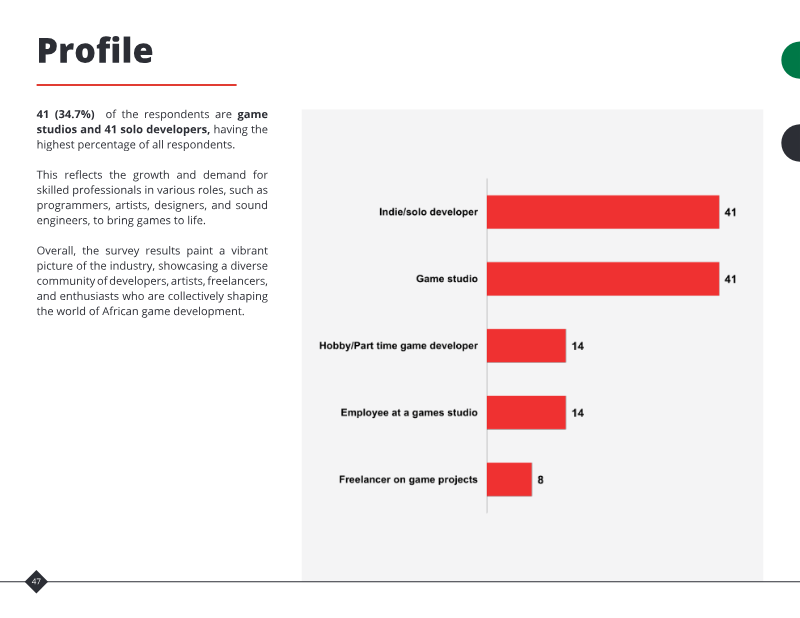
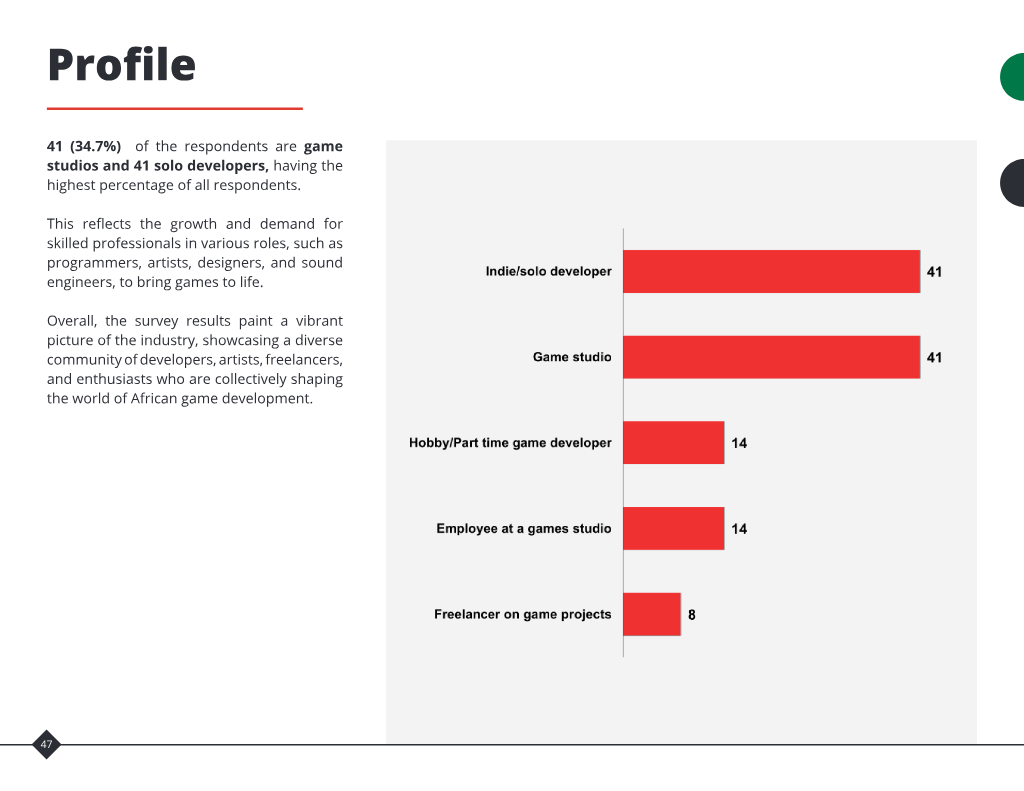
- The industry is currently in a nascent, hobbyist-dominated state where 59% of developers have never secured external investment and only 36% earn a full-time living from their work.
Africa Games Industry Report 2024
The Africa Games Industry Report 2024 presents a data-driven assessment of the continent’s gaming ecosystem, targeting investors, policymakers, developers and the broader public.
- The Sub-Saharan gamer base grew from 77 million in 2015 to 186 million in 2021, with mobile gaming driving 95% of the player base and nearly 90% of the region's $778.6 million revenue in 2022.
- Free-to-play with in-app purchases is the dominant revenue model, with approximately one-third of players currently making in-app purchases.
- Infrastructure remains the primary barrier to growth, with 71% of developers citing unreliable power and 57% citing high internet costs as significant impediments.


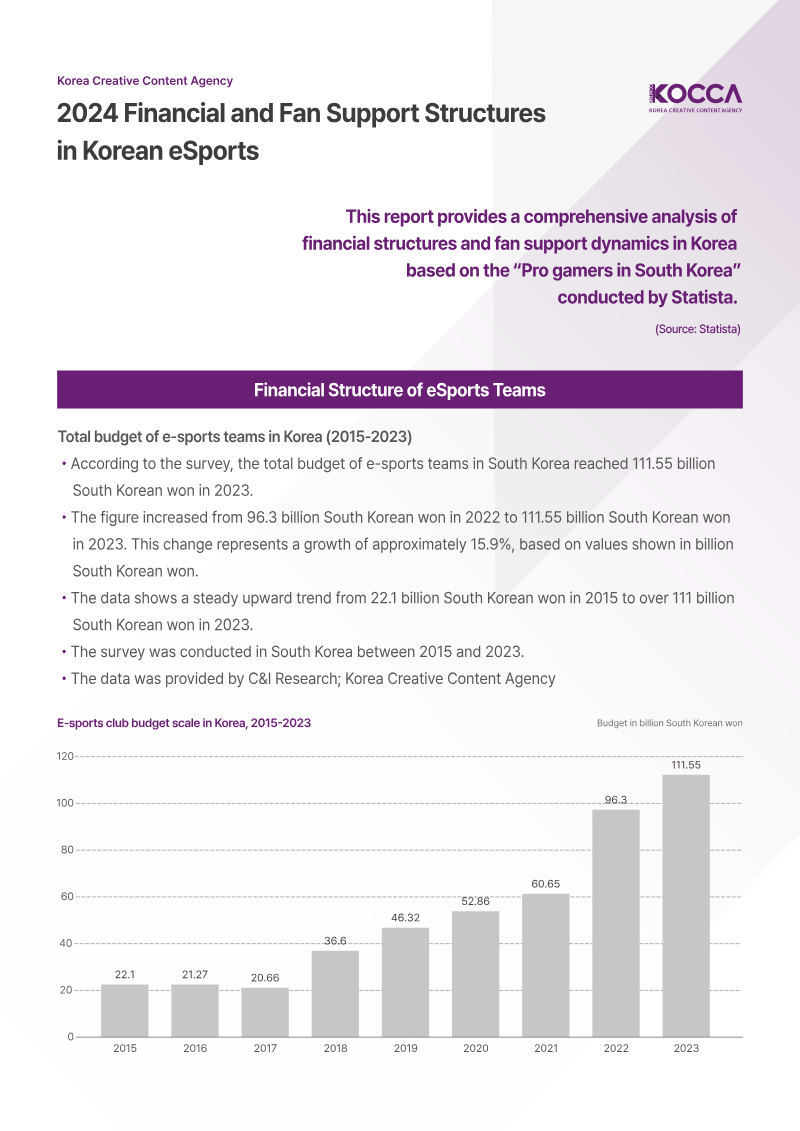
2024 Financial and Fan Support Structures in Korean eSports
The analysis examines the financial scale of Korean e-sports organizations and the patterns of fan support, drawing on a longitudinal budget survey (2015-2023) and two 2024 public opinion polls conducted across South Korea.
- Korean e-sports team expenditures grew nearly five-fold between 2015 and 2023, rising from 22.1 billion won to 111.6 billion won.
- Market investment is accelerating, with total team spending increasing by 15.9% between 2022 and 2023 alone.
- Fan loyalty is highly concentrated, as T1 commands 78.2% of identified team supporters, while the runner-up Gen.G holds only 5.4%.
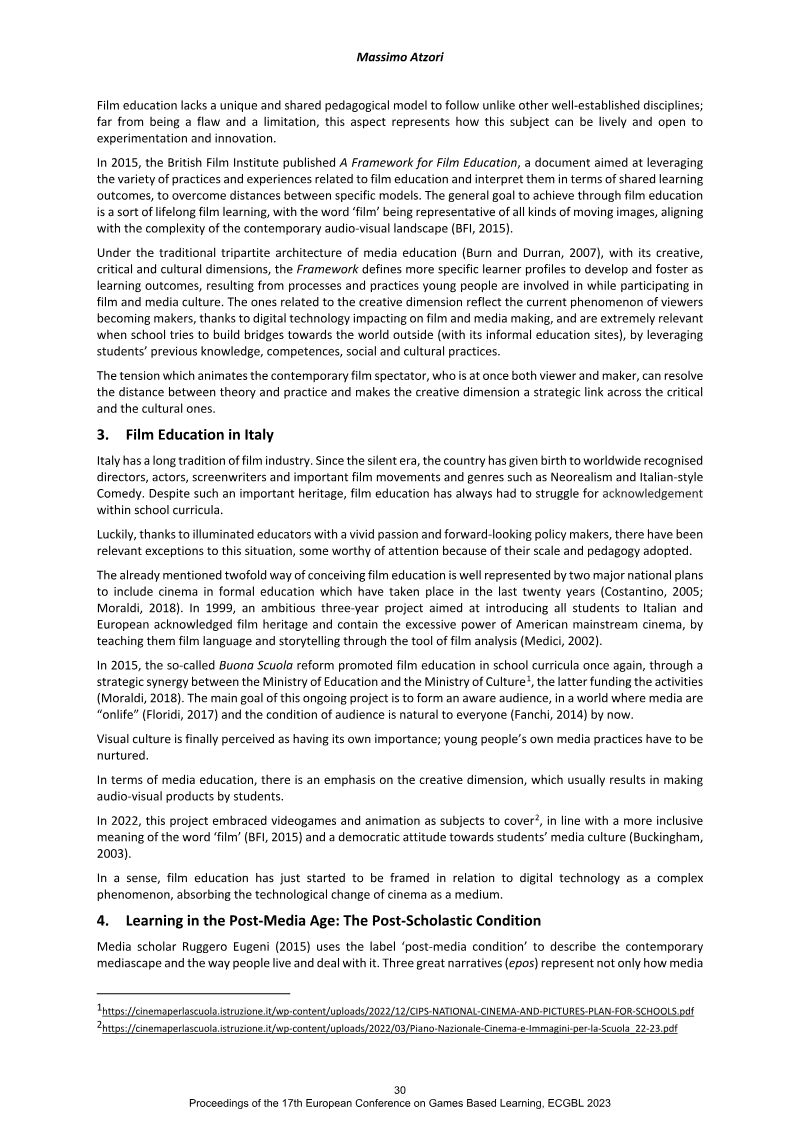
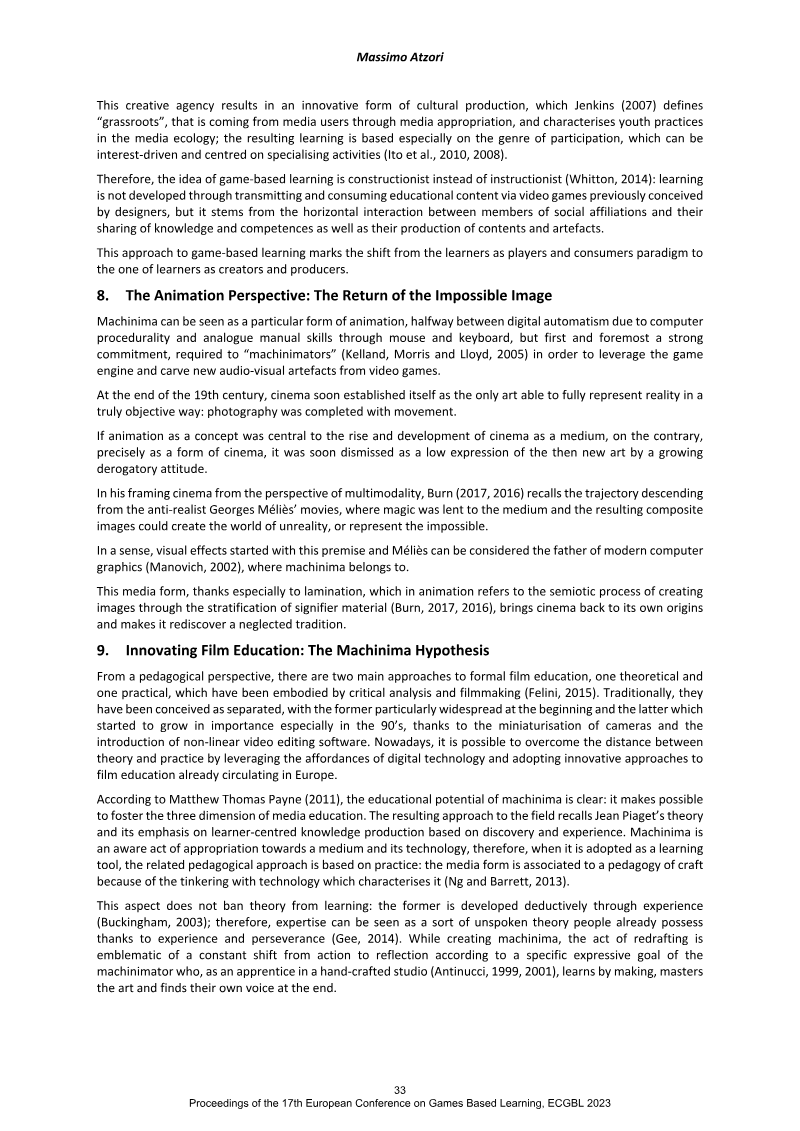
Media Convergence and Game-Based Learning: Developing a Hypothesis of Film Education for the Post-Media Age
Atzori's paper argues that film education should adopt a broad, inclusive understanding of "film" that encompasses video games and participatory media, treating these forms as spaces for experimentation rather than peripheral objects of study.
- The paper argues film education should adopt a broad definition of "film" that includes video games and participatory media, treating them as spaces for experimentation rather than peripheral objects of study, grounded in Gee's semiotic domains and Eugeni's "post-media condition."
- Machinima, films produced by recording gameplay within game engines, is framed as "transformative play" that turns players into creators and is presented as a constructionist, practice-based alternative to conventional film education linking critical analysis with filmmaking.
- The central case study is the 2002–2003 Casablanca Interactive Performance Experiment at the University of Cambridge, in which students recreated a Casablanca scene in the Unreal engine, which the paper identifies as a founding example of machinima as a pedagogical method.
Unpacking Student Perceptions of Board Game Mechanics
"Unpacking Student Perceptions of Board Game Mechanics" examines how undergraduate students at the University of Johannesburg experienced the Boardroom Challenge, a custom board game used as a formative assessment in an accountancy-related business management course.
- The study examines the Boardroom Challenge, a custom board game used as formative assessment in an accountancy-related business management course at the University of Johannesburg, run annually from 2015 to 2019 and resumed in 2022.
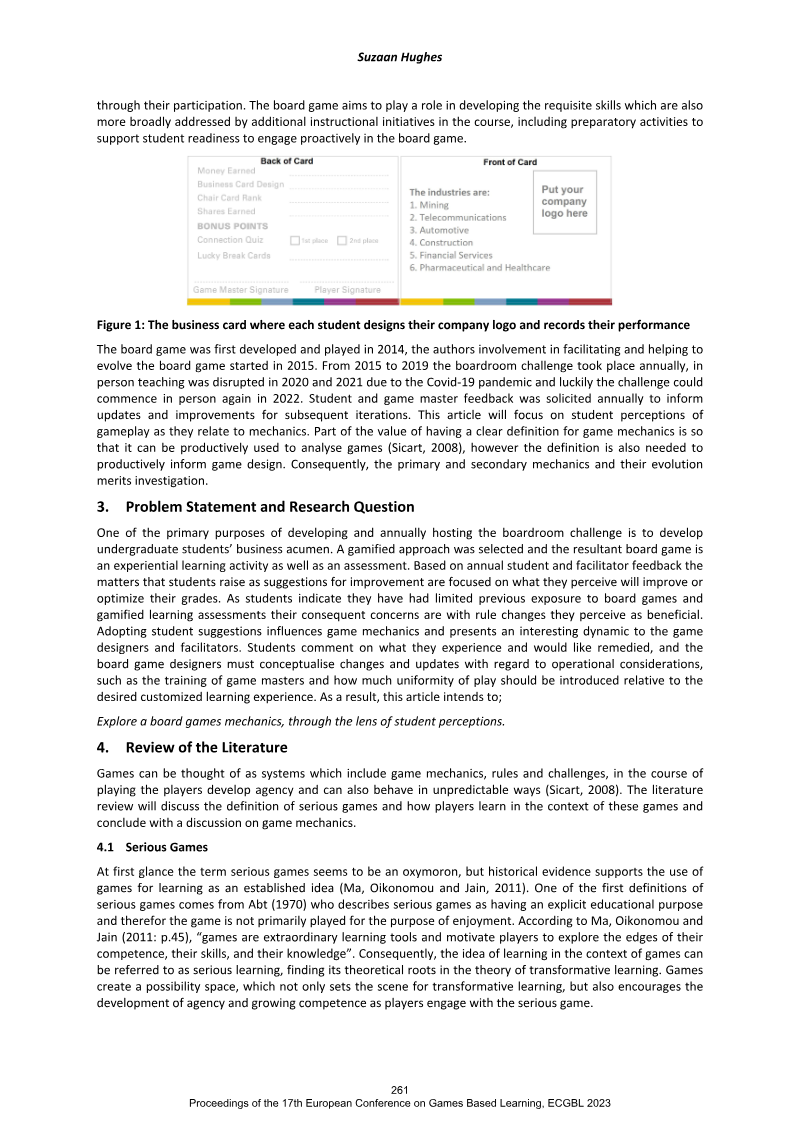
- Core mechanics are dice-driven scenario and theory questions, promotion up a corporate ladder to CEO, and game cash gained or lost based on answer accuracy, with secondary mechanics such as timers, lucky break cards, and game master roles added or refined through feedback.
- Thematic analysis of open-ended student feedback, supported by document analysis of rules, revisions, and training materials, surfaced three themes: perceptions of luck and unfairness, student agency in proposing improvements, and reflections on learning's future professional relevance.