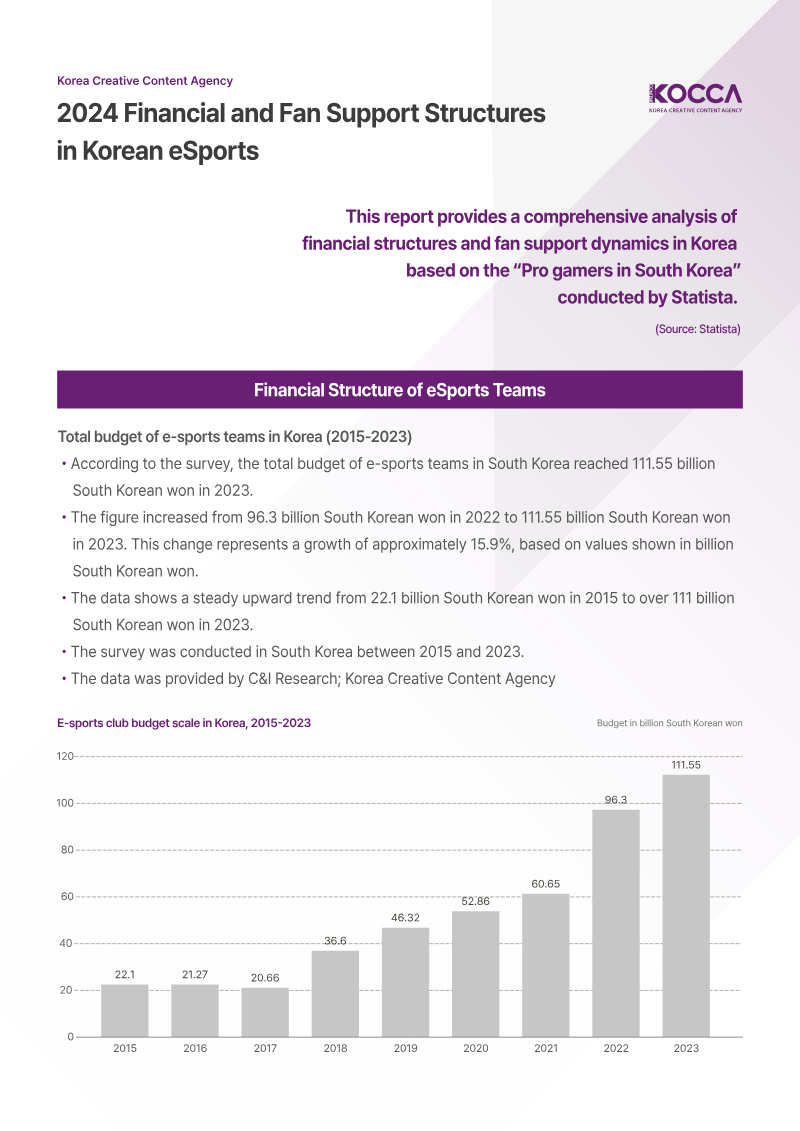
2024 Financial and Fan Support Structures in Korean eSports
20245 pages~4 min full read
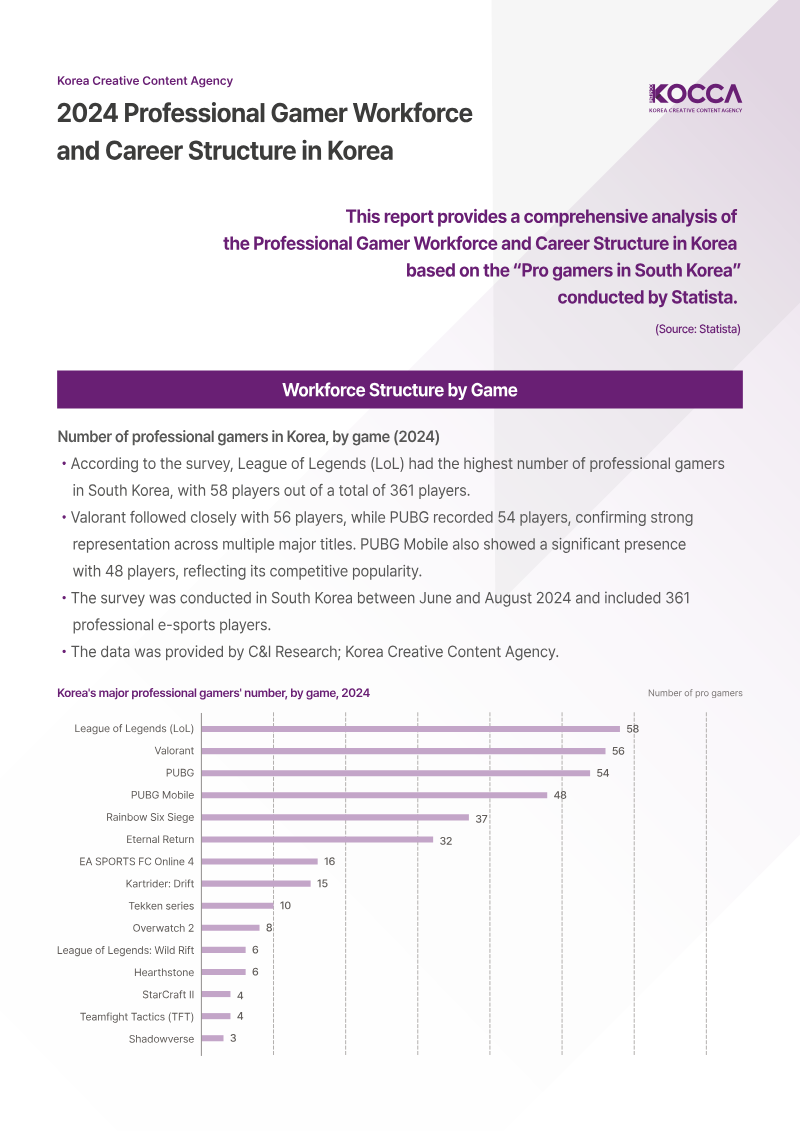
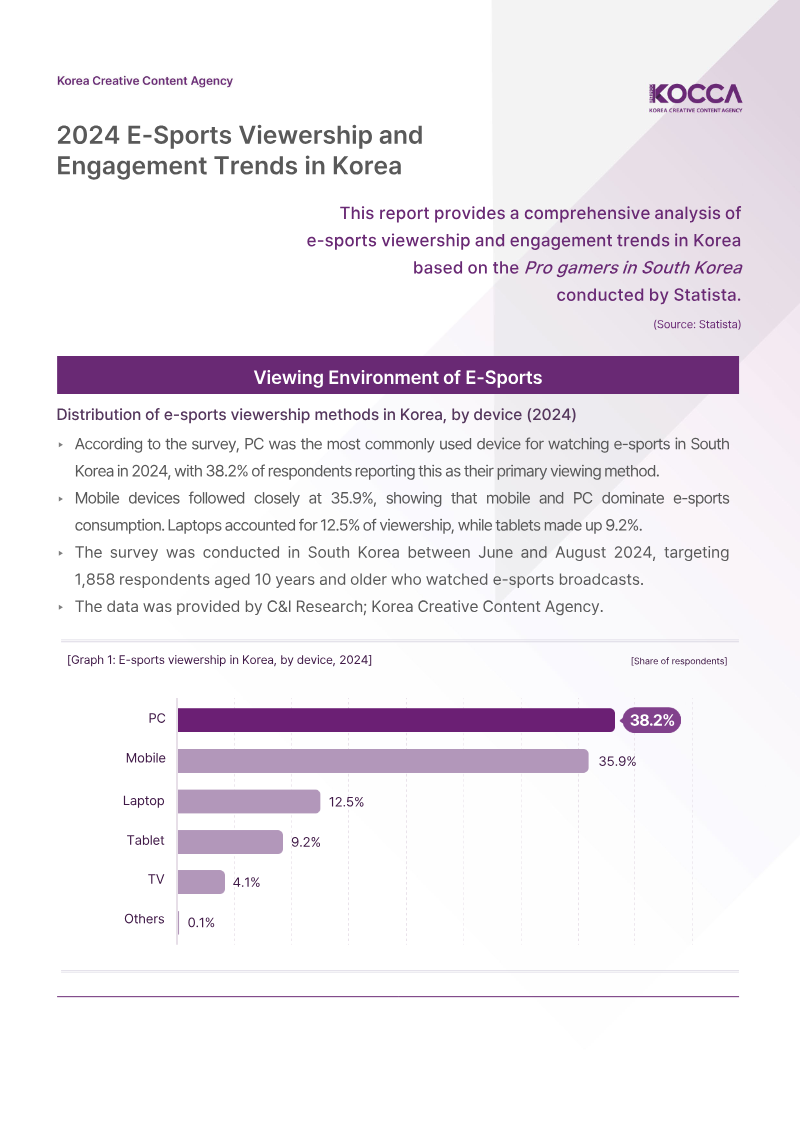
The analysis examines the financial scale of Korean e‑sports organizations and the patterns of fan support, drawing on a longitudinal budget survey (2015‑2023) and two 2024 public opinion polls conducted across South Korea. It targets professional teams, the broader e‑sports audience aged ten and older, and the period from the mid‑2010s through mid‑2024, providing a comprehensive view of market growth and consumer behavior.
Budget data reveal a steady expansion, with total team expenditures rising from roughly 22.1 billion won in 2015 to 111.6 billion won in 2023—a near five‑fold increase over eight years. The most recent year alone saw a 15.9 % jump from 96.3 billion won in 2022, underscoring accelerating investment in the sector. These figures originate from C&I Research and are based on the Statista “Pro gamers in South Korea” survey.
Fan engagement remains modest: among 2,000 respondents surveyed between June and August 2024, only 35.3 % reported supporting a specific professional team, while 64.7 % did not align with any team. Of the 706 supporters who identified a favorite, T1 commanded an overwhelming 78.2 % share, with the runner‑up Gen.G attracting just 5.4 % and all other teams each receiving under 2 % of votes, indicating a highly concentrated fan base.
Motivational analysis shows that personal affinity for players drives support (48.6 %), followed by a positive perception of the team’s image (41.4 %). Interest in tactical or skill‑based aspects accounts for only 9.2 % of the rationale, highlighting the primacy of player appeal in shaping loyalty.
Overall, the sector demonstrates robust fiscal growth, yet the majority of the audience remains unaffiliated with specific teams, and fan allegiance is heavily skewed toward a single dominant organization. Player popularity emerges as the key lever for deepening fan commitment and expanding market participation.
KOCCA – Korea Creative Content Agency · 2025
KOCCA – Korea Creative Content Agency · 2025
KOCCA – Korea Creative Content Agency · 2025
KOCCA – Korea Creative Content Agency · 2025
KOCCA – Korea Creative Content Agency · 2025
KOCCA – Korea Creative Content Agency · 2025
KOCCA – Korea Creative Content Agency · 2025
KOCCA – Korea Creative Content Agency · 2025

KOCCA – Korea Creative Content Agency · 2025
KOCCA – Korea Creative Content Agency · 2025
KOCCA – Korea Creative Content Agency · 2025
KOCCA – Korea Creative Content Agency · 2024
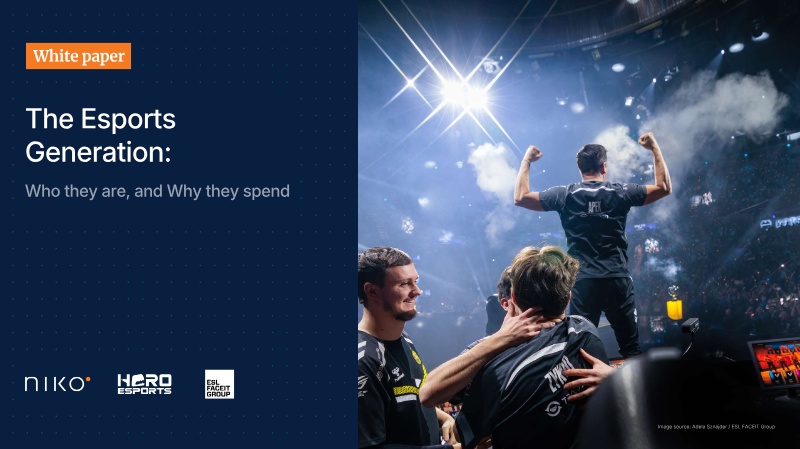
Niko Partners · 2026
GamesBeat · 2026
Deloitte · 2026
Decision Lab · 2026
KOCCA – Korea Creative Content Agency · 2024
Newzoo · 2022

Newzoo · 2020
PayPal
Bryter · 2026
GameAnalytics · 2026
Poki · 2026
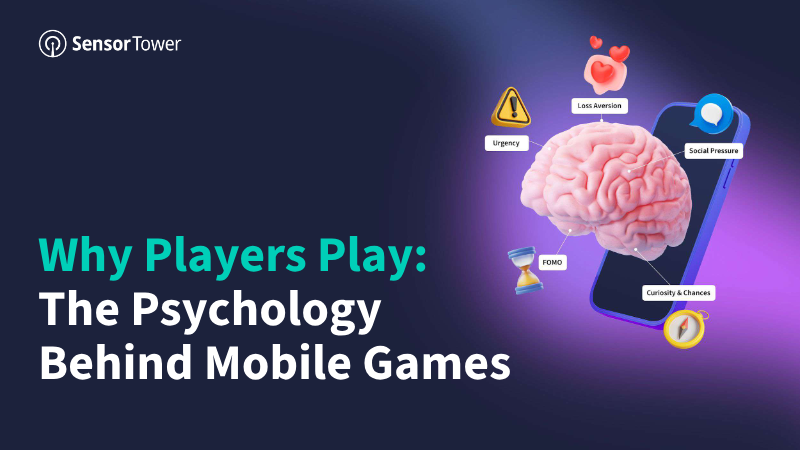
Sensor Tower · 2026