2015
Company
Documents about 2015
Rapidly-Exploring Random Tree Approach for Geometry Friends
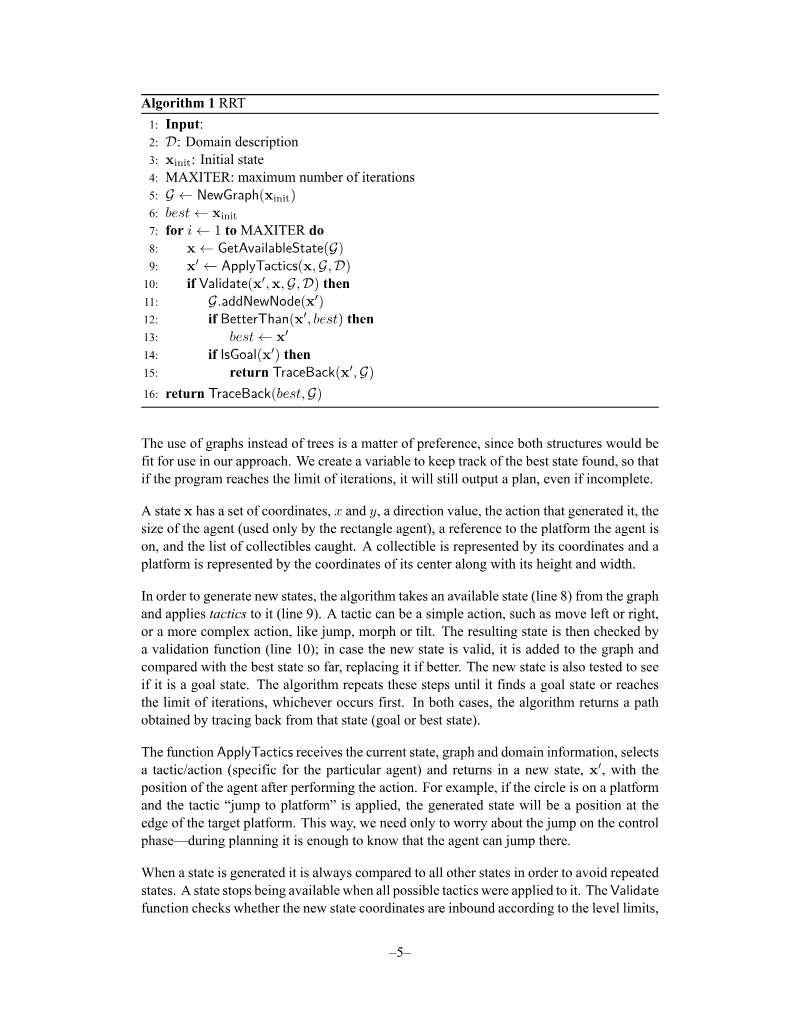
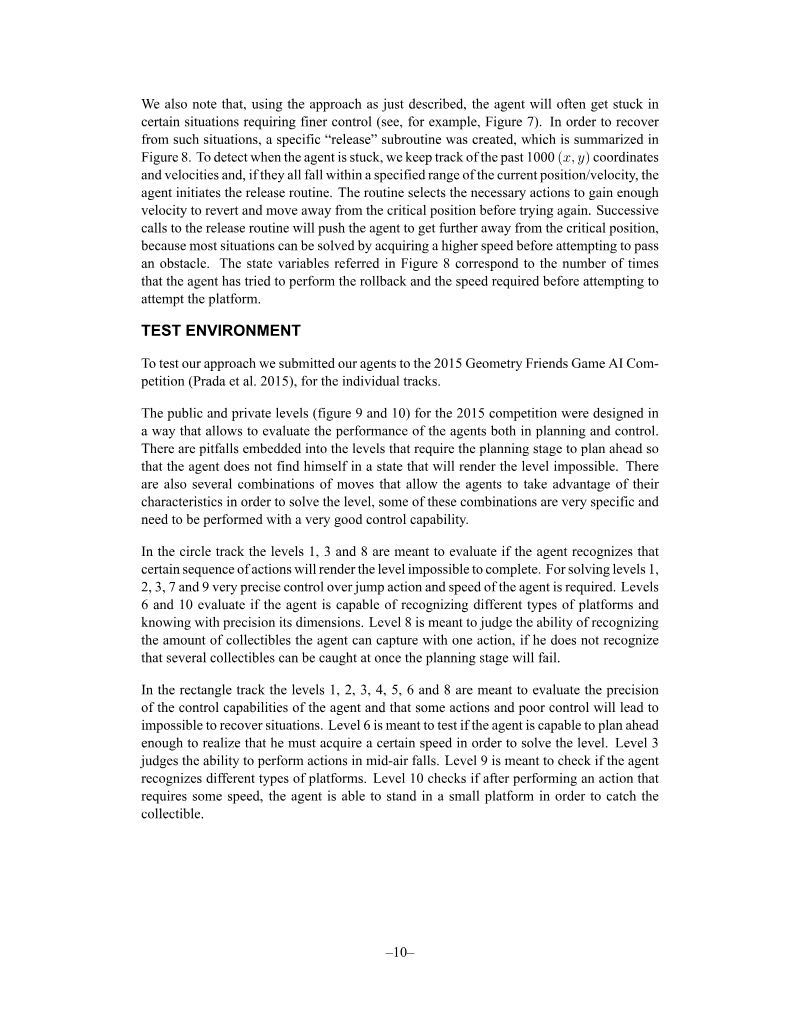
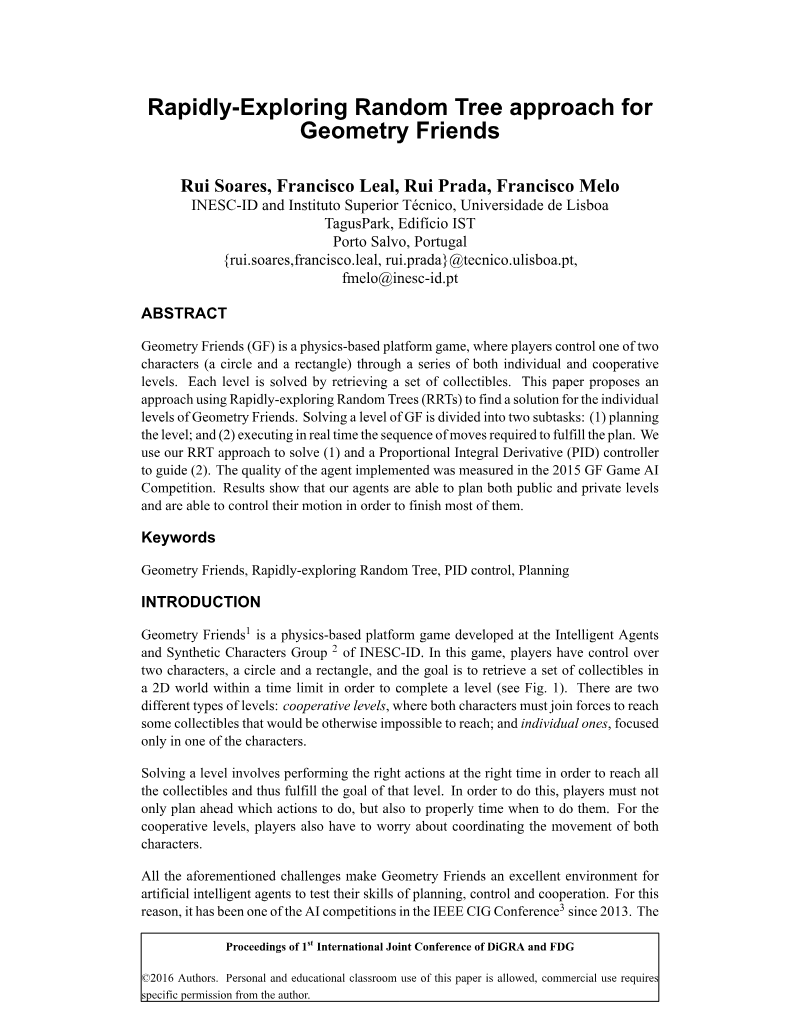
The paper presents a two-stage agent design for Geometry Friends, a physics-based cooperative platform game, using a Rapidly-exploring Random Tree (RRT) for high-level planning and a PID controller for real-time execution.
- The paper proposes a two-stage Geometry Friends agent: a Rapidly-exploring Random Tree (RRT) handles high-level planning and a PID controller handles real-time execution, with the aim of a generic, map-feature-independent method that generalizes to unseen levels.
- The circle agent placed first on the circle track of the 2015 IEEE Computational Intelligence and Games competition with a score of 2096, while the rectangle agent placed third on the rectangle track with 1487.
- Success rates were 0.32 on public circle levels and 0.38 on private levels, which the authors cite as evidence that performance does not collapse on unseen maps.
Three Shadowed Dimensions of Feminine Presence in Video Games
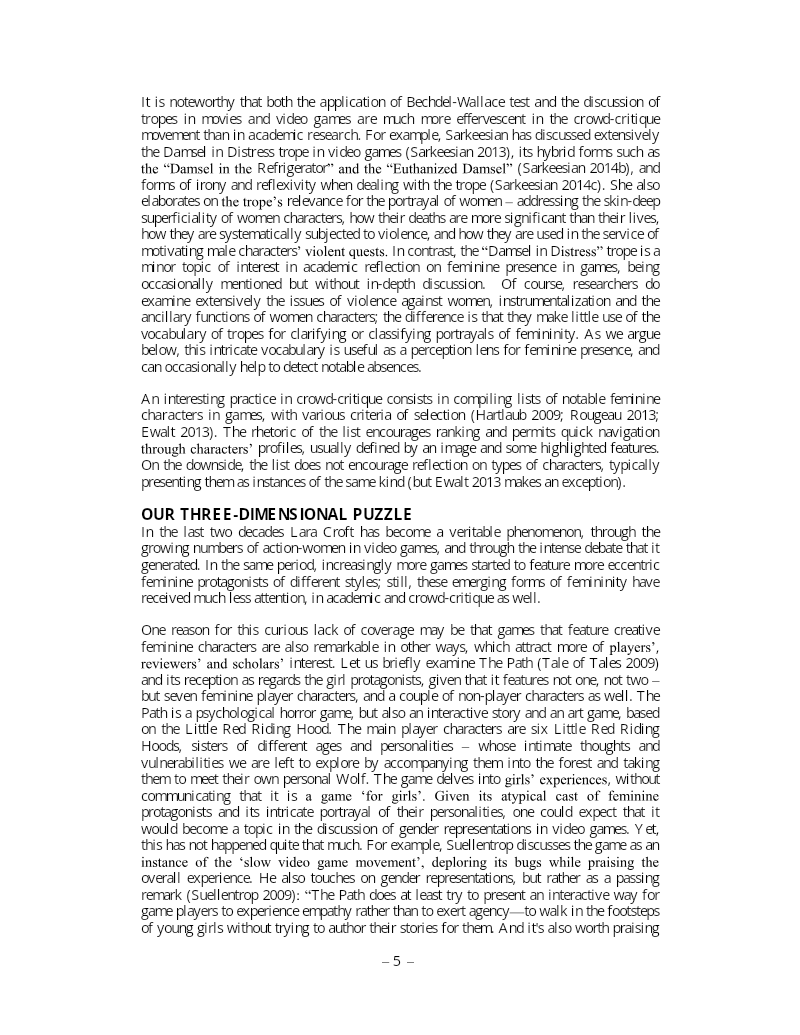
The paper "Three Shadowed Dimensions of Feminine Presence in Video Games" argues that scholarly and critical attention to women in games has concentrated narrowly on sexist portrayals and the action-heroine archetype, exemplified by Lara Croft, leaving other forms of feminine presence underexplored.
- The paper argues that scholarship on women in games has focused narrowly on sexist portrayals and the action-heroine archetype (exemplified by Lara Croft), leaving other forms of feminine presence underexplored.
- It proposes three neglected analytical axes: aging (including the 'Adventurous Alice' trope of child and older women characters), the contrast between protagonist-focused and world-focused perception, and feminine sociability.
- The sociability lens, adapted from the Bechdel-Wallace test, asks whether women interact meaningfully with one another rather than only in relation to men.
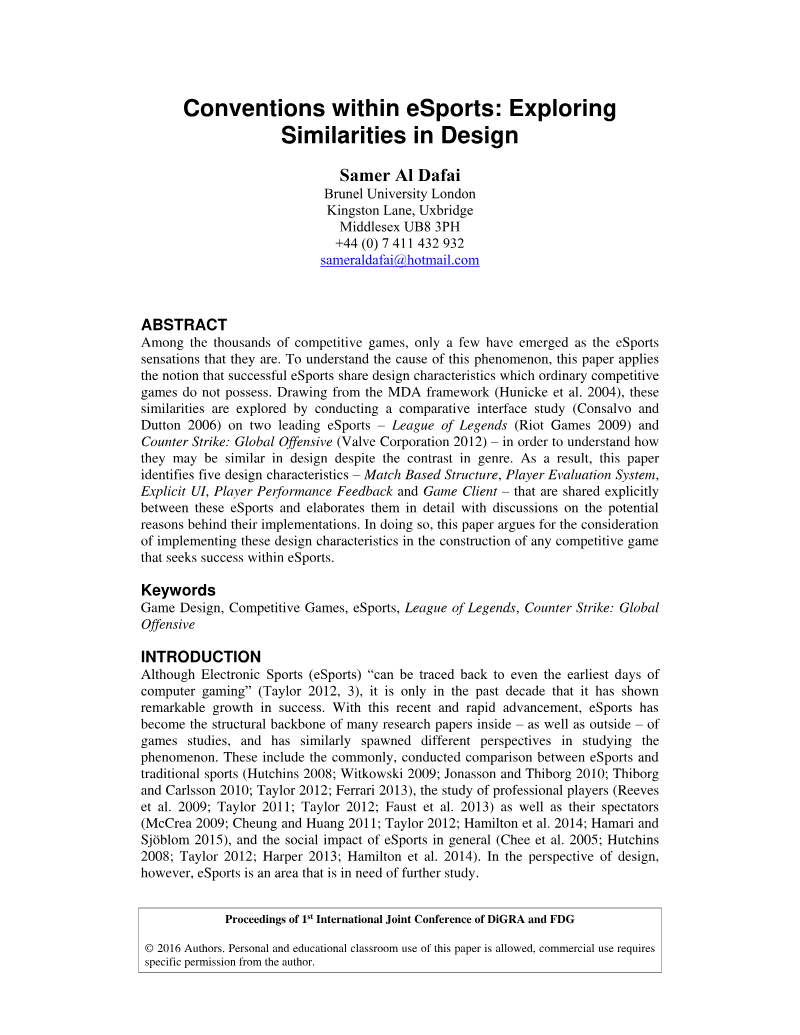
Conventions Within eSports: Exploring Similarities in Design
"Conventions Within eSports: Exploring Similarities in Design" investigates whether successful competitive electronic sports share recognizable design characteristics, using League of Legends and CS:GO as its primary case studies.
- The study identifies five shared structural characteristics across successful competitive eSports, using League of Legends and CS:GO as case studies: a Match Based Structure, a Player Evaluation System, Explicit User Interfaces, Player Performance Feedback, and the Game Client.
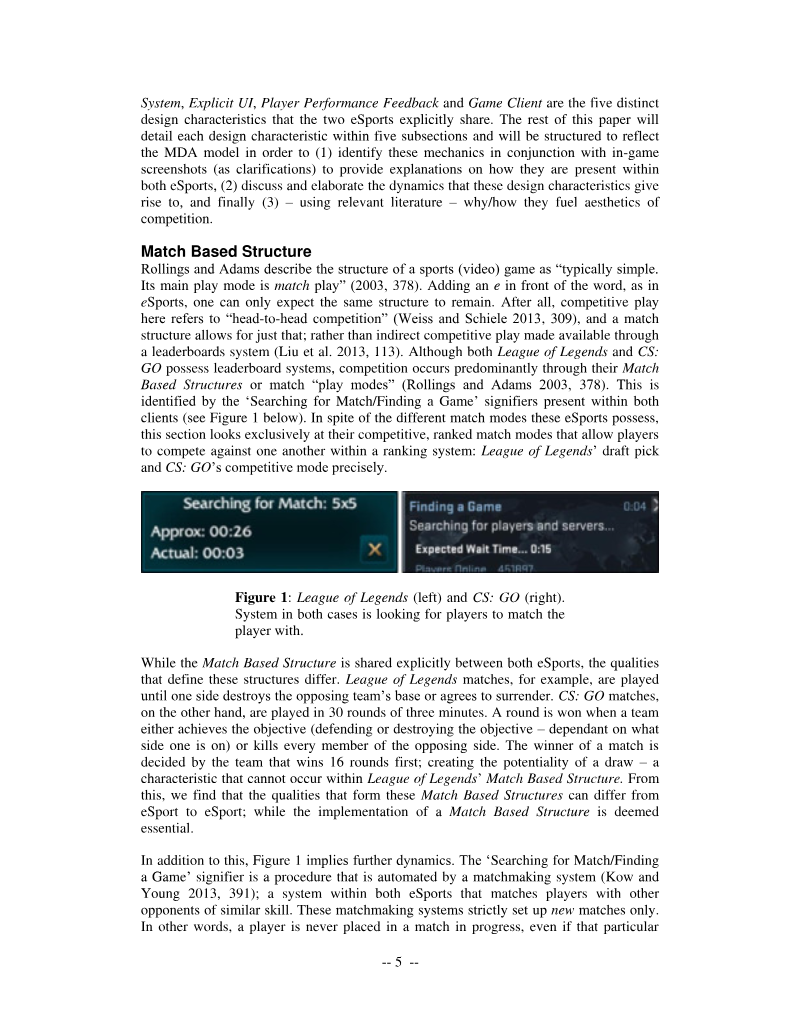
- Both games use head-to-head matches with automated matchmaking that places players only in new matches, though their rules differ, such as base destruction in League of Legends versus thirty three-minute rounds in CS:GO, where draws are possible only in the latter.
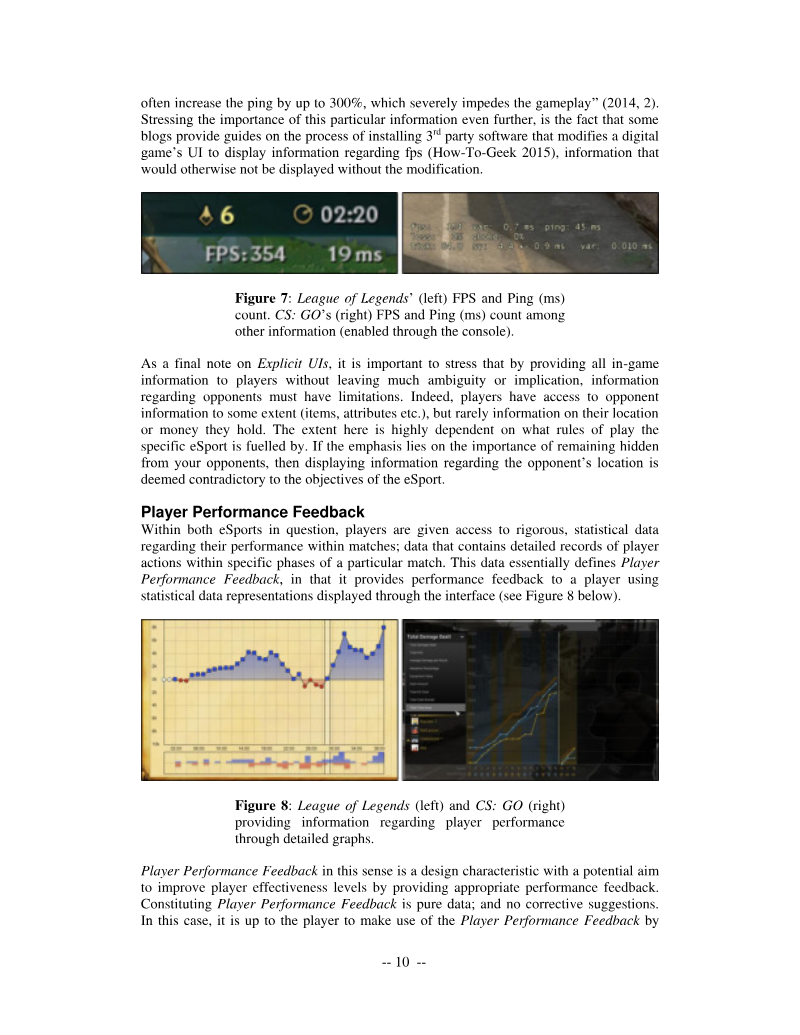
- Both titles rank players by skill, with rank changes driven by win and loss records, and present gameplay information clearly through their interfaces.



Prank, Troll, Gross and Gore: Performance Issues in Esport Live-Streaming
Karhulahti's study examines how live-streaming of competitive esports is shaped by spectator interference, using a twelve-month observation of League of Legends streamer Gross Gore.
- Spectator interference in live esports streams, such as pranks, trolling, and mass food orders, disrupts the 'interview frame' of streamer-viewer conversation, and the streamer responds by sustaining a consistent, humorous persona.
- Live-stream viewers actively seek to alter match outcomes and broadcast direction, and the resulting unpredictability creates a distinctive dramatic appeal that drives viewership, differing fundamentally from traditional sport or esport spectatorship.
- The study's single case study, League of Legends streamer Gross Gore, drew over ten million viewers and £106,033 in fan donations in 2015, illustrating the economic scale of such performances.



Creative Communities: Shaping Process through Performance and Play
"Creative Communities: Shaping Process through Performance and Play" argues that play can disrupt entrenched assumptions within communities of practice and foster innovation, and it proposes a "context provider's framework" under which creative hubs and universities design spaces that support creative process.
- The authors argue that play can disrupt entrenched conventions in communities of practice, such as generic game-engine styles and oversaturated videogame genres, which they claim limit creative output.
- They propose a 'context provider's framework' in which creative hubs and universities design spaces and conditions that support creative process, while acknowledging that a community of practice itself cannot be designed.
- The Development Cultures study (2014) ran for six months with reflective seminars and two game jams, and participation grew from 23 to 46.
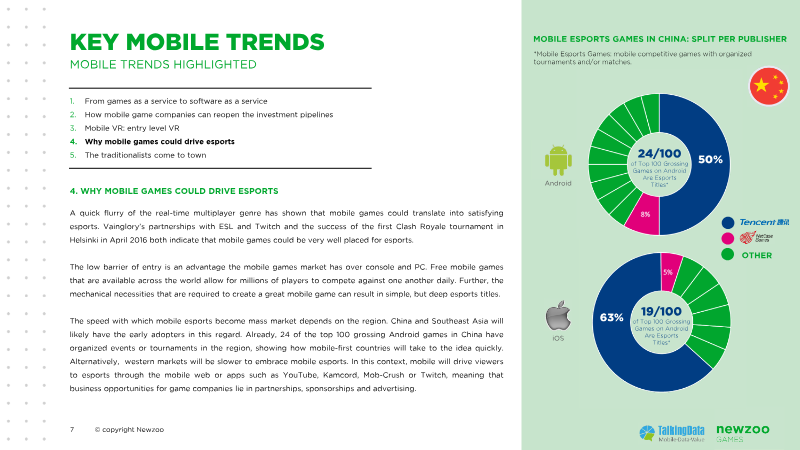
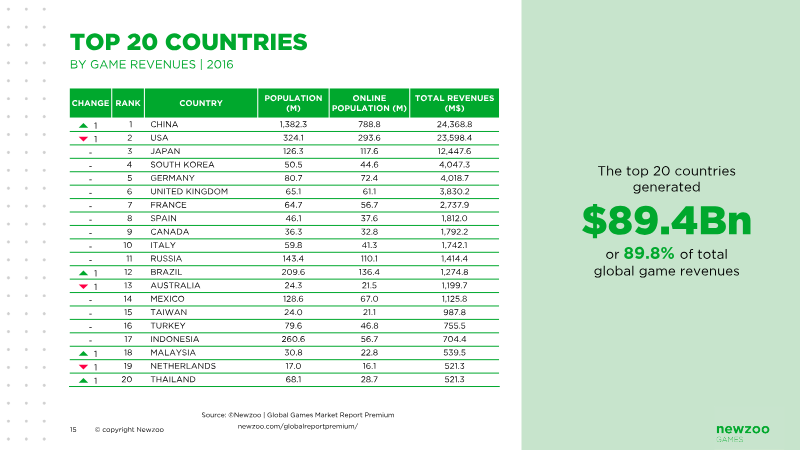

2016 Global Games Market Report: An Overview of Trends & Insights
The 2016 Global Games Market Report provides a comprehensive analysis of the international gaming landscape, offering revenue projections and trend forecasts for the 2015–2019 period.
- The global games market reached $99.6 billion in 2016, marking an 8.5% year-on-year growth rate.
- Mobile gaming is the primary industry driver, generating $36.9 billion in revenue and achieving a 21.3% year-on-year increase.
- The Asia-Pacific region is the dominant global market, accounting for 47% of total revenues with a 10.7% growth rate.
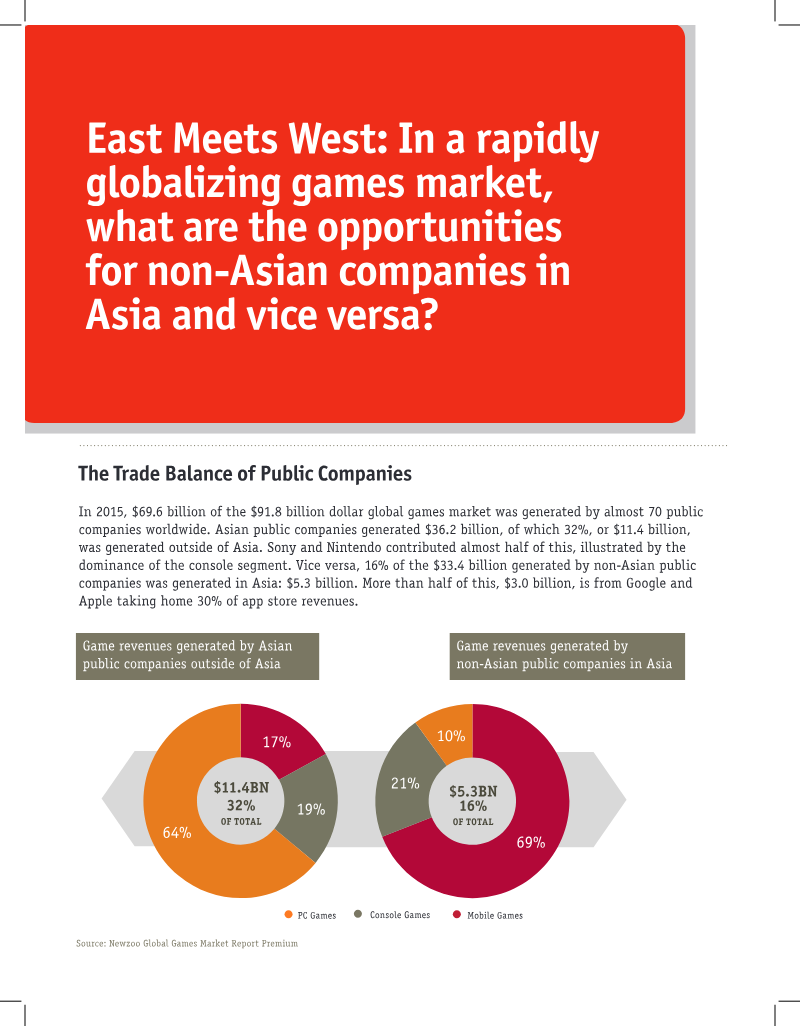

The Asian Games Market: Casual Games Sector Report 2016
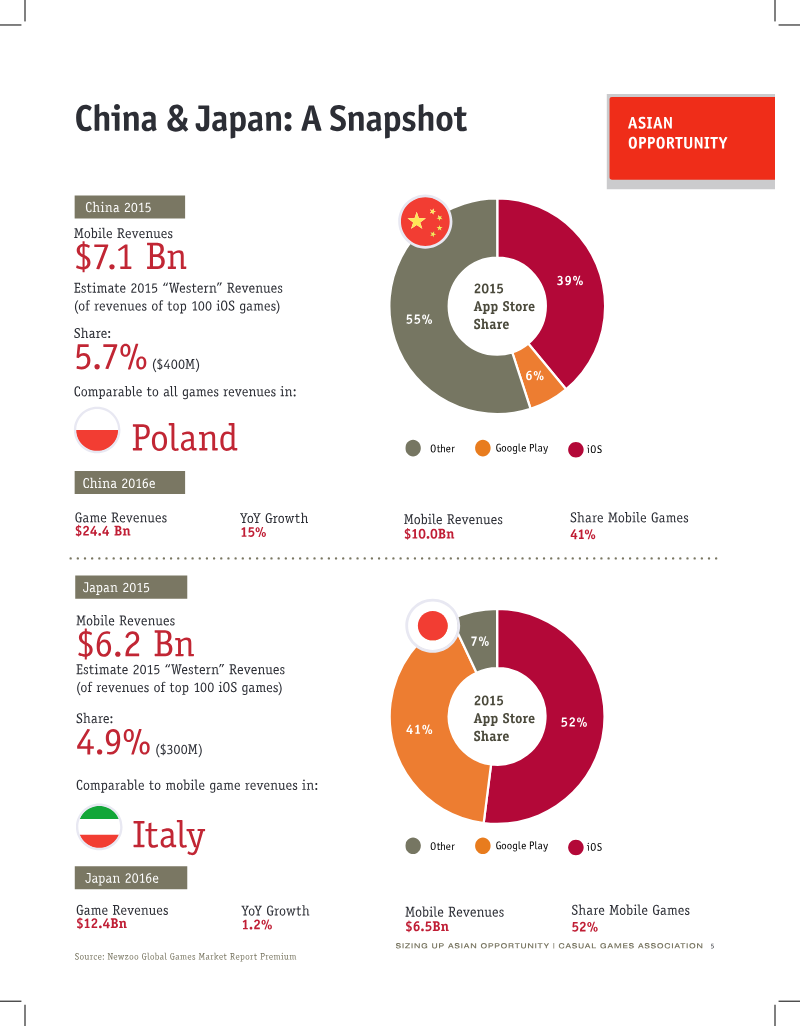
The 2016 Casual Games Sector Report provides a comprehensive analysis of the Asian gaming landscape, emphasizing its critical role in the global market.
- In 2016, the Asian gaming market (China, Japan, South Korea, and Southeast Asia) generated $45 billion in revenue, accounting for 45% of the total global market.
- Asia serves as the primary engine for the global mobile gaming sector, contributing 55% of all worldwide mobile game revenues.
- Mobile platforms command over 50% of the revenue share in Southeast Asia, while console gaming remains the dominant platform in Japan.

TIGA Genre Report 2016
The UK game development landscape in 2015 was defined by a strong preference for action and adventure titles, which accounted for 24.21 percent of all releases.
- Action/Adventure is the most common game genre, with over 45 releases, followed by Arcade and Puzzle/Trivia, each with over 30 releases.
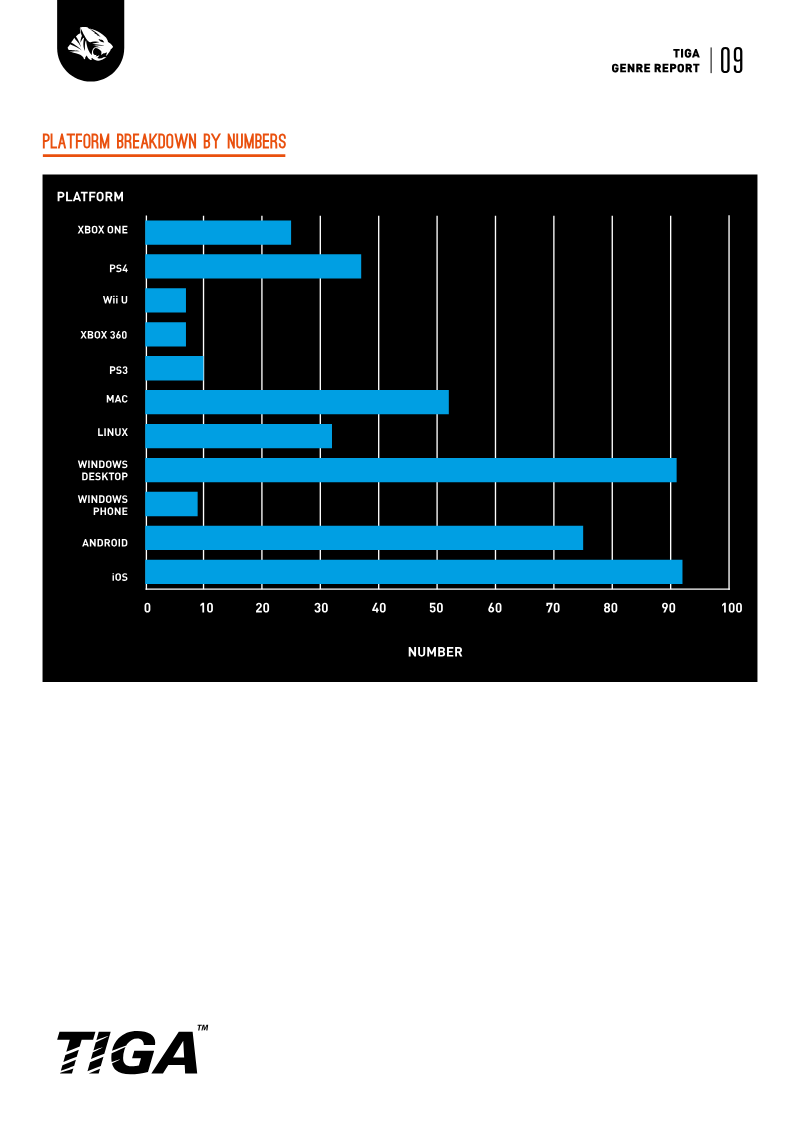
- Mobile platforms (iOS, Android, Windows Phone) show a higher number of releases in Casual, Puzzle/Trivia, and Action/Adventure genres compared to other genres.
- Desktop platforms (PC, Mac, Linux) have a significantly higher number of releases in Action/Adventure and RPG genres, with over 70 and 60 releases respectively.

Estudio Videojuegos y Adultos 2015: España
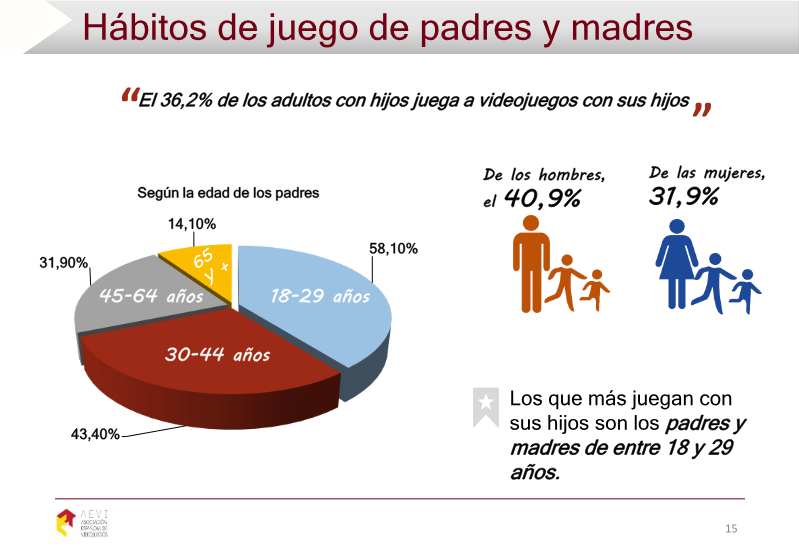
The study aimed to gauge the penetration of video games among Spanish adults, map the demographic profile of adult gamers, explore attitudes and usage habits, compare adults with and without children, and assess purchase intentions for the 2015 holiday season.
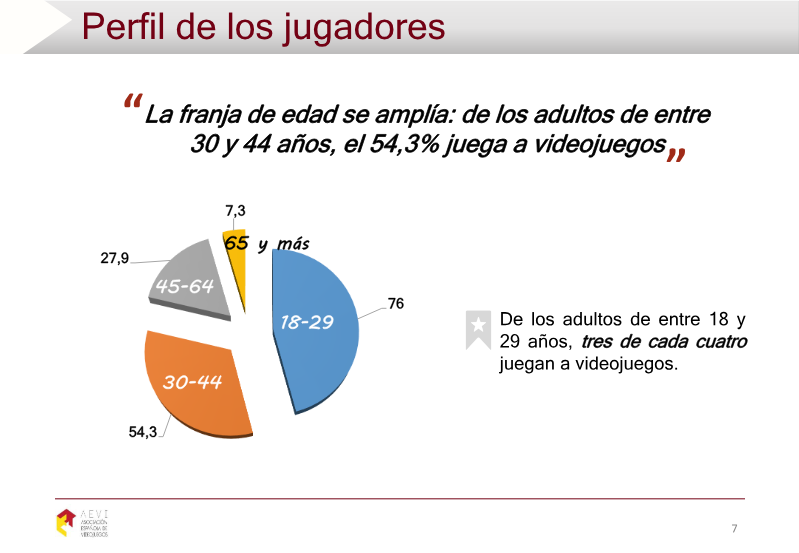
- In 2015, 38.9 percent of Spanish adults played video games, with the highest engagement found in the 18-29 age demographic at 75 percent.
- Gaming habits are gender-split by platform preference: men favor consoles (66.2 percent), while women primarily use smartphones (57.6 percent).
- Habitual gamers, defined as those playing weekly or daily, account for 41.5 percent of the gaming population and are 60 percent male.

Game Developer Index 2015: Sweden
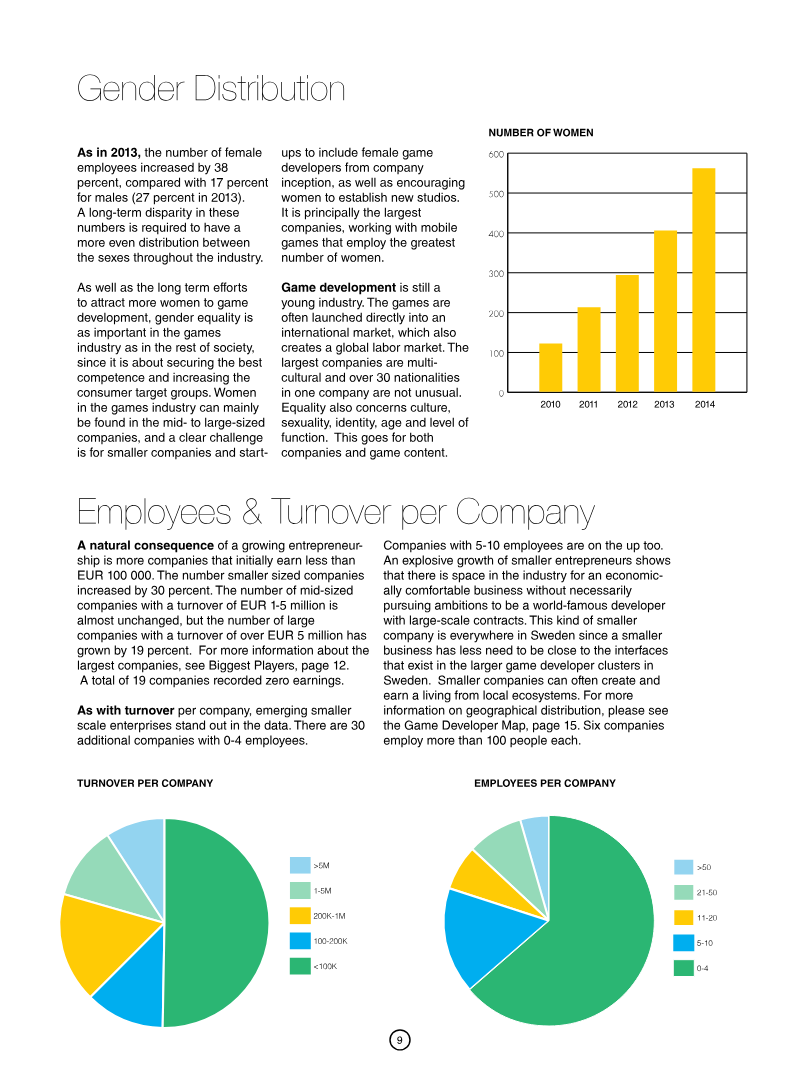
The Swedish game industry serves as a primary engine of national economic growth, characterized by a consistent compound annual growth rate of nearly 40% since 2006.
- The Swedish game industry achieved a turnover of €930 million by 2015, driven by a consistent compound annual growth rate of nearly 40% since 2006.
- The sector is almost entirely export-oriented, with 99% of its total earnings generated from international markets.
- By 2015, the industry supported over 200 active companies and employed more than 3,100 full-time staff, with female workforce participation increasing by 38%.

China's Mobile Game Industry's Possibilities for Finnish Game Developers
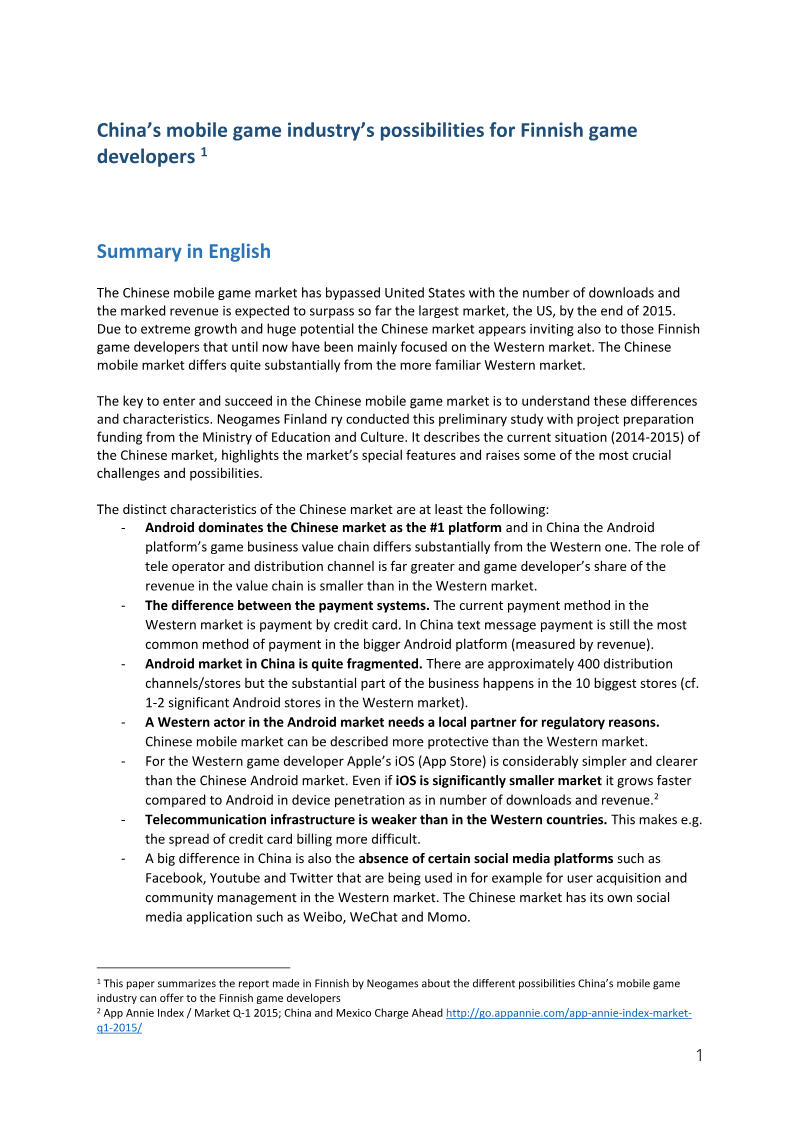
The Chinese mobile game market represents a significant growth opportunity for Finnish developers, having surpassed the United States in total downloads and approaching it in revenue.
- The Chinese mobile game market is a high-priority target that has surpassed the U.S. in total downloads and is approaching parity in total revenue.
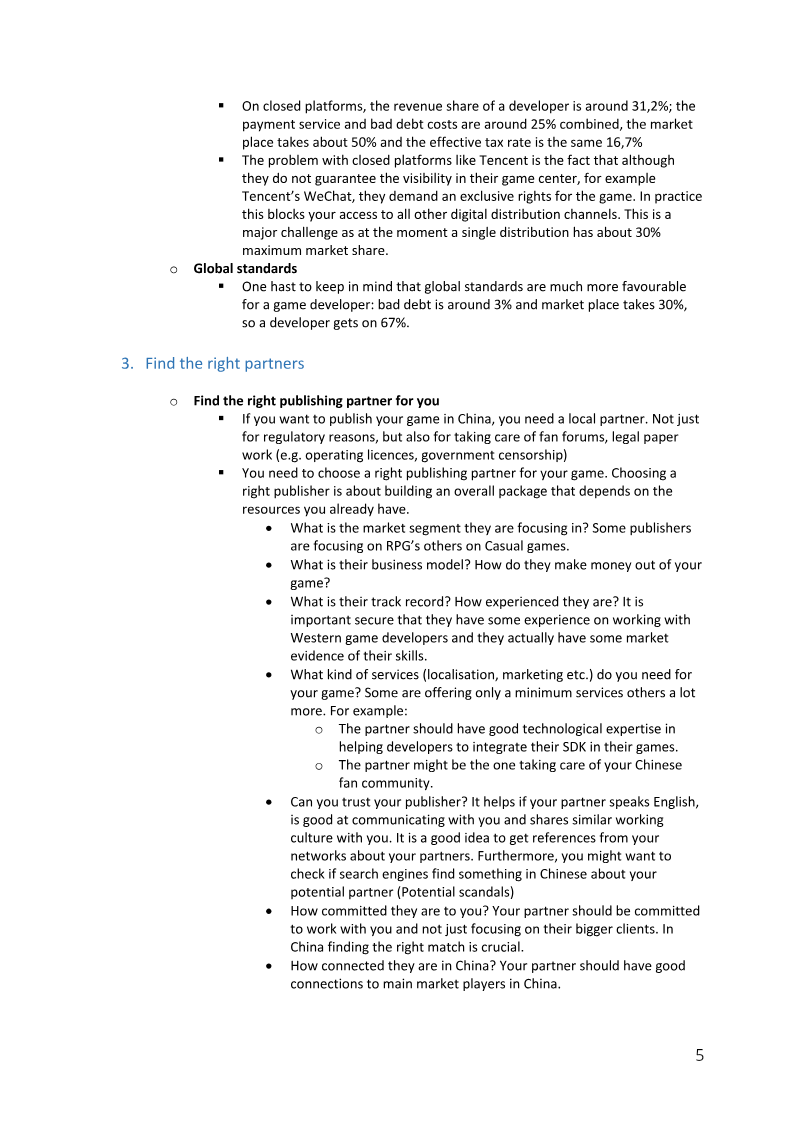
- Market entry requires a local partner to navigate strict government censorship, licensing requirements, and the technical integration of disparate software development kits.
- The Android ecosystem is highly fragmented, necessitating distribution across approximately 400 different channels rather than a centralized store model.
Stillfront Group Company Presentation
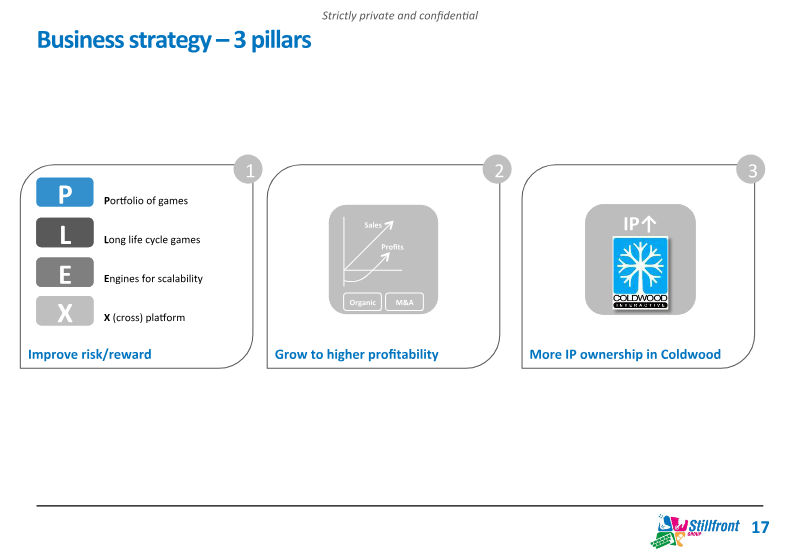
Stillfront Group operates as a diversified developer and publisher of independent games, with a strategic focus on long-lifecycle titles and scalable gaming engines.
- Stillfront Group achieved a 63% increase in organic net revenue for the year-to-date period ending September 2015 compared to the previous year.
- The company's underlying EBITDA margin expanded by 15 percentage points to reach 23% during the same period, driven by low marginal costs and free-to-play monetization.
- Growth is primarily fueled by the successful launch of the strategy game Call of War and the strong market performance of the title Unravel.