ReportNewzoo
2016 Global Games Market Report: An Overview of Trends & Insights
24 pages~11 min full read
Key insights
5 slides
Market Size
The global games market reached $99.6 billion in 2016.
Gaming has evolved into a primary form of entertainment.
Market Growth. The global games market reached $99.6 billion in 2016, marking an 8.5% year-on-year growth rate.
Page 10 of the report$99.6 billion
Global Games Market Revenue in 2016.
- Year-on-year growth
- 8.5%
Regional Dominance
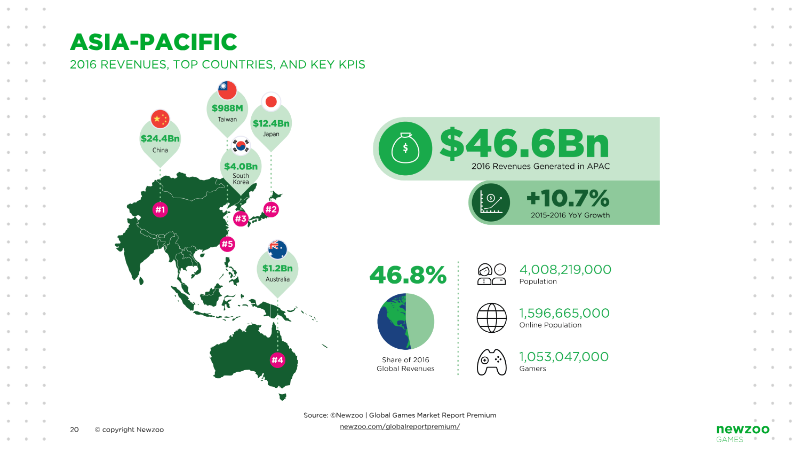
The Asia-Pacific region accounts for 47% of total global revenues.
This makes Asia-Pacific the dominant global market. The region experienced a 10.7% growth rate.
Mobile Dominance
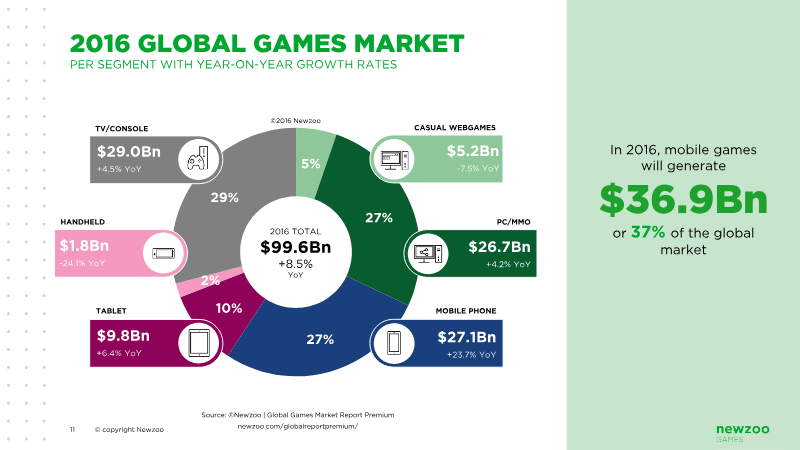
Mobile gaming is the primary industry driver, generating $36.9 billion in revenue.
Mobile gaming achieved a significant 21.3% year-on-year increase. It accounts for 37% of the total market.
Like a rising tide lifting all boats, mobile gaming's growth is propelling the entire industry forward.
Emerging Tech
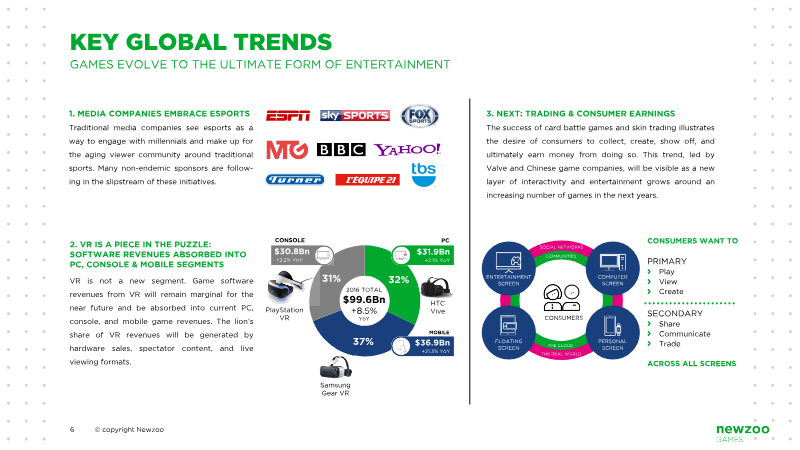
Virtual reality is expected to have a marginal financial impact in the near term.
Its revenues will largely be absorbed into existing PC, console, and mobile segments. VR is identified as a significant technological development.
Industry Evolution
Industry strategy is shifting toward 'games as a service'.
This shift is characterized by a focus on community management and live-streaming integration. Traditional media companies are also investing in esports.
1 / 5
Ask AI about this report