Serious Games reports and market data
Documents


Comparing Voluntary and Mandatory Gameplay
The integration of serious games into professional and academic curricula often rests on the assumption that voluntary participation is a prerequisite for engagement and learning success.
- Mandatory gameplay requirements do not negatively impact user enjoyment or instructional effectiveness compared to voluntary participation models.
- Requiring participation in serious games consistently increases the total duration of user interaction with the system.
- While voluntary participants may report higher initial motivation, this does not result in statistically significant differences in final test performance.


Steps to Design a Household Energy Game
The Powersaver Game project establishes a framework for utilizing user-centered design to influence household energy consumption through persuasive gameplay.
- The Powersaver Game framework bridges the gap between virtual engagement and real-world energy reduction by integrating smart electricity meter data directly into gameplay mechanics.
- Long-term conservation habits are most effectively fostered by linking game elements like personalized avatars, progressive difficulty, and social interaction to a user’s actual domestic energy environment.
- An analysis of ten existing energy-focused games indicates that current industry offerings fail to sustain long-term user interest due to weak narrative structures and ineffective engagement loops.


A Model-driven Framework for Educational Game Design
The creation of educational games often suffers from fragmented communication, inconsistent terminology, and outdated documentation.
- A model-driven, web-based framework has been developed to standardize educational game design by integrating principles from educational psychology, game design theory, and software engineering.
- The framework utilizes a model-view-controller architecture to replace static design documents with a centralized, semi-automated repository that ensures data consistency across multidisciplinary teams.
- By operationalizing the relationship between game mechanics and cognitive outcomes through linked objects, the system enforces a rigorous, data-driven methodology for aligning pedagogical goals with entertainment.

Exploring the Prosociality Domains of Trust and Cooperation, through Single and Cooperative Digital Gameplay in Path of Trust
Path of Trust functions as an innovative educational intervention designed to cultivate prosocial skills, specifically trust and cooperation, among children aged 7 to 10.
- Eighty-eight percent of children aged 7 to 10 demonstrated intended trusting behaviors after playing Path of Trust, confirming the game's effectiveness in teaching cooperation.
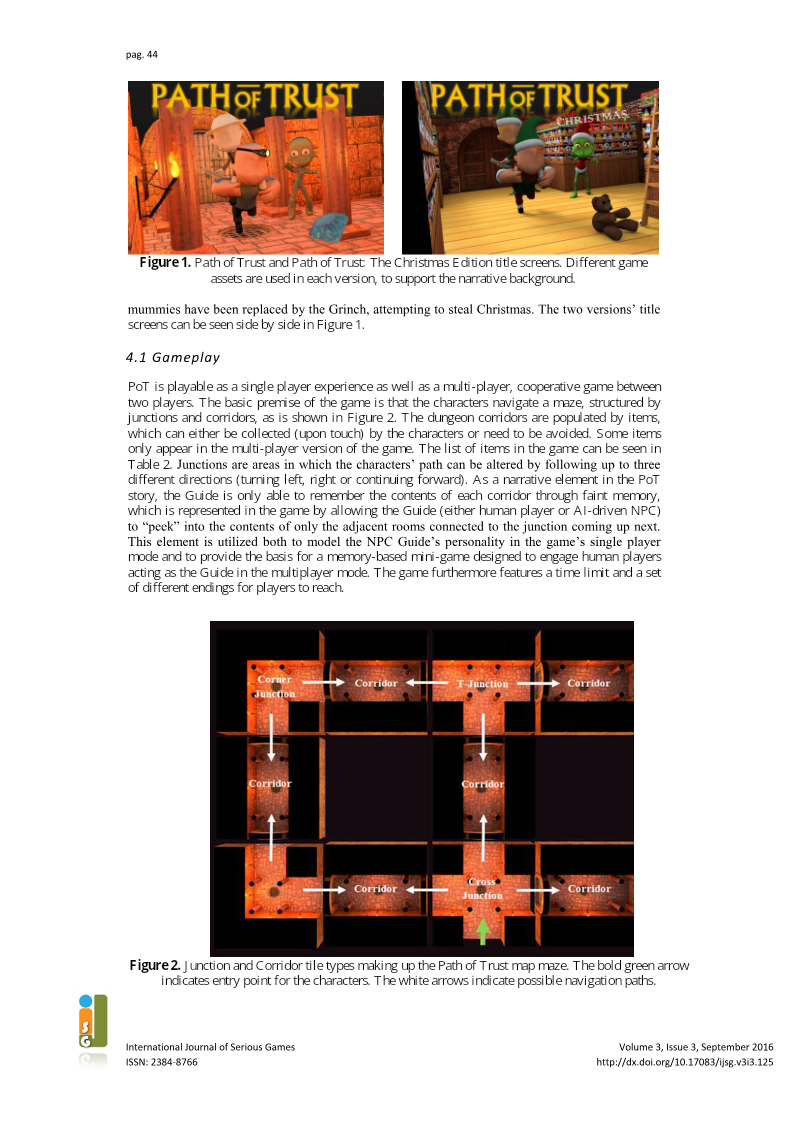
- The game utilizes asymmetric roles, Fog of War mechanics, and mandatory role-switching to force a balance between individual incentives and collective success.
- Participants consistently viewed game outcomes as shared achievements rather than individual wins, successfully shifting the focus from competitive gain to mutual reliability.
Teacher Assessment of Simulation-based Serious Games for Science Education: South Korea
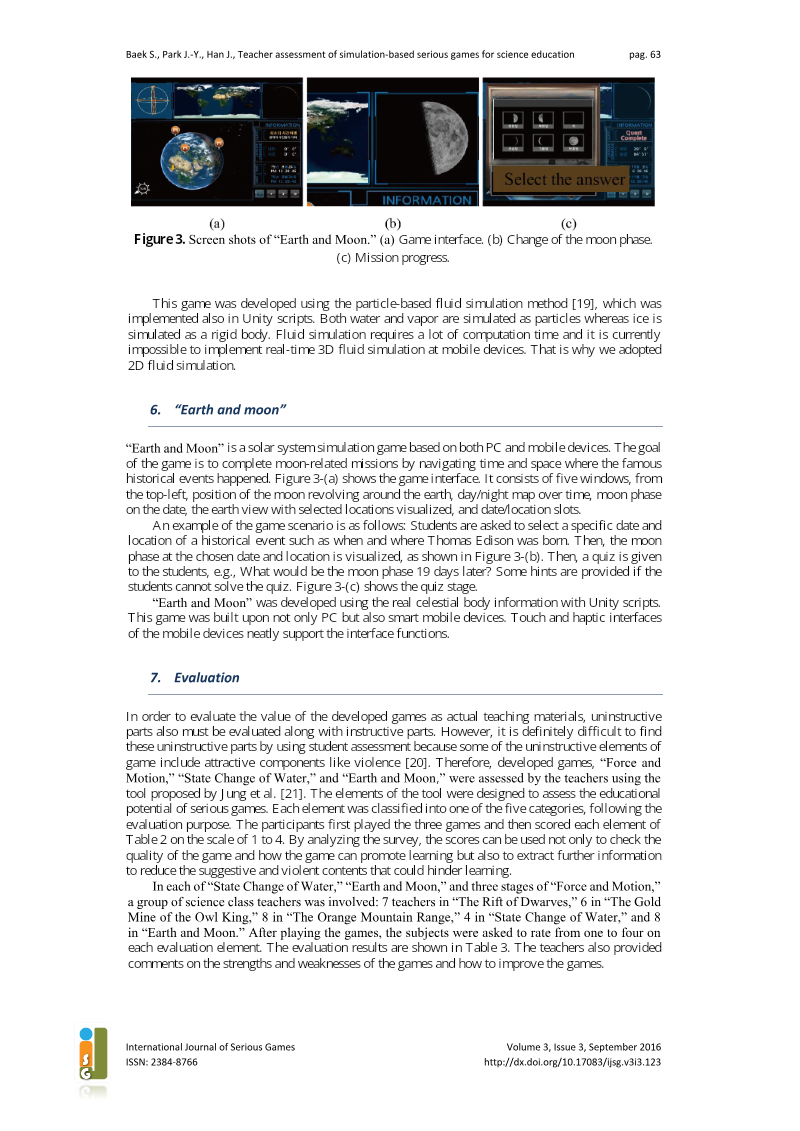
This analysis examines the development and teacher assessment of three simulation-based serious games designed for science education in South Korean elementary and middle schools.
- Simulation-based serious games for science education, specifically covering Force and Motion, State Change of Water, and Earth and Moon, effectively address complex concepts through physically-based modeling.
- Teachers rated the technology category highest at 2.97 out of 4, validating the successful implementation of complex simulations like particle-based fluid dynamics.
- User interface design and screen organization are critical pain points, with both categories scoring below 2.5, indicating a need for more intuitive controls and clearer instructions.


Development and Validation of a Questionnaire to Measure Perceptions of Freedom of Choice in Digital Games
The perception of autonomy in digital environments is defined by two core dimensions: exploratory freedom, which relates to the ability to navigate and interact with game worlds, and outcome freedom, which pertains to the influence players exert over narrative or mechanical results.
- Player autonomy is defined by two distinct dimensions: exploratory freedom (navigation and interaction) and outcome freedom (influence over narrative or mechanical results).
- A validated nine-item questionnaire provides a reliable method for measuring player perceptions of autonomy, demonstrating high internal consistency and construct validity.
- Data from 290 primary school students indicates that players prioritize immersion, agency, and character control over the presence of win/loss states.

On the Effectiveness of Gamified Risk Management Workshops: Evidence from German SMEs
Gamified risk management workshops serve as a viable intervention to address systemic failures in small and medium-sized enterprises, specifically regarding employee motivation, knowledge gaps, and the prevalence of cognitive biases.
- Gamified risk management workshops significantly improve the quality of risk-related discussions and decision-making by replacing abstract processes with structured, interactive frameworks.
- The integration of game mechanics like points and leaderboards fosters employee autonomy and mastery, effectively addressing common issues of low motivation and knowledge gaps in SMEs.
- Collaborative gamified environments mitigate individual cognitive biases by forcing teams to consider a broader range of threats and strategic responses.

Using Digital Games to Learn Mathematics: What Students Think?
Digital games offer a potential, albeit nuanced, pedagogical tool for mathematics education at the university foundation level.
- A student’s pre-existing interest in mathematics is the primary determinant of success for game-based learning, rendering technology confidence and gaming habits insufficient drivers on their own.
- Digital games are not a universal solution for disengaged learners but function most effectively as a supplementary tool for students who already possess a positive attitude toward mathematics.
- While 78 percent of university foundation students identify as active gamers, their enthusiasm for integrating these games into formal mathematics curricula is only moderately positive.

Development of an HIV Prevention Videogame Intervention: Lessons Learned
The development of PlayForward: Elm City Stories establishes a rigorous framework for creating serious games aimed at adolescent HIV prevention.
- Successful health-focused digital interventions require an iterative, theory-driven development process that prioritizes depth of engagement over the breadth of educational content.
- The use of 'Game Playbooks' is essential for maintaining focus on specific behavioral targets and preventing superficial content delivery during the development cycle.
- Integrating behavioral science with interactive entertainment creates a scalable model for health behavior change that bridges the gap between clinical theory and game design.

Business Management Simulations: A Detailed Industry Analysis and Recommendations
Business management simulations serve as a critical bridge between theoretical instruction and practical application, functioning as a formative yet fragmented industry.
- The post-simulation debriefing process is the most critical factor for achieving educational outcomes, outweighing the simulation's internal game mechanics.
- Successful simulations must integrate robust instructor support, assessment mechanisms, and collaborative features like team-based play and immersive storylines.
- The market is currently dominated by North American providers, with significant untapped growth opportunities in Europe, Asia, and Australia.

Kinesthetic Elementary Mathematics: Creating Flow with Gesture Modality
Kinesthetic interaction serves as a powerful pedagogical tool for elementary mathematics, specifically designed to foster a state of flow and sustained cognitive engagement among children aged six to eight.
- Integrating gesture-based technology like the Microsoft Kinect into elementary mathematics education significantly improves student immersion, retention, and academic performance.
- Empirical testing with sixty-seven participants demonstrates that physical interaction with digital content facilitates deep work and sustained cognitive engagement.
- Kinesthetic learning is particularly effective for students with diverse needs, such as those with ADHD, as gross motor activity helps stabilize concentration during complex tasks.

Game Based Cyber Security Training: Are Serious Games Suitable for Cyber Security Training?
This analysis evaluates the efficacy of serious games as training tools for cyber security, a field increasingly vital due to the high economic and social costs of digital crime.
- Serious games for cyber security are currently in an immature state, with most existing tools limited to basic public awareness topics like phishing rather than advanced professional training.
- There is a critical lack of specialized training resources tailored for IT professionals and management decision-makers.
- Current interventions predominantly rely on short-term, single-session formats, which contradicts established behavioral science indicating that effective training requires long-term, sustained engagement.