International Journal of Role-Playing
Open-access peer-reviewed journal on role-playing games, larp and related play forms, now hosted by Uppsala University.
Documents
Bridging Historical and Present-Day Queer Community Through Embodied Role-playing
This article examines Just a Little Lovin' (JaLL), a Nordic live action role-playing game set in New York during the HIV/AIDS crisis, and asks what participants can learn from embodying queer history.
- The central argument is that the affirmative frame of the larp Just a Little Lovin' (JaLL), supported by metareflection and transformational containers, lets players explore marginalized aspects of their identity through emotional, emancipatory, and ego bleed.
- Sustained personal growth requires integration work that extends well beyond the game itself, and the author's own integration of a queer identity was slow and depended on finding lasting queer communities rather than on the larp alone.
- The evidence is qualitative and reflective, drawing on the author's 2016 play and 2022 organizing experience, participant observations, and off-game conversations; no survey sample or systematic data collection is reported.
Experiencing China's Intangible Cultural Heritage in Role-Playing Games: Comparative Studies Between MMORPGs and Larps
This study examines how China's intangible cultural heritage (ICH) is represented in role-playing games, comparing two massively multiplayer online role-playing games (MMORPGs), A Dream of Jianghu and Justice Online, with a live-action role-playing game (larp) known as Jubensha, exemplified by The Secret of the Gauze Lantern.
- China has 42 elements on UNESCO's Intangible Cultural Heritage list and 1,557 nationally recognized ICH items, many of which are declining due to a shortage of young practitioners.
- The Chinese government invested 7.76 billion yuan in intangible cultural heritage safeguarding over the past decade.
- The study argues that MMORPGs and Jubensha (live-action role-playing) can both help safeguard Chinese heritage, but in distinct ways: MMORPGs showcase national-level heritage from many regions, while Jubensha focuses on the customs of small local communities.
Larp as a Potential Space for Non-Formal Queer Cultural Heritage
Larp, or live action role-playing, is argued here to hold real potential as a non-formal space for documenting, disseminating, and educating audiences about queer history, culture, and heritage.
- The report argues that larp (live action role-playing) can serve as a non-formal space for documenting and educating audiences about queer history, positioned as analogous to drag venues and social spaces that have long transmitted queer heritage outside institutional archives.
- The central case study is the larp Just a Little Lovin' (2011), which depicts the 1980s HIV/AIDS crisis and the queer social worlds surrounding it.
- Player testimony reportedly describes simulated queer venues and historically grounded framing activities as deepening participants' understanding of 1980s queer community, its subcultures, and the impact of the AIDS epidemic.
Playing With the Fictitious "I": Early Forms of Educational Role-Playing in Hungary, 1938-1978
Eszter Leveleki's Bánk, a Hungarian children's summer camp that operated from 1938 to 1978 under successive repressive regimes, is the subject of this study, which argues that the camp developed forms of play remarkably close to modern educational live-action role-play (edu-larp).
- The study argues that Eszter Leveleki's Bánk, a Hungarian children's summer camp operating from 1938 to 1978 under successive repressive regimes, developed forms of play remarkably close to modern educational live-action role-play (edu-larp).
- Its practices, including ritualized games, an invented language called "traditage," and the fictional kingdom of Pipecland, are presented as prefiguring the larp movement, with descendants evolving into full edu-larps by the late 1980s.
- The camp's "Grand Play" was an elaborate, competitive, culturally embedded form of play that deliberately blurred the boundary between in-game and out-of-game worlds, with participants adopting "Fictitious I" alter egos as citizens of Bánk.
Playing with Wonders: Objects, Role-Playing Games, and the Cultural Legacy of Bispo do Rosário for the City of Rio de Janeiro
This paper examines how physical objects can stimulate imagination and new modes of thinking, using the art of Arthur Bispo do Rosário as a foundation for micro role-playing games set in Rio de Janeiro.
- The paper proposes the "Storytelling Cloak," a double-sided, reconfigurable garment inspired by Arthur Bispo do Rosário's Presentation Cloak, to which removable elements are attached and reused or recombined by successive participants.
- The authors frame physical "Living Objects" as tools that carry narrative and provoke wonder beyond rational thought, drawing on theories of the marvelous (Sarah Tindal Kareem), the "poetics of delirium" (João Frayze-Pereira), and the Romantic concept of witz as a sparking fragment.
- Small-scale experiments with volunteers, some familiar and some unfamiliar with Bispo's work and some experienced or inexperienced in storytelling, produced autobiographical, fictional, and historical narratives about Rio de Janeiro followed by debriefs and feedback.
Towards the Post-Modern Art Week: Anthropophagic Reflexes in the Brazilian Larp Scenes
This essay by Tadeu Rodrigues Iuama applies Oswald de Andrade's concept of anthropophagy, the cultural metaphor of critically digesting the Other, to larp (live-action role-playing) in Brazil.
- Larp is argued to be inherently anthropophagic: character construction digests media and biographical references, and the bleed between player and character reinforces this exchange.
- The essay frames its argument through Oswald de Andrade's anthropophagy, the Brazilian Modern Art Week of 1922, and its legacy across literature, theater, cinema, music, and education.
- Larp is presented as essentially dialogic, a counterpoint to the discursive imbalance of mass media and authoritarian communication, drawing on Vilém Flusser's communicology and his four communicational structures (circle, amphitheater, pyramid, bundle).
The People: A Serious Role-playing Game Designed to Address a Humanitarian Crisis
The People is a case study of a serious role-playing board game developed by Weronika Szatkowska with researchers and NGOs, including Badacze i Badaczki na Granicy, Wolno Nam, and Grupa Granica, in response to the 2021 migration crisis on the Polish-Belarusian border.
- The People is a serious role-playing board game by Weronika Szatkowska, developed with researchers and NGOs in response to the 2021 migration crisis on the Polish-Belarusian border, and places players as residents of the 183-village State of Emergency Zone, some sympathetic to refugees and others seeking to block their passage.
- The game's distinct contribution is framing the refugee problem through the affected borderland community rather than solely the perspective of asylum seekers, unlike earlier titles such as Bury Me My Love and The Migrant Trail.
- The design draws on serious-games research arguing that role-play can foster empathy, experiential learning, and identity exploration, with the debriefing phase treated as critical for processing emotions.
Playing Political Science: Leveraging Game Design in the Post-Secondary Classroom
Mikael Hellström's paper examines how game design principles can be applied to structure a post-secondary political science course, drawing on Lee Sheldon's "Multiplayer Classroom" model, which treats a course as a persistent computer game with experience points, quests, and player roles derived from Richard Bartle's taxonomy…
- The paper applies Lee Sheldon's 'Multiplayer Classroom' model, treating a course as a persistent game with experience points, quests, and player roles drawn from Richard Bartle's player-type taxonomy.
- The design was implemented in Winter 2015 at the University of Calgary across a 400-level comparative politics seminar (about 75–80 students) and an evening public administration course (about 20 students).
- Students could resubmit quests without limit, and experience points determined final grades, with 2,000 XP serving as the threshold for an A; some students reached it within weeks and pursued research beyond the assigned readings.
Between Game Facilitation and Performance: Interactive Actors and Non-Player Characters in Larps
Stenros's study examines interactive actors, or "ractors," who perform non-player characters in live action role-playing games (larps), with a focus on the pervasive larp The Company P's Conspiracy For Good (CFG).
- The study centers on interactive actors, or 'ractors,' who perform non-player characters in live action role-playing games (larps), focusing on the pervasive larp The Company P's Conspiracy For Good, and examines how they balance player agency against narrative coherence.
- The core of ractors' work is runtime game mastering: managing pacing, responding to unforeseen player actions, and mentoring players through example, with the physical co-presence and improvisation of live events setting it apart from online play.
- Ractors trained in theatre tended to see the character as a functional tool serving the game, while role-players typically built the character as a complete inner life grounded in their own personality.
Edu-Larp as Revision of Subject-Matter Knowledge
Michał Mochocki's paper argues that educational live-action role-plays, or edu-larps, should be designed as tightly structured, game-like tools for revising a single school subject, such as a final review of a high-school history unit, rather than as vehicles for cross-disciplinary, artistic, or soft-skills goals.
- Mochocki argues edu-larps should be tightly structured, game-like tools for revising a single school subject, such as a final review of a high-school history unit, rather than vehicles for cross-disciplinary, artistic, or soft-skills goals.
- The model is proposed as a practical alternative to traditional drama education in Poland, which saw a 1998–2001 school experiment with positive outcomes but little subsequent uptake due to heavy teacher workloads, low pay, and a mismatch with subject-specific exam requirements.
- Effectiveness is framed as depending on three factors: embedded subject matter, learner willingness, and out-of-game reflection, with entertainment treated as nonessential, supported by a meta-analysis finding no correlation between a simulation game's entertainment value and its learning outcomes.
Cultural Languages of Role-Playing
"Cultural Languages of Role-Playing" argues that live action role-playing games, or larps, operate as cultural languages in which participants draw on shared codes, collective memory, literary references, folklore, and stereotypes to generate meaning that goes beyond ordinary speech.
- The report argues that live action role-playing games (larps) function as cultural languages, where participants draw on shared codes, collective memory, literary references, folklore, and stereotypes to generate meaning beyond ordinary speech.
- Its central claim is that role-playing is a space of cultural bricolage in which participants construct and recognize identities in real time, using semiotic theory from Lotman, Barthes, and Fine and memory studies associated with the Assmanns.
- The most significant finding is a "creolisation of semiotic structures": high-culture references, including the European literary canon and Bulgakov's novel, are absorbed into popular interactive culture and recombined with fantasy literature and folklore.
Self Arcana: A Self-Reflective, Story-Based Tarot Game
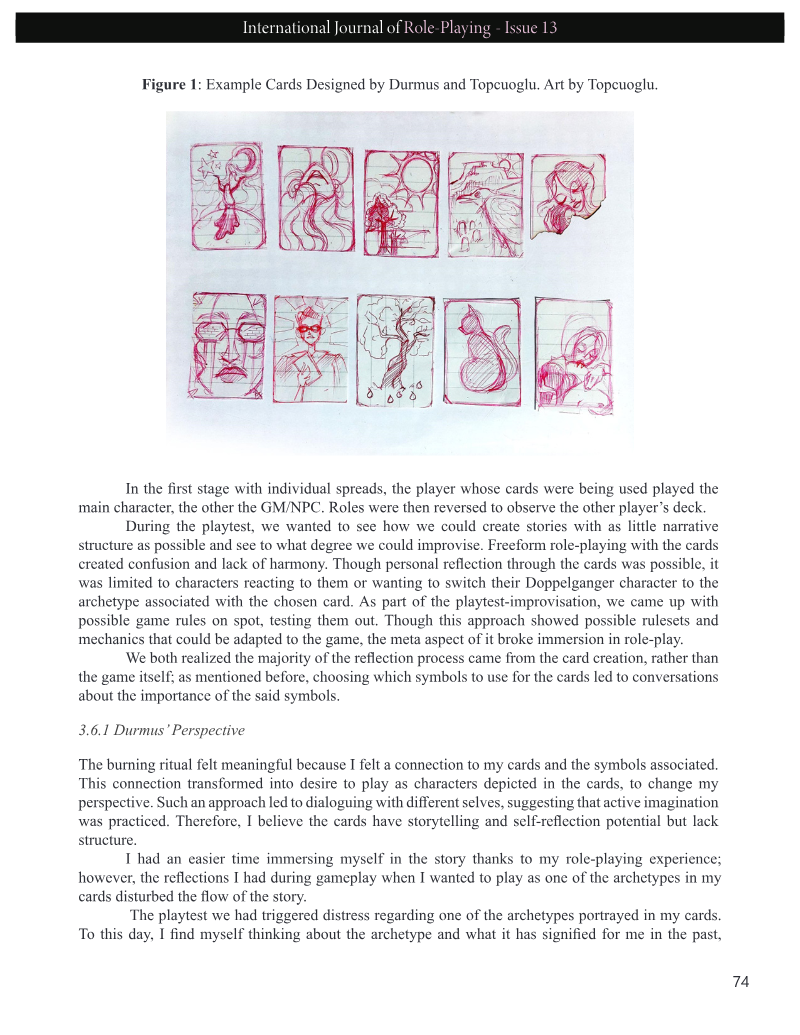
Self Arcana is a design-research paper presenting a collaborative two-player storytelling and self-reflection card game in which players create personalized tarot decks rather than using traditional imagery.
- Self Arcana is a two-player collaborative storytelling and self-reflection card game in which players build personalized tarot decks from their own life symbols instead of traditional tarot imagery, grounded in Jungian psychology and archetype theory.
- The design uses a five-card personal deck drawn from the Rider-Waite-Smith Major Arcana, regrouped into clusters such as Self, Creation, Transformation, and Enlightenment, with reversed cards representing shadow aspects.
- Gameplay proceeds in two stages: individual role-play with a character type from a nine-type taxonomy and a chosen location, followed by a joint ten-card spread combining both players' decks, with end-game rituals of burning, keeping, or changing cards.