Monetization reports and market data
Documents

Good Deeds Through Games: Integrating Features to Address Climate Change
Integrating climate change initiatives into free-to-play gaming environments serves as a viable strategy for fostering player engagement while maintaining financial sustainability.
- Climate initiatives in free-to-play games must achieve profit neutrality by offsetting costs through in-game purchases, ad revenue, or increased player retention to secure studio leadership support.
- Integrating environmental causes into a game's core thematic elements allows developers to transform standard live operations into platforms for real-world impact.
- Successful programs leverage existing infrastructure and API-integrated partners to automate the conversion of player activity into tangible environmental benefits like reforestation.

How Mobile Gaming Headwinds Affected Take-Two and EA - The Metacast by Naavik
The global gaming industry is currently undergoing a significant structural correction, transitioning from the unsustainable growth of the pandemic era toward a period defined by fiscal discipline and profitability.
- Take-Two Interactive's stock price has fallen to five-year lows, reflecting market skepticism following their acquisition of Zynga and a downward revision of full-year revenue projections by $200 million to $300 million.
- Mobile gaming revenue in China experienced a significant decline of over 20% in Q3, contributing to a broader global downturn in the mobile sector.
- Electronic Arts remains financially robust compared to its peers, leveraging strong performance from EA Sports titles like FIFA 23—which saw a 10% unit sales increase—to fund dividends and share repurchases.

Future of eSports ft. Ilaria Caputo (EA), Hugo Tristao (Newzoo), & Matt Kanterman (Ball Metaverse)
The esports industry is undergoing a period of sustained expansion, with the global audience projected to reach 640 million viewers by 2025.
- The global esports audience is projected to reach 640 million viewers by 2025, with industry revenue expected to grow from $1.4 billion in 2022 to $1.9 billion.
- Publishers should prioritize localized strategies that account for regional hardware preferences, such as the dominance of mobile gaming in Southeast Asia versus PC-centric markets in North America.
- Esports functions as a strategic pillar for game publishers by driving long-term player engagement, user acquisition, and the development of deep-seated emotional fandom.

Let's Play! 2022: The European Esports Market
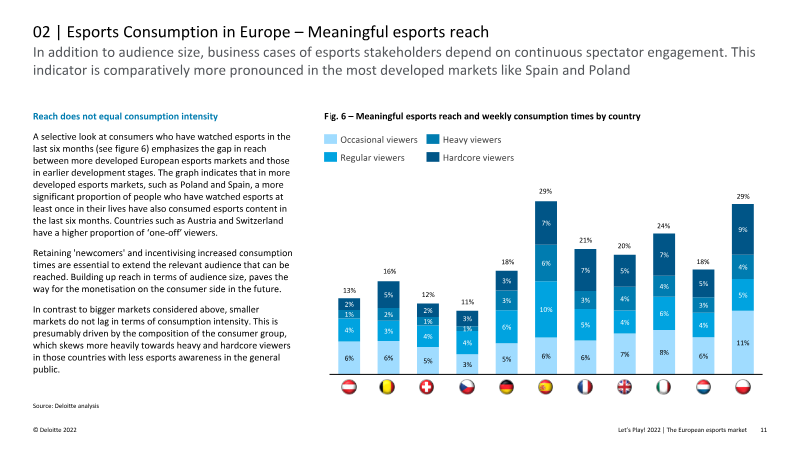
The European esports market has reached a critical inflection point, transitioning from the rapid, pandemic-driven expansion of 2020 toward a phase of stabilization and strategic maturation.
- The European esports market has shifted from pandemic-driven expansion to a phase of stabilization, characterized by a plateau in total reach and a decline in regular viewership.
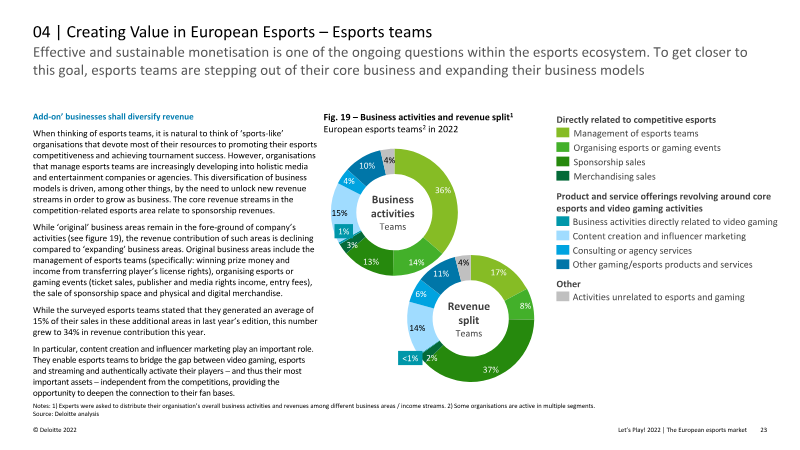
- Esports organizations are pivoting away from pure competitive play toward diversified business models that integrate agency services, media production, and content creation to ensure long-term sustainability.
- The industry is currently under-monetized due to a historical reliance on free-to-access content, necessitating a shift toward converting casual viewers into consistent, paying consumers.
Keynote: Purchase Behaviour Targeting Insights To Scale IAPs in the Age of the App-ocalypse.
The mobile app industry faces significant challenges in user acquisition and monetization due to privacy-centric changes, such as the deprecation of IDFA and increased regulatory scrutiny.
- Purchase behavior targeting serves as a privacy-compliant alternative to IDFA-based tracking by using anonymized transaction data to identify high-value payers without individual user identification.
- Developers can achieve high-precision targeting by moving beyond broad genres to focus on granular sub-niches, such as specific types of casino or blockchain games.
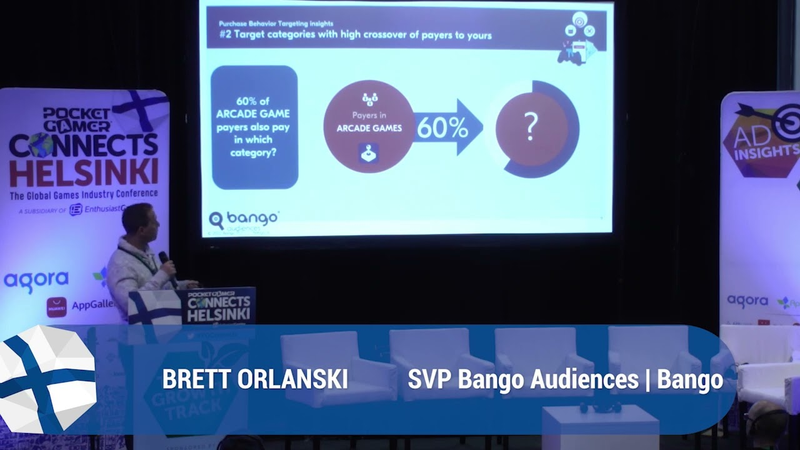
- Cross-category targeting is highly effective, evidenced by a 72% correlation between payers in interactive story games and those in puzzle games.

How To Measure & Compare Financial Returns on UA Spend - MARTIN MACMILLAN, Pollen VC
The primary objective of this analysis is to improve the financial literacy of gaming studios by establishing a standardized framework for measuring and comparing the financial returns of user acquisition (UA) investments.
- Studios should adopt a monthly Return on Investment (mROI) framework, calculated by dividing lifetime profit (LTV minus CAC) by acquisition cost and annualizing based on the time required to reach break-even.
- UA strategies vary significantly by genre, with hyper-casual games achieving break-even within 30 days, while mid-core and merge titles may require 270 to 400 days to recover initial investment.
- Relying on third-party publishers for UA funding is negatively correlated with acquisition potential, making self-publishing a vital milestone for long-term business viability.

ASO + RETENTION = Game Changer - Sergio Martinez, Agatha Bejan, Phiture
App Store Optimization (ASO) and retention marketing function as interdependent pillars of mobile game success, directly influencing a title's Lifetime Value (LTV).
- ASO and retention marketing must be integrated as interdependent pillars to maximize Lifetime Value (LTV) and signal game quality to platform algorithms.
- ASO success requires a dual-focus strategy: increasing visibility through metadata, localization, and featuring, while simultaneously driving conversion via optimized visual assets like icons and screenshots.
- Retention marketing should be integrated during the pre-production phase of the development lifecycle rather than treated as an afterthought.

Panel: Are We Over IDFA Tips & Methods To Rebuild Your Data
The mobile gaming industry has undergone a fundamental transformation following the 2021 deprecation of the Identifier for Advertisers (IDFA), necessitating a departure from granular, user-level tracking toward more sophisticated, privacy-centric methodologies.
- The 2021 deprecation of IDFA has forced a shift from deterministic, user-level tracking to privacy-centric methodologies like predictive modeling and cohort-based analysis.
- Developers must prioritize first-party in-app event data to project lifetime value and return on ad spend while remaining compliant with regulations like the UK’s Age-Appropriate Design Code.
- Successful growth strategies now require a cross-functional alignment between data science, product development, and user acquisition teams to interpret anonymized telemetry.
From Hyper to Casual & Merge - Gus Viegas, Lessmore
This analysis outlines strategic approaches to game development, soft launching, and user acquisition (UA) within the hyper-casual, casual, and merge game segments.
- Product quality is the primary driver of success, as user acquisition acts only as an amplifier for games that already demonstrate strong retention and monetization.
- Hybrid monetization is essential; developers should integrate rewarded ads into IAP-focused games and implement battle passes into hyper-casual titles to diversify revenue streams.
- Soft launches must follow a phased methodology, starting with technical stability before testing KPIs like retention and session time at scale to avoid the 'golden cohort' trap.
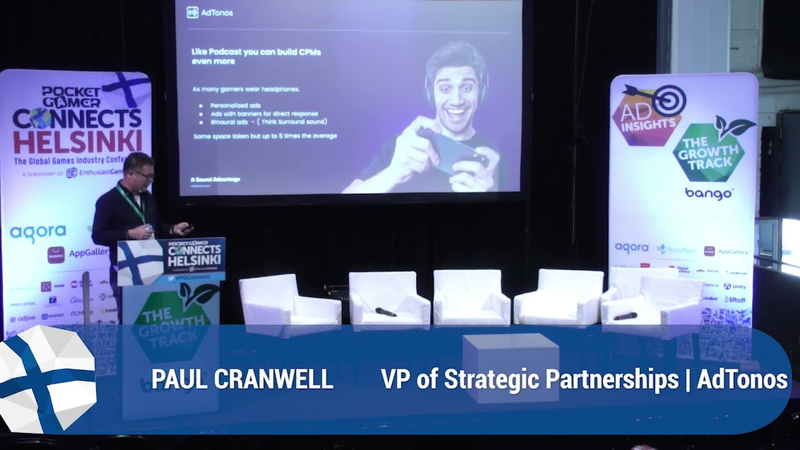
How Can Publishers & Developers Maximise Audio Ad Revenues - PAUL CRANWELL
Audio advertising represents a significant, underutilized revenue stream for mobile game developers and publishers, offering a non-intrusive alternative to traditional video and display formats.
- Audio ads offer a non-intrusive monetization alternative that improves retention, with research showing gamers have 36% to 39% higher memory recall for audio compared to video ads.
- Approximately 61% of mobile gamers listen to music while playing, creating a natural, high-engagement environment for audio-based advertising.
- Developers can increase CPM rates by shifting from internal reward-based ad loops to high-quality, third-party brand integrations.

Recharging Your App Revenue with HAJAR NOREDDINE, adjoe
The mobile advertising landscape faces significant challenges, including revenue cannibalization, user churn, and inconsistent eCPMs.
- Implementing the Playtime time-based rewarded ad unit can generate a 20% increase in incremental ad revenue and a 20% boost in average revenue per daily engaged user, according to data from Gameloft.
- The platform utilizes an Android-based SDK to track gameplay duration in real time, allowing for immediate user rewards that scale as engagement time increases.
- An integrated engagement loop uses push notifications to drive user re-engagement with the original application up to 20 times per week.

Panel: Know Your Audience How To Choose Between Subscription or Ad Models -
The mobile gaming industry is shifting away from binary monetization strategies, moving toward sophisticated hybrid models that integrate subscriptions, advertising, and virtual goods to maximize revenue and user retention.
- Mobile game monetization is shifting from binary strategies to hybrid models that integrate subscriptions, advertising, and virtual goods to maximize both revenue and retention.
- Monetization frameworks must be embedded into the early stages of game design rather than treated as secondary features to ensure long-term sustainability.
- Developers should abandon one-size-fits-all approaches in favor of data-driven, personalized experiences that align with specific game genres and player behaviors.