1 free read left. Create a free account for unlimited reading + AI research.
Create free account
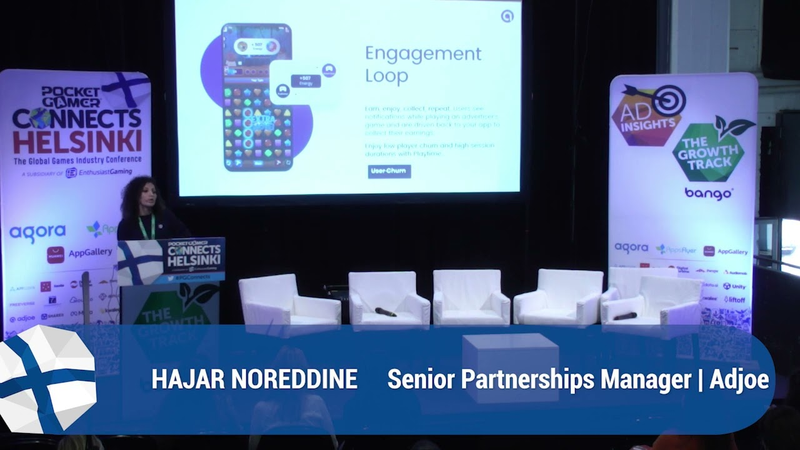
Recharging Your App Revenue with HAJAR NOREDDINE, adjoe
Key insights
7 takeaways- 01The solution functions independently of traditional offer walls, providing incremental revenue streams that avoid cannibalizing existing monetization models.
- 02Implementing the Playtime time-based rewarded ad unit can generate a 20% increase in incremental ad revenue and a 20% boost in average revenue per daily engaged user, according to data from Gameloft.
- 03The platform utilizes an Android-based SDK to track gameplay duration in real time, allowing for immediate user rewards that scale as engagement time increases.
- 04An integrated engagement loop uses push notifications to drive user re-engagement with the original application up to 20 times per week.
- 05Machine learning algorithms deliver personalized game recommendations to mitigate ad quality concerns and reduce user churn.
- 06The platform incorporates real-time traffic filtering to prevent fraud and ensure accurate publisher payouts.
- 07Integration is designed for rapid deployment, with most partners completing the setup process within a single day.
Ask AI about this video
Transcript
Right, let's welcome to the stage to talk about recharging your app revenue Hadjar Nour Eddine from Adjoe. Thank you, Dave. Thank you very much. All right, hello everybody. Um, can you hear me well? Yeah? Perfect. Cool. Um, it's nice to see some familiar faces, but also some new ones. First of all, I would like to thank you for joining um this session today. Uh, my name is Hadjar. Uh, quick introduction about me. I have been in the industry for the past 6 and 1/2 years. Uh, three of which has
been with Adjoe. Um, I take care of ad monetization there for the past 3 years. Uh, basically helping publishers and app and app developers and mobile developers um to unlock their new revenue streams and basically integrate um ad monetization solutions through us. Uh, quick introduction about Adjoe. It was founded in 2018. Uh, it is a fast uh growing ad tech company that does user acquisition and ad monetization solutions for mobile games and mobile apps. Uh, we are part of the AppLike Group family and we are financially backed by uh Bertelsmann Group. Um, just to quickly uh highlight that today I will actually be focusing on the ad monetization side of things and not user acquisition. Uh, I really wanted to engage the audience, but Pocket Gamer and Steel Media decided to try this new headset, so it's going to be a little bit hard for you to hear, I guess, each other,
but let's give it a try. I wanted to ask you, what are your advertisation challenges when it comes to rewarded ads or stuff that you heard of? If anybody wants to punch one. Oh. Thank you, Dave. Um I would say cannibalization. Sorry, just 1 second. Let's go. Yeah. No, I don't hear. Okay. Hello? Now I hear. Perfect. So, I said cannibalization. Perfect. Thank you. Anybody else? I I'm going to go here and I'll come back to you. Showing gaming ads to gamers can cause user churn. Okay, cool. User churn, like that. Um I was thinking ad quality. Good. All right, yes. Ad quality. I think we're good. Or anybody else? Anybody else wants to contribute? All right, great. Thank you, guys, for contributing. So, in addition to what
you mentioned, yes, we noticed from our partners that they see all of these challenges or issues, including low eCPMs or fluctuation eCPMs, fraud or fraud detection, user churn, like you mentioned, low conversion rates, revenue cannibalization, like Cami said, integration, ad quality or UX disruption. Uh in my opinion, for advertisation when I help my partners to find or unlock new revenue streams, my main goal is to find to help them get something that is not too intrusive for the the the the users. So, we want to keep the users happy when playing their favorite games, but we also want to help these game developers and and up developers to Sorry about that. To unlock new revenue streams to basically build new apps or new games. So we took all these challenges into account and into consideration and
designed a new unique rewarded ad unit called Playtime. So what Playtime does, it's a rewarded ad unit that is based on time. It rewards your users with your in-app currency from the very first minutes of their gameplay. And the longer they play, the more rewards they earn. So it is designed for the highest eCPMs and the highest engagement metrics. So to dive a little bit deeper into that, I included here a user flow to help you guys understand. I'll just take an example from the audience. Let's say Uni for example. Uni is playing her favorite game. This is a game called Pusher Mania that I took for the example. The main in-app currency here is called energy. So Uni wants to earn more energy in order to advance in the game. Um Playtime is in this case located in the home page. So this is a placement that is decided of course by the publishers, but we help them identify the best placements based on our best practice, but the final say is of course yours. So
the user would click here. They have to accept terms and conditions. Then they have to accept app usage permission, which basically allows us to which basically allows us to reward the users for the time that they played. And once they do that, they are then redirected to Playtime experience, which is customized as you can see to the initial app where the user started. So it has a header and matching colors to make the user feel kind of at home if you want to to say that. So it tells the user here overall what is the total rewards they can earn with specific game for them. And then it also tells them in 1 minute how many rewards they can earn. When the user clicks on play now, as shown there, they are redirected then to Google Play. And once they install the game of their choice and then start playing it. Once they unlock the first minute of the
reward curve, we show them a notification that is triggered by our SDK in the advertisers app. And this is basically done as a way of re-engaging your users back to you because of course we're sending the users out to play some of their games. You're making money out of it, but we want your users to go back to your game. That's what will remind them to do that. And then they are seeing their new balance of the rewards that they just earned in order to help them advance in your games. I hope this was clear. Um So, what does Playtime exactly do? Uh we want to give a little bit of everything to everybody, of course. So, for publishers, it brings new incremental revenues without cannibalization, which is one of the challenges that we hear about. Um the way we do that is because uh it's important to highlight that we are Android only because that's why that's why we can track the time. Uh so, the users of course uh are playing and for the publishers in order to unlock new revenue streams, our SDK integration is
stand-alone and independent. So, it comes back to it comes on top of any ad stack that you already have. And we also bring our own uh advertising uh budgets from top grossing uh advertisers, mostly gaming. Hence, anything that you make with Playtime comes on top. Uh for the users, of course we also want to deliver premium user experience and also fun way from the very first minute of their gameplay. And we do that as shown in the user flow. Uh plus, it also elevates your engagement engagement metrics with personalized ads. To dig To dig a little bit deeper into the details, uh the toast that is triggered from our SDK is as you see here, an engagement loop. Um the main issue I think for most of the extended uh ad rewarded units or or rewarded ad units for publishers is that they complain if the user is taken for so many hours in order to unlock the first um the first reward for them. Um we come to help that, of course, with the first
minute engagement, but also with the first minute rewards, but also with the re-engagement loop to remind the users to go back to the initial app. We show this uh notification every few times that the users are playing in the advertisers' games. But also we noticed uh from our partners that we bring the users back to the initial uh games or app about 20 times per week. Um to um get rid of user experience disruption or bad user experience, uh we are giving instant uh gratification and instant reward based on time. So, from the very first minute, and the longer the users play, the more rewards they get. Again, um quickly to highlight, the publishers' revenues are not tied to the time that is being played of the users. So, publishers are making money upon the first install, and then the user is getting their rewards extended through time. Um in order to um help with
quality, like you mentioned, that's really good. So, we also have uh we're able to do personalized ad experience. Um the way we do this is thanks to our opt-in that is part of the user flow, and uh we also have an integrated uh machine learning in the SDK that is helping us uh basically target the right groups for the right games. So, we show users games and apps that are more relevant to them rather than just an irrelevant ad that they're not wanting to do or not wanting to play or not wanting to see. Um we also are able to show games that they don't already have installed in their in their device. Um next thing is secured rewards. And I think this is one of the biggest complaints from user end because if they play for really long time then they don't get the rewards, you end up with a frustrated user. And this usually happens in the standard offer walls, unfortunately. Uh, with Playtime, how we came to solve that issue, um, we track
the time with our SDK thanks to the opting that the user gave us. Hence, the users are sure to get their rewards after they play. So, if they play 1 minute, they are getting rewarded for it. If they play 5 to hours, they get their rewards accordingly. Um, we also have uh, many fraud rules actually integrated as part of the SDK and they filter all the traffic in real time. Now, you're going to tell me, "Great, but this is more for the advertisers." That's very good, but also for the publishers, if the advertisers are happy, their revenues are more, but also the publishers are not getting any deductions at the end of the month. So, our publishers, they actually get the payments that they see every month on our dashboard as it is thanks to our fraud prevention rules. Uh, we also offer smart ad distribution. What this basically means is that we're showing the campaigns or games with the highest eCPMs first. And once the users install those games, then we show the next highest eCPM. Um, this is of course
good for publishers because they make they they increase or they maximize their eCPMs, but also on the other hand, the users are getting the highest reward potential with these games. So, just to recap quickly on all the challenges that we mentioned earlier and how we solved all of them with Playtime and what we actually did to overcome with this. So, we maximize your ARPDAU. We boost your retention rates. We reduce the risk of revenue loss through our fraud prevention. We enhance user engagement with the engagement loop. We draw longer and more frequent sessions. So, from the first minute and then the users can play more and get more rewards. And we have a seamless straightforward integration that is compatible with all technologies and most of our partners were able to integrate within a day. Um to share a little bit of success stories with you as well, I took here an example of one of our supply partners,
Gameloft. Um they added Playtime to their Android game. First it was Asphalt 8. And I will just share some stories some stories about what they saw. So, how did they do it or what they why did they do it as well? They wanted to solve some ad monetization challenges when it comes to rewarded ad units. So, they wanted to find an alternative to traditional rewarded ad formats in order to increase their ad revenue. They wanted to give players a new way to earn in-app currency. And of course, improving user experience. And they wanted to avoid revenue cannibalization and user churn and boost engagement. So, the impact that they saw after adding Playtime was 20% incremental ad revenues on top of what they're already making. Uh plus 20% increase in average revenue per daily engaged user. Um what is the
difference between engaged user and the normal app now is that engaged user is a metric that takes into account the performance of revenue stream in relation to the users that are directly engaging with it. So, in other words, this is a very good metric for you to try if or to look at when you are having different ad monetization units in your apps or in your games because this will actually tell you how successful or how good the performance of this ad unit is. Um wanted to quickly also highlight a quick testimony from George Youssef uh from programmatic uh operations manager at Gameloft or management at Gameloft. Um I quote, "Playtime has been a no stress source of revenue and user engagement. As part of our monetization strategy, it is an incremental revenue source. The format is easy is fun for users and we have no worries about user churn making it the ideal solution for mobile games." Um I just want to say
thank you to George, wherever he is. He's not here with us today. Next time. Um Next, yep. A little bit more uh of success stories I would like to highlight. Uh last year we were named uh fastest growing Android platform by AppsFlyer and we were among uh best Android ROI ad networks. Um ROI is great for advertisers. However, again, this is reflecting on the budget increase our per thousand eCPMs for our publishers. And by Adjust, we were named top 20 global gaming channels. This brings me to the end of my presentation. Um I guess let's open floor for questions. Sounds good. Thank you very much. Um yeah, if you have any questions, I can bring you a mic so we can uh we can all hear them. Uh Here we go. Oh. Again, here we go. I'd be curious to understand more about the difference between how Playtime rewards compared to other uh rewarded ad units.
That's a very good question. I'll remove this out of my face myself. All right. So, uh the difference between Playtime and the normal uh rewarded ad units, um we have first of all, it's a time-based rewarded uh system that's other um ad monetization providers don't have. So, we reward the users from the very first minute. Um also, we include the premium direct um gaming um demand that we have, basically connecting the users with the best games that they want to play or they rather play. And also, of course, bringing the publishers new incremental ways um to get revenue. Plus, of course, the secured rewards. That's if you take the standard um a standard rewarded ad units, they don't have a way to secure the rewards because all the rewards are basically tied to the advertisers postback. So, if it was blocked by an MMP or if the postback does not arrive for one reason or another, the user ends up not getting the rewards and also the
publisher probably not getting paid. Uh, so, tracking this with time helps us deliver better results. Thank you. Any other questions? Thank you. Oh, one here, too. So, where does the money from the rewards come from and for how long do you keep rewarding the user? Very good question. Thank you. Um, so, the money comes from a setup that we basically ask our partners, supply partners, for every $1 that they earn with us net, how much they want to give from the rewards, from the in-app currency to the users. We do this system in order not to abuse the apps economy or the games economy. So, if they decide, for example, let's say 100 um gems uh per dollar, depending on what is the price of that campaign, our algorithm is calculated automatically and it it is distributed throughout time. Uh, now, again, this is also machine learning that at first we distri- the system distributed to a specific time in terms of minutes and
then the more we watch the user behavior, the more it's adjusted to basically how much these users are playing. Cool. Great. Thank you. Thank you. Uh, any more? We have a Yeah, we have a we have a couple of minutes. Is there any more questions? What are the is that if people do have questions for you that they uh look you up on uh LinkedIn Match or your email is right there. I Exactly. Or also, please visit our booth at G6. That's great. That's also easy. That's perfect. Thank you so much, Dave. No, thank you very much. A round of applause. Thank you. Thank you. Appreciate it. Thank you very much. That was That was great. And yes, of course, you have a booth over here down in the main area. Yes, exactly. Very close by.
Summary
The mobile advertising landscape faces significant challenges, including revenue cannibalization, user churn, and inconsistent eCPMs. To address these issues, the ad tech company adjoe developed Playtime, a time-based rewarded ad unit designed to maximize publisher revenue while maintaining user engagement. Unlike traditional rewarded models that often rely on delayed or uncertain postbacks, this solution utilizes an Android-based SDK to track gameplay duration in real time, ensuring users receive immediate gratification for their time spent.
Playtime functions by rewarding users with a publisher’s in-app currency from the first minute of gameplay, with rewards scaling as the user continues to play. The system integrates seamlessly into existing ad stacks and employs machine learning to deliver personalized game recommendations, which helps mitigate ad quality concerns and reduces user churn. A key feature is the engagement loop, which uses push notifications to encourage users to return to the original application, reportedly driving re-engagement up to 20 times per week. Because the system is independent of standard offer walls, it provides incremental revenue that does not cannibalize existing monetization streams.
Performance data from partners, such as Gameloft, indicates that implementing this model can yield a 20% increase in incremental ad revenue and a 20% boost in average revenue per daily engaged user. The platform emphasizes fraud prevention through real-time traffic filtering, ensuring that publishers receive accurate payouts without deductions. By focusing on Android-only environments to facilitate precise time tracking, the solution offers a stable, high-engagement alternative to traditional rewarded ads. The model is designed for rapid integration, with most partners completing the setup process within a single day.















Comments