Market Analysis reports and market data
Documents

NOT a Security Episode - Trading Privacy for Service in the PSN Hack - Extra Credits
The central thesis of this analysis is that the modern digital landscape necessitates a fundamental shift in the relationship between corporations and consumers, moving toward a model built on transparency and mutual trust.
- In the modern digital economy, corporations must shift from viewing customers as adversaries to treating them as partners by prioritizing transparency and mutual trust.
- The 2011 PlayStation Network hack serves as a primary case study demonstrating that while companies cannot always prevent cyberattacks, their subsequent crisis management determines their long-term integrity.
- Sony’s response to the 2011 breach was criticized for being opaque and utilizing 'free' service trials that functioned more as marketing upsells than genuine consumer restitution.

Console Is the New Coin-Op - Monetizing Games in a Future Without Consoles - Extra Credits
The gaming industry is currently undergoing a structural shift analogous to the decline of the arcade era, where dedicated hardware is increasingly being superseded by more convenient, accessible, and cost-effective platforms.
- The home console is projected to become obsolete within two hardware cycles as cloud gaming, mobile devices, and web-based platforms achieve performance parity with dedicated hardware.
- The gaming industry is undergoing a structural shift similar to the decline of the arcade era, where specialized, stationary hardware is being displaced by more accessible and cost-effective digital distribution models.
- Rising AAA development costs and the superior reach of streaming ecosystems necessitate a move away from proprietary hardware to avoid relegating high-budget gaming to a niche market.

Piracy - How Can the Game Industry Stop Illegal Downloads? - Extra Credits
The video game industry faces a persistent conflict regarding digital piracy, a complex issue where neither developers nor consumers hold the moral high ground.
- Restrictive Digital Rights Management (DRM) is a failed strategy that penalizes legitimate customers with inferior software while failing to effectively deter piracy.
- Creating a product experience that is objectively worse than a pirated version inadvertently incentivizes users to seek illegal downloads.
- Piracy should be addressed by improving service accessibility and rewarding loyal customers rather than relying on punitive measures.

Kinect and Move - Can Motion Control Ever Succeed? - Extra Credits
The introduction of motion control peripherals like Microsoft’s Kinect and Sony’s Move represents a strategic attempt by major console manufacturers to extend the life cycles of the Xbox 360 and PlayStation 3.
- Microsoft and Sony introduced Kinect and Move as strategic hardware upgrades to extend the life cycles of the Xbox 360 and PlayStation 3, aiming to avoid the high manufacturing costs of launching new console generations.
- The industry's push into motion control was primarily inspired by the Nintendo Wii, which proved the commercial viability of motion-based input and its ability to attract new demographics.
- A major barrier to adoption is the reliance on derivative software, as many Kinect and Move titles are perceived as clones of existing Wii games rather than unique experiences.

Project Ten Dollar - EA Campaigns Against Used Games - Extra Credits
The video game industry faces a significant revenue challenge regarding the secondary market, where retailers like GameStop capture the entirety of used game sales while publishers receive nothing.
- Modern console game development costs often exceed $30 million, requiring publishers to sell over one million new units just to break even.
- Publishers introduced 'Project Ten Dollar' to capture revenue from the secondary market by requiring second-hand buyers to pay extra fees for content that original owners receive for free.
- The current secondary market model is problematic for publishers because retailers like GameStop retain 100% of the profit from used game sales, leaving developers with zero revenue from those transactions.

Free Speech - The Supreme Court Case Against Violent Video Games - Extra Credits
The Supreme Court case Brown v. Entertainment Merchants Association serves as a critical focal point for the legal status of video games as a protected artistic medium.
- The Supreme Court case Brown v. Entertainment Merchants Association determined whether video games qualify as a protected artistic medium under the First Amendment.
- California attempted to criminalize the sale of violent video games to minors by shifting legal arguments from obscenity to the alleged psychological harm caused by interactive media.
- A ruling against the industry could have legally reclassified video games as controlled substances or adult content, effectively stripping the medium of constitutional protections.
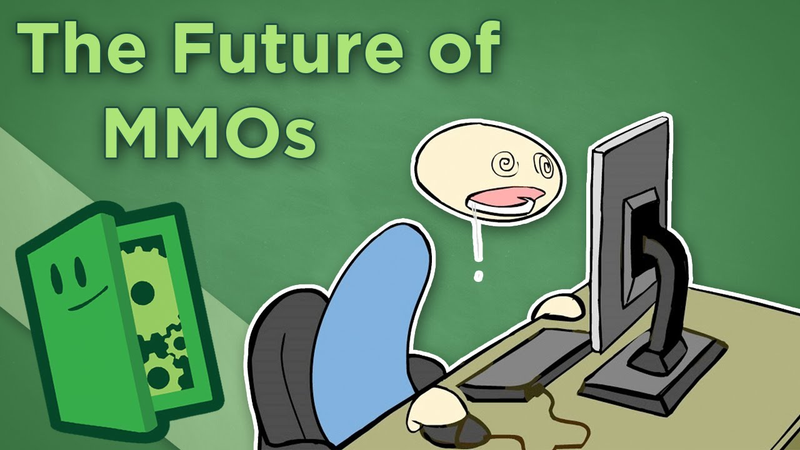
The Future of MMOs - Why Are There So Many WoW Clones? - Extra Credits
The modern massively multiplayer online (MMO) market suffers from a cycle of failure driven by high development costs and a misguided reliance on cloning the industry leader, World of Warcraft.
- The $60 million to $100 million development costs for modern MMOs force studios to prioritize risk-averse, proven formulas over innovation to satisfy investors.
- The market is saturated because MMOs are time-intensive, perpetual experiences that lock players into established social bonds, making it difficult for new titles to displace incumbents like World of Warcraft.
- Developers should decouple the 'MMO' label from the RPG genre to create lower-budget, genre-specific titles like racing or strategy games that utilize shared hub spaces instead of massive 3D worlds.
Mario's Legacy and Sonic's Heritage: Replays and Refunds of Console Gaming History
This study examines how major console manufacturers Nintendo, Sony, and Microsoft use, reuse, and manage their gaming histories, proposing a heuristic model that distinguishes awareness of historicity, the uses of history, and the management of history at both organizational and product levels.
- Nintendo is the most history-conscious of the three major console makers, leaning heavily on iconic characters like Mario and its Virtual Console, which offered 379 classic games in the Finnish store by late 2011.
- Nintendo's historical awareness appears to have sharpened after a 2003–2004 Famicom anniversary exhibition, which suggested retro products could serve as a long-tail revenue source.
- Sony and Microsoft draw more on third-party and PC-era software, such as Windows Solitaire and Flight Simulator, and their downloadable offerings may gradually shift toward new games as third-party developers mature.
European Online Game Survey 2012
The European Online Game Survey 2012 provides a comprehensive analysis of the European game development landscape, focusing on industry trends, technical infrastructure, and gamer behavior.
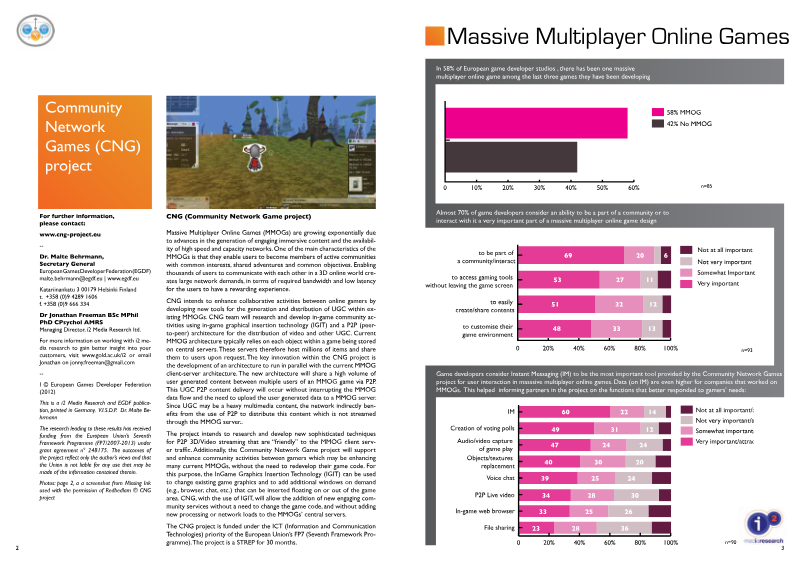
- 58% of surveyed European studios have worked on a Massive Multiplayer Online Game (MMOG) within their three most recent projects, signaling a strong industry focus on the genre.
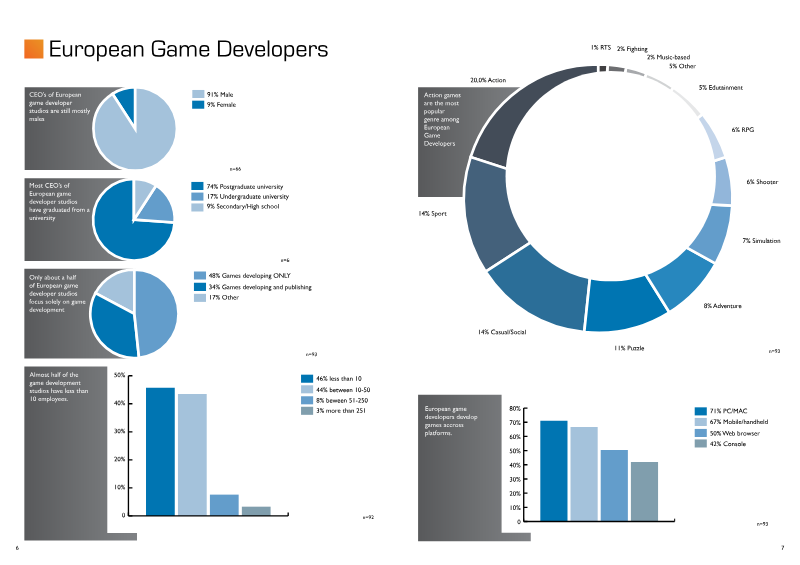
- Nearly 50% of European game studios are small-to-medium enterprises employing fewer than 10 people.
- Developers are increasingly adopting peer-to-peer architectures and in-game graphical insertion technology to integrate social features without the need for expensive central server infrastructure or extensive code modifications.

Gamesmonitor '12: Gamesindustrie Onderzocht
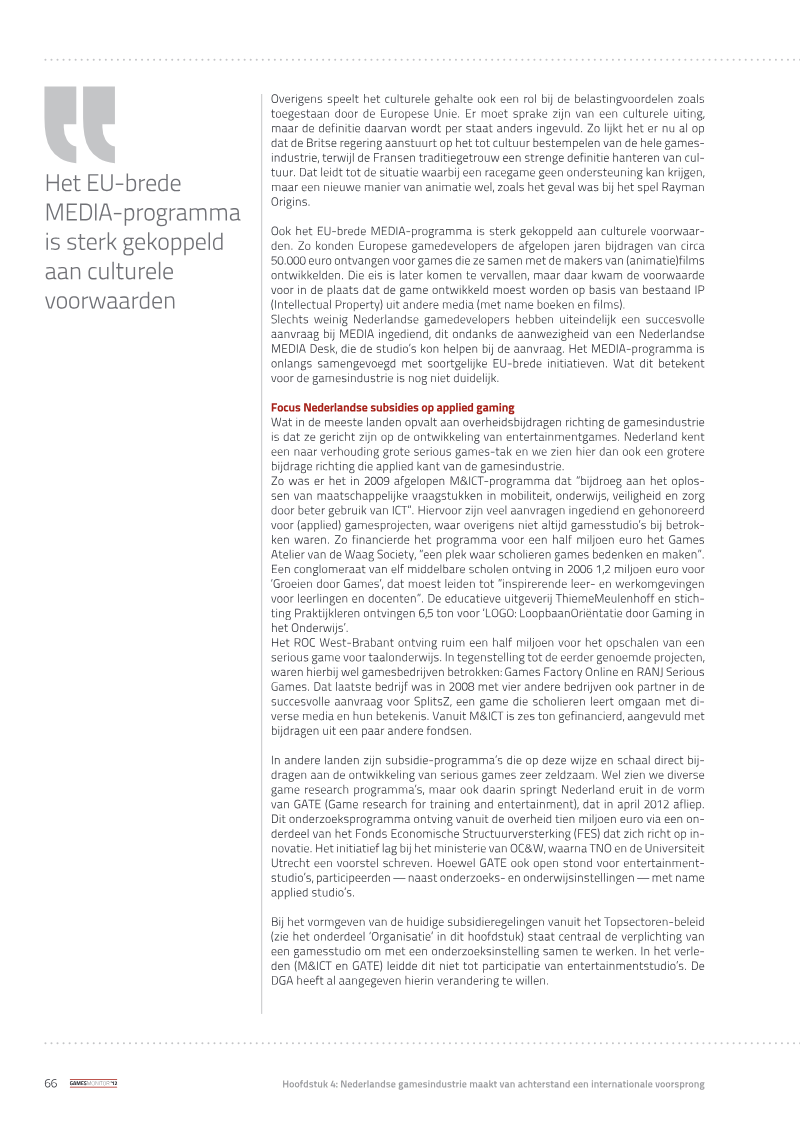
The Dutch games industry, as of 2011, functions as a dynamic yet maturing ecosystem comprising approximately 330 companies and 3,000 professionals.
- Amsterdam remains the leading city for the games industry in the Netherlands, with nearly 800 jobs in 2011, followed by Hilversum (over 500 jobs) and Utrecht (270 jobs).
- The traditional computer games industry, dominated by US and Japanese platforms like Sony, Nintendo, and Microsoft, is seeing limited growth (2% annually for console gaming) and a shrinking market for PC games, due to the rise of casual games.
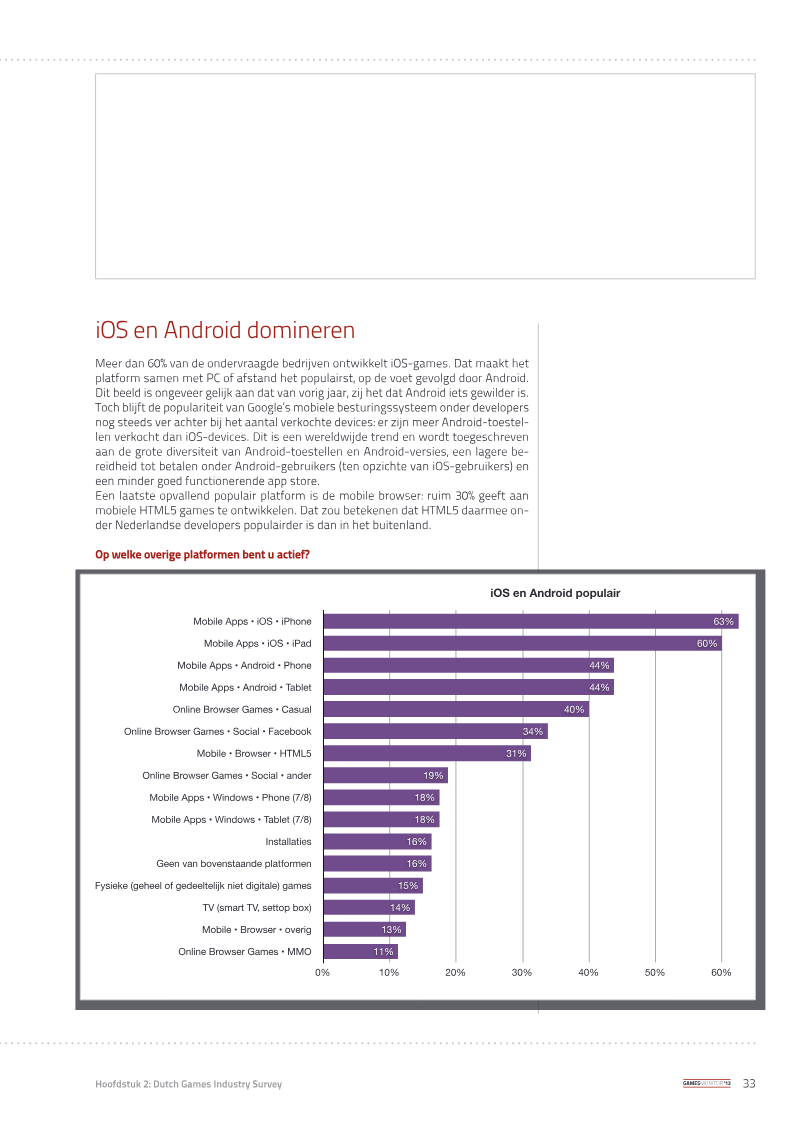
- Mobile apps, particularly for iOS (iPhone 63%, iPad 60%) and Android (Phone 60%, Tablet 44%), are highly popular platforms in the Dutch games industry.


Essential Facts 2012: Canada
Essential Facts 2012: Canada provides a comprehensive statistical overview of the Canadian video game industry and consumer landscape.
- The Canadian video game industry contributed $1.7 billion to the economy in 2011 and supports approximately 16,000 direct jobs across 348 companies.
- Gaming is a mainstream activity in Canada with an average player age of 31, and 90% of children and teens identifying as gamers.
- While 68% of industry labor remains focused on console development, mobile gaming has surged, with 25% of Canadians now citing mobile as their primary gaming platform.



Faits Essentiels 2012: Profil de l'industrie canadienne du jeu vidéo
The 2012 Essential Facts report provides a comprehensive profile of the Canadian video game industry, highlighting its significant economic impact and the evolving habits of its diverse player base.
- The Canadian video game industry contributes $1.7 billion to the economy and supports 16,000 direct jobs across 348 companies, ranking Canada third globally in industry employment.
- Industry growth is accelerating, with an 11% increase between 2009 and 2010 and a projected 17% growth rate for the 2011-2012 period.
- The sector provides high-value employment with an average annual salary of $62,000, which is more than double the Canadian national average.